Zum Inhalt springen
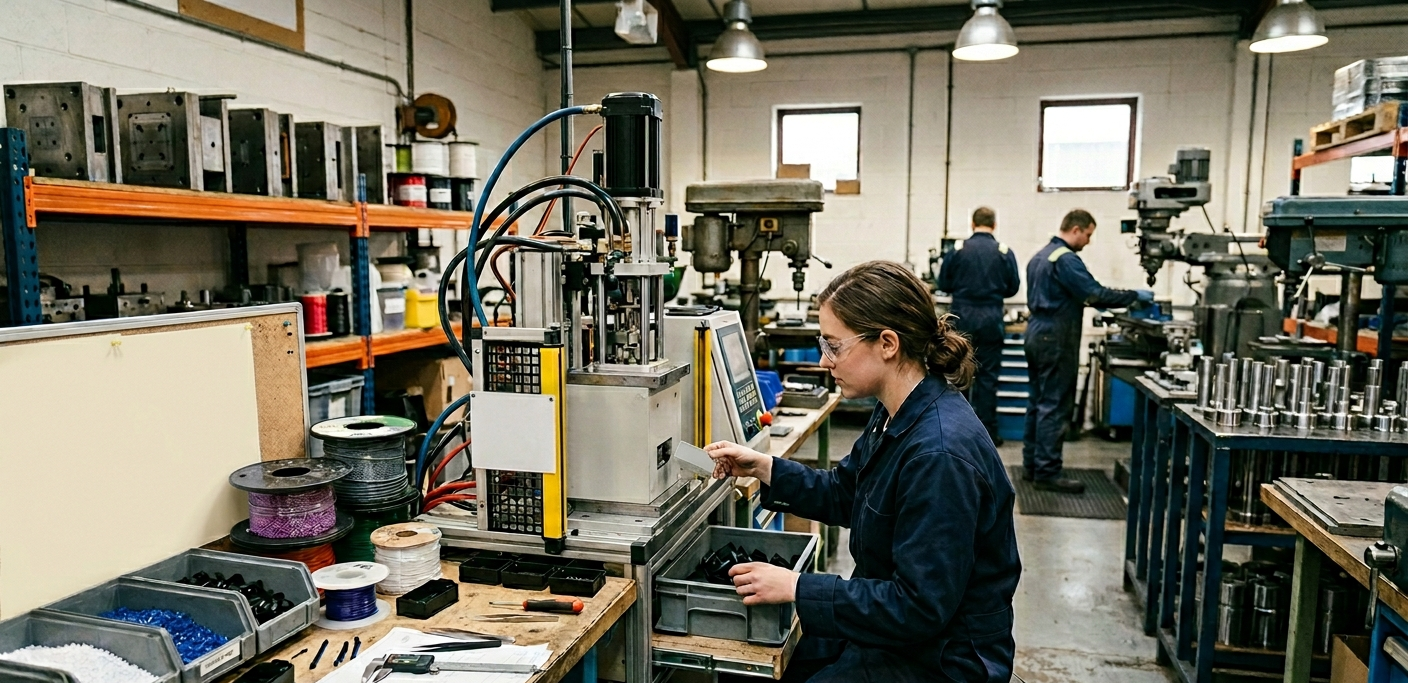
A Kickstarter hardware founder closes a $180,000 raise on a Tuesday and gets quoted $42,000 for a single 4-cavity steel mold on Thursday. The founder pays it, locks the design, and finds out at unit 800 that the side-action lifter the design needed could have run in aluminum at $7,800 — if anyone had asked. We see this every month. The single most expensive decision a hardware startup makes is not the mold itself; it is locking the tooling specification before someone with manufacturing experience has looked at the part. Low-volume injection molding is not the same procurement problem as Apple’s. It is its own problem with its own math.
For hardware startups producing 500–5,000 units per year, low-volume injection molding sits between 3D printing (too slow above 200 units) and high-volume steel tooling (too expensive below 25,000 units). This guide walks DTC and Kickstarter founders through what a low-volume mold actually costs in 2026, what drives per-part pricing, the MOQ math that decides whether molding is even the right process, and the four DFM mistakes that double startup tooling spend.
What ‘Low-Volume Injection Molding’ Actually Means in 2026
Low-volume injection molding is a specific tooling and process category, not just a small order quantity. The defining choice is the mold material and life expectancy:
- Aluminum mold (7075 or QC-10) — life 5,000 to 80,000 shots depending on resin and complexity; build time 15–25 business days; cost $3,000–$12,000 for simple parts
- Pre-hardened steel (P20) — life 100,000 to 500,000 shots; build time 20–35 days; cost $6,500–$28,000
- Soft-tool prototype mold (insert-style) — life 200–2,000 shots; build time 8–12 days; cost $1,200–$4,800
- MUD (Master Unit Die) inserts — life 5,000–25,000 shots; build time 7–14 days; cost $1,800–$5,500
For a startup running 500–5,000 units, aluminum is almost always the correct mold material. P20 steel is overbuilt for the volume and adds $4,000–$16,000 of unnecessary tooling cost. MUD inserts are the right call when the part is small (under 50g) and you need to share the base across multiple variants — a useful tactic for color-variant DTC products.
Our injection molding line runs both aluminum and P20 tooling — most first-run startup hardware ships off aluminum molds, and we explicitly recommend against P20 below 25,000 annual units unless the part has high glass-fiber filler that wears soft aluminum quickly.
Aluminum Injection Mold Cost in 2026: Real Numbers by Part Complexity
Mold cost is driven by features and finish, not part size — within reason. A simple flat enclosure top with no side actions runs $2,800–$4,500 in aluminum; the same enclosure top with two side actions, three undercuts, and a polished interior surface for an optical window runs $9,000–$15,500.
| Mold Type | Build Cost | Tool Life (shots) | Build Time |
|---|---|---|---|
| Soft tool / 3D-printed insert | $1,200–$4,800 | 200–2,000 | 8–12 business days |
| MUD insert (small parts) | $1,800–$5,500 | 5,000–25,000 | 7–14 business days |
| Aluminum, simple, 1-cavity | $2,800–$4,500 | 10,000–40,000 | 12–18 business days |
| Aluminum, moderate complexity, 1-cavity | $4,500–$9,000 | 20,000–60,000 | 15–22 business days |
| Aluminum, complex w/ side actions, 1-cavity | $9,000–$15,500 | 15,000–50,000 | 18–25 business days |
| P20 steel, moderate, 1-cavity | $6,500–$14,000 | 100,000–300,000 | 20–30 business days |
| P20 steel, complex, 2–4 cavity | $14,000–$28,000 | 200,000–500,000 | 25–35 business days |
What drives aluminum mold cost, in order of impact:
- Number of side actions and lifters — each adds $1,200–$3,500. Most startup DFM wins eliminate one or two of these.
- Surface finish on the mold cavity — SPI A2 polish for optical clarity adds $1,800–$4,200 over standard B2 finish
- Number of cavities — going from 1 cavity to 2 cavities adds 40–60% to mold cost but cuts per-part cycle time roughly in half
- Ejector pin count and gating strategy — complex multi-gated parts add $600–$1,800 for additional machining
- Heat treatment or selective hardening on aluminum — adds $400–$1,200 but extends tool life on glass-filled resins
Per-Part Injection Molding Cost: What 500–5,000 Units Actually Cost
The per-part cost in low-volume injection molding has three components: material, cycle time, and post-processing. The material call-out alone moves price by 2–4× — ABS at $2.40/kg is fundamentally cheaper than PC-ABS at $5.80/kg, glass-filled nylon at $7.50/kg, or PEEK at $90/kg.
Realistic per-part costs in 2026 for a 35g consumer enclosure component:
- ABS or PP, 1-cavity aluminum mold — $1.20–$2.80 per part at 1,000 units, $0.85–$1.90 at 5,000 units
- PC or PC-ABS, 1-cavity aluminum — $1.80–$3.60 at 1,000 units, $1.40–$2.60 at 5,000 units
- 30% glass-filled nylon, 1-cavity aluminum — $2.40–$4.80 at 1,000 units, $1.90–$3.40 at 5,000 units
- Add insert molding or overmolding — $0.40–$1.20 per part premium
Cycle time on a typical 35g consumer part on a 100-ton press runs 24–42 seconds — the part itself shoots in 0.8–2 seconds, but cooling and ejection dominate. Cycle time is where insert and overmolding multiply cost: each additional manual insert step adds 12–25 seconds of cycle time, which roughly doubles labor allocation per part.
For DTC startups planning hardware variants, our gear manufacturing and spring manufacturing lines often pair with the molded enclosure under one PO — paperless QMS traceability and one auditor handles the entire BOM.
The MOQ Math: When Injection Molding Is Actually the Wrong Process
Most startups assume injection molding is the goal and 3D printing is the bridge. That is wrong in two specific scenarios.
- Annual volume under 250 units — the amortized mold cost per part ($3,800 mold ÷ 250 = $15.20/part on tooling alone) makes injection molding cost more than continued 3D printing in SLA or MJF. Stay on 3D printing until volume justifies tooling.
- Design still in active iteration with revisions every 30–60 days — every mold revision after the build costs 25–60% of the original mold cost in re-machining. Three revisions can equal a second mold. Stay on 3D printing until the design stabilizes.
The injection molding break-even is where amortized tooling per unit + per-unit molding cost drops below the 3D printing cost. For a typical consumer enclosure, that crossover sits at 350–800 units, depending on part complexity and printing service pricing.
Above 5,000 units, the inverse problem appears: aluminum mold life starts to be a real consideration, and the savings from moving to a P20 steel mold (longer life, faster cycles, less downtime) start to outweigh the higher upfront cost. The aluminum-to-P20 break-even sits at roughly 20,000–35,000 lifetime units for most consumer hardware.
Four DFM Mistakes That Double Startup Tooling Spend
The four mistakes we see most often in first-time founder hardware projects — each preventable with a 90-minute DFM review before tooling kicks off:
- Designing in undercuts that require side actions when a redesigned parting line would eliminate them — typical avoidable cost: $1,800–$4,200 per side action.
- Specifying an SPI A2 mirror polish on the entire mold cavity instead of only the customer-visible surfaces — typical avoidable cost: $1,200–$3,500.
- Designing wall thickness variation greater than 30% across the part — drives sink marks, voids, and cosmetic rework. The fix is wall-thickness normalization before tooling — adds 30 minutes to CAD, saves 12–18% on scrap.
- Choosing a single 4-cavity mold for first production instead of a 1-cavity mold for the first 5,000 units — multi-cavity tooling triples the cost upfront, and 90% of first-run startup hardware reveals at least one design change during early units that would have been cheap on a 1-cavity tool and expensive on a 4-cavity.
On any first-time founder project, our DFM walk-through runs all four checks before pricing is committed. The typical net savings for a first-run hardware startup is $4,500–$14,000 in tooling — money the founder can redeploy into marketing or working capital.
The Xinyang Hardware Startup Tooling Framework
Use this framework when scoping injection molding for a new hardware product. Each row is a decision threshold with real cost anchors.
| Decision Factor | Threshold | Recommendation |
|---|---|---|
| Annual volume forecast | <250 units/year | Stay on 3D printing — molding does not amortize |
| Annual volume forecast | 250–5,000 units/year | Aluminum mold, 1-cavity, plan for one revision |
| Annual volume forecast | 5,000–20,000 units/year | Aluminum mold, 2-cavity, or upgrade to P20 |
| Annual volume forecast | >25,000 units/year | P20 steel, multi-cavity, full production tooling |
| Design revision stability | >1 revision per 60 days | Stay on 3D printing until design freezes |
| Mold polish requirement | Visible cosmetic surface only | Polish only visible surfaces; B2 standard elsewhere |
| Side actions / lifters | Each adds $1,200–$3,500 | Redesign parting line first; tool side actions only when unavoidable |
Frequently Asked Questions
How much does a low-volume injection mold cost for a hardware startup in 2026?
For a hardware startup running 500–5,000 units annually, a 1-cavity aluminum mold typically costs $3,000–$12,000 depending on part complexity, surface finish, and side actions. Simple geometries like flat enclosure tops without undercuts land at the lower end ($3,000–$5,000), while parts with multiple side actions, polished optical surfaces, or insert features push into the $9,000–$15,000 range. P20 steel molds run roughly 2–2.5× the cost of equivalent aluminum molds and are usually overbuilt for volumes under 25,000 annual units. Most first-run startup hardware ships off aluminum tooling and migrates to steel only after demand validates the volume.
What is the per-part cost of low-volume injection molding?
For a typical 35-gram consumer enclosure component in ABS or PP, per-part cost from a 1-cavity aluminum mold runs $1.20–$2.80 at 1,000-unit lots and drops to $0.85–$1.90 at 5,000-unit lots. Engineering resins (PC, PC-ABS, glass-filled nylon) typically run 30–80% higher per-part. Overmolding or insert molding adds $0.40–$1.20 per part because of the additional cycle time and labor. The per-part cost generally excludes secondary operations — printing, assembly, packaging — which can add 20–60% to the total finished cost depending on complexity.
When does injection molding beat 3D printing for hardware startups?
The crossover happens when the amortized tooling cost per unit plus per-unit molding cost drops below the 3D-printing cost for the same part. For a typical consumer enclosure with a $4,800 aluminum mold and $1.80/part molding cost, the break-even versus MJF or SLA printing (typically $7–$22 per part) sits at 350–800 units. Below that, 3D printing is cheaper. Above that, injection molding wins decisively. Founders should also factor in cycle time — molding ships 500 parts in 4–6 hours of press time; 3D printing the same 500 parts takes 4–8 days.
How long does a low-volume aluminum mold last?
Aluminum mold life depends on resin choice and shot conditions. With unfilled resins like ABS, PC, or PP, a quality aluminum mold (7075 or QC-10) typically delivers 20,000–60,000 shots before wear affects part quality. With glass-filled resins (30% glass nylon, 30% glass PC), aluminum mold life drops to 5,000–15,000 shots because the glass fibers abrade the aluminum cavity. For glass-filled materials at production volumes, P20 steel tooling is the more economical long-term choice despite the higher upfront cost. Aluminum tooling is rarely the right call above 25,000 lifetime shots in abrasive resins.
Can I use my 3D-printed prototype design directly for injection molding?
Almost never without modification. 3D-printed parts can tolerate uniform thick walls, sharp internal corners, and zero draft angle — injection molded parts cannot. Before tooling, every part needs a DFM pass that adds 0.5–1.5° draft on all vertical walls, normalizes wall thickness to within 30% variation across the part, adds radii to internal corners, and confirms the parting line and gate location. Skipping this DFM pass is the single most expensive mistake first-time founders make — typically requiring a $1,500–$4,000 mold revision after the first sample shots, plus 2–3 weeks of program delay.
Bottom Line
Three takeaways:
- Aluminum is the right tooling material for 500–25,000 annual units — P20 steel is overbuilt below 25,000 and adds $4,000–$16,000 unnecessarily.
- Run a full DFM pass before tooling — eliminating side actions, normalizing wall thickness, and limiting cosmetic polish to visible surfaces saves $4,500–$14,000 on a typical first-run mold.
- Start 1-cavity and migrate to multi-cavity only after design freezes and demand validates — first-run multi-cavity tooling triples cost and rarely survives without revision.
Xinyang Industrial Tech runs aluminum and P20 injection molding, 3D printing, CNC machining, and assembly under a paperless QMS — single PO and traceability across the BOM for hardware startups.