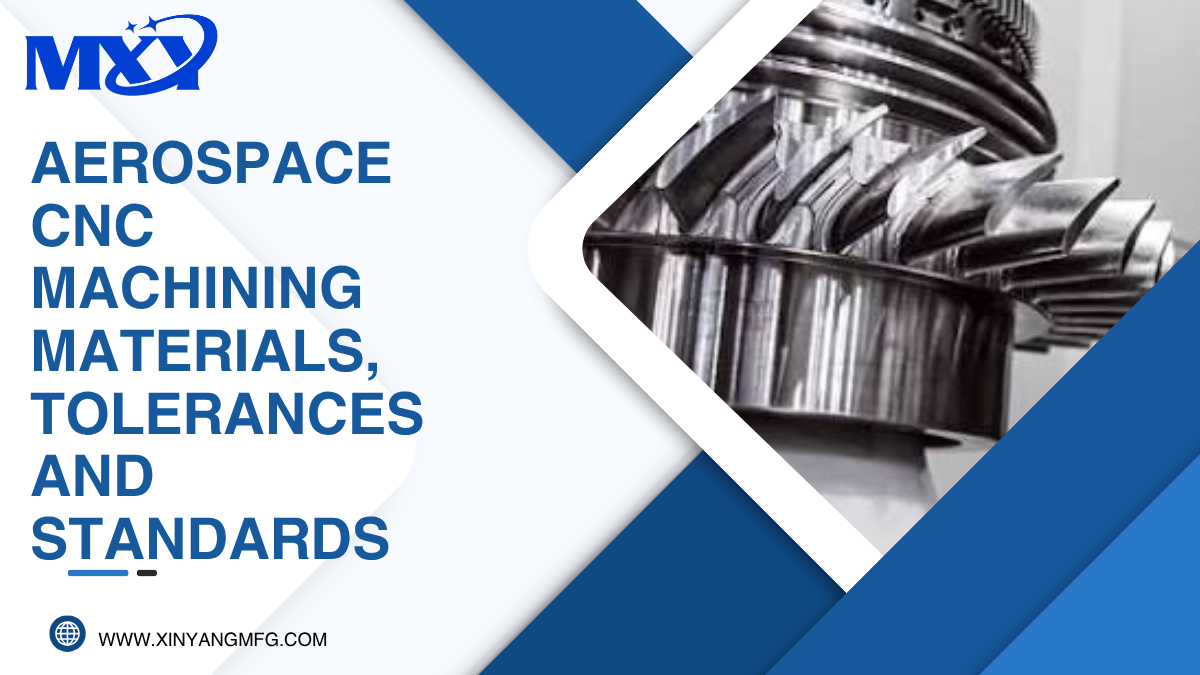
Aerospace CNC machining is the precision manufacture of flight-critical parts to extremely tight tolerances, typically on 5-axis machines , using aerospace-grade materials such as titanium Ti-6Al-4V, aluminum 7075, and nickel superalloys like Inconel 718. What separates it from general machining is the combination of tolerance, traceability, and certification: critical features are often held to ±0.0005″ or tighter, every material lot is traceable back to its mill certificate, and suppliers are typically expected to hold AS9100 quality certification, with NADCAP accreditation for special processes and ITAR compliance for defense work. The stakes are simple: a part that fails in the air is not an option, so the entire process is built around proof, not just precision.
This guide covers the materials, tolerances, standards, and applications that define aeroespacial machining, what actually drives cost and lead time, and what to look for when sourcing it.
What Makes Aerospace CNC Machining Different
Aerospace parts live in a punishing environment: extreme temperature swings, high cyclic stress, vibration, and strict weight budgets. That forces three things to happen at once. Tolerances are tighter than almost any other industry, often in the range of a few ten-thousandths of an inch on critical features like bearing bores or sealing surfaces. Materiales are harder to machine, since the strength-to-weight and heat resistance aerospace needs comes from titanium and nickel superalloys that wear tooling quickly and generate heat that has to be managed carefully during cutting. And documentation is non-negotiable: every flight-critical part must be traceable back to its material heat lot, its inspection records, and the operator and machine that produced it.
General machining optimizes for cost and speed. Aerospace machining optimizes for proof. That difference shapes everything from how material is received and stored, to how a part is fixtured, to the paperwork that ships with the finished piece. A shop that does both general and aerospace work usually runs them as genuinely separate processes — different travelers, different inspection sign-offs, different storage — because mixing the two is exactly the kind of gap an aerospace audit is designed to catch.
Common Aerospace Machining Materials
Aerospace work centers on a handful of well-understood materials, each chosen for a specific structural or thermal reason:
- Titanium Ti-6Al-4V (Grade 5): the aerospace workhorse, prized for its strength-to-weight ratio and corrosion resistance. Used for structural fittings, fasteners, and engine components. It machines slowly, generates concentrated heat at the cutting edge, and is hard on tooling — all of which drive up cost relative to aluminum.
- Aluminum 7075 and 2024: high-strength aerospace aluminums used for airframe structures, brackets, and housings where weight matters as much as strength. They machine far faster than titanium and are the default choice whenever the application allows it.
- Inconel 718 and other nickel superalloys: chosen for strength retention at high temperature, which makes them the standard for engine and exhaust-section components. They are among the most difficult materials to machine in any industry, which is the single biggest driver of their cost premium.
- Stainless steels such as 17-4 PH: used where strength and corrosion resistance matter more than minimizing weight, including landing gear components and certain fasteners.
Material choice is a balance of strength, temperature performance, weight, and machinability, and it should be confirmed against the part’s actual operating environment early — substituting a more machinable alloy late in a program is far more expensive than specifying correctly the first time.
Tolerances, GD&T, and Why Traceability Matters
Aerospace parts routinely require tolerances tighter than ±0.001″, with critical features sometimes specified to ±0.0005″ or finer. Holding those numbers takes rigid workholding, premium tooling, temperature-controlled machining environments, and thorough inspection — usually with a coordinate measuring machine (CMM) and a documented First Article Inspection Report (FAIR) built to the AS9102 format that aerospace customers expect.
Tolerances on aerospace drawings are almost always expressed through Geometric Dimensioning and Tolerancing (GD&T) rather than simple plus/minus call-outs, because GD&T captures how features relate to each other — true position, flatness, perpendicularity — not just their individual size. A shop that machines aerospace parts needs to be fluent in reading and inspecting to GD&T, not just hitting a single linear dimension.
Just as important as the tolerance itself is traceability. Aerospace and defense programs require that each part can be traced back to the certified material lot it came from, the specific machine and operator that produced it, and the inspection records that prove it met spec. This paper trail is part of the deliverable, not an afterthought, and it is one of the main reasons aerospace machining costs more than general work of similar geometric complexity.
The Standards: AS9100, NADCAP, and ITAR
Three credentials define a credible aerospace supplier, and they cover different things — confusing them is a common sourcing mistake:
| Standard | What it covers | Who governs it |
|---|---|---|
| AS9100 | The supplier’s overall quality management system — built on ISO 9001 with added requirements for risk, configuration management, and counterfeit-parts prevention | International Aerospace Quality Group (IAQG), published in the Americas by SAE International |
| NADCAP | Specific “special processes” that can’t be fully verified by inspection alone — heat treating, non-destructive testing, chemical processing, welding | Performance Review Institute (PRI) |
| ITAR | Export and handling control of defense-related articles and technical data on the U.S. Munitions List | Directorate of Defense Trade Controls (DDTC), U.S. Department of State |
AS9100 is the aerospace quality management standard. It takes the ISO 9001 foundation and adds aerospace-specific requirements for safety, configuration control, and risk management throughout design, production, and servicing. It is the baseline credential most aerospace OEMs and Tier 1 suppliers expect, and a current AS9100 certificate (verifiable through the IAQG’s OASIS database) is usually the first thing a buyer should confirm.
NADCAP accredits the specific “special processes” a part goes through — heat treating, anodizing, non-destructive testing, welding, and similar operations that can’t be fully verified by inspecting the finished part. Notably, NADCAP accreditation for a process requires the supplier’s underlying quality system to already be AS9100-certified, so it’s a layer on top of, not a substitute for, AS9100. If your part needs any of these special processes, confirm the supplier or its sub-tier holds the relevant NADCAP accreditation for that exact process, not just AS9100 generally.
ITAR governs defense-related articles and technical data. Parts and drawings classified under the U.S. Munitions List must be handled by a registered, compliant U.S. supplier — foreign nationals generally cannot have access to ITAR-controlled technical data or hardware without specific State Department authorization. This typically means production stays domestic and the workforce handling the part and drawings must be confirmed as U.S. persons.
When you evaluate a supplier, ask which of these three actually apply to your specific part — not every aerospace part is ITAR-controlled, and not every process needs NADCAP — and confirm the certificates rather than taking a claim at face value.
Typical Aerospace Machined Parts
Mecanizado CNC produces a wide range of aerospace components, including structural brackets and mounts, housings and enclosures for avionics, hydraulic and fuel-system fittings, landing-gear components, engine and turbine hardware, and interior structural parts for cabin and galley systems. Many of these combine tight tolerances with complex, contoured geometry, which is why they are frequently machined on multi-axis equipment from a single setup rather than passed between several machines.
Why 5-Axis Machining Dominates Aerospace Work
Aerospace parts tend to have complex, contoured geometry that must be reached from several angles in a single piece — a turbine blade root, a structural rib with machined flanges on multiple faces, a complex manifold. A 5-axis machine moves the tool or table in two additional rotational axes on top of the standard three linear axes, so it can machine multiple faces of a complex part in one setup. That matters for two reasons. First, fewer setups mean fewer chances for misalignment between features, which is exactly what protects tight position and perpendicularity tolerances. Second, complex contours like turbine-blade surfaces or compound-angle structural fittings simply cannot be produced efficiently any other way. For flight-critical parts, the accuracy gain from single-setup machining is often the deciding factor in whether a tolerance is achievable at all, not just whether it’s cheaper.
What Actually Drives Aerospace Machining Cost and Lead Time
Aerospace quotes routinely run several times higher than a general-machining quote for a geometrically similar part, and the reasons are specific rather than arbitrary. Material cost and machinability are the first factor — titanium and Inconel cost more per pound than aluminum and cut at a fraction of the speed, which directly multiplies machine time. Tolerance and GD&T complexity add inspection time on top of machining time, since every critical characteristic typically needs to be measured and recorded, not just sampled. First-article inspection adds a fixed cost on new parts, since a full FAIR has to be built and approved before production quantities can ship. And any NADCAP special process adds both the processing step itself and the documentation that has to travel with the part to prove it was done correctly.
Lead time follows the same logic. Long-lead titanium and superalloy stock, NADCAP processing queues at sub-tier suppliers, and FAIR approval cycles routinely add weeks to a program compared with a general-machining job of similar size. Building these realities into a program schedule from the start, rather than discovering them after a quote comes back, is one of the more valuable things an experienced aerospace supplier does for a buyer.
How to Source Aerospace CNC Machining
Before sending a drawing, confirm four things with any prospective supplier:
- A current AS9100 certificate, ideally cross-checked against the IAQG’s OASIS database rather than taken on the supplier’s word alone.
- Any NADCAP accreditation your part’s specific special processes require — heat treat, NDT, plating, welding — held either by the supplier directly or by a named, qualified sub-tier.
- ITAR registration status if your part or its technical data is defense-related, and confirmation that the personnel who will handle it are U.S. persons.
- The inspection and traceability documentation package that will ship with the parts, including whether a full AS9102 FAIR is required for your program.
Then confirm tolerances, GD&T requirements, and material certifications in writing for your specific part rather than relying on a general capability statement.
Mecanizado XY provides CNC machining, including 5-axis work, with DFM feedback and inspection documentation for demanding industries, and serves aerospace programs through its dedicated aerospace solutions. [XY Machining: insert your specific aerospace credentials here — for example, AS9100 certification status and any NADCAP-accredited processes — to strengthen this section with verifiable, named claims.]
Preguntas frecuentes
What is aerospace CNC machining?
Aerospace CNC machining is the precision manufacture of flight-critical parts to very tight tolerances using aerospace-grade materials like titanium, high-strength aluminum, and nickel superalloys, with full material traceability and aerospace quality certifications such as AS9100.
What materials are used in aerospace machining?
The most common are titanium Ti-6Al-4V, high-strength aluminums 7075 and 2024, nickel superalloys like Inconel 718 for high-temperature parts, and stainless steels such as 17-4 PH. Each is chosen for a balance of strength, weight, heat resistance, and machinability.
What certifications does an aerospace machining supplier need?
AS9100 is the baseline aerospace quality management standard. NADCAP accreditation is needed for specific special processes like heat treating and non-destructive testing, and ITAR registration is required for defense-related parts and technical data. Confirm which of these actually apply to your specific part.
What tolerances does aerospace machining require?
Aerospace parts often require tolerances tighter than ±0.001″, with critical features sometimes specified to ±0.0005″ or finer, typically expressed through GD&T and verified with a documented First Article Inspection Report and full traceability back to the material lot.
Why is aerospace CNC machining more expensive than general machining?
It combines hard-to-machine materials, very tight GD&T-driven tolerances, multi-axis machining, rigorous CMM inspection, first-article inspection on new parts, and full traceability documentation. Each of those adds real time and cost compared with general machining, and the documentation itself is part of the deliverable, not overhead.
Does every aerospace part need NADCAP and ITAR?
No. NADCAP only applies to the specific special processes a part actually goes through, and ITAR only applies to parts and data that are genuinely defense-related and appear on the U.S. Munitions List. AS9100 is the broader baseline; NADCAP and ITAR are conditional on what the part is and what’s done to it.