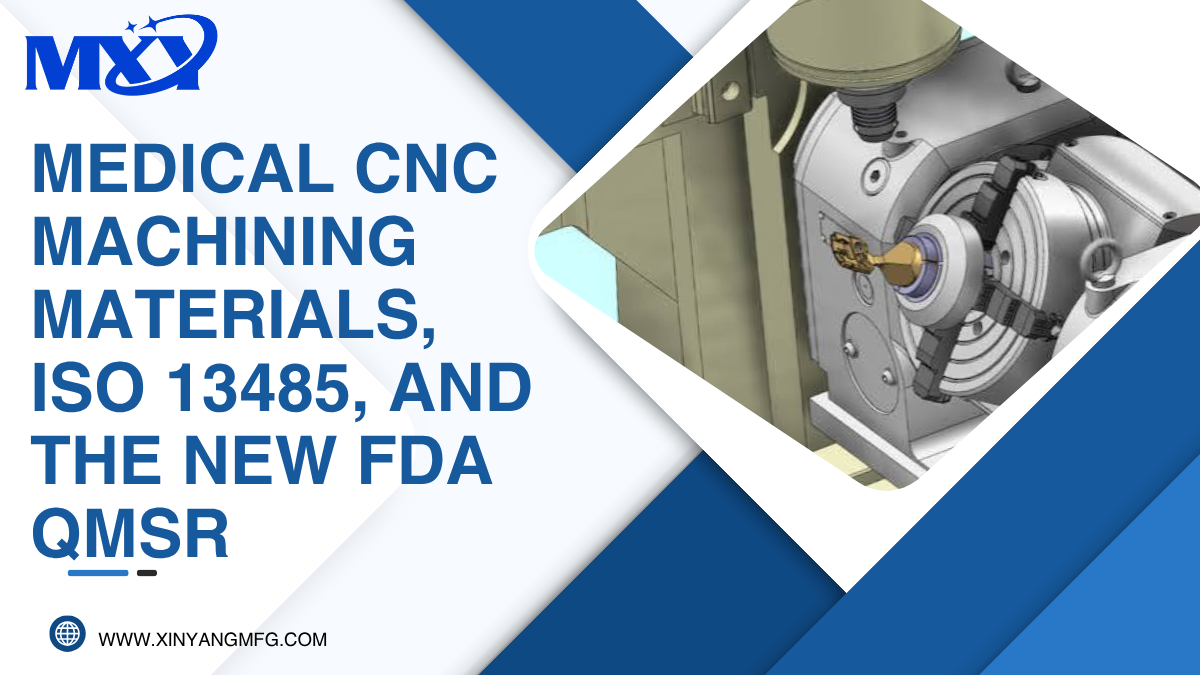
Medical Mecanizado CNC is the precision manufacture of medical device components — implants, surgical instruments, diagnostic hardware — using biocompatible materials and a quality system built around ISO 13485. As of February 2, 2026, that standard sits at the center of U.S. regulation too: the FDA’s old Quality System Regulation has been replaced by the Quality Management System Regulation (QMSR), which incorporates ISO 13485:2016 directly by reference into 21 CFR Part 820. Unlike general machining, medical work operates under strict regulation, often in cleanroom conditions, with biocompatible materials like titanium, 316L stainless steel, cobalt-chrome, and PEEK, and full documentation proving each part meets spec. The reason is patient safety: a machined surgical tool or implant has to perform exactly as designed, every time, so accuracy and traceability matter as much as the part itself.
This guide covers the materials, the new regulatory landscape, processes, and applications that define medical machining, and what to confirm when sourcing it.
What Makes Medical CNC Machining Different
Medical machining sits under tighter regulatory control than almost any other field. The human body is an unforgiving environment, so materials must be biocompatible, surfaces must be clean and precise, and every part must be traceable and documented. CNC machining suits this work well because it delivers consistent, repeatable accuracy across both one-off custom parts and production runs, which is exactly what surgical instruments and implants demand.
The defining difference from general machining is the quality system around the part. A medical supplier is not just cutting metal; it is running a documented, audited process designed to satisfy regulators and protect patients. That system has to produce a Device History Record for every batch, hold design and process changes under formal change control, and be ready to reconstruct exactly how any given part was made if a question ever comes up after the device ships.
Biocompatible Materials Used in Medical Machining
Material selection is driven by biocompatibility, strength, and how the part interacts with the body. Common choices include:
- Titanium and Ti-6Al-4V ELI: widely used for implants because it is strong, lightweight, corrosion-resistant, and well tolerated by the body. The ELI (“extra low interstitial”) grade reduces oxygen and other interstitial content for better fatigue performance and biocompatibility in long-term implants.
- 316L stainless steel: a low-carbon stainless used for surgical instruments and some implants for its corrosion resistance, strength, and the fact that it can be reliably sterilized through repeated autoclave cycles without degrading.
- Cobalt-chrome alloys: chosen for wear resistance in joint implants and other load-bearing applications, where the part has to survive millions of cycles of articulation without generating excessive wear debris.
- PEEK and other medical polymers: used for spinal and orthopedic devices where a non-metallic, radiolucent material is needed so the implant doesn’t obscure post-surgical imaging.
Material certifications and biocompatibility documentation — typically testing to the ISO 10993 biological evaluation series — are part of the deliverable, so they should be confirmed up front for the specific application and the device’s classification.
The New Regulatory Landscape: ISO 13485 and the FDA’s QMSR
For years, U.S. medical device manufacturers had to satisfy two overlapping but separate frameworks: ISO 13485 internationally, and the FDA’s own Quality System Regulation (QSR) domestically. That changed on February 2, 2026. The FDA’s Quality Management System Regulation (QMSR) took effect, amending 21 CFR Part 820 to incorporate ISO 13485:2016 directly by reference rather than maintaining a separate, parallel set of U.S.-only requirements.
In practice, this means most of Part 820 now simply points to the relevant clause of ISO 13485:2016 instead of restating its own version of the same requirement. The FDA retained a small number of U.S.-specific additions where it felt ISO 13485 didn’t fully cover its expectations — including more detailed requirements for complaint records, device labeling and packaging inspection, and traceability for life-sustaining implantable devices. For a supplier, the practical upshot is that a current, properly scoped ISO 13485 certificate is now closer than ever to the actual FDA requirement, though it still isn’t a substitute for FDA registration and inspection readiness.
ISO 13485 itself is the international quality management standard specific to medical devices, covering risk management, traceability, process control, and documentation across the full product lifecycle — from design and development through production, distribution, installation, and servicing. It is the baseline most medical OEMs require, and unlike some other industries, biocompatibility and risk-based decision-making run through nearly every clause rather than sitting in a separate section.
Together, ISO 13485 and the QMSR mean a medical supplier must run a documented, auditable process, not just produce accurate parts. When you evaluate a supplier, ask to see the ISO 13485 certificate, confirm it’s current and properly scoped to the processes you need, and ask how their quality system has been updated for QMSR compliance since the February 2026 effective date.
Tolerances, Finish, and Cleanroom Production
Medical parts often require very tight tolerances and specific surface finishes, since both affect how an implant or instrument performs and how it interacts with tissue. Surface finish is especially important: a poorly finished implant surface can affect biocompatibility and osseointegration (how well bone bonds to an implant), while surgical instruments need finishes that can be cleaned and sterilized reliably across repeated use cycles without harboring contaminants in microscopic surface irregularities.
Many medical components are produced or finished in controlled cleanroom environments to limit particulate and biological contamination, with cleanroom classification depending on the device’s intended use and regulatory risk class. Parts are validated against the print with documented inspection, often including dimensional verification on a CMM and surface roughness measurement. This combination of tight tolerance, controlled finish, and clean handling is a core reason medical machining is more involved — and typically more expensive per part — than general work of similar geometric complexity.
Typical Medical Machined Parts
CNC machining produces a broad range of medical components, including orthopedic implants such as hip and knee joints, spinal devices, dental implants and abutments, surgical instruments and handles, bone screws and plates, and housings and parts for diagnostic and monitoring equipment. Many of these are small, intricate, and tight-tolerance, which is why multi-axis machining is common in the field — a single setup reduces the handling and repositioning that can introduce contamination or dimensional drift on parts this small.
Device Classification and What It Means for Sourcing
Not every medical part carries the same regulatory weight. The FDA’s device classification system — Class I, II, and III — scales regulatory control to risk: Class I devices (many surgical hand tools, for example) carry the lightest controls, Class II devices (many diagnostic and orthopedic components) require more extensive premarket review, and Class III devices, including most permanent implants, carry the highest level of scrutiny, typically requiring premarket approval. The classification of your specific device should shape how much documentation, biocompatibility testing, and process validation you ask your machining supplier to support — a Class III implant component needs a fundamentally more rigorous paper trail than a Class I instrument handle, even if the two parts look geometrically similar on a print.
How to Source Medical CNC Machining
Before sending a drawing, confirm five things:
- A current ISO 13485 certificate, scoped to the specific processes (machining, finishing, cleanroom packaging) you need.
- How the supplier’s quality system has adapted to the FDA’s QMSR since its February 2026 effective date, if your device will be sold in the U.S.
- Experience with your specific material and device classification — a Class III implant supplier and a Class I instrument supplier need different levels of process validation.
- The inspection and traceability documentation, including Device History Record content, that will accompany the parts.
- Whether cleanroom production or specific surface finishing and biocompatibility testing is required for your application.
Then confirm tolerances, finish, and material certifications in writing for your part.
XY Machining provides precision CNC machining with DFM feedback and inspection documentation, and serves the medical and dental sector through its dedicated medical solutions. [XY Machining: insert your specific medical credentials here — for example, ISO 13485 certification status and cleanroom capability — to strengthen this section with verifiable, named claims.]
Preguntas frecuentes
What is medical CNC machining?
Medical CNC machining is the precision manufacture of medical device components, such as implants, surgical instruments, and diagnostic hardware, using biocompatible materials and quality systems built around ISO 13485 and the FDA’s Quality Management System Regulation, often in cleanroom conditions.
What materials are used in medical CNC machining?
Common biocompatible materials include titanium and Ti-6Al-4V ELI for implants, 316L stainless steel for instruments, cobalt-chrome alloys for wear-resistant joint implants, and PEEK for radiolucent spinal and orthopedic devices.
What certifications does a medical machining supplier need?
ISO 13485, the medical device quality management standard, is the baseline, and as of February 2, 2026, it’s also incorporated directly into the FDA’s Quality Management System Regulation (QMSR) for devices sold in the U.S. Ask to see a current ISO 13485 certificate and how the supplier has adapted to the QMSR transition.
Did the FDA’s medical device quality requirements actually change?
Yes. Effective February 2, 2026, the FDA’s old Quality System Regulation was replaced by the Quality Management System Regulation (QMSR), which incorporates ISO 13485:2016 by reference into 21 CFR Part 820, with a small number of added U.S.-specific requirements. ISO 13485 certification alone still doesn’t replace FDA registration and inspection.
Does medical machining need a cleanroom?
Many medical components are produced or finished in controlled cleanroom environments to limit contamination, especially implants and parts that contact the body. Whether a cleanroom is required depends on the specific device and its regulatory class.
What parts are made with medical CNC machining?
Common parts include orthopedic implants like hip and knee joints, spinal and dental devices, surgical instruments, bone screws and plates, and components for diagnostic and monitoring equipment.
Does device classification (Class I, II, III) affect how a part should be sourced?
Yes. Higher-risk classes, especially Class III implantable devices, require more extensive process validation, biocompatibility testing, and documentation than lower-risk Class I instruments, even when the parts look similar on a drawing.