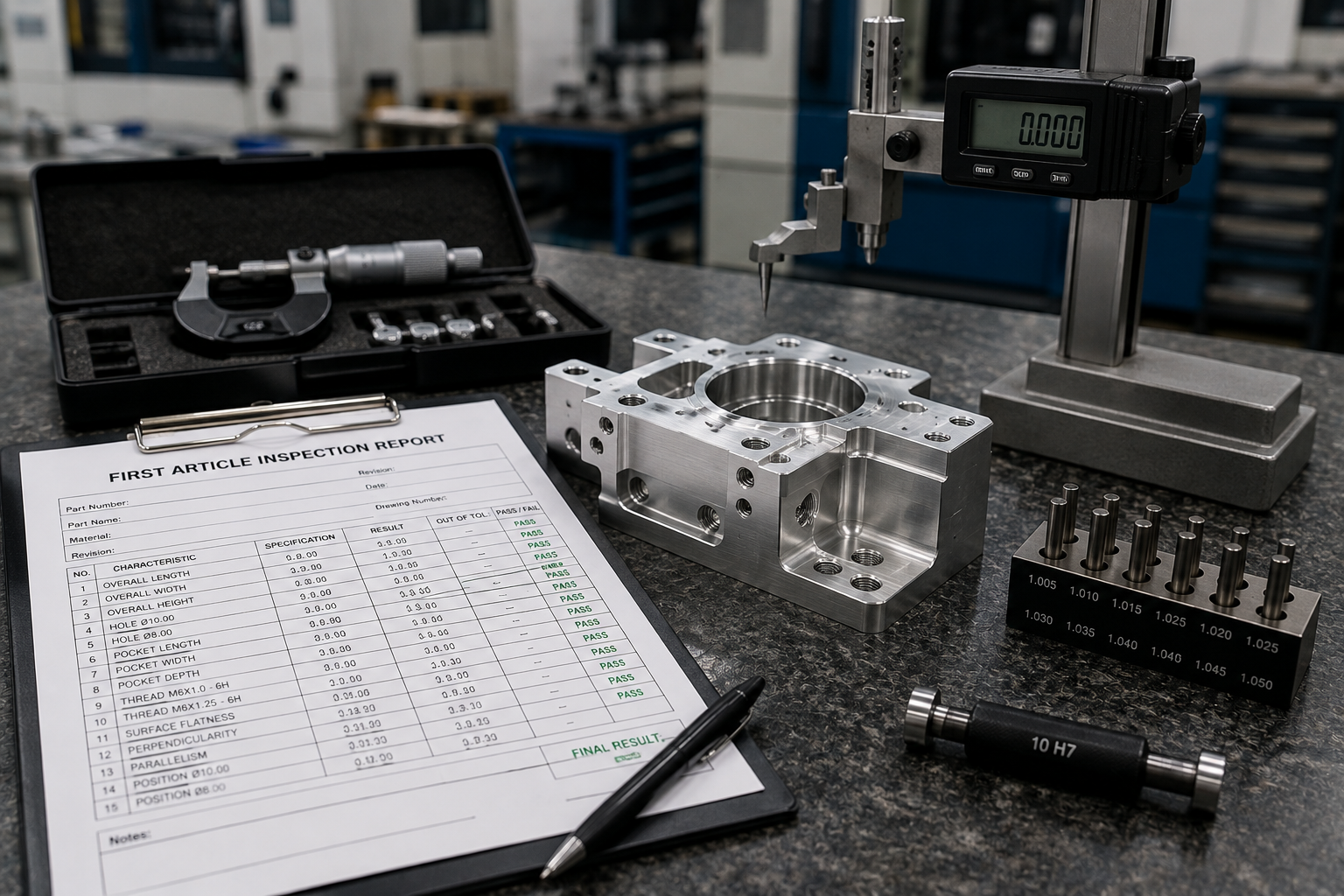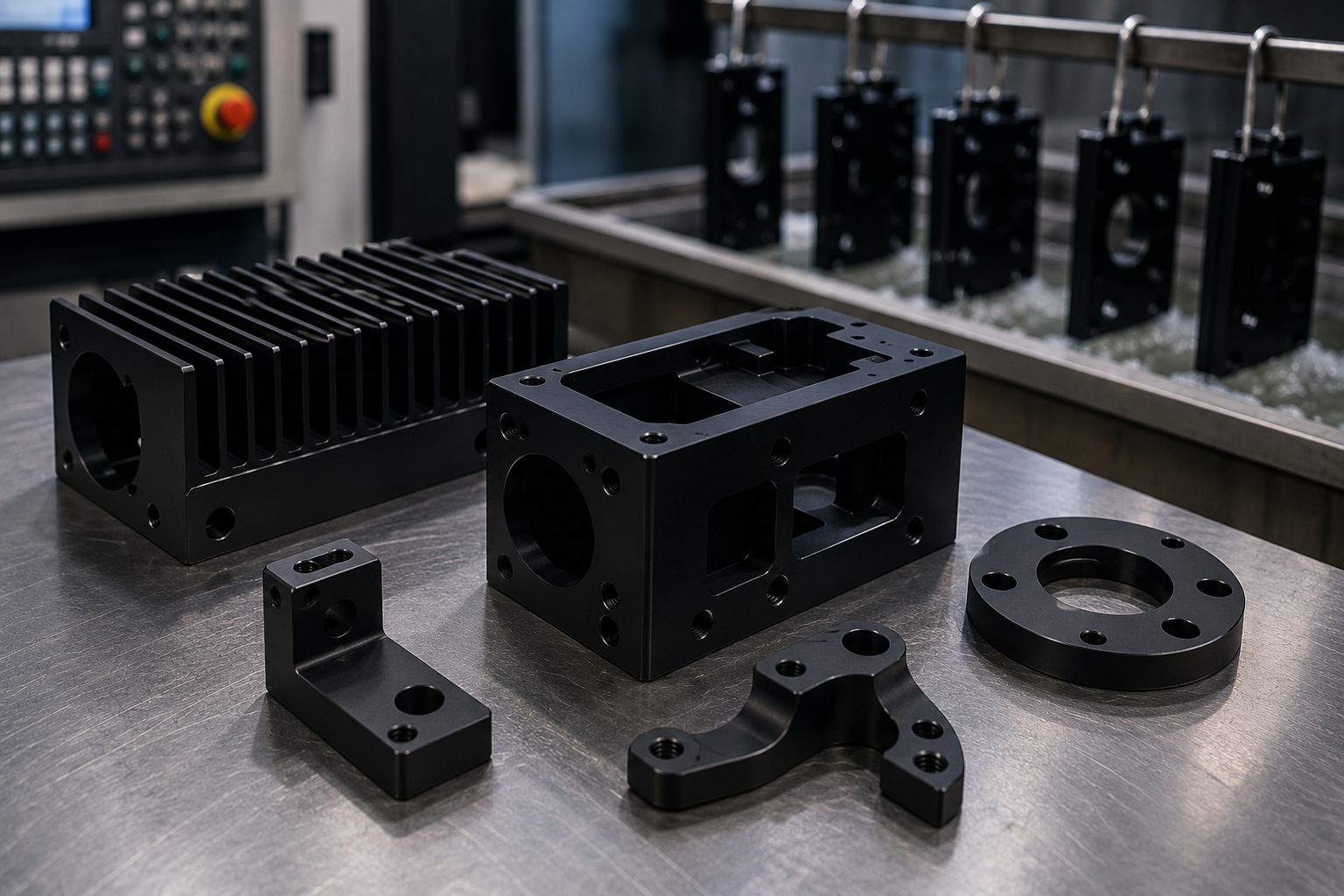
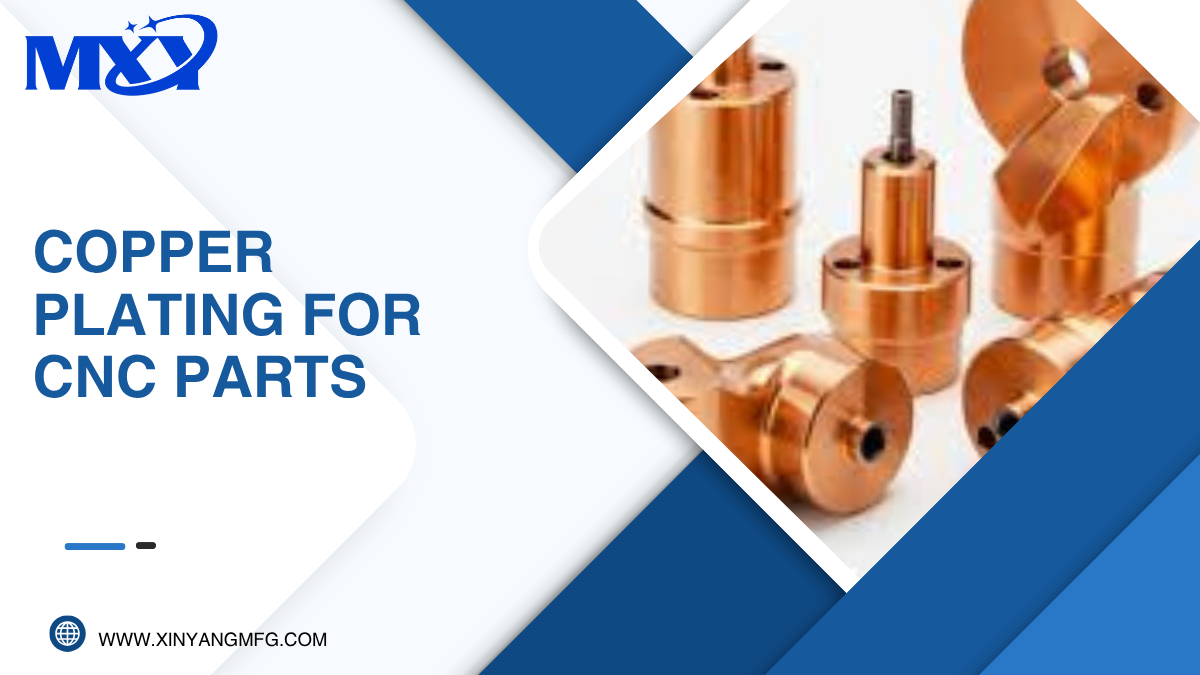
Copper plating is specified for CNC parts for three primary technical reasons: electrical conductivity enhancement, EMI/RF shielding, and thermal management. In high-power electronics, busbars and contact surfaces depend on copper’s electrical conductivity — 58.0 MS/m at room temperature — to minimize resistive losses. In RF enclosures, a copper layer acts as a Faraday cage, blocking electromagnetic interference from entering or leaving the assembly. In heat sinks and thermal interface components, copper’s thermal conductivity of 385 W/m·K distributes heat far more efficiently than most base metals.
The engineering problem is that specifying copper plating as a post-machining operation is not simply a surface finish decision. Every copper layer adds measurable physical thickness to every exposed surface — typically between 5 µm and 50 µm depending on the process and specification. On a part machined to ±0.01mm, an unaccounted 25 µm copper layer on each side of a bore represents a 50 µm diameter reduction, which can turn an interference fit into a line-to-line fit or render a precision thread non-functional.
The engineers who successfully specify copper plating on tight-tolerance CNC parts treat the plating process as an extension of the machining process — accounting for deposition thickness in the pre-plating dimensions and designing features to receive consistent, predictable copper coverage.
The Four Copper Electroplating Baths: A Technical Comparison
The electrolyte chemistry chosen for the plating bath determines deposition rate, thickness uniformity, substrate compatibility, and the purity of the deposited copper. Selecting the wrong bath for a substrate or geometry type is the leading cause of adhesion failure and dimensional non-conformance in copper-plated CNC parts.
| Bath Type | Deposition Rate | Uniformity | Substrate Compatibility | Primary Application |
|---|---|---|---|---|
| Acid Copper Sulfate | Fast (>1 µm/min) | Moderate — builds on edges | Copper, brass, pre-struck steel | PCBs, busbars, heat sinks |
| Cyanide Copper Strike | Slow (0.2–0.5 µm/min) | Excellent — high deep-hole coverage | Aluminum, carbon steel, zinc | Adhesion layer for active metals |
| Pyrophosphate Copper | Modéré | Very good | Zinc alloys, aluminum, plastics | Flexible circuits, high-ductility parts |
| Electroless Copper | Very slow (<0.1 µm/min) | Perfect — no current concentration | Ceramics, non-conductive polymers | Blind hole metallization, RF housings |
Acid Copper Sulfate — High-Rate Bulk Deposition
The acid copper sulfate bath is the standard for applications requiring thick copper deposits at fast cycle times. The bath operates at low pH (0.5–1.0), which produces a bright, dense copper layer with good electrical properties. The limitation is that the acidic environment attacks many base metals directly — aluminum oxidizes aggressively, and carbon steel dissolves at the surface, contaminating the bath and producing powdery, non-adherent deposits.
Acid copper is the correct final bath for pure copper, brass, and pre-treated steel substrates where bulk conductivity is the objective. For precision CNC parts, the edge build-up behavior — where current density concentrates at corners and produces thicker deposits at sharp edges — must be addressed through DFM before the drawing is released for machining.
Cyanide Copper Strike — The Essential Adhesion Layer
The cyanide copper bath operates at high pH (12–13), which passivates active metal surfaces rather than attacking them. This chemistry is the standard undercoat applied to aluminum, carbon steel, and zinc die-cast parts before the thick acid copper layer is applied. The strike layer is thin — typically 2–5 µm — but its function is critical: it creates a metallurgically bonded copper foundation on substrates that the acid bath cannot wet.
Specifying copper plating on aluminum or steel without a cyanide copper strike results in immediate delamination because the acid bath produces a mechanically trapped, non-bonded deposit on these substrates. The presence or absence of the strike layer is not visible on the finished part — it is a process discipline issue that separates competent plating facilities from those who cut steps.
Electroless Copper — The Only Option for Blind Holes
Electroless copper deposition does not use electrical current. Instead, a chemical reducing agent (typically formaldehyde in an alkaline solution) drives copper ion reduction at the substrate surface. Because deposition is driven by chemistry rather than current, it is completely insensitive to geometric factors — inside blind holes, on curved surfaces, and on non-conductive substrates, the deposition rate is identical to flat external surfaces.
For CNC parts with blind holes requiring conductive inner surfaces — RF shielding cavities, coaxial connector housings, fluid conduit components — electroless copper is the only process that produces reliable uniform coverage. The trade-off is low deposition rate: achieving 10 µm of coverage via electroless copper requires approximately 100 minutes, versus 10 minutes with acid copper.
Substrate Preparation: What Must Happen Before Any Copper Is Deposited
Copper plating adhesion failure almost always originates in inadequate surface preparation, not in the plating bath itself. The substrate surface must arrive at the plating bath in a specific condition — free of oxides, machining oils, and contamination — for any plating chemistry to produce a bonded deposit.
Aluminum Alloys: The Zincate Process Is Mandatory
Aluminum is protected by a tenacious native oxide layer (Al₂O₃) that reforms within seconds of exposure to ambient air. This oxide is electrically insulating and chemically stable in most plating bath chemistries. Attempting to plate copper directly onto aluminum produces a deposit that appears adherent immediately after plating but delaminates within days under thermal cycling.
The zincate process dissolves the aluminum oxide in a strong alkaline zincate solution (sodium hydroxide + zinc oxide) and simultaneously deposits a thin, adherent zinc layer on the exposed aluminum surface. This zinc layer replaces the oxide with a metallic surface that accepts the subsequent cyanide copper strike. The complete preparation sequence for aluminum is: degrease → alkaline etch → acid de-smut → double zincate → cyanide copper strike → acid copper final.
The double zincate (two zincate cycles with a nitric acid strip between them) is important for precision aerospace and electronics grade parts. The second zincate cycle produces a finer-grained zinc layer with better coverage uniformity, which translates directly to more consistent copper adhesion.
Carbon and Alloy Steel: Acid Pickling and Embrittlement Risk
Carbon steel parts require acid pickling in hydrochloric or sulfuric acid to remove mill scale, rust, and surface oxides before entering the cyanide copper strike bath. The pickling step is effective but introduces a significant risk for high-strength steels: hydrogen embrittlement.
During acid pickling and during the electroplating process itself, atomic hydrogen generated at the cathode surface is absorbed into the steel lattice. In steels with tensile strength above 1,000 MPa (approximately 30 HRC hardness), this absorbed hydrogen causes delayed brittle fracture under applied or residual stress — a failure mode that may not manifest until hours or days after the part is put into service.
The standard mitigation is baking: high-strength steel parts must be placed in an oven at 190–220°C within four hours of plating completion and held at temperature for a minimum of two to four hours. The elevated temperature causes hydrogen to diffuse out of the steel lattice before it can cause damage. This baking requirement must be specified on the engineering drawing or purchase order — it cannot be assumed.
Stainless Steel: Activation Is Required
Stainless steel’s corrosion resistance comes from its passive chromium oxide surface layer — the same layer that makes copper adhesion difficult. Before cyanide copper strike, stainless steel parts must be activated by immersion in a Wood’s nickel strike bath (hydrochloric acid + nickel chloride). The Wood’s strike dissolves the passive layer and deposits a thin, active nickel flash that the copper strike can bond to. Without this activation step, copper deposits on stainless steel are mechanically trapped rather than metallurgically bonded, and will delaminate under thermal or mechanical stress.
DFM Rules for Copper-Plated CNC Parts
Rule 1: Pre-Plate Dimensions Must Account for Copper Thickness
This is the most frequently violated DFM rule in copper plating. A bore machined to the final nominal diameter will be undersized after plating because copper deposits on the bore wall, reducing the diameter by twice the plating thickness on each side.
The correct approach is to machine the bore oversize before plating by the anticipated plating allowance. For a bore specified at 20.000mm nominal with a 25 µm copper specification, the pre-plating bore diameter should be machined to 20.050mm (20.000 + 2 × 0.025). External features follow the opposite logic: a boss specified at 10.000mm should be machined to 9.950mm pre-plating.
This pre-plating dimension must appear on the manufacturing drawing alongside the final post-plating dimension. A drawing that specifies only the final dimension without explicitly calling out the pre-plating allowance creates ambiguity between the machinist and the plating facility.
Rule 2: Minimum 0.5mm Fillet on All External Edges
Current density in an electroplating bath follows the electric field, which concentrates at sharp convex features — external corners, edges, and protrusions. At a sharp 90-degree corner, current density can be two to three times the density on adjacent flat surfaces. This produces a copper nodule at the corner that is substantially thicker than the nominal specified thickness, creating a functional interference hazard on mating parts.
Adding a minimum 0.5mm radius fillet or chamfer to all external edges redistributes the current density gradient and produces edge thickness within acceptable tolerance of the flat surface specification. This is a free DFM improvement — the chamfer or fillet adds machining time measured in seconds but prevents assembly failures that require full re-machining and re-plating.
The inverse applies to internal corners and concave features: current density is reduced inside re-entrant geometry, producing thinner-than-nominal deposits in sharp internal corners. Internal radii larger than 0.5mm improve coverage consistency in these zones.
Rule 3: Mask All Critical Tolerance Features
Features that must maintain their machined dimensional tolerances — precision bores, thread engagement zones, bearing seats, tight-clearance datums — should be masked during plating to exclude copper deposition entirely. Silicone plugs for bores and holes, and chemical-resistant masking tape for flat datum surfaces, are the standard masking methods.
The masking specification must appear on the engineering drawing as a defined zone with clear boundary dimensions. Verbal instructions to the plating facility to “mask the threads” are insufficient — the plating technician needs a dimensional boundary they can verify with a ruler. Drawings should call out masked zones with a note such as: “MASK ZONE: Ø8.000–8.025mm bore, 12mm deep from face datum A — NO PLATE.”
Rule 4: Surface Roughness Between Ra 0.8 µm and Ra 1.6 µm
The substrate surface roughness before plating determines the mechanical interlocking between the copper layer and the base metal. A surface machined to a mirror finish (Ra < 0.4 µm) provides insufficient mechanical anchor for copper ion nucleation, resulting in a deposit with poor adhesion that delaminates under thermal cycling or mechanical vibration.
Conversely, a surface that is too rough (Ra > 3.2 µm) produces non-uniform deposition that accentuates the peaks and valleys of the substrate, creating surface asperities in the plated surface that affect dimensional consistency.
The range Ra 0.8–1.6 µm, which corresponds to a standard finish milling or turning operation, provides the optimal mechanical keying surface for electroplated copper on most metallic substrates.
Rule 5: Blind Hole Design for Uniform Coverage
Standard electroplating baths produce severely non-uniform coverage inside blind holes because the electric current lines cannot easily reach the bottom of a deep closed bore. The physical effect — known as the Faraday cage effect — causes heavy copper deposition at the hole entrance and progressively thinner deposits toward the bottom.
The practical depth-to-diameter limit for uniform electroplated coverage is approximately 1:1 for acid copper baths. Blind holes with depth-to-diameter ratios exceeding 1:1 should either use electroless copper for uniform internal coverage, or be redesigned as through-holes where the geometry permits. Cross-drilled vent holes in the bottom of blind bores also help by allowing electrolyte circulation and gas bubble escape during plating, both of which improve coverage uniformity.
How to Specify Copper Plating Correctly on Engineering Drawings
A drawing note that reads “copper plate per ASTM B734” is not an adequate specification for precision CNC parts. A complete copper plating specification must define:
Minimum and maximum deposit thickness — specified in micrometers (µm), not as a range like “thin” or “standard.” For functional electrical applications, typical specifications range from 10 µm (light conductivity enhancement) to 50 µm (heavy busbar or thermal applications). For EMI shielding, 15–25 µm is a common range.
Applicable areas — a drawing note or shaded zone defining exactly which surfaces receive copper and which are masked. Include the dimensional boundaries of masked zones.
Post-plate condition — whether the copper is left as-plated (bright or matte), is to receive a secondary overlay (nickel, silver, or tin over copper), or is to be passivated. Bare copper oxidizes and discolors within days in ambient conditions; specify a protective overlay if the appearance or surface conductivity of the copper layer must be maintained long-term.
Substrate pre-treatment — specify the required pre-treatment for the substrate material. For aluminum: “double zincate per MIL-C-26074 pre-treatment sequence.” For high-strength steel: “bake at 190–220°C for 3 hours minimum within 4 hours of plating completion per ASTM F519 hydrogen embrittlement relief.”
Relevant standards — ASTM B734 covers electrodeposited copper for engineering uses. ASTM B579 covers electroless copper. MIL-C-26074 covers electroless nickel (referenced for pre-treatment procedures). IPC-4562 covers metal foil for PCB copper specifications.
Common Failure Modes in Copper-Plated CNC Parts
Blistering under thermal cycling — caused by organic contamination in the plating bath or inadequate pre-cleaning of the substrate. Machining oils, fingerprints, and drawing lubricants that survive the pre-clean cycle create organic barriers between the copper and substrate that fail under the differential thermal expansion of heating and cooling cycles. Prevention: specify and verify a clean room pre-clean protocol that includes ultrasonic degreasing.
Edge nodules causing assembly interference — caused by insufficient edge radius on the machined part, as described in Rule 2 above. Prevention: mandatory minimum 0.5mm fillet specification on all external edges.
Thread engagement failure after plating — caused by specifying thread engagement without pre-plating oversized taps. Standard tap sizes cut threads to final nominal diameter. After copper plating the thread flanks, the pitch diameter is reduced by approximately four times the nominal plating thickness, causing Go gauge failure. Prevention: specify pre-plating oversized taps at the machining stage; the tap oversize must be specified as four times the nominal plating thickness.
Hydrogen embrittlement fracture in high-strength steel — delayed fracture occurring hours to days after plating, caused by absorbed hydrogen from acid pickling. Prevention: mandatory post-plate bake specification on the drawing for all steel parts with hardness above 30 HRC.
Delamination of copper on aluminum without zincate — immediate or short-term delamination caused by inadequate oxide removal before plating. Prevention: specify double zincate pre-treatment on all aluminum substrates; require supplier to document the zincate process in their quality records.
Foire aux questions
How much does copper plating affect CNC part tolerances? Each side of a feature gains copper thickness equal to the specified deposit. A 25 µm copper specification adds 25 µm to each exposed surface, meaning a bore loses 50 µm in diameter and an external pin gains 50 µm in diameter. Pre-plating machined dimensions must be offset by the expected plating thickness. For precision parts with tolerances tighter than ±0.05mm, the pre-plating allowance should be confirmed with the plating supplier using their process thickness control data.
Does copper plating require a secondary protective coating? Bare copper oxidizes in ambient conditions, forming a dark cuprous or cupric oxide layer that increases surface electrical resistance and affects solderability. For electrical contact surfaces, RF shielding surfaces, and any application where the copper’s surface properties must remain stable, a secondary protective layer is required. Common options are electroplated tin (for solderability), electroplated silver (for maximum conductivity), electroplated nickel (for wear and corrosion resistance), or chemical passivation for temporary protection.
Can you copper plate plastic or non-conductive substrates? Yes, using the electroless copper process. Non-conductive substrates require an initial activation step — typically immersion in a palladium chloride activating solution — that creates catalytic sites for electroless copper nucleation. Once a thin (1–3 µm) electroless copper layer covers the substrate, standard electrolytic copper baths can be used to build the layer to final thickness. This approach is used for RF shielding of plastic enclosures, decorative copper on ABS parts, and metallization of ceramic or composite components.
What is the difference between electroplated and electroless copper? Electroplated copper uses an electric current to drive copper ion deposition — the part is the cathode in an electrochemical cell. Deposition rate is fast (>1 µm/min) but thickness is non-uniform because current distributes unevenly across complex geometries. Electroless copper uses chemical reduction rather than electrical current, producing uniform thickness regardless of geometry — including inside blind holes and on non-conductive substrates — but at much lower deposition rates (<0.1 µm/min). Electroless copper is also the only process suitable for non-conductive substrates.
How do you prevent copper plating adhesion failure on aluminum? The complete pre-treatment sequence for aluminum is: alkaline degreasing, alkaline etch to remove the native oxide, acid de-smut to remove smut residue from alloying elements, double zincate (two cycles with a nitric acid strip between them), cyanide copper strike, then final acid copper bath. Skipping the double zincate or the cyanide strike produces deposits that appear bonded initially but fail within days under thermal or mechanical stress. Always specify the pre-treatment sequence explicitly on the purchase order or engineering drawing.
What copper purity can be achieved through electroplating? Standard acid copper sulfate baths produce copper with purity in the range of 99.5–99.9%, depending on bath contamination control. For applications requiring maximum conductivity — RF transmission components, high-frequency busbars, precision resistors — Oxygen-Free High Conductivity (OFHC) copper electrolyte baths using 99.99% pure copper anodes can produce deposits exceeding 99.9% purity. The higher purity requires tighter bath chemistry control and more frequent anode replacement, which is reflected in processing cost.
How do you specify hydrogen embrittlement relief on a drawing? The drawing note should reference ASTM F519 (standard test method for hydrogen embrittlement detection) and specify the bake parameters directly: “Post-plate hydrogen embrittlement relief: bake at 190–220°C for minimum 3 hours within 4 hours of completion of plating. Applies to all steel parts with hardness ≥ 30 HRC (≥ 1,000 MPa tensile strength).” The four-hour window between plating completion and bake start is critical — hydrogen becomes increasingly difficult to diffuse out as it migrates deeper into the steel lattice over time.