Skip to content
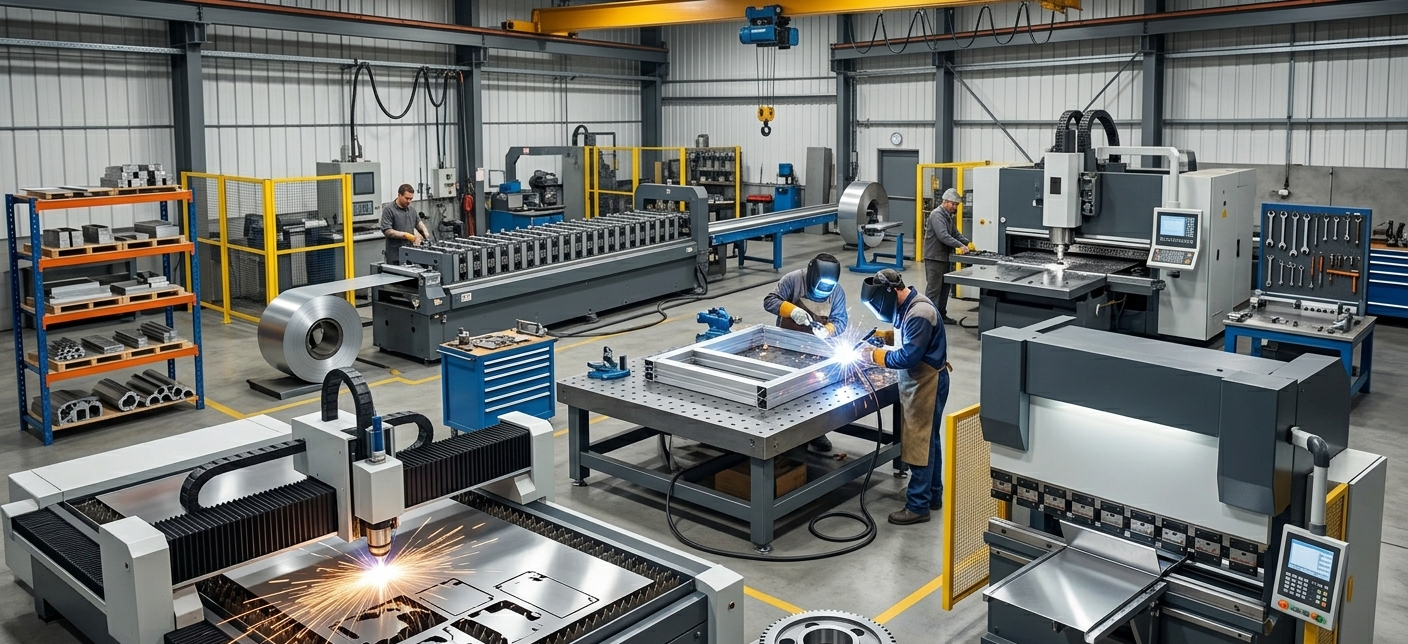
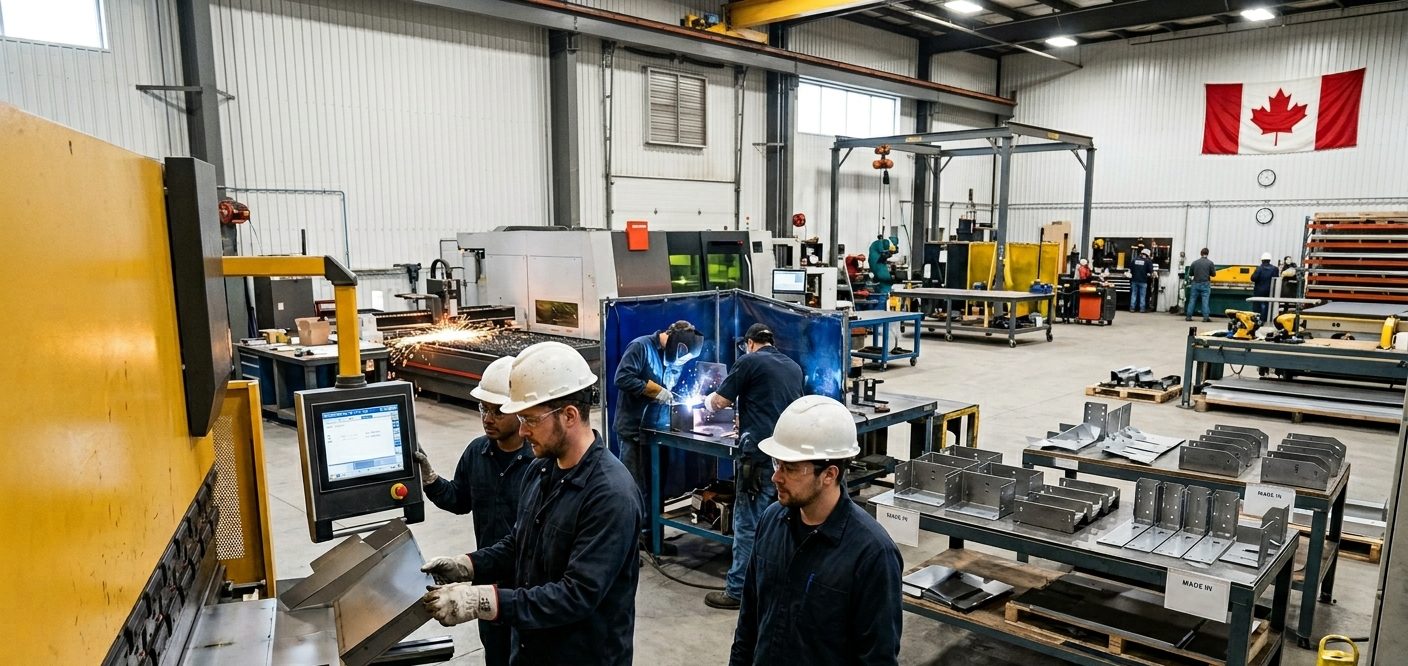
Sheet metal fabrication encompasses eight primary processes used to transform flat metal sheets into finished components: (1) laser cutting, (2) waterjet cutting, (3) plasma cutting, (4) punching and stamping, (5) bending and forming, (6) deep drawing, (7) welding and joining, and (8) finishing operations including deburring, anodizing, and powder coating. Each process has distinct tolerance capabilities, material thickness ranges, and cost economics. Modern sheet metal shops combine 3–5 of these in sequence to deliver finished parts: typical workflow is laser cut → deburr → bend → weld → finish. Achievable tolerances range from ±0.005 in (0.13 mm) on laser cutting to ±0.001 in on precision stamping, with sheet thicknesses from 0.005 in foil up to 0.5 in plate.
8 Sheet Metal Fabrication Processes at a Glance
| Process | Material Thickness | Tolerance | Typical Cost |
|---|---|---|---|
| Laser Cutting (Fiber) | 0.020–0.5 in | ±0.005 in | $$ |
| Waterjet Cutting | 0.010–6 in | ±0.005 in | $$$ |
| Plasma Cutting | 0.060–2 in | ±0.020 in | $ |
| Punching / Stamping | 0.020–0.25 in | ±0.001–0.005 in | $ (high vol) |
| Bending / Forming | 0.010–0.5 in | ±0.5° angular | $ |
| Deep Drawing | 0.005–0.25 in | ±0.005 in | $$ (high vol) |
| Welding (TIG/MIG/Spot) | 0.020–0.5 in | ±0.030 in | $ |
| Finishing (Anodize, Powder) | All | Cosmetic | $ |
1. Laser Cutting
Laser cutting uses a focused beam (typically fiber laser at 2–12 kW or CO2 laser at 2–6 kW) to vaporize material along a programmed path. Fiber lasers dominate sheet metal under 0.5 in and have largely displaced CO2 lasers for steel cutting due to 3–4x faster cut speeds and 40–60% lower energy consumption.
Tolerance capability is ±0.005 in (0.127 mm) on standard fiber lasers and ±0.002 in (0.050 mm) on high-end machines with autofocus and adaptive optics. Kerf width runs 0.004–0.012 in depending on power and material. Heat-affected zone (HAZ) is typically 0.003–0.010 in — small enough that it doesn’t affect mechanical properties on most structural applications. Cuttable materials include carbon steel (up to 0.75 in with 12 kW), stainless steel (up to 0.5 in), aluminum (up to 0.5 in), brass and copper (up to 0.25 in, requires special lens setup due to high reflectivity), and titanium.
2. Waterjet Cutting
Waterjet cutting uses a high-pressure stream (typically 60,000–90,000 PSI) of water mixed with abrasive garnet to erode material. Unlike laser cutting, waterjet introduces zero heat-affected zone, preserving material temper and avoiding distortion on heat-sensitive alloys.
Tolerance is ±0.005 in (0.13 mm) on standard waterjet, tightening to ±0.002 in on dynamic-head precision systems. Kerf is wider than laser at 0.025–0.045 in. Material thickness range is the broadest of any sheet process: 0.010 in foil up to 6 in plate (steel), or 8+ in on stone and ceramic. Best for heat-sensitive alloys (aluminum honeycomb, titanium for aerospace, hardened tool steels), composites (carbon fiber, fiberglass), and stacks of multiple sheets where laser would distort.
3. Plasma Cutting
Plasma cutting uses a high-velocity ionized gas stream (typically nitrogen, argon, or compressed air) at 20,000–50,000°F to cut electrically conductive materials. Lower precision than laser or waterjet but significantly cheaper for thicker carbon steel.
Tolerance is ±0.020 in (0.5 mm) on standard plasma, tightening to ±0.010 in on high-definition (HD) plasma systems. Kerf is wide at 0.060–0.150 in. Best for carbon steel and stainless 0.060–2 in thick where laser becomes uneconomical. Common in heavy fabrication, structural steel, and shipbuilding rather than precision sheet work.
4. Punching and Stamping
Punching uses mechanical or hydraulic presses to drive a hardened tool steel punch through sheet material into a die, shearing out a hole or shape. Stamping is a broader category including punching, blanking, piercing, lancing, embossing, and coining — typically combined in a progressive die for high-volume production.
Tolerance capability runs ±0.005 in on a turret punch, tightening to ±0.001 in on precision stamping with hardened tooling. Material thickness is 0.020–0.25 in for typical sheet work. Tooling cost is high ($5,000–$50,000+ for progressive dies) but per-piece cost is the lowest of any sheet process at production volumes — making stamping the standard for automotive body panels, electronics chassis, appliance bodies, and any part exceeding ~10,000 annual units.
5. Bending and Forming
Sheet metal bending uses a press brake to plastically deform material around a forming die. Bend angle is controlled by ram depth, bend radius is controlled by die geometry, and bend allowance is calculated from material thickness, K-factor (typically 0.33–0.45 depending on hardness), and inside bend radius.
Standard tolerance is ±0.5° angular with ±0.010 in linear; precision CNC press brakes with adaptive crowning and laser angle measurement hold ±0.1° and ±0.005 in. Common bending operations include air bending (most flexible, modest tolerance), bottoming (tighter angle control), and coining (tightest tolerance, highest tool wear). Material recommendations: minimum inside bend radius is typically 1.0t for soft aluminum, 1.5t for half-hard aluminum, 2.0t for stainless 304/316, and 1.5t for mild steel — where t is the material thickness.
6. Deep Drawing
Deep drawing uses a hydraulic press to force sheet metal into a die cavity, forming a hollow cup or box from a flat blank. Common for cylindrical containers, kitchen sinks, fire extinguisher bodies, and consumer electronics enclosures.
Process limit is the drawing ratio (D/d, where D is blank diameter and d is finished diameter): typically 1.6–2.2 in a single draw, with deeper parts requiring multiple drawing operations and intermediate annealing. Tolerance is ±0.005 in on critical dimensions, ±0.020 in on overall height. Tooling cost is high but per-piece cost is very low at production volumes — making deep drawing the standard for parts requiring seamless cylindrical or rectangular geometry without welded joints.
7. Welding and Joining
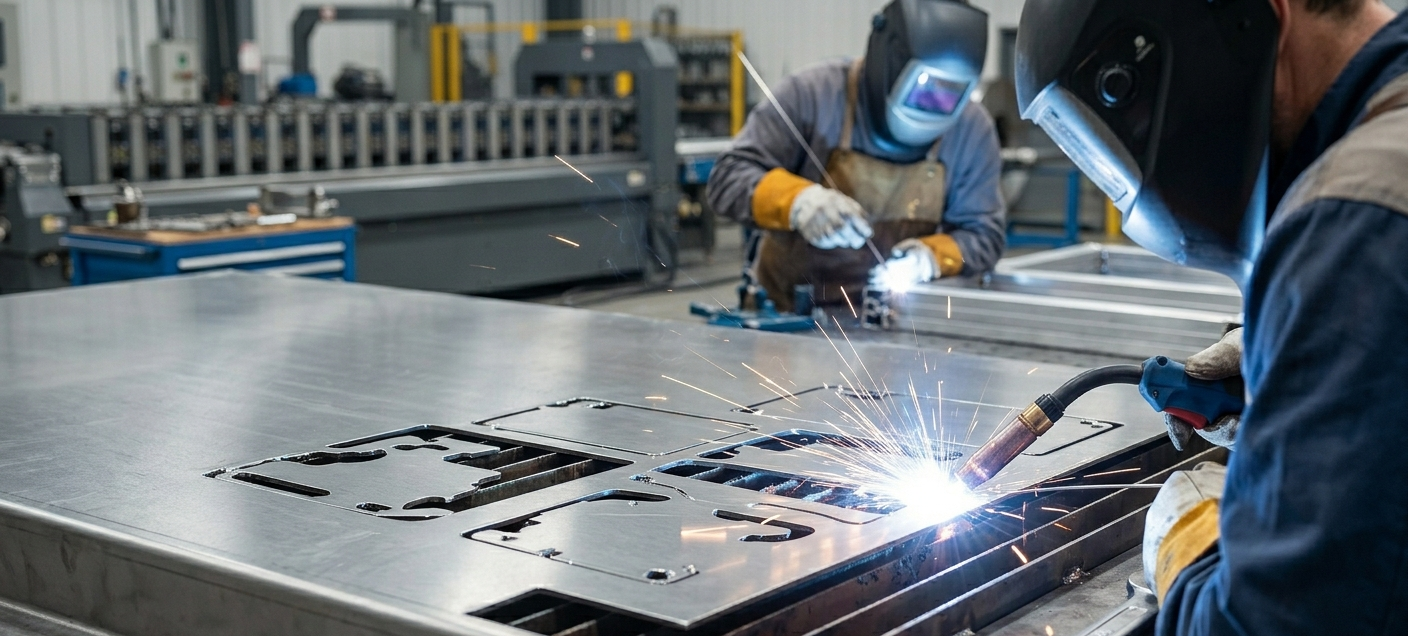
Sheet metal welding uses heat to fuse adjoining edges. TIG (gas tungsten arc welding) is the highest-quality option with tightest control of heat input, used for stainless and aluminum structural welds. MIG (gas metal arc) is faster and more economical, used for carbon steel structural fabrication. Spot welding (resistance welding) is the dominant high-volume joining method for automotive bodies and electronics chassis: two clamped electrodes pass current through stacked sheets, melting a small nugget at the contact point.
Welding tolerance is ±0.030 in linear due to heat distortion, tightening to ±0.010 in with rigid fixturing and pulse-controlled welding. Common defects to avoid include porosity (gas contamination), undercut (too much heat), warping (excessive distortion from heat input), and burn-through (too much current on thin sheet).
8. Finishing Operations
Finishing converts as-fabricated sheet metal into a finished, durable, and visually acceptable component. The major finishing categories: deburring (removes sharp edges using tumblers, brushes, or laser), anodizing (electrochemical conversion of aluminum surface to hard oxide layer, available in clear, black, gold, red, and other dyed finishes), powder coating (electrostatically applied dry pigment cured at 350–400°F to a tough thermoset finish), wet painting (liquid coatings for color flexibility and complex geometries), plating (zinc, nickel, chrome electrodeposition for corrosion resistance), and passivation (chemical treatment of stainless steel to enhance corrosion resistance per ASTM A967).
Combining Sheet Metal Processes for Real-World Parts
Most production sheet metal parts combine 3–5 processes in sequence. A typical electronics enclosure flow: (1) laser cut from 0.060 in 5052-H32 aluminum, (2) deburr edges, (3) form 90° bends on press brake, (4) tap threaded holes for fasteners, (5) clear anodize Type II finish. A typical automotive bracket flow: (1) progressive-die stamp from 0.080 in HSLA steel, (2) tab welding of reinforcement gusset, (3) zinc plating for corrosion protection, (4) e-coat primer.
Process selection is dictated by quantity, tolerance, and material: prototypes and low volumes (1–500 parts) typically use laser cut + bend + weld; medium volumes (500–10,000) move to turret punch + bend + weld; high volumes (10,000+) move to progressive-die stamping. Tolerance tightening pushes choices toward precision stamping or 5-axis laser cutting.
Frequently Asked Questions
1. What is the difference between sheet metal fabrication and stamping?
Sheet metal fabrication is the broad category of processes for forming flat metal sheets into finished parts, including cutting (laser, waterjet, plasma), forming (bending, drawing), joining (welding), and finishing. Stamping is one specific category within fabrication: using hardened-tool dies to punch, blank, or coin sheet metal in high volumes. All stamping is fabrication; not all fabrication is stamping.
2. What tolerance can sheet metal fabrication achieve?
Tolerance varies by process: laser cutting holds ±0.005 in (0.13 mm) standard, ±0.002 in on precision systems; waterjet ±0.005 in; plasma ±0.020 in; turret punch ±0.005 in; precision stamping ±0.001 in; press brake bending ±0.5° angular and ±0.010 in linear standard; precision CNC press brakes ±0.1° and ±0.005 in. Welding adds ±0.030 in due to heat distortion.
3. How thick can sheet metal be cut by laser vs waterjet?
Fiber laser at 12 kW cuts up to 0.75 in carbon steel, 0.5 in stainless or aluminum. Waterjet cuts up to 6 in steel and 8+ in stone or ceramic. For materials over 0.5 in thickness or for heat-sensitive alloys (titanium, aluminum honeycomb), waterjet is the better choice.
4. What is the minimum bend radius for sheet metal?
Minimum inside bend radius depends on material and temper: soft aluminum 1.0t, half-hard aluminum 1.5t, stainless 304/316 2.0t, mild steel 1.5t, where t is sheet thickness. Tighter radii cause cracking on the outer fiber. For minimum-radius requirements, specify annealed material or design for a slightly relaxed radius.
5. When is deep drawing better than welded fabrication?
Deep drawing is preferred when a part requires seamless cylindrical or rectangular geometry without weld seams (kitchen sinks, fire extinguisher bodies, beverage cans, deep enclosures). Welded fabrication is preferred for low-to-medium volumes (under 5,000 units) or for parts where deep draw ratios exceed 2.2 in a single operation.
6. What sheet metal finishes are available?
Common finishes: clear anodize Type II, hardcoat anodize Type III (for aluminum); powder coat (any color, durable); wet paint (custom color, complex geometry); zinc plating (clear or yellow chromate), nickel plating, chrome plating; passivation per ASTM A967 (stainless steel); e-coat primer; brushed, polished, or grained mechanical finishes.
Conclusion
Sheet metal fabrication is a stack of 8 distinct processes, each with specific tolerance capability, material thickness range, and cost economics. Modern production parts combine 3–5 of these processes in sequence: typical flow is laser cut → deburr → bend → weld → finish. Process selection is driven by quantity (laser/punch for low volume; stamping for high volume), tolerance (precision stamping for tightest tolerances; laser for medium), and material (waterjet for heat-sensitive alloys; laser for steel and aluminum).
Xinyang Industrial Tech operates a paperless digital QMS sheet metal facility with laser cutting, CNC press brake forming, MIG/TIG welding, and integrated finishing. To get a quote on your sheet metal part, upload your CAD file and receive a quote with full DFM feedback within 24 hours.