コンテンツにスキップ
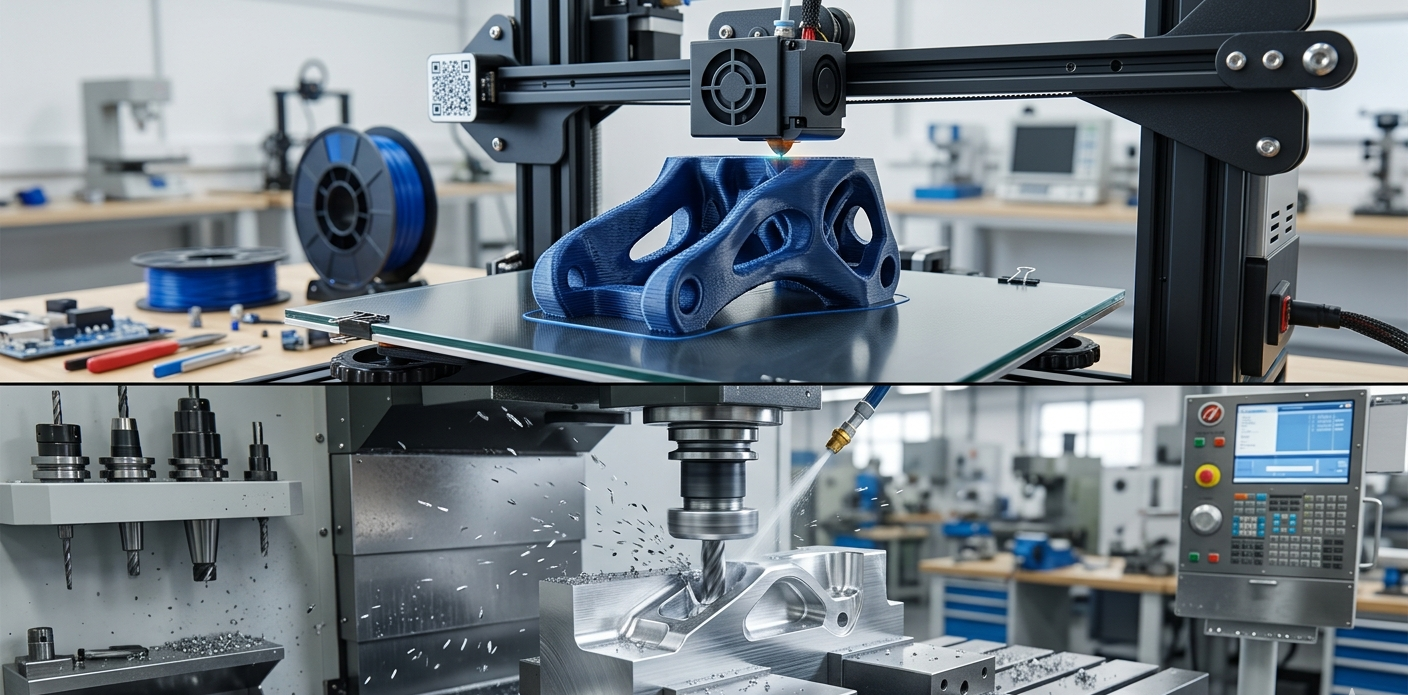
For hardware engineers choosing between 3D printing and CNC machining for a bracket that needs ±0.02 mm on a bearing bore, the answer is CNC — always. For a product manager choosing between 3D printing and CNC machining for a consumer device housing needed in 48 hours for a demo — the answer is 3D printing. The mistake is not knowing which scenario you are in before you submit the RFQ and discover the process is wrong three days before your launch event.
3D printing and CNC machining are not competing technologies in the sense that one will eventually obsolete the other. They have fundamentally different cost structures, achievable tolerances, material properties, and geometry capabilities. For most hardware programs, both technologies appear at different stages: 3D printing for early concept validation and complex organic geometries; CNC machining for functional metal prototypes, tolerance-critical features, and production parts. Understanding the transition point is what separates programmes that hit their timeline from those that don’t.
Full Process Comparison: 3D Printing vs CNC Machining
| Factor | FDM 3D Printing | SLA/SLS/MJF 3D Printing | CNC Machining |
|---|---|---|---|
| Process type | Additive — fused filament layer-by-layer | Additive — UV curing (SLA) or powder sintering (SLS/MJF) | Subtractive — removes material from solid billet |
| Tolerance | ±0.3–1.0 mm (anisotropic — worse in Z) | ±0.1–0.3 mm | ±0.005–0.05 mm standard; ±0.002 mm achievable |
| Surface finish | Ra 10–50 µm (layer lines visible) | Ra 1.6–6.3 µm (SLA smooth; SLS grainy) | Ra 0.4–3.2 µm as-machined; Ra 0.1 µm with finishing |
| Material options | PLA, PETG, ABS, ASA, TPU, nylon, PEEK (high-temp) | SLA: engineering resins. SLS: nylon, TPU, glass-filled. MJF: PA12, PA11 | Metals (Al, SS, Ti, Cu), engineering plastics (Delrin, PEEK, PC), composites |
| Part strength (vs solid billet) | 40–70% (anisotropic — weak in Z layer direction) | 60–80% (SLA); 80–95% (SLS/MJF) | 100% — wrought material properties throughout |
| Cost at 1 part | $10–$300 | $50–$600 | $80–$2,000+ |
| Cost at 50 parts | $8–$150/part | $30–$300/part | $20–$500/part (setup amortised) |
| Lead time (1 part) | 4–24 hours | 1–3 days | 3–7 days |
| Geometry freedom | Very high — overhangs with support | Very high (SLA); moderate undercuts (SLS) | Moderate — limited by tool access and undercut geometry |
| Internal features | Excellent — print internal channels and cavities | Good | Limited — requires EDM or multi-axis for complex internal geometry |
| Production suitability | Low — not economical or accurate enough for most production | Low-moderate — niche production applications | High — standard production process for metal and precision plastic parts |
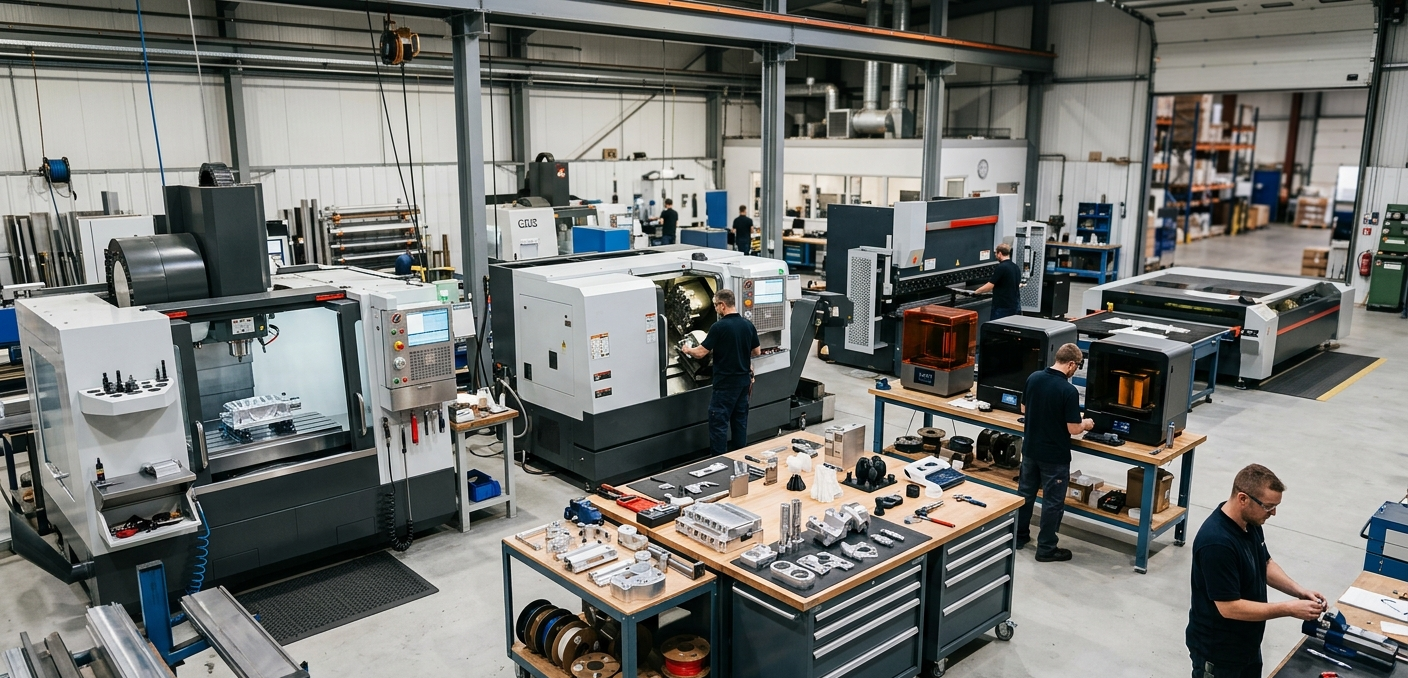
Xinyang Industrial Tech provides both CNC machining and 3D printing services from the same facility — enabling hybrid programmes where organic complex geometry is 3D printed and precision-critical features are CNC machined in a combined workflow.
Where 3D Printing Wins: 6 Specific Scenarios
1. Overnight Concept Models and Form Studies
For a product review presentation the next morning where the team needs to see and hold the form, FDM 3D printing delivers a part in 4–24 hours at $10–$80. CNC machining at $150–$800 and 3–5 days cannot serve this use case. Tolerance doesn’t matter for a concept model.
2. Complex Organic Geometry With No Functional Load
Organic consumer product shapes, ergonomic grips, parametric lattice structures, and biologically inspired geometries that would require 5-axis CNC machining at high cost are printed in a fraction of the time and cost. SLA produces fine feature detail at Ra 1.6–3.2 µm. For non-functional visual models or ergonomic evaluation, 3D printing is the right process.
3. Internal Channels, Conformal Cooling, and Hollow Structures
3D printing creates internal channels, conformal cooling passages in tooling, and hollow structures that are geometrically impossible with subtractive machining. For heat exchanger manifolds, conformal cooled injection moulds, and medical implants with trabecular internal structure — 3D printing is not just cheaper, it is the only feasible process.
4. Early Design Iteration Before CNC Investment
Printing 5 iterations of a mounting bracket in 2 days at $30 each costs $150. CNC machining 5 iterations of the same bracket costs $200–$600 each — $1,000–$3,000 total. For any part where the geometry is not yet finalised, 3D printing de-risks the design at a fraction of the CNC cost.
5. Metal 3D Printing (SLM/DMLS) for Topology-Optimised Parts
Selective Laser Melting (SLM) and Direct Metal Laser Sintering (DMLS) produce metal parts with internal lattice structures, topology-optimised ribs, and conformal features that CNC cannot produce. For aerospace weight-reduction brackets, medical implants with osseointegration surfaces, and custom jigs with complex profiles — metal 3D printing is the process. Cost: $500–$3,000 per part at 1-piece quantity, vs $400–$2,000 for equivalent CNC on a geometrically simpler design.
6. Batch Production of Small Plastic Parts (SLS/MJF Nest Printing)
SLS and MJF print multiple parts simultaneously in a powder bed without supports — a 200 × 200 × 200 mm build volume can hold 50–200 small consumer clips, brackets, or housings in one run. At $0.30–$2.00/part in a full nest, this is more economical than injection moulding below 500 parts per year and far cheaper than CNC for small plastic components.
Where CNC Machining Wins: 5 Scenarios That Are Clear
1. Any Metal Part With Tolerance < ±0.1 mm
Metal 3D printing (SLM/DMLS) typically achieves ±0.1–0.2 mm post-sintering before any finishing. CNC machining achieves ±0.005–0.025 mm as standard. For bearing bores, precision shafts, threaded interfaces, and sealing faces — CNC machining is the required process regardless of geometry complexity.
2. Production Volume Metal Parts
Metal 3D printing at $500–$3,000 per part makes sense for low-volume complex geometry. At 100 units of a medium-complexity bracket, CNC machining at $35–$80/part produces better economics than SLM at $500+/part. For metal production volumes above 20–50 parts per year, CNC is almost always more economical.
3. Wrought Material Properties Required
3D printed metals have lower fatigue resistance (typically 50–80% of wrought), anisotropic properties (stronger in some directions), and porosity that reduces dynamic strength. For parts subject to cyclic loading, vibration, or pressure cycling — CNC machined from wrought billet is the required process.
4. Engineering Plastics With Full Material Properties
Machined Delrin (POM) has excellent dimensional stability, low friction, and chemical resistance. FDM-printed Delrin has layer-orientation-dependent properties and reduced surface quality. For bearing surfaces, valve seats, and precision plastic gears — CNC machined engineering plastic is required.
5. Surface Finish Requirements Below Ra 1.6 µm
CNC machining achieves Ra 0.1–0.4 µm with finishing passes. Standard 3D printing surfaces start at Ra 1.6–50 µm and require post-processing (sanding, tumbling, vapour smoothing) to improve. For optical surfaces, tribological surfaces, or medical implant surfaces requiring Ra < 0.8 µm — CNC machining plus grinding or polishing is the correct process chain.
The Hybrid Approach: When Both Processes Serve the Same Part
For complex parts that combine organic geometry with precision-critical features — a turbine blade with conformal cooling channels and precision root attachment — the optimal strategy is hybrid: 3D print the complex geometry near-net-shape, then CNC machine the precision features to tolerance. This approach captures 3D printing’s geometry freedom while achieving CNC’s precision where it matters.
| Part Feature | Process | Reason |
|---|---|---|
| Complex organic surface contour | 3D printing (SLM or SLA) | Geometry impossible or very expensive to CNC machine |
| Precision bore (±0.01 mm) | CNC bore after 3D print | 3D print ±0.1–0.2 mm insufficient; CNC finishes to tolerance |
| Thread (M8 × 1.25) | CNC tap after 3D print | 3D printed threads have poor load capacity; tapped threads are standard |
| Surface finish (Ra 0.4 µm) | CNC finish pass or grinding | 3D print Ra 1.6–50 µm; CNC achieves Ra 0.4 µm directly |
| Datum surfaces (flatness ±0.02 mm) | CNC face after 3D print | 3D print flatness ±0.1–0.3 mm; CNC achieves ±0.01–0.02 mm |
Frequently Asked Questions
Is 3D printing cheaper than CNC machining?
For 1–10 parts of complex organic geometry: yes, 3D printing is typically 3–10× cheaper. For 1–10 parts of a precision metal bracket: no — CNC machining produces better dimensional accuracy at similar cost. For 50+ parts of most geometries: CNC machining is typically cheaper than metal 3D printing (SLM/DMLS) when setup cost amortises. For small plastic parts in batch quantities (50–500): SLS/MJF nest printing at $0.30–$2.00/part is cheaper than CNC machining. The cost comparison is always part-specific — there is no universal answer.
What tolerances can 3D printing achieve vs CNC machining?
FDM 3D printing: ±0.3–1.0 mm (layer direction worst). SLA: ±0.1–0.3 mm. SLS/MJF: ±0.1–0.3 mm. Metal SLM/DMLS: ±0.1–0.2 mm as-sintered. CNC machining standard: ±0.01–0.05 mm. CNC machining precision: ±0.002–0.005 mm on critical features. For any feature requiring tighter than ±0.1 mm — CNC machining is the required process. 3D printed parts requiring ±0.02 mm on a specific feature can be achieved by printing to ±0.5 mm and CNC machining the precision feature in a hybrid workflow.
Can 3D printed metal parts replace CNC machined metal parts in production?
For specific applications — yes. Metal 3D printing (SLM/DMLS) has replaced CNC machining in aerospace (topology-optimised brackets, GE LEAP fuel nozzles), medical implants (porous titanium acetabular cups with osseointegration surface), and tooling (conformal cooled injection moulds). For general engineering metal parts — no. The 50–80% fatigue life reduction, anisotropic properties, and 5–10× higher per-part cost of metal 3D printing vs CNC machining make it impractical for most volume metal manufacturing. Metal 3D printing wins specifically when geometry cannot be achieved by CNC and the part value justifies the cost premium.
Conclusion: Use the Right Tool for the Right Stage
- Concept model, overnight, no tolerance requirement → 3D printing
- Complex organic geometry, internal channels, hollow structure → 3D printing
- Precision metal part, ±0.05 mm or tighter → CNC machining
- Production volume metal parts (> 20–50 units) → CNC machining
- Complex geometry + precision features → hybrid: 3D print near-net, CNC finish critical features