Skip to content
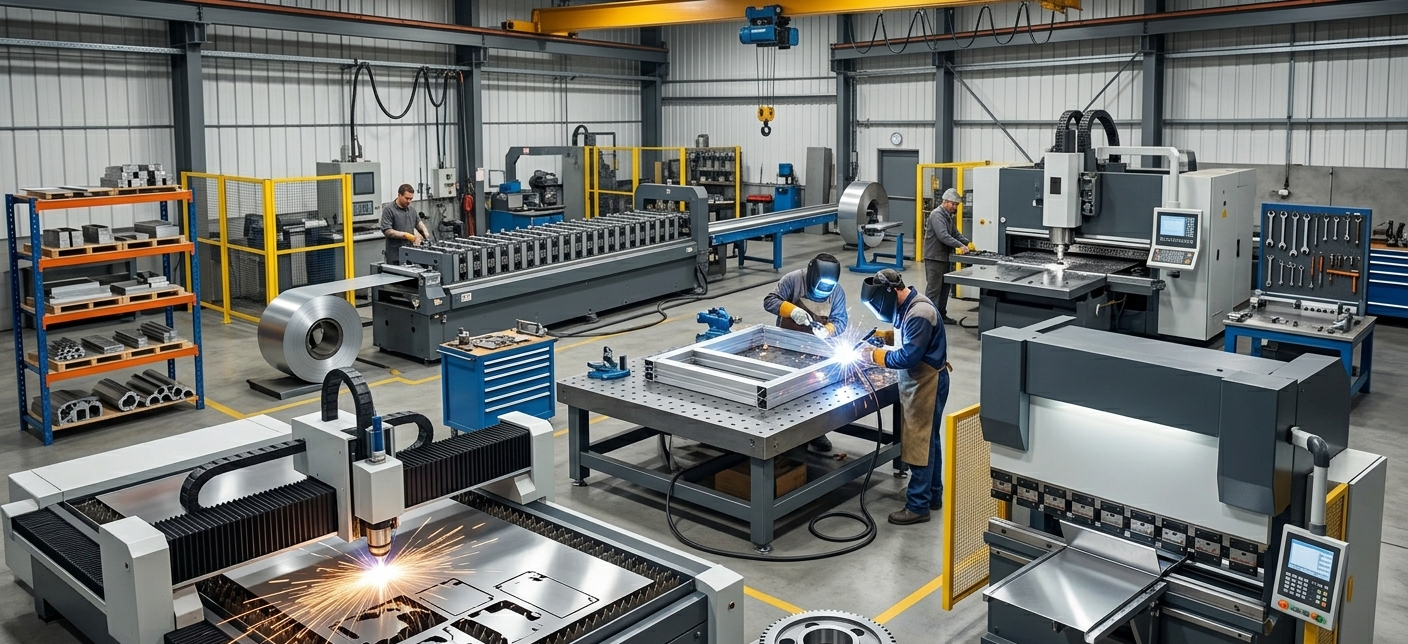
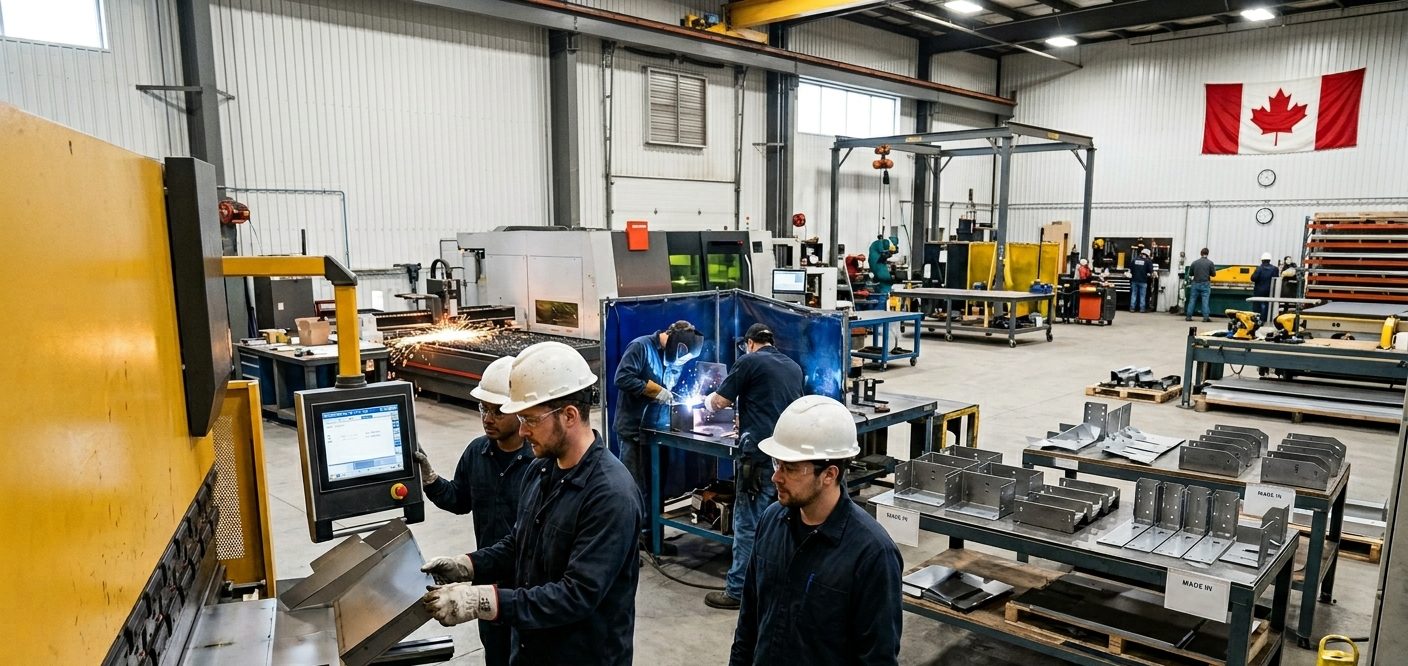
Sheet metal fabrication is the family of processes that converts flat metal stock into formed parts: laser cutting, punching, bending, welding, and finishing. Standard tolerances are ±0.1 mm on cut edges and ±0.3 mm on bent dimensions, with material thickness typically 0.5–6 mm. A well-specified job ships in 5–10 days and avoids the three most common DFM errors: too-small bend radius, holes too close to bends, and overlooked stretch on long flanges.
Sheet Metal Process Comparison
| Process | Typical Material Range | Tolerance | Best For | Setup Cost |
|---|---|---|---|---|
| Fiber Laser Cutting | 0.5–25 mm steel, 0.5–12 mm SS, 0.5–10 mm Al | ±0.1 mm | Complex outlines, slots, tabs | Low |
| CO2 Laser Cutting | 0.5–20 mm (slower than fiber) | ±0.15 mm | Older legacy parts | Low |
| CNC Punching | 0.5–6 mm steel/SS/Al | ±0.1 mm | High-quantity, repetitive holes | Medium (tooling) |
| Press Brake Bending | 0.5–10 mm typical | ±0.3 mm angle, ±0.5 mm length | Single-bend brackets, enclosures | Low |
| Robotic Welding | 1–10 mm steel/SS | ±0.5 mm position | Production weldments | Medium |
| Manual TIG/MIG | 0.5–25 mm | ±1.0 mm position | Prototype, repair, complex weldments | Low |
| Powder Coat Finishing | All — post-process | Coating 60–120 µm | Durable, color-flexible finish | Medium |
The Five Core Sheet Metal Processes
Sheet metal fabrication runs on five process families, used in combination on almost every part:
Laser Cutting
Fiber lasers (1.5 kW to 30 kW resonators) dominate modern sheet metal cutting. A 6 kW fiber laser cuts 16-gauge mild steel at 8,000 mm/min and 6 mm aluminum at 3,500 mm/min with ±0.1 mm dimensional accuracy. Edge quality on the cut face is typically Ra 3.2–6.3 µm — clean enough for most applications without secondary grinding.
Practical limits: minimum hole diameter equals roughly 1× material thickness (a 3 mm thick sheet should have holes no smaller than 3 mm); minimum slot width 0.8× thickness. Going below those limits forces more passes, higher heat input, and dross on the back side.
CNC Punching and Nibbling
Turret punch presses excel at high-quantity hole work. A modern Amada or Trumpf turret punch nibbles a 50 mm slot in 16-gauge steel in under 2 seconds and runs unattended for 4–8 hour shifts. Tolerance is comparable to laser at ±0.1 mm, but tooling cost (custom punches) and the per-part time advantage flips around quantity 200–500.
For quantities above 500 with repetitive hole patterns, CNC punching beats laser on cost. Below 200, laser wins because there’s no tooling cost.
Press Brake Bending
Press brakes form the bend in sheet metal. The two practical methods are air bending (bottom of the V-die unsupported, angle controlled by ram depth) and bottoming (forced into the die, more consistent but more tonnage required).
Standard bend tolerances are ±0.3° on angle and ±0.5 mm on flange length. Tighter tolerances are achievable but require attention to:
- Bend radius — minimum 1× material thickness for mild steel, 1.5× for stainless, 2× for harder aluminum tempers (6061-T6).
- Hole-to-bend distance — holes within 2.5× thickness of a bend will deform during forming. Push them away or accept the deformation.
- Bend stretch — long flanges grow 0.5–1.5% during forming. K-factor matters; calibrated CAM (SolidWorks, Inventor, Fusion 360) handles it correctly.
- Edge-to-bend — minimum 4× material thickness from cut edge to bend center on most materials.
Welding
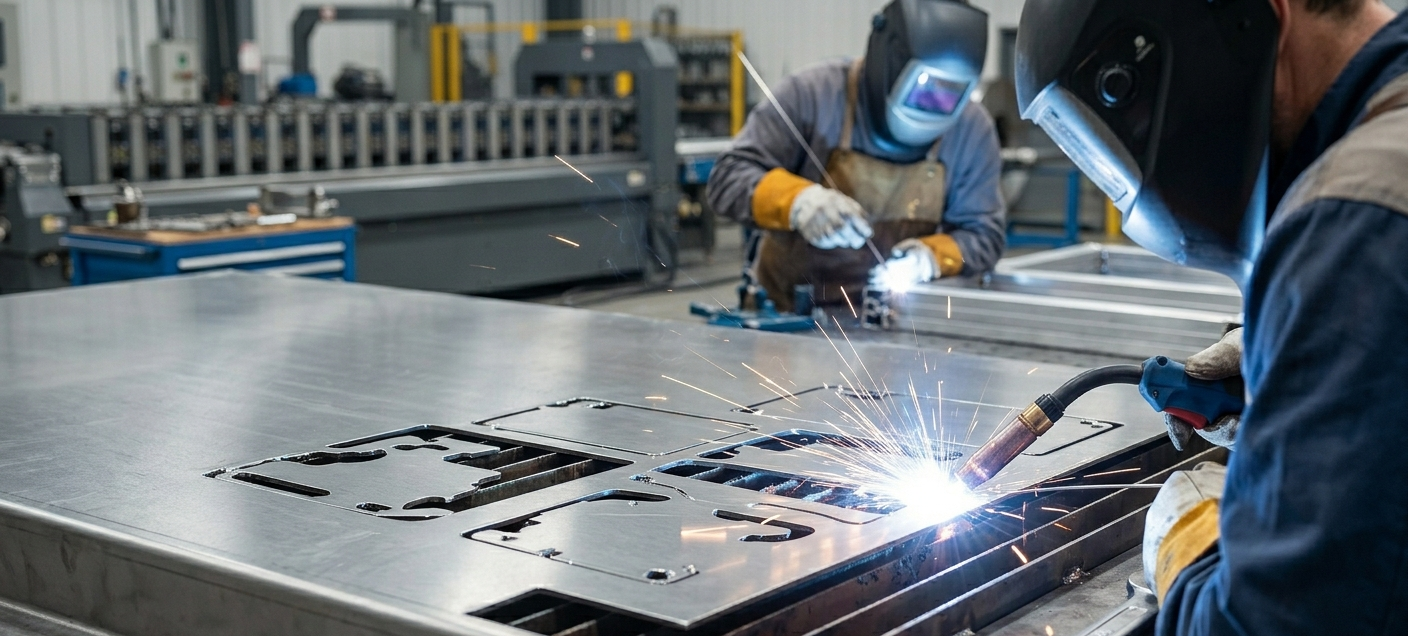
Three welding methods dominate sheet metal work. TIG (GTAW) is the highest-quality, slowest, and most expensive at $80–$140 per hour. Best for stainless steel, aluminum, and parts where weld appearance matters. MIG (GMAW) is faster, cheaper at $60–$100 per hour, and the workhorse for steel weldments. Robotic MIG is used at production volumes — 5–10x throughput of manual welding with ±0.5 mm joint position.
Spot welding handles thin-gauge sheet (under 2 mm) where edge appearance doesn’t matter. A pneumatic spot welder makes a weld in 0.3–0.8 seconds and is the standard for HVAC ductwork, electrical enclosures, and consumer-product chassis.
Finishing
Powder coating, wet paint, anodize (for aluminum), zinc plating, and passivation cover most sheet metal finishing needs. Powder coat is the volume winner: durable, color-flexible, and 60–120 µm thick. Adds 2–4 days to lead time and $4–$15 per part on a typical bracket. Anodize (Type II clear or color, Type III hardcoat) is preferred for aluminum where the finish must be conductive on threads or where corrosion resistance is critical.
Material Selection: Beyond ‘Cold-Rolled Steel’
The three material families that cover 90% of sheet metal fabrication:
- Mild steel (CRS, A1008): cheapest, easiest to weld, magnetic, must be coated to resist corrosion. Common gauges: 22ga (0.76 mm) through 7ga (4.55 mm).
- Stainless steel (304, 316, 316L): corrosion resistant, harder to bend (tighter minimum radius), more expensive at 3–5× mild steel. 316L is the food-grade and chemical-grade default.
- Aluminum (5052-H32, 6061-T6, 3003-H14): lightweight, corrosion resistant naturally, thermally conductive. 5052 bends best (most ductile); 6061-T6 is stronger but cracks at small bend radii.
Less common but important: galvanized steel for outdoor structures, copper for electrical bus bars, brass for decorative work, and titanium for aerospace and medical.
How to Spec a Sheet Metal Job
A clean drawing or CAD file with the following information will get a fast quote and a part that ships right the first time:
- Material specification with grade and temper (e.g., ‘aluminum 5052-H32, 1.5 mm thick’) — not just ‘aluminum’.
- Flat pattern is helpful but not required if your CAD has the bends modeled correctly.
- Bend radius callouts — if you’re okay with shop-default (1× thickness for mild steel), say so. If not, specify.
- Tolerance callouts on critical dimensions only — over-toleranced drawings drive cost without value.
- Hardware insertion notes (PEM nuts, studs, standoffs) with part numbers.
- Weld spec — fillet leg length, weld-all-around or specific edges only, weld inspection level.
- Finish specification including masking notes if any threads or surfaces should stay bare.
Cost and Lead Time Realities
For a typical electrical enclosure — 300 × 200 × 150 mm, 1.5 mm cold-rolled steel, 12 bends, 18 holes, 2 PEM nut inserts, powder coat black:
- Quantity 1 prototype: $85–$140, lead time 5–7 days.
- Quantity 50: $32–$48 per unit, lead time 8–12 days.
- Quantity 500: $14–$22 per unit, lead time 15–22 days.
- Quantity 5,000+: $7–$11 per unit, lead time 25–35 days, often shipped via sea freight to lower per-unit cost.
Add 35–50% to those numbers for 316 stainless, subtract 5–15% for raw aluminum without anodize. Powder coat color (RAL standard) doesn’t change the price; non-standard or low-quantity custom colors add $200–$500 in setup.
Frequently Asked Questions
What’s the smallest hole I can put in 1 mm sheet metal?
On a fiber laser, 0.8 mm minimum reliably. Anything smaller risks dross, slag, and dimensional inconsistency. CNC punch with the right tooling can do 0.5 mm in 1 mm material but tooling cost may not justify it.
How do I avoid distortion when welding thin sheet metal?
Sequence the welds (skip-weld pattern, not continuous start-to-end), use the lowest practical heat input, clamp into a fixture, and let the part cool between passes. Aluminum is especially distortion-prone — robotic MIG with a pulsed transfer mode helps significantly.
Can I anodize after welding?
Yes, but the weld zone discolors differently than the parent material because the heat-affected zone has different grain structure. For appearance-critical parts, alodine or chemical conversion coating gives a more uniform finish than anodize.
What’s the difference between 5052 and 6061 aluminum for bending?
5052 is more ductile — minimum bend radius around 1× thickness, very forgiving. 6061-T6 is stronger but cracks at tight radii — minimum 2× thickness, and even then microcracks can show. For brackets that need to bend tightly, 5052. For brackets that need strength after bending, 6061-T6 with a generous radius.
How does Xinyang’s digital QMS help?
Every part flows through a paperless inspection chain: laser cut card, bend card, weld card, finish card. Each station signs off digitally with photos and dimensional measurements. The customer receives a downloadable inspection packet at shipment. The system caught and corrected three out-of-tolerance bends on our last batch of 800 enclosures before they reached final assembly.
What’s the typical sheet metal lead time at Xinyang?
Standard: 7–10 business days door-to-door for prototypes and small batches under 100 units. Production runs of 500–5,000 units typically ship in 18–28 days. Express service compresses prototype lead time to 4–5 days for moderate-complexity parts.
Conclusion
Sheet metal fabrication is the most economical way to produce structural enclosures, brackets, panels, and chassis components in quantities from 1 to 100,000+. The process is well-understood and the tolerances are predictable when the drawing is specified properly. The biggest cost lever is DFM — getting the bend radii, hole-to-bend distances, and material gauges right before quoting saves 15–40% on the per-part price.