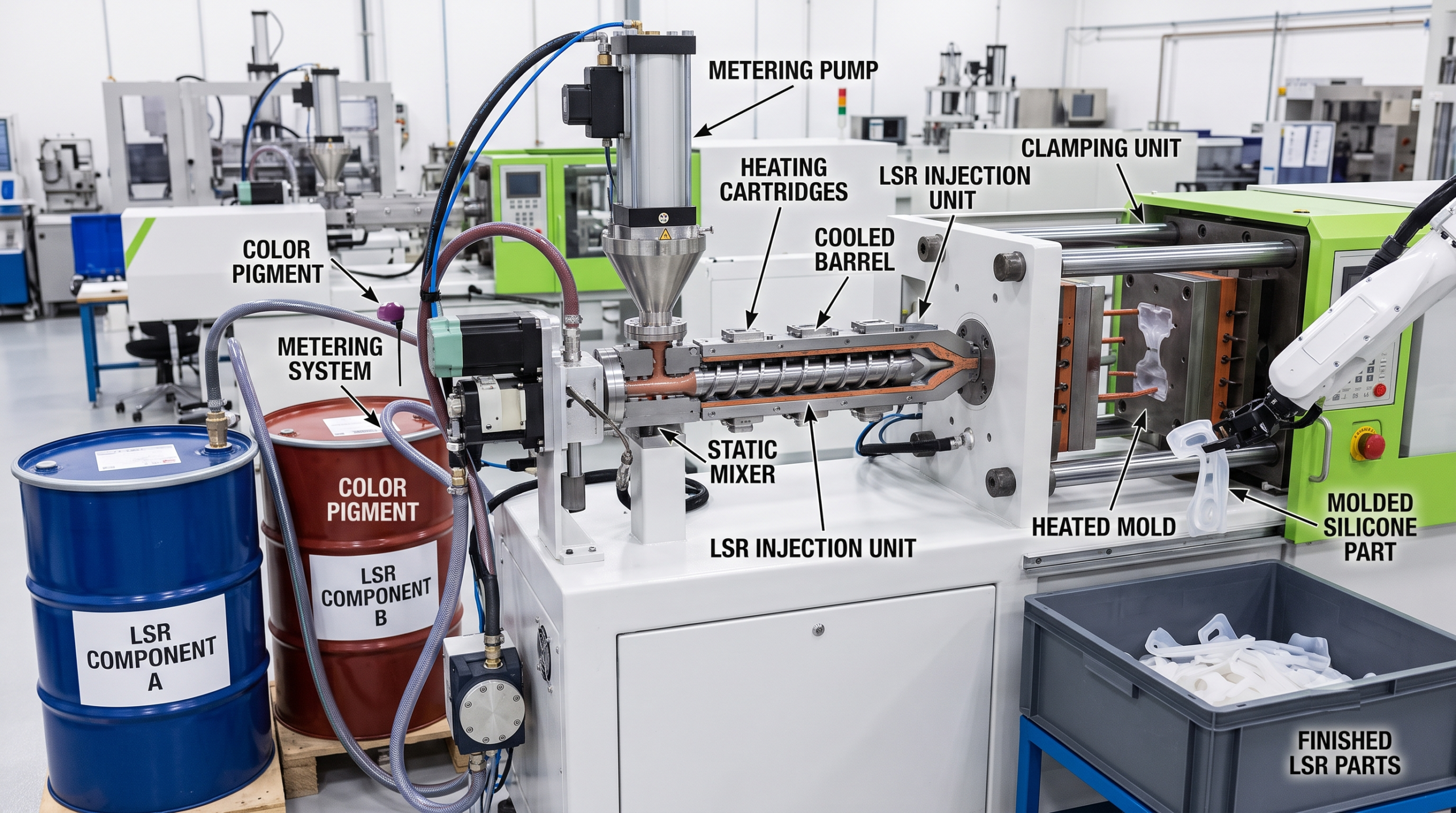
Quick answer: LSR injection molding (liquid silicone rubber molding) is a process that injects a two-part liquid silicone into a heated mold, where it cures into a flexible, durable rubber part. Unlike thermoplastics that cool to harden, LSR is a thermoset that heats to cure — so the tooling and process run in reverse of standard injection molding. It is the go-to method for seals, gaskets, medical components, baby products, and anything that must stay flexible, biocompatible, and stable from -50 °C to 200 °C.
The first time I watched an LSR press run, it broke my mental model. A plastic part goes into a mold hot and comes out cold and rigid. An LSR part goes in as a cool liquid and comes out hot and rubbery. Everything about the tooling — the gates, the venting, the temperature control — follows from that one inversion.
What LSR is and why it behaves differently
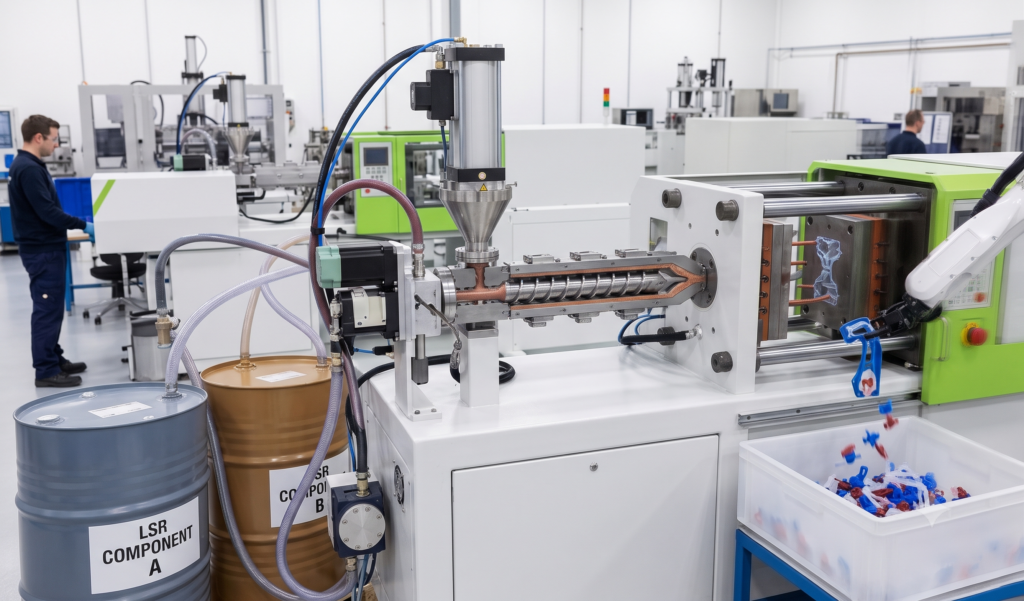
Liquid silicone rubber arrives as two components, an A side and a B side, kept separate until molding. A metering pump mixes them in a precise 1:1 ratio, injects the blend into a heated cavity (typically 150–200 °C), and the heat triggers a platinum-catalyzed cure. Seconds later, a fully cross-linked silicone part is ejected.
Because it is a thermoset, LSR does not melt again once cured. That gives it properties thermoplastics cannot match:
- Wide temperature range: flexible from roughly -50 °C to +200 °C.
- Biocompatibility: medical and food-grade formulations are standard.
- Chemical and UV resistance: it does not degrade outdoors or in harsh media.
- Excellent sealing: low compression set means gaskets keep sealing for years.
For the deeper materials view, see our page on liquid silicone rubber molding.
LSR vs standard silicone vs thermoplastics
Buyers often confuse LSR with the silicone you buy in a tube or with soft thermoplastics like TPE. They are not the same, and the difference decides your part’s performance.
| Property | LSR (injection) | HCR / gum silicone | TPE / TPU (thermoplastic) |
| Process | Automated injection | Compression, more manual | Standard injection molding |
| Cycle time | Very fast (seconds) | Slow | Fast |
| Temperature range | -50 to +200 °C | -40 to +200 °C | -30 to +120 °C |
| Biocompatibility | Excellent | Good | Varies |
| Best volume | High volume | Low–medium | High volume |
| Flash / finish | Minimal, clean | More flash | Clean |
If you need high volumes of a flexible, heat-stable, medical-safe part, LSR is usually the answer. If you need a soft-touch grip that can be recycled and molded with standard equipment, a thermoplastic elastomer may fit better.
Where LSR molding shines
The applications cluster around properties no other material stacks together:
- Medical: valves, seals, respiratory masks, wearable device components (biocompatible, sterilizable).
- Baby and consumer: pacifiers, bottle nipples, soft grips (safe, durable, dishwasher-proof).
- Automotive: gaskets, connector seals, membranes (heat and chemical resistant).
- Electronics: keypads, waterproof seals, cable glands.
- Industrial: O-rings and custom seals with low compression set.
Design rules for LSR parts
LSR forgives some things thermoplastics do not, and punishes others. The rules that matter most:
- Thin walls are fine. LSR flows well and can fill walls down to ~0.3 mm — thinner than most thermoplastics allow.
- Undercuts are more forgiving. Because cured LSR is flexible, parts can often be de-molded over undercuts that would need side actions in rigid plastic.
- Design for flash control. LSR is very low viscosity and will find any gap, so parting lines and venting must be precise.
- Account for shrinkage. LSR shrinks roughly 2–3% on cure; the tool is cut oversize to compensate.
- Gate location drives quality. Cold-runner systems reduce waste and keep the material cool until it enters the cavity.
Because the tooling is precision-critical, LSR molds cost more than simple thermoplastic molds — but they last, often for millions of shots. Our injection mold tooling cost guide breaks down where that money goes.
Tooling, cost, and lead time
LSR is a high-volume process. The economics reward scale because the tool is the big upfront cost and the per-part cost is low.
| Factor | Typical range | Notes |
| Tooling cost | Higher than thermoplastic | Precision cavities, heating, cold runner |
| Tooling lead time | 4–8 weeks | Depends on cavity count and complexity |
| Per-part cost at volume | Low | Fast cycles, high automation |
| Break-even volume | Thousands+ | Below that, consider urethane casting or compression molding |
| Cavity life | Often millions of shots | Steel tooling, low wear |
If you only need dozens or a few hundred flexible parts for testing, LSR tooling rarely pays off — cast urethane or compression-molded silicone prototypes get you there cheaper. LSR earns its cost when you are committing to production volume. For low-volume plastic parts, compare with low-volume injection molding cost.
Overmolding with LSR
One of LSR’s most valuable tricks is overmolding: bonding silicone directly onto a rigid plastic or metal substrate to create, say, a hard housing with a soft sealed grip or a waterproof button. It requires careful material pairing and surface prep so the silicone bonds reliably. If your product combines rigid and soft zones in one part, our overmolding cost guide covers the trade-offs.
Common LSR defects and how to prevent them
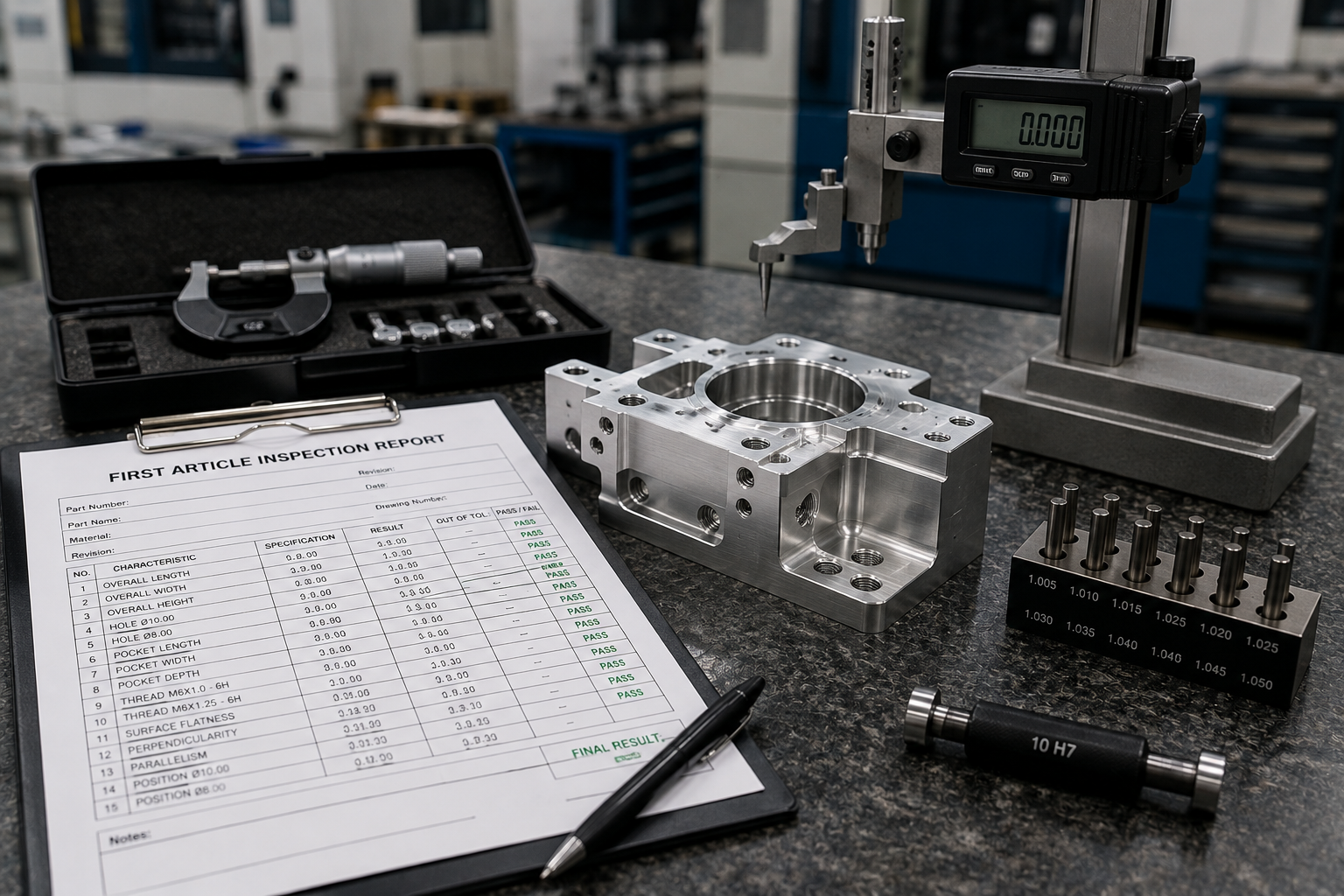
Even a well-designed LSR part can fail on the press if the process is not dialed in. Knowing the usual culprits helps you have a smarter conversation with your molder and read a first-article report critically.
- Flash: the thin webbing at the parting line. Because LSR is so low in viscosity, it escapes through gaps a thermoplastic never would. The fix is precise tooling, correct clamp force, and good venting.
- Air traps and voids: trapped air leaves bubbles or short shots. Proper vent placement and injection speed control solve most of it.
- Incomplete cure: a part that stays tacky or weak usually means the cure temperature or dwell time was off, or the A/B mix ratio drifted.
- Bonding failure on overmolds: if silicone lifts off its substrate, the surface prep or primer was wrong, or the material pair was incompatible.
- Dimensional drift: if parts come out consistently oversize or undersize, the shrinkage compensation in the tool needs adjustment.
A capable molder anticipates these before the first shot and inspects for them on the first article, rather than discovering them at volume. This is exactly why validating the process — not just the design — matters before you commit to a full production run.
Frequently asked questions
What is the difference between LSR molding and regular silicone molding? LSR molding is a fast, automated injection process using low-viscosity liquid silicone that cures with heat, giving clean parts with minimal flash and short cycle times. Traditional silicone (HCR, or high-consistency gum rubber) is a thicker material usually processed by compression or transfer molding, which is slower and more manual. LSR wins on volume, consistency, and finish; HCR can suit certain thick or specialized parts. For most modern high-volume flexible components — medical, baby, sealing — LSR is the standard choice.
Is LSR injection molding suitable for low volumes? Generally no, because the precision tooling represents a significant upfront investment that only amortizes over thousands of parts. For prototypes or short runs of a few hundred flexible parts, cast urethane, 3D-printed silicone, or compression molding will be far cheaper per part even though they are slower. LSR becomes the economical choice once your annual volume climbs into the thousands, where its fast cycle times and long tool life drive the per-part cost well below any low-volume alternative.
Can LSR parts be used in medical and food applications? Yes — biocompatibility is one of LSR’s defining strengths and a major reason it dominates these markets. Medical-grade and food-grade LSR formulations are widely available, and cured LSR is chemically inert, sterilizable by autoclave or gamma, and stable across a wide temperature range. That combination makes it standard for respiratory components, valves, wearables, pacifiers, and bottle nipples. As always, the specific grade and any required certifications (USP Class VI, FDA) must be confirmed for your application before production.
How long does LSR tooling take to build? Expect roughly 4–8 weeks for an LSR mold, depending on the number of cavities, part complexity, and whether a cold-runner system is included. The tooling is more involved than a basic thermoplastic mold because it must be heated precisely, vented carefully to control flash from the low-viscosity material, and sized to compensate for cure shrinkage. That upfront time is why teams often run cast-urethane prototypes in parallel — validating the design while the production tool is being cut, so nothing is redesigned after the steel is committed.
When LSR is the right call
LSR injection molding is the right process when you need flexible, heat-stable, biocompatible parts in real volume — seals, medical components, baby products, soft grips. It runs opposite to standard plastic molding: liquid in, cured rubber out. Respect the design rules, plan for the tooling investment, and validate with cheaper prototypes first. Do that, and LSR delivers parts that stay flexible and keep sealing for the life of the product.
About the author Patrick Chen — Applications Engineer, XY Machining Patrick reviews thin-wall designs for US engineering teams at XY Machining and works with the shop floor on the fixturing and toolpaths that keep delicate parts in tolerance. To pressure-test a thin-wall part before quoting, send your model to our team.