Aller au contenu
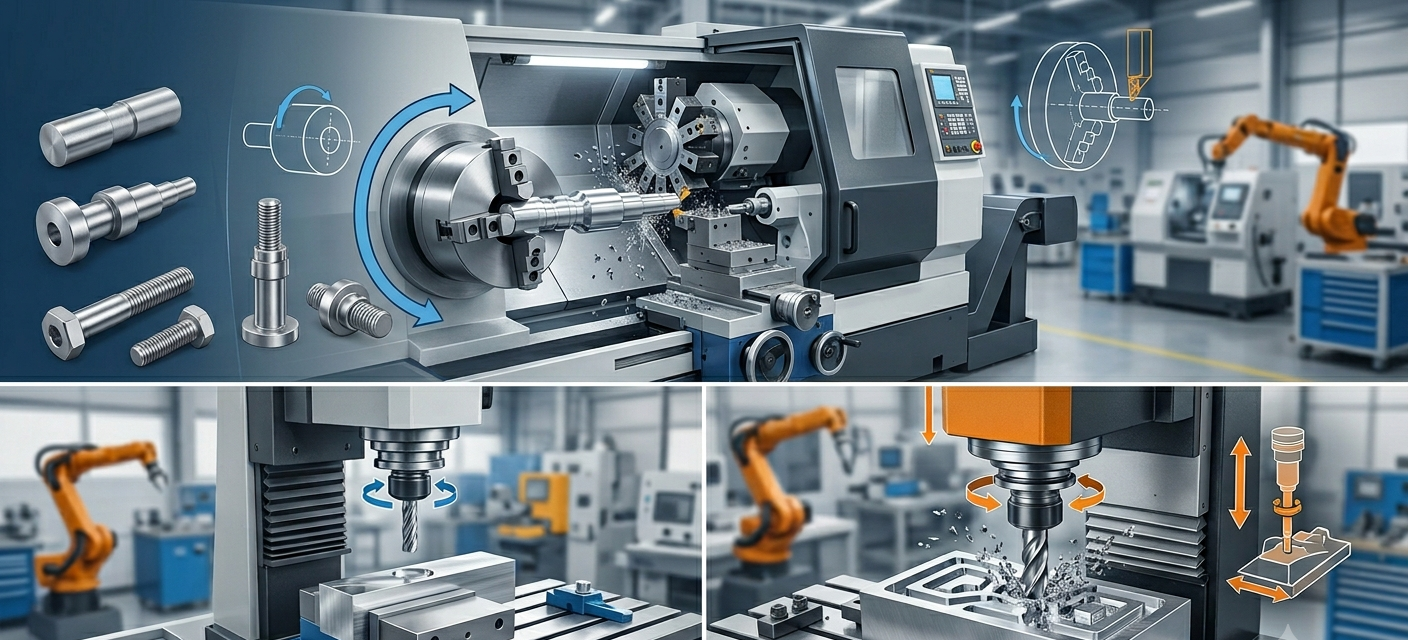
The difference comes down to what moves. In CNC turning, the workpiece spins while a stationary cutting tool removes material, which is ideal for round, symmetrical parts like shafts, pins, and bushings. In CNC milling, the cutting tool spins while the workpiece stays fixed (or moves on a table), which is ideal for prismatic parts with flat faces, slots, pockets, and complex three-dimensional features. Many real parts need both, and modern mill-turn machines combine them in one setup.
This guide explains how each process works, what each is best at, and how to decide, so you can specify the right one before requesting a quote. Both are part of our CNC machining services.
How CNC Turning Works
Turning runs on a lathe. The part is held in a chuck or collet and rotated at speed while a single-point tool moves along and across it to cut the profile. Because the part rotates around one axis, turning naturally produces cylindrical and conical geometry: outside diameters, bores, tapers, grooves, threads, and faces. It is fast and efficient for round parts and holds excellent concentricity, since every feature is cut about the same spinning axis.
Typical turned parts include shafts, axles, pins, bushings, fasteners, rollers, and connectors. Live tooling on a CNC lathe can add cross-holes or flats, extending what a single turning setup can do.
How CNC Milling Works
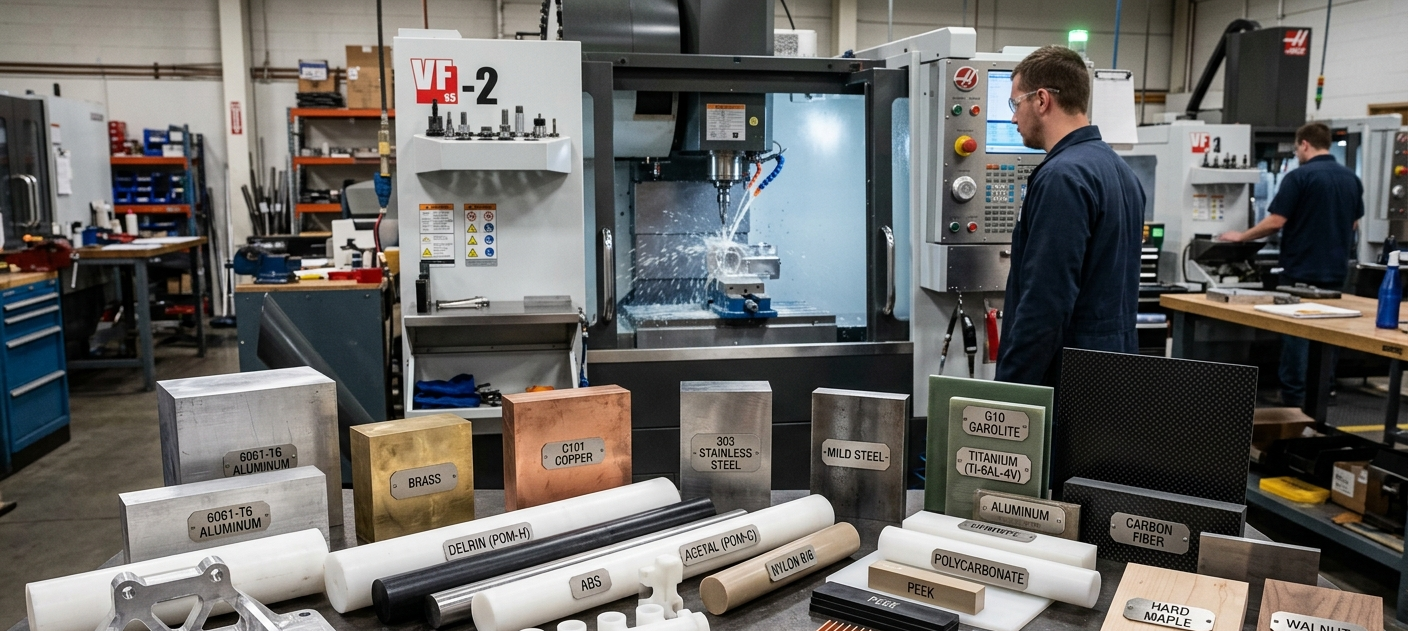
Milling runs on a mill or machining center. The workpiece is clamped to a table and a rotating multi-edge cutter removes material as the machine moves the tool through X, Y, and Z. Three-axis mills cut flat faces, slots, pockets, holes, and steps; four- and five-axis machines add rotation so the cutter can reach angled and contoured surfaces in fewer setups.
Milling suits prismatic and freeform parts: brackets, housings, plates, manifolds, molds, and enclosures. It is the more versatile process for complex geometry, at the cost of being slower than turning for purely round features.
Turning vs Milling at a Glance
| Factor | CNC turning | CNC milling |
| What moves | Workpiece rotates | Tool rotates |
| Best geometry | Round, symmetrical | Prismatic, complex, 3D |
| Typical parts | Shafts, pins, bushings | Brackets, housings, molds |
| Strength | Speed and concentricity on round parts | Versatility on complex features |
| Axes | 2-axis, plus live tooling | 3, 4, or 5-axis |
How to Choose
Pick turning when the part is fundamentally round and most features share a central axis; it will be faster and more concentric than milling the same shape. Pick milling when the part has flat faces, pockets, multiple feature orientations, or freeform surfaces. When a part is round but also needs flats, cross-holes, or off-axis features, a mill-turn machine or a turning operation followed by milling is the efficient answer, avoiding multiple setups and preserving accuracy.
In practice, the geometry usually decides for you. If you are unsure, share the model and a manufacturability review will recommend the process and setup.
Frequently Asked Questions
What is the main difference between CNC turning and milling?
In turning, the workpiece rotates against a stationary tool, which suits round parts. In milling, the tool rotates against a fixed workpiece, which suits prismatic and complex parts. The distinction is simply what spins.
Which is better for round parts?
Turning. Rotating the part about a single axis produces cylindrical features quickly and with excellent concentricity, making it the natural choice for shafts, pins, and bushings.
Can one machine do both turning and milling?
Yes. Mill-turn machines and turning centers with live tooling combine both, producing round features and milled details like flats and cross-holes in a single setup, which improves accuracy and reduces handling.
Is milling more expensive than turning?
For purely round geometry, milling is usually slower and therefore costlier than turning. For complex prismatic parts, milling is the right and most economical process. Cost follows the match between geometry and process.