CNC turning and CNC milling are the two foundational machining operations. They are complementary, not interchangeable — each is suited to a specific category of geometry, and specifying the wrong process adds cost and reduces quality.
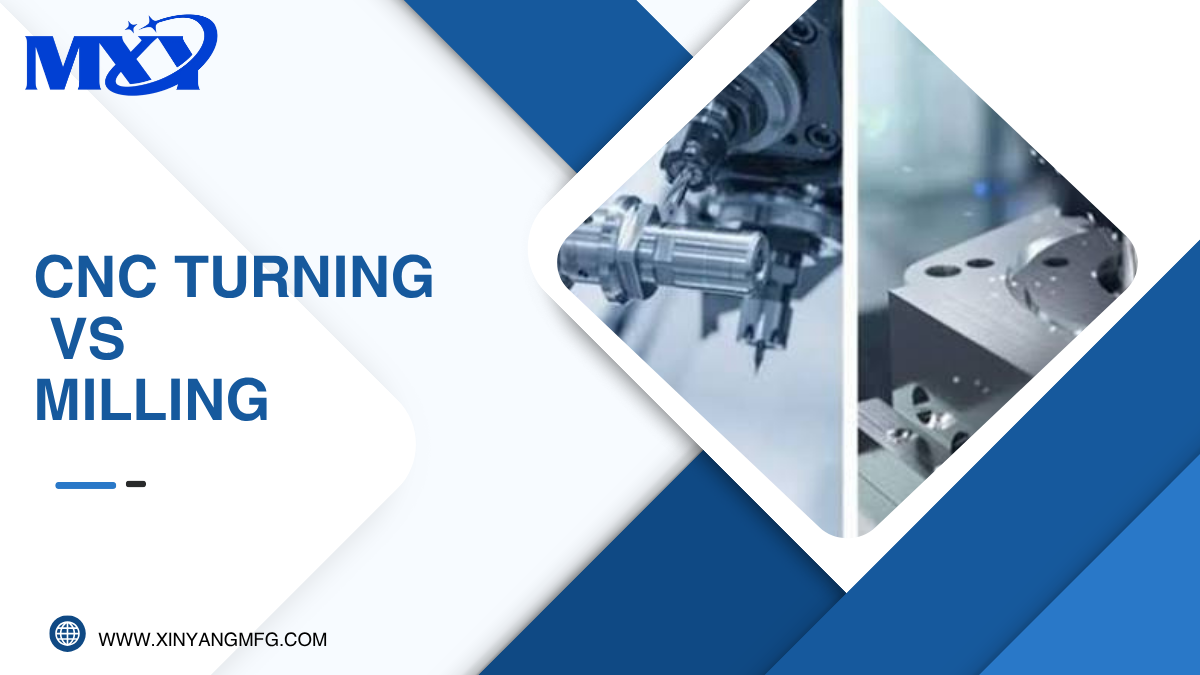
The governing distinction is what moves. In CNC turning, the workpiece rotates while a stationary single-point cutting tool moves linearly along and across it. This rotating-workpiece geometry naturally produces cylindrical and conical features: outside diameters, bores, grooves, tapers, threads, and faces. In CNC milling, the cutting tool rotates while the workpiece is held stationary (or moves on a controlled table). The rotating-tool geometry is suited to flat faces, pockets, slots, contoured surfaces, and any feature that requires the cutter to approach from multiple directions.
Many production parts require both operations, which is why mill-turn machines — lathes with live milling spindles capable of performing both operations in a single setup — are increasingly common in precision job shops. This guide explains how each process works, what geometry each handles best, how they compare on speed and cost, and how to decide which your part needs. Both are available through our CNC machining services.
How CNC Turning Works
Turning runs on a CNC lathe. The workpiece is clamped in a chuck or collet at the spindle and rotated at a programmed speed. One or more single-point cutting tools are mounted in a turret and moved in X (across the axis) and Z (along the axis) to remove material from the rotating workpiece. The geometry produced is inherently symmetric about the spindle axis: any feature that can be described as a surface of revolution is a natural turning feature.
Standard turning operations include: facing (producing a flat end perpendicular to the axis), OD turning (reducing the outside diameter), boring (enlarging or finishing an internal bore), grooving (cutting circumferential grooves for O-rings, snap rings, or relief), parting (cutting the finished part from the bar stock), and single-point threading (cutting internal or external threads by advancing the tool one pitch per spindle revolution).
CNC lathes execute these operations at high surface speeds — the cutting speed is determined by the spindle RPM and the part diameter — and typically achieve high metal removal rates on round parts. Concentricity between features is excellent because all features are cut about the same axis without re-fixturing. A shaft with an OD, a bore, and two grooves is machined in one continuous operation with sub-micron concentricity between the features.
Live tooling extends turning capability. A CNC lathe with live (rotating) tooling in the turret can perform milling and drilling operations — cross-holes, flats, keyways, off-axis features — while the part is still in the chuck. This eliminates the need to transfer a turned part to a mill for secondary operations, improving accuracy and reducing handling.
How CNC Milling Works
Milling runs on a CNC machining centre (VMC — vertical machining centre — or HMC — horizontal). The workpiece is clamped to a table and a rotating multi-tooth cutter removes material as the machine moves the tool through the programmed path in X, Y, and Z simultaneously. The geometry produced is prismatic: any surface that can be reached by a rotating cutter approaching from above (VMC) or from the side (HMC) is a natural milling feature.
Standard milling operations include: face milling (producing a flat surface), pocket milling (cutting a closed cavity), slot milling, profiling (cutting an external contour), drilling (axial holes), reaming and boring (precision hole finishing), and thread milling (producing internal threads by helical interpolation — see our tapping vs thread milling guide for details).
Three-axis milling covers the majority of prismatic parts. Four-axis milling adds rotation about one of the linear axes, allowing the cutter to reach features on the sides of the part without re-fixturing. five-axis milling adds a second rotation and is the process for complex contoured surfaces — turbine blades, impellers, mould cavities, and undercut features — that cannot be reached by a three-axis cutter without multiple setups.
Surface finish in milling depends on the cutter geometry, the step-over distance, and the depth of cut. Finishing passes at small step-overs produce smooth surfaces; roughing passes at large step-overs are fast but leave tool-mark patterns on the surface. For tight-tolerance bores and precision fits, a final boring or reaming operation after milling is standard practice.
CNC Turning vs Milling: Side-by-Side Comparison
| Factor | CNC Turning | CNC Milling |
| What rotates | Workpiece | Cutting tool |
| Best geometry | Round, symmetric, concentric | Prismatic, pocketed, contoured, 3D |
| Typical parts | Shafts, pins, bushings, rollers, fasteners | Brackets, housings, manifolds, moulds, plates |
| Axes | 2-axis standard; 4-axis with C-axis live tooling | 3-axis standard; 4- and 5-axis for complex geometry |
| Thread cutting | Single-point threading on OD or ID | Thread milling by helical interpolation |
| Surface finish | Excellent for cylindrical surfaces | Excellent for flat surfaces; step-over marks on contours |
| Concentricity | Inherently excellent (all features on same axis) | Requires careful fixturing for concentric features |
| Typical batch | Single setup for most turned features | May require multiple setups for complex parts |
Choosing Between Turning and Milling: A Decision Framework
The geometry of the part almost always makes the decision straightforward. Ask whether the defining features of the part can be described as surfaces of revolution — cylindrical surfaces, tapers, bores, grooves, faces. If yes, turning is the primary process. If the defining features are flat faces, pockets, angled surfaces, or features oriented off-axis relative to a central bore, milling is the primary process.
For a shaft with a keyway and cross-holes, the answer is a turning operation for the shaft geometry, followed by either a milling operation for the keyway and holes, or a live-tooling turning operation that completes all features in one setup. The one-setup option is preferred for accuracy: transferring a turned part to a mill introduces fixturing error and adds handling time. When concentricity between the turned OD and the milled features is critical — for example, an eccentric shaft where the offset position of the milled features must be accurately positioned relative to the turned OD — a mill-turn machine is the right tool.
For a bracket with a pattern of through-holes, mounting faces, and a counterbored pocket, milling is clearly the primary process. If that bracket also requires a precision turned bore as a bearing seat, a boring head or a finishing pass with a boring bar on the mill centre is the standard approach — not a separate lathe operation, which would require additional fixturing.
Mill-Turn: Combining Both Operations
Mill-turn machines — also called multi-tasking machines or turn-mill centres — integrate a CNC lathe spindle with a full milling spindle and often a second spindle (sub-spindle) for back-face operations. In a single setup, a part can be turned, milled, drilled, bored, tapped, and profiled without being moved between machines. Sub-spindle capability allows the part to be picked up by the second spindle after the front-face operations are complete, and all back-face features machined without re-chucking.
Mill-turn machining is particularly valuable for parts that are fundamentally round but have significant off-axis features: flanged connectors, eccentric shafts, valve bodies, pump components, and complex fittings. The single-setup advantage improves both accuracy (no re-fixturing error) and throughput (no machine-to-machine transfer). Mill-turn centres carry a higher capital cost than standalone lathes or mills, which is reflected in hourly rates, but the single-setup accuracy and reduced handling often justify the premium for complex parts.
Cost Drivers: When Is One Process More Economical?
For purely round parts — a shaft, pin, or bushing with no off-axis features — turning is almost always faster and cheaper than milling the equivalent geometry. Turning removes material continuously around the full circumference with a single tool engagement. Milling the same geometry requires many tool passes and significantly more cycle time.
For prismatic parts — plates, brackets, and housings with flat faces and pockets — milling is clearly the right process and attempting to turn prismatic features is impractical. Cost is therefore driven by programming complexity, number of setups, fixturing requirements, and the depth of pockets relative to cutter length.
The cost premium for mill-turn versus turning alone is justified when the alternative is two separate machine setups. Setup time (fixturing, probing, tool loading) for a separate milling operation on a turned part can easily add thirty to sixty minutes to a job. For a part with only one or two milled features, live tooling on the lathe or a mill-turn machine eliminates this cost. For a part with extensive complex milled geometry, a dedicated machining centre is often the more economical choice than a mill-turn machine.
Tolerances and Surface Finish
Both turning and milling can achieve tight tolerances with the right tooling and process control. Turned diameters and bores typically hold plus or minus 0.005 to 0.025 mm in finish turning. Ground diameters on a CNC cylindrical grinder can reach plus or minus 0.001 mm. Milled flats and pockets typically hold plus or minus 0.025 to 0.05 mm in standard finish machining; precision boring achieves plus or minus 0.005 to 0.010 mm.
Surface finish in turning is characterised by feed marks from the single-point tool — closely spaced, helical tool marks visible at low magnification. Surface finish in milling shows a scalloped cusp pattern from the rotating cutter, with cusp height proportional to the step-over distance and cutter radius. Both can achieve Ra 0.8 micrometres or better in finishing operations with appropriate parameters.
Frequently Asked Questions
What is the main difference between CNC turning and milling?
In CNC turning, the workpiece rotates against a stationary cutting tool — this produces cylindrical and concentric geometry: shafts, bores, grooves, and threads. In CNC milling, the cutting tool rotates against a fixed workpiece — this produces prismatic and complex geometry: flat faces, pockets, slots, and contoured surfaces. The distinction is which element rotates.
Which is better for round parts?
Turning, unambiguously. Rotating the part about a single axis produces cylindrical features continuously and with inherently excellent concentricity. Milling equivalent round geometry requires many tool passes, is slower, and introduces concentricity error without careful fixturing. For shafts, pins, bushings, and any part whose defining geometry is a surface of revolution, turning is the faster and more accurate process.
Can one machine do both turning and milling?
Yes. Mill-turn machines and CNC lathes with live tooling combine both operations. A mill-turn centre can turn ODs, bore holes, cut threads, and mill flats, pockets, cross-holes, and contours in a single setup. This improves accuracy by eliminating transfer error and reduces handling time. The cost per hour of mill-turn machining is higher than a standalone lathe, but the single-setup benefit often makes the total job cost lower for complex parts.
Is milling more expensive than turning?
For geometry that suits turning — round, concentric, symmetric — milling is slower and therefore more expensive. For geometry that suits milling — prismatic, pocketed, multi-directional — milling is the right and most economical process and turning is not applicable. Cost always follows the match between geometry and process: the wrong process for the geometry is always more expensive than the right one.