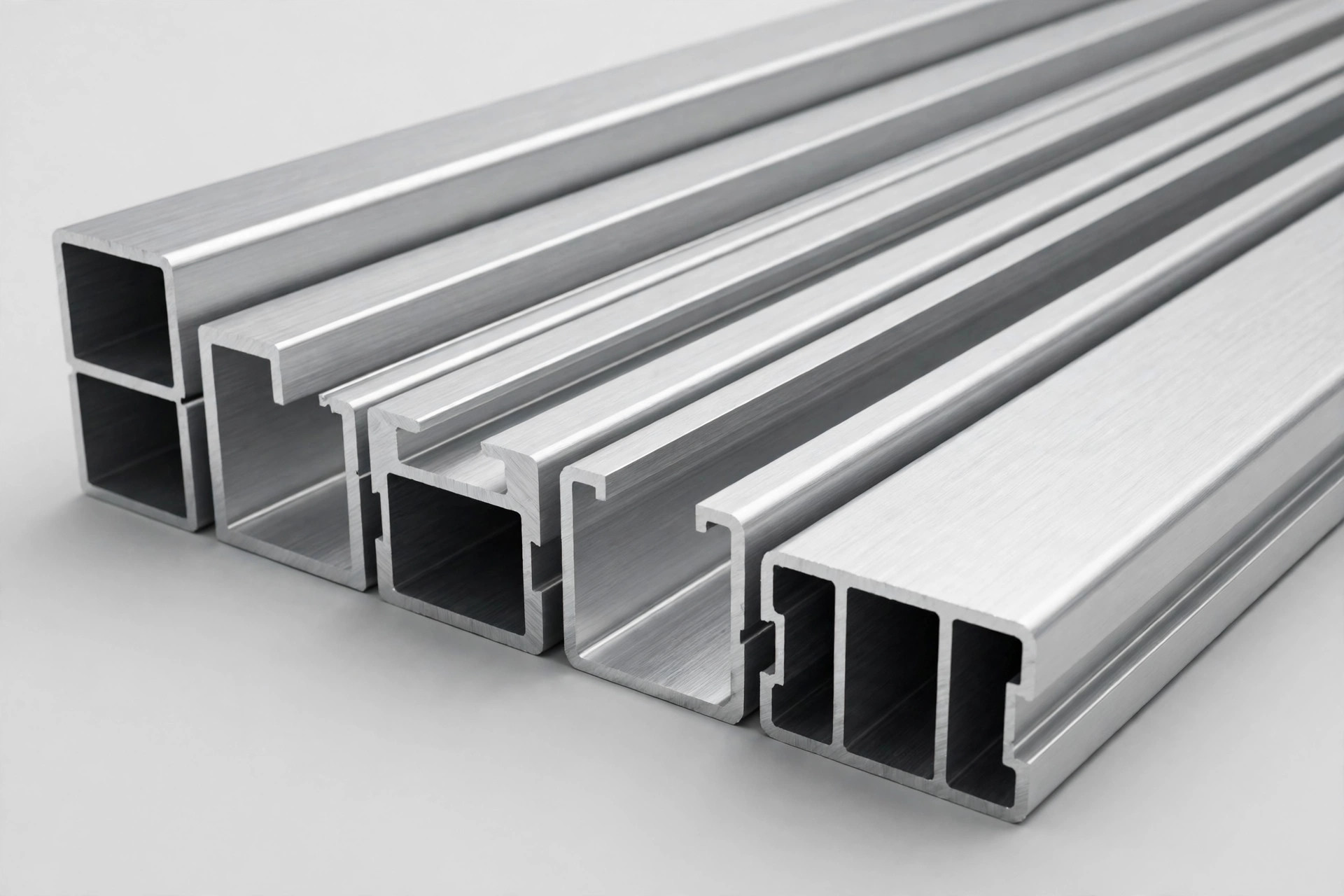
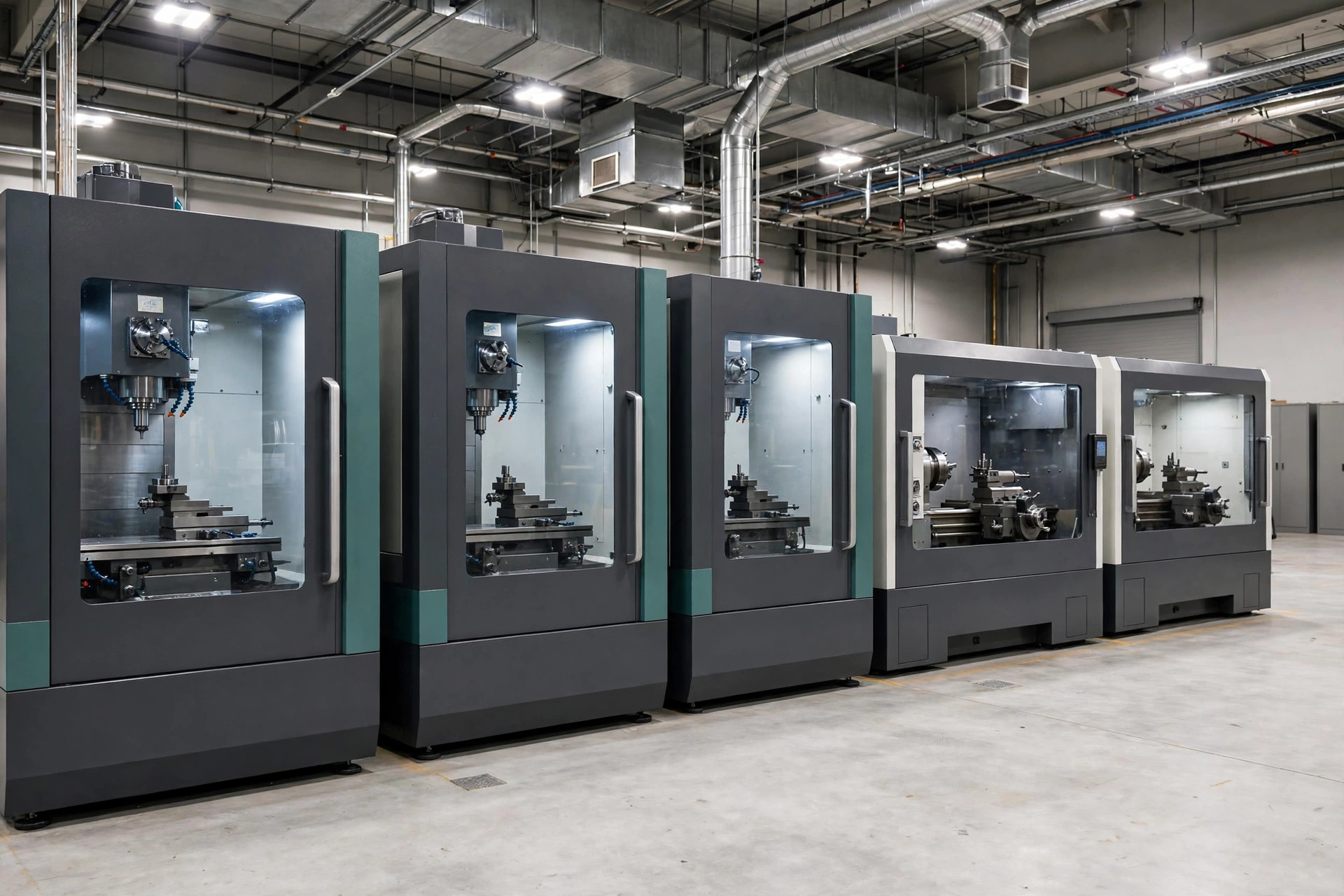
There are about a dozen common types of CNC machines, but most precision parts are made on just three: machining centers (mills), lathes, and machines that combine the two. The rest, such as routers, EDM machines, grinders and laser, plasma or waterjet cutters, handle specific materials, features or finishes.
This guide explains each CNC machine type from the point of view of someone buying parts, not buying a machine.
Quick answer
Quick answer: The five most common CNC machine types are the CNC mill (machining center), the CNC lathe, the CNC router, the CNC plasma or laser cutter, and the EDM machine. For metal and plastic parts with tight tolerances, mills and lathes do most of the work, and the number of axes on the machine decides how many setups your part needs.
CNC Machine Types at a Glance
Use this table to find the right machine family for your part at a glance.
| Machine | What it does best | Typical parts |
|---|---|---|
| Vertical machining center (VMC) | Milling from the top, 3 to 5 axes | Brackets, plates, housings |
| Horizontal machining center (HMC) | Milling from the side, multiple faces | Production housings, manifolds |
| CNC lathe / turning center | Turning round features | Shafts, bushings, fittings |
| Swiss-type lathe | Long, slender turned parts | Pins, medical screws, connectors |
| Mill-turn | Turning and milling in one setup | Complex shafts, valve bodies |
| CNC router | Fast cutting of sheet and soft materials | Wood, plastics, aluminum panels |
| Wire and sinker EDM | Hard metals, sharp inside corners | Mold inserts, punches, splines |
| CNC grinder | Very fine size and surface finish | Hardened pins, bearing seats |
| Laser, plasma, waterjet | 2D profiles from sheet or plate | Flat blanks, gaskets, brackets |
CNC Milling Machines (Machining Centers)
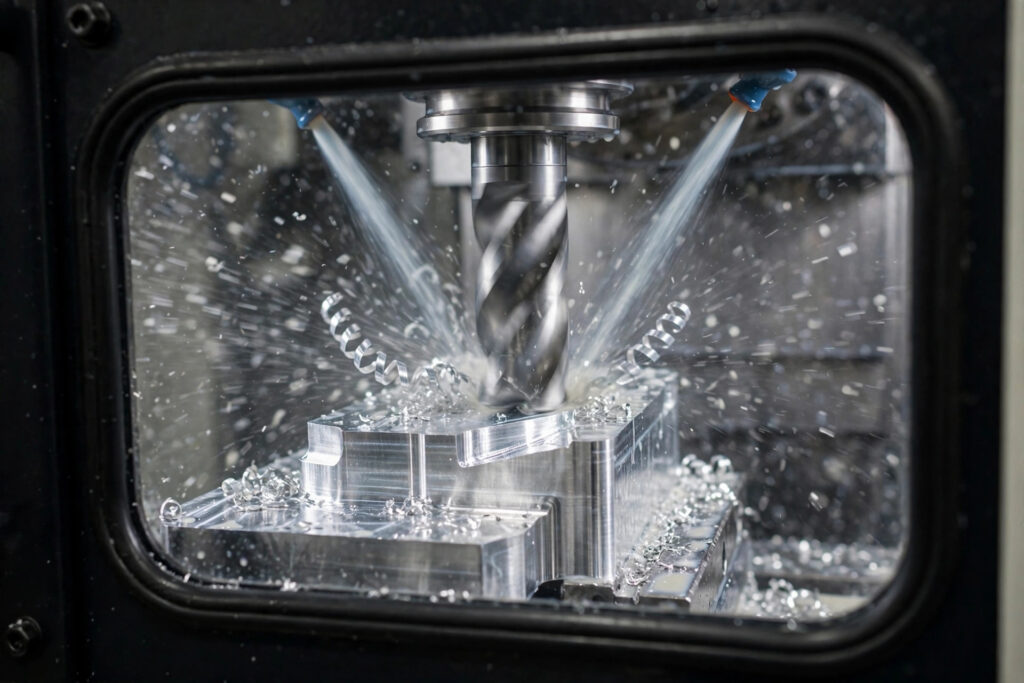
A mill holds the workpiece still, or moves it on a table, while a rotating cutter removes material. Modern CNC mills with automatic tool changers are called machining centers.
Vertical Machining Centers
Vertical machining centers have a vertical spindle and are the workhorse of most job shops. They suit plates, brackets and housings, and handle prototypes as easily as production.
Horizontal Machining Centers
Horizontal machining centers have a horizontal spindle and usually a rotating table. Chips fall away from the cut, and the machine can reach several faces in one setup, so they are common for higher-volume production.
Milling covers flat faces, pockets, slots, holes and 3D contours.
CNC Lathes and Turning Centers
A lathe spins the workpiece while a stationary tool cuts it, which makes it the natural choice for anything round. CNC lathe types range from basic two-axis machines to turning centers with live tooling and sub-spindles. Live tooling lets rotating tools drill and mill flats or cross holes without moving the part to a mill.
Swiss-type lathes feed bar stock through a guide bushing so the cut always happens close to support. That makes them the best option for long, thin parts that would bend on a conventional lathe.
Multi-Axis Machines: 3, 4 and 5 Axes Explained
Axis names are standardized. ISO 841 defines X, Y and Z as the linear axes and A, B and C as rotations around them.
3-Axis Machines
3-axis machines move the tool in X, Y and Z. Each new face of the part usually needs a new setup.
4-Axis Machines
4-axis machines add one rotary axis, so the part can be indexed to reach several sides.
5-Axis Machines
5-axis machines add two rotary axes. In 3+2 mode they lock the angle and then cut. In full simultaneous mode all five axes move together for blades, impellers and organic shapes.
More axes do not always mean a better part, and the cheapest CNC machine type is often the simplest one that reaches every feature. A simple bracket is often cheapest on a 3-axis mill.
Mill-Turn Machines
Mill-turn machines combine a turning center with a milling spindle and often a sub-spindle. A shaft with flats, cross holes and a turned profile can be finished in one cycle instead of moving between a lathe and a mill.
Axis Count at a Glance
| Axes | How it moves | Best for |
|---|---|---|
| 3-axis | Tool moves in X, Y and Z | Most parts, one face per setup |
| 4-axis | Adds one rotary axis | Features around a part’s circumference |
| 5-axis, 3+2 | Two rotary axes, angle locked while cutting | Complex angles, deep cavities |
| 5-axis, full simultaneous | All five axes move together | Blades, impellers, organic shapes |
CNC Routers, EDM, Grinders and Cutting Machines
The remaining kinds of CNC machines are more specialized.
CNC Routers
CNC routers look like mills but are built for speed over rigidity, usually with a gantry over a large flat bed. They excel at wood, plastics, composites and thin aluminum sheet.
EDM: Wire and Sinker
EDM (electrical discharge machining) removes conductive metal with sparks, not a cutter. Wire EDM cuts through-profiles with a thin wire. Sinker EDM burns a shaped electrode into the part. Both work on hardened steel and can make sharp internal corners that a rotating cutter cannot.
CNC Grinders
CNC grinders use abrasive wheels for the final size and surface finish on hardened parts. Surface grinders finish flat faces, and cylindrical grinders finish shafts and bores.
Laser, Plasma and Waterjet Cutters
Laser, plasma and waterjet cutters profile flat sheet and plate. Fiber lasers cut thin metal with fine edges. Plasma is faster on thick steel but rougher. Waterjet cuts almost anything, including stone and glass, without a heat-affected zone.
CNC Router vs CNC Mill at a Glance
| Feature | CNC mill | CNC router |
|---|---|---|
| Build | Heavy and rigid | Lighter and faster, gantry over a large bed |
| Best materials | Steel, titanium and aluminum to tight tolerances | Wood, plastics, composites and thin aluminum sheet |
| Strength | Tight tolerances on metal parts | Speed over rigidity |
| Best for | Precision metal parts | Sheet and soft materials |
Laser, Plasma and Waterjet Compared
| Cutter | Best for | Trade-off |
|---|---|---|
| Fiber laser | Thin metal with fine edges | Best on thin stock |
| Plasma | Thick steel, fast cutting | Rougher edges than laser |
| Waterjet | Almost anything, including stone and glass | No heat-affected zone |
How the Types of CNC Machines Affect Your Part Cost
Buyers rarely choose the type of CNC machine, but that choice shows up in the quote. Three things drive it.
Setups
Every time a part is re-clamped, someone spends time, and accuracy between features can drift. Fewer setups usually mean lower cost and better feature-to-feature position.
Machine Rate
A 5-axis machine or mill-turn costs more per hour than a 3-axis mill. It wins only when it removes enough setups to offset the rate.
Process Mix
A part that needs turning, milling and grinding moves through three departments. Designing round features and flat features so one machine can reach them saves real money.
Avoid Designs That Force an Extra Machine
What commonly goes wrong is a design that forces an extra machine for one small feature, such as a sharp internal corner that only EDM can produce. Ask for a radius instead and the part may stay on one mill. Tolerance follows the same logic: our CNC machining tolerances guide explains which callouts push a part onto slower, more precise equipment.
Machine capabilities vary widely between models and shops, so treat any published accuracy figure as indicative and confirm what your supplier can hold.
Frequently Asked Questions
What are the 5 most common CNC machine types?
The five most common are CNC mills or machining centers, CNC lathes, CNC routers, CNC plasma or laser cutters, and EDM machines. For precision metal and plastic parts, mills and lathes do most of the work, while routers, cutters and EDM cover sheet materials, flat profiles and hardened steel features.
Which CNC machines are most common in machine shops?
Vertical machining centers and CNC lathes are the most common in job shops because they cover most prismatic and round parts. Production shops add horizontal machining centers, 5-axis machines and mill-turn centers to reduce setups. EDM and grinding machines usually support toolmaking and hardened parts.
What is the difference between a CNC router and a CNC mill?
A CNC mill is heavy and rigid, built to cut steel, titanium and aluminum to tight tolerances. A CNC router is lighter and faster, usually a gantry over a large bed, and suits wood, plastics, composites and thin aluminum sheet. For precision metal parts, a mill is the better choice.
How many axes does my part need?
Most parts need only three axes, machined in a few setups. Four axes help when features sit around a part’s circumference. Five axes pay off for complex angles, deep cavities and contoured surfaces, or when cutting the number of setups improves accuracy. Your machinist can suggest the cheapest capable option.
Do I need to choose the CNC machine type when I order parts?
No. You do not need to pick a machine when you order parts, but knowing the CNC machine types helps you design for the cheapest one that can do the job. Round parts go to lathes, prismatic parts to mills, complex angles to 5-axis or mill-turn, and hardened details to EDM or grinding.
Choosing Between the Types of CNC Machines for Your Part
Which Machine Fits Your Part
| Part shape | Machine to use |
|---|---|
| Round parts | Lathes |
| Prismatic parts | Mills |
| Complex angles | 5-axis or mill-turn |
| Hardened details | EDM or grinding |
You do not need to pick a machine when you order parts, but knowing the CNC machine types helps you design for the cheapest one that can do the job. Round parts go to lathes, prismatic parts to mills, complex angles to 5-axis or mill-turn, and hardened details to EDM or grinding.
Program formats follow ISO 6983-1, but capabilities still differ between shops. Send your drawing to XY Machining and we will tell you which machines your part needs and how to reduce setups before we quote.