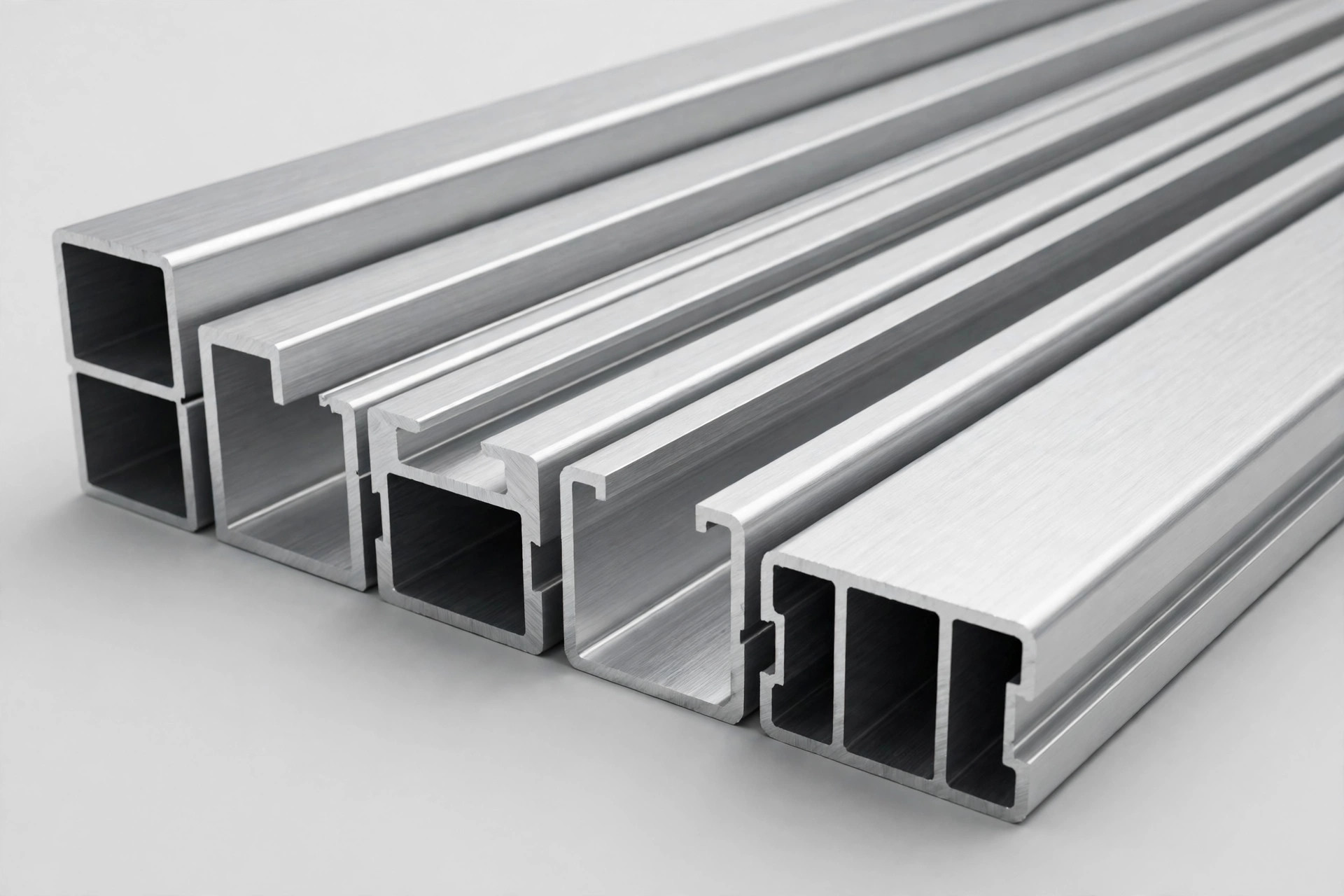
This aluminum extrusion design guide covers the rules that decide whether a custom profile is cheap and easy to run or expensive and prone to scrap. Most of them come down to how evenly hot aluminum can flow through a steel die.
In short: Keep the profile inside a small circumscribing circle, keep walls close to uniform, round every corner, avoid deep narrow channels, and use 6063 unless you need the strength of 6061. Then flag only the dimensions that truly matter, because tight tolerances on every feature raise cost without improving the part.
Start With the Circumscribing Circle
The circumscribing circle diameter (CCD) is the smallest circle that encloses the whole cross section. It decides which press and die size can run your profile, which makes it the first number to check in any extrusion design.
Guidance from the Aluminum Extruders Council puts most profiles under a 12-inch circumscribing circle. Extrusions are most economical between 1 and 10 inches, and profiles under 8 inches cost significantly less. The same guidance favors profiles at or below 3 pounds per foot.
| Profile size | Guidance |
|---|---|
| Circumscribing circle | Most profiles fit under 12 inches |
| Most economical range | Extrusions are most economical between 1 and 10 inches |
| Under 8 inches | Profiles cost significantly less |
| Weight | Profiles at or below 3 pounds per foot are favored |
Estimate the Weight Early
You can estimate weight early. Multiply cross-section area in square inches by the alloy density and by 12. For 6061 at roughly 0.0975 lb/in³, a 2.5 in² profile weighs about 2.9 lb/ft.
Core Profile Rules in This Aluminum Extrusion Design Guide
These extrusion design rules most affect die life and scrap.
| Rule | Guideline |
|---|---|
| Wall thickness | Keep adjacent walls close in thickness; blend changes gradually |
| Inside corners | At least 0.015 in radius |
| Outside corners | At least 0.020 in radius |
| Channel depth to width | 3:1 or less |
| Symmetry | Balance mass around the center where possible |
| Hollows | Use only where the function needs a closed section |
Uniform Walls
Uniform walls. Metal flows faster through thick sections than thin ones. Large differences cause distortion, twist and surface streaks. Where thickness must change, blend it with a generous radius.
Rounded Corners
Rounded corners. Sharp corners concentrate stress in the die and the part. Add radii everywhere unless a mating part needs a sharp internal corner. In that case, a dog-bone relief keeps the sharp fit without a sharp die feature.
Tongue Ratio
Tongue ratio. A deep, narrow channel needs a long, thin tongue of die steel to form it. That tongue can deflect or break. Widen the opening, reduce the depth, or add a radius at the root.
Hollows
Hollows. Hollow and semi-hollow shapes need more complex dies than solid shapes. They are worth it for stiffness and screw channels, but ask whether an open profile would do the job.
How Do You Design T-Slots, Screw Bosses and Fins?
Functional features are where most extrusion design changes happen.
T-Slots
T-slots should have open, radiused throats so the die section forming them is not a fragile tongue. Check the slot against the fastener you will use.
Screw Bosses
Screw bosses formed as open C-shaped channels are easier to extrude than closed bosses. Size them for the thread-forming screw.
Heat Sink Fins
Heat sink fins are limited by fin height to gap ratio. Tall fins with narrow gaps need a capable extruder, so confirm before committing.
Ribs
Ribs stiffen thin walls and reduce twist on wide, flat sections.
Which Alloy and Temper Should You Choose?
6063 is the default for custom aluminum extrusion profiles with complex shapes and visible surfaces. It extrudes easily and anodizes well. 6061 is stronger and used for structural parts, but it is harder to push through intricate dies. We recommend 6063-T5 unless a load case proves you need 6061-T6, because the cost and finish benefits are usually larger than the strength gap.
| Alloy | Best for | Notes |
|---|---|---|
| 6063 | Complex shapes and visible surfaces | Default choice; extrudes easily and anodizes well; use 6063-T5 unless a load case proves otherwise |
| 6061 | Structural parts | Stronger than 6063, but harder to push through intricate dies; use 6061-T6 when strength is needed |
| 6082 | Structural parts | Strong structural option, often used in Europe |
Tolerances: What to Specify and What to Leave Alone
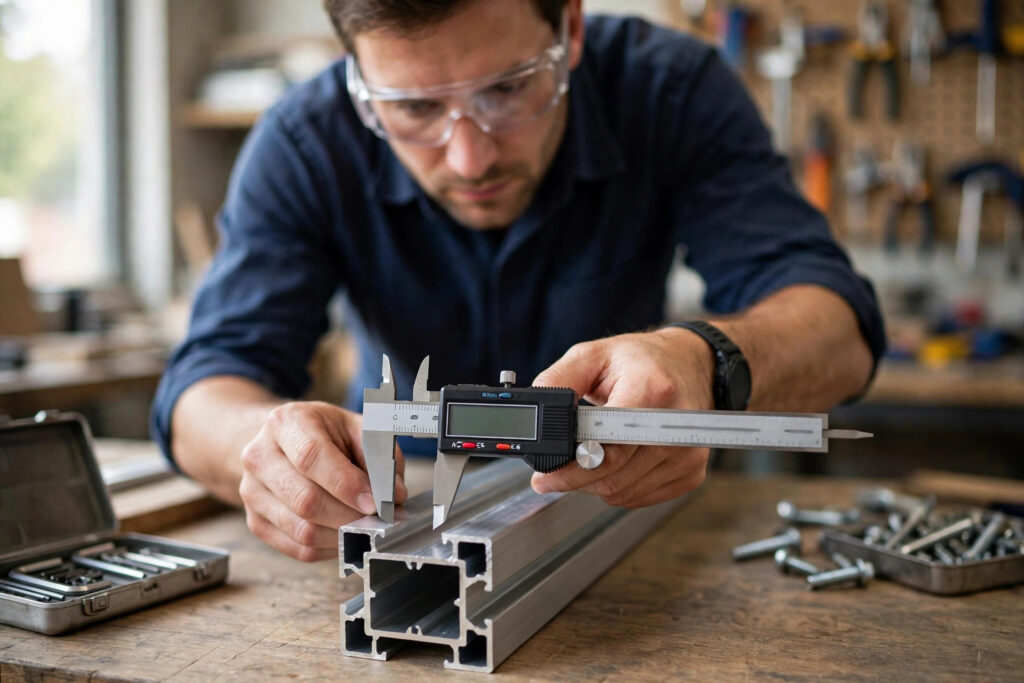
Standard extrusion tolerances in the United States come from ANSI H35.2, published by the Aluminum Association, and material requirements from ASTM B221. Tolerances there vary with alloy, CCD and feature type, so check the current tables.
Tighter than standard is possible, but each tight callout adds die tuning, inspection and scrap. Flag only the dimensions that mate with other parts.
| Decision | Guidance |
|---|---|
| Standard tolerances | Follow ANSI H35.2; tolerances vary with alloy, CCD and feature type |
| Tighter than standard | Possible, but each tight callout adds die tuning, inspection and scrap |
| Very tight features | Machine after extrusion instead of holding them in the die |
| Which dimensions to flag | Only the dimensions that mate with other parts |
Design for the Machining and Finishing That Follows
Most extrusions are cut, drilled or machined afterward. A common extrusion design mistake is putting features into the die that are cheaper to machine. Tapped holes, cross holes, tight bores and pockets belong in a CNC machining operation, not the profile.
Leave a little stock on faces that will be machined. If the part will be anodized, remember the coating adds thickness and alters color slightly between alloys. Our notes on black anodizing aluminum parts and the surface finishes we offer cover the options. For enclosures, see our aluminum enclosure design guide.
What to Send With a Quote Request
A complete package speeds up quoting for custom aluminum extrusion profiles:
| Item | What to include |
|---|---|
| Profile drawing and 3D model | DXF drawing and 3D model of the profile |
| Alloy and temper | Alloy and temper, for example 6063-T5 or 6061-T6 |
| Cut length | Cut length and length tolerance |
| Finish | Mill, anodized or powder coated |
| Critical dimensions | Mark the critical dimensions on the drawing |
| Secondary operations | List any operations needed after extrusion |
| Annual volume | Expected annual volume |
Frequently Asked Questions
What is the minimum wall thickness for an aluminum extrusion?
There is no single minimum. It depends on the alloy, the profile shape and the circumscribing circle size, and larger profiles need thicker walls. Easy alloys such as 6063 allow thinner walls than 6061. Ask your extruder for its chart early, before the rest of the profile is finalized.
Which aluminum alloy is best for extrusion?
6063 is the most common choice because it extrudes easily, holds detail and gives a good anodized finish. 6061 is chosen for higher strength in structural parts. 6082 is a strong structural option often used in Europe. Pick the easiest alloy that meets the load and finish requirements.
What tolerances can aluminum extrusions hold?
Standard tolerances are set by ANSI H35.2 and depend on alloy, feature type and profile size, so a small 6063 profile holds tighter than a large 6061 one. Tighter limits are possible at extra cost. Features needing very tight tolerances are usually machined after extrusion instead.
How do you design a T-slot aluminum extrusion?
Give the slot an open, radiused throat so the die is not forming a long, thin tongue. Keep walls around the slot uniform, size the slot for the actual fastener or nut, and add radii at every inside corner. Confirm the profile with your extruder before ordering the die.
What is the circumscribing circle diameter in aluminum extrusion?
The circumscribing circle diameter, or CCD, is the smallest circle that encloses the whole cross section of a profile. It decides which press and die size can run the profile, so it is the first number to check in any extrusion design. Guidance from the Aluminum Extruders Council puts most profiles under 12 inches, with extrusions most economical between 1 and 10 inches.
Using This Aluminum Extrusion Design Guide on Your Next Profile
Run your aluminum extrusion design through the rules above before you send it out: CCD, uniform walls, radii, tongue ratio, alloy and tolerances. Figures here are general guidance, and limits vary by extruder and press, so confirm them with your supplier. Upload your profile to XY Machining for a DFM review, or see our custom aluminum extrusion services for cutting, machining and finishing in one order.