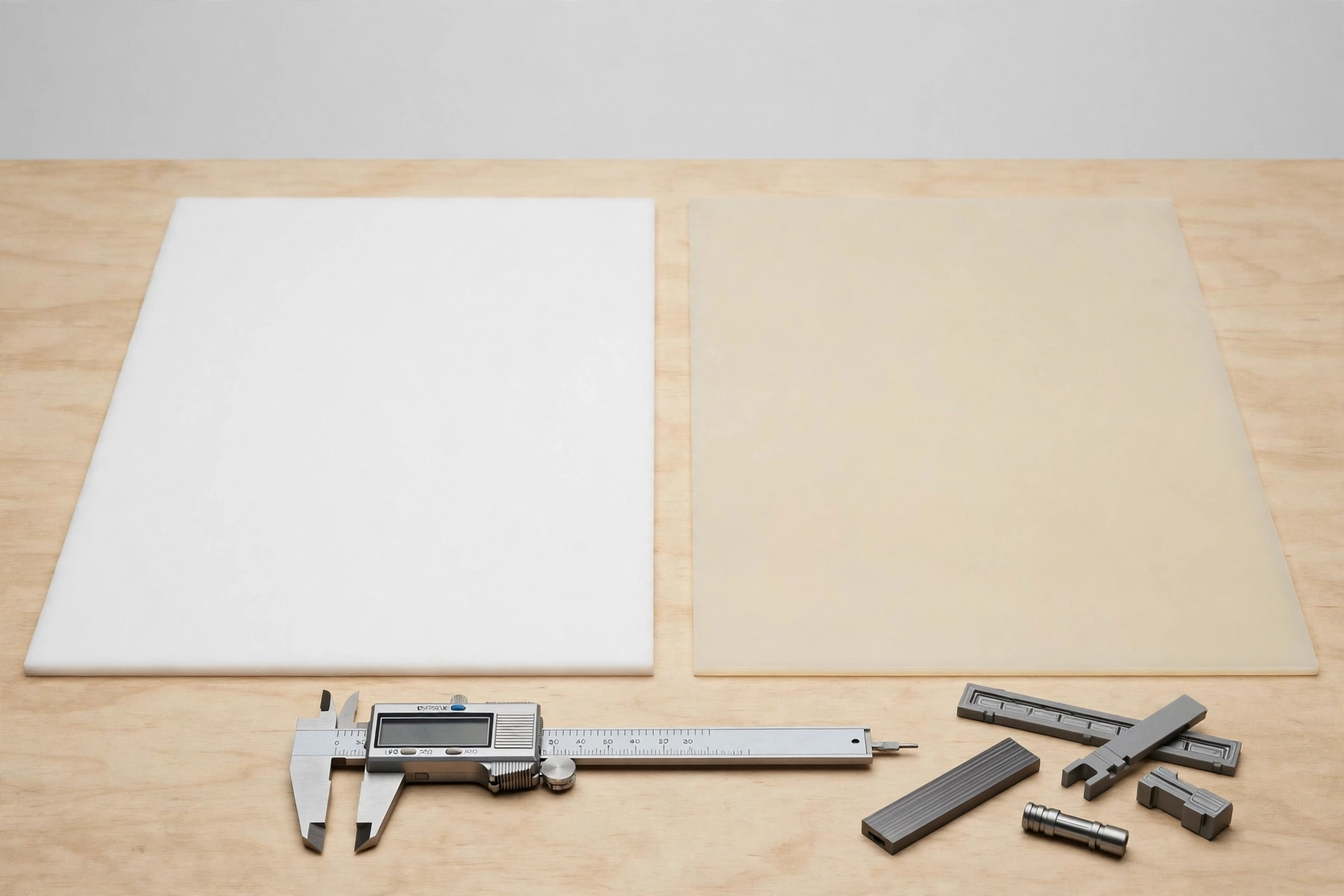
When you compare uhmw vs hdpe, you are comparing two members of the same polyethylene family that behave very differently in service. Both resist chemicals and moisture, both machine from sheet and rod, and both appear in food, marine, and industrial parts. The choice usually turns on wear, stiffness, fabrication, and price. Start with the XY Machining materials page to see where HDPE sits among other plastics.
This guide compares wear, strength, friction, heat limits, machining, and cost, using published supplier property tables. Grades vary, so confirm the exact grade before you order.
What UHMW and HDPE Actually Are
HDPE stands for high density polyethylene. Its polymer chains are relatively short and pack closely together, giving it a high strength to density ratio, good stiffness for a polyethylene, and easy fabrication. UHMW stands for ultra high molecular weight polyethylene, also written UHMWPE. Its chains are far longer, and one supplier guide puts its molecular weight at 5 to 9 million AMU.
Those longer chains do not melt and flow as easily as HDPE, so UHMW is normally supplied as sheet, rod, and machined parts rather than as injection molded resin. HDPE, by contrast, is widely molded, extruded, and welded, which rules UHMW out for some high volume molded parts.
UHMW vs HDPE: Side-by-Side Comparison
The table below uses typical values from published supplier tables. Values vary by brand and grade, so treat them as a comparison guide and confirm the exact grade before you order.
| Property | HDPE | UHMW |
|---|---|---|
| Density / specific gravity | 0.93 to 0.97 g/cm3; one table lists 0.96 | 0.93 to 0.95 g/cm3; one table lists 0.93 |
| Tensile strength | 4,000 psi in one table; 11 to 43 MPa yield in another | 3,100 psi in one table; 20 MPa yield in another |
| Tensile elongation | 600 percent | 350 percent |
| Flexural modulus | 200,000 psi | 110,000 psi |
| Hardness, Shore D | 69 in one table; 50 to 76 in another | 64 in one table; over 63 in another |
| Coefficient of friction | Around 0.20 in one guide | 0.10 to 0.20 in one table; around 0.14 average in another guide |
| Melting point | 118 to 137 degrees C | 133 degrees C |
| Water absorption | 0.010 to 0.10 percent | 0.010 percent |
| Best known advantage | Lower cost, stiffer, easier to weld and mold | Higher wear and impact resistance, lower friction |
Wear Resistance and Friction
Wear resistance is where UHMW earns its premium. Its long chains resist abrasion from sliding and repeated contact, which is why it is the usual choice for wear strips, chain guides, and chute liners. HDPE also resists wear well, but guides consistently place UHMW ahead for heavy contact.
Friction tells a similar story. One guide puts HDPE at around 0.20 and UHMW at around 0.14 on average, while a supplier table lists UHMW at 0.10 to 0.20. Lower friction means less drag, less heat from sliding, and less wear on the mating part. For a guide rail that moves all day, that difference adds up.
Strength, Stiffness and Impact
Do not assume UHMW is stronger in every test. In the supplier tables checked, HDPE shows higher tensile strength and a much higher flexural modulus: 4,000 psi and 200,000 psi against 3,100 psi and 110,000 psi for UHMW. HDPE is also slightly harder on the Shore D scale in the same table, at 69 against 64.
UHMW answers with impact resistance and toughness. Its notched Izod impact value is listed at 18.0 ft-lbs/in in one table, while the same table leaves HDPE blank on that test. That toughness suits bumpers, dock fenders, and outrigger pads.
Machining, Welding and Fabrication
Both materials machine well from sheet and rod, and both are used for CNC machined plastic parts in prototypes and low volume runs. HDPE has a clear fabrication advantage beyond machining: it welds readily with thermoplastic welding equipment and molds by injection, blow molding, and thermoforming. That makes tanks, vessels, and molded housings far easier in HDPE.
UHMW is harder to weld and cannot be injection molded in the usual way, so complex molded shapes are not its strength. Its strength is in cut, routed, and machined flat parts: liners, strips, guides, star wheels, and bearings. If your design is mostly flat stock with holes and slots, UHMW fabrication is straightforward.
UHMW vs HDPE Price and Cost in Use
On raw material price, HDPE is generally cheaper than UHMW. One supplier guide lists HDPE at roughly $1.2 per kg and UHMW at $2 to $6 per kg, with the exact figure depending on form, grade, and quantity. Treat those figures as a guide only, because sheet thickness, color, and order size move prices.
Cost in use can reverse that ranking. A UHMW wear strip that lasts far longer in a high wear conveyor can cost less over a year, despite a higher sheet price. Compare replacement labor and downtime, not just sheet price.
UHMW vs HDPE for Wear Strips and Guides
For wear strips and guides, UHMW is the default in most supplier guides: lower friction, higher abrasion resistance, and good impact resistance in one material. Under heavy, continuous contact, UHMW guides and slide plates drag less and need replacement less often than HDPE.
HDPE still wins some wear strip jobs. If the contact is light, intermittent, or low speed, HDPE wear strips cost less and perform well enough, and they are easier to weld into a larger assembly. Choose UHMW for heavy, continuous wear and HDPE for light wear where fabrication or price matters more.
Best Uses: When to Pick Each One
Use the job, not the material name, to decide. Match the dominant demand, whether that is wear, stiffness, welding, molding, or price, and pick the material that wins on that demand.
Choose UHMW when
- Parts face constant sliding, rubbing, or abrasive contact, such as wear strips, chain guides, and chute liners.
- Impact and toughness matter more than stiffness, such as bumpers, dock fenders, and machine padding.
- Low friction is needed without constant lubrication, such as bearings, slide plates, and star wheels.
Choose HDPE when
- Parts need welding, molding, or thermoforming, such as chemical tanks, containers, and housings.
- Stiffness and lower cost matter more than maximum wear life, such as cutting boards, panels, and light duty liners.
- Outdoor and marine parts need a low cost, weather resistant sheet, such as playground parts and boat panels.
Limitations You Should Know
HDPE has real limits. It wears faster than UHMW under heavy sliding contact, softens at a lower heat deflection temperature in the tables checked, and can creep under sustained load when warm. One guide notes it can be remelted at least 10 times before quality is affected.
UHMW has limits too. It costs more per kg, it is less stiff than HDPE in the tables checked, and it is harder to weld and mold, which limits part shapes. Both materials also share a heat ceiling well below engineering plastics: one table lists UHMW at a maximum continuous service temperature of 180 degrees F in air, and HDPE at a heat deflection temperature of 172 degrees F at 66 psi.
Test Before You Commit
For a prototype in either material, rapid prototyping lets you test fit, friction, and wear in the real assembly before you commit to a production grade. A short wear test on the actual mating surface is worth more than any table value, because grade, finish, and load change real wear rates.
Frequently Asked Questions
Which is stronger, HDPE or UHMW?
It depends on the test. HDPE is stiffer and shows higher tensile strength in supplier tables, at 4,000 psi against 3,100 psi for UHMW. UHMW is tougher and more wear resistant, so it survives impacts and abrasion that would wear HDPE down faster.
Is UHMW cheaper than HDPE?
No, UHMW is generally more expensive per kg than HDPE. One supplier guide lists HDPE at roughly $1.2 per kg and UHMW at $2 to $6 per kg, depending on form and grade. UHMW can still cost less over time in high wear parts that need fewer replacements.
What is the disadvantage of HDPE?
The main disadvantage of HDPE is lower wear resistance than UHMW under heavy sliding contact, plus lower toughness in impact and abrasion service. It is also less suited than UHMW for parts that face constant rubbing, heavy loads, and repeated blows.
Can UHMW stop a bullet?
Standard UHMW sheet is not body armor, and it should not be treated as bulletproof. Ballistic protection uses specially made UHMWPE fiber layers and plates, built and rated for that purpose, which are different products from ordinary wear strip sheet. Never use standard sheet as protection.
What is stronger than HDPE?
UHMW is stronger than HDPE for wear and impact resistance, while other plastics beat HDPE on stiffness or heat resistance depending on the grade. For heavy sliding wear, UHMW is the usual step up from HDPE, and for hot or highly loaded parts, a different engineering plastic may be needed.
Sources
Property values in this article come from Curbell Plastics HDPE vs UHMW comparison and Xometry HDPE vs UHMW guide, with friction values from PolymerShapes HDPE vs UHMW. For the wider plastic families, see our thermoplastic vs thermoset guide.