Sourcing CNC machined parts for a UK project means weighing three things simultaneously: the technical standards and quality-system certifications your sector requires, the true landed cost once import duty and VAT are factored in, and a supplier who communicates clearly and delivers to schedule.
For UK buyers in 2026, the trade picture is structurally more favourable than in comparable markets. The UK does not operate China-specific punitive tariffs comparable to the US Section 301 regime — machined components from China enter under the standard UK Global Tariff, where most machinery and parts categories attract duty in the low single digits. Combined with Postponed VAT Accounting, which removes the need to pay import VAT at the border, the cash-flow cost of importing is manageable for any VAT-registered business.
This guide covers every dimension UK engineers need to evaluate: the standards to specify, the 2026 duty and VAT position with references to gov.uk and HMRC guidance, the sectors with the most demanding requirements, and a supplier vetting checklist. XY Machining provides CNC machining services, injection moulding, sheet metal, and 3D printing to UK engineering teams; the guidance in this article applies to any supplier you evaluate.
Standards and Specifications for UK Engineering
UK engineering drawings work in metric and reference BS EN and ISO standards. ISO 2768 is the standard general tolerance callout, defining classes from fine (f) to very coarse (v) for linear and angular dimensions. Calling out a class in the drawing title block — ISO 2768-m for medium, for example — establishes the baseline for all untoleranced dimensions and is understood by any competent machining supplier internationally.
ISO 9001 is the quality management baseline. It confirms a supplier has documented and auditable processes for order management, production planning, inspection, and corrective action. For most commercial work, ISO 9001 is the minimum acceptable quality system.
For regulated sectors, the requirements step up. AS9100 is the aerospace quality management standard, incorporating ISO 9001 requirements with additional mandates for traceability, first article inspection, risk management, and design authority controls. UK aerospace primes and Tier 1 suppliers routinely require it. ISO 13485 governs medical devices; its requirements for design control, device history records, and sterilisation validation go significantly beyond ISO 9001. IATF 16949 applies to automotive production and service parts and includes requirements for statistical process control, measurement system analysis, and PPAP (production part approval process).
Post-Brexit conformity deserves attention on any product with a regulatory dimension. CE marking is no longer sufficient for many products sold in Great Britain. UKCA (UK Conformity Assessed) marking is now required for most regulated products covered by former EU New Approach directives — including machinery, pressure equipment, and medical devices. CE acceptance has been extended on a temporary basis for certain categories, but the current position changes periodically. Confirm the applicable conformity route via gov.uk before finalising your product design.
Import Duty and VAT in 2026
The UK has no free trade agreement with China, so Chinese-made goods enter under the UK Global Tariff. For machinery and machined components, the duty rate depends on the Harmonised System (HS) commodity code for the specific part. Rates are typically modest — in some engineering categories, zero percent; in others, 2 to 4 percent. Engineers should determine the exact rate for their parts by looking up the commodity code on the UK Trade Tariff tool at gov.uk, which gives the current applicable rate for any HS classification.
The absence of China-specific punitive tariffs is a material cost advantage compared with the US market. Under US Section 301, additional tariffs on Chinese goods run from 25 percent to over 100 percent in some categories. A UK buyer importing machined aluminium components from China pays standard Global Tariff rates; a US buyer for the same parts pays 25 percent or more on top of normal MFN duties. This structural difference supports the competitiveness of offshore-manufactured parts for UK buyers.
Import VAT is charged at 20 percent on the customs value plus duty. For VAT-registered businesses, import VAT is recoverable as input tax on the next VAT return and is therefore a timing cost rather than a permanent cost. Postponed VAT Accounting (PVA), available to all UK VAT-registered importers, allows businesses to account for import VAT on their VAT return rather than paying at the point of importation. This substantially improves cash flow for businesses that import regularly.
Practical requirements for UK importation: a GB EORI (Economic Operator Registration and Identification) number, obtainable from HMRC via gov.uk and required before any import; correct HS classification of goods to avoid misdeclaration penalties; commercial invoices clearly stating Incoterms; and a customs broker for complex or time-sensitive shipments. For DDP (Delivered Duty Paid) offers from overseas suppliers, request a copy of the import entry separately so you can verify and reclaim the VAT component.
UK Sectors With High Machining Demands
Aerospace is the UK’s largest precision machining sector by value. Major prime contractors and a deep Tier 1 and Tier 2 supply chain generate demand for AS9100-certified suppliers with full materials traceability, first article inspection reports, and in some cases NADCAP approval for special processes including heat treatment and non-destructive testing. Parts with flight-safety classification require a documented chain of custody from raw material to finished component.
Motorsport and high-performance automotive, centred on the UK’s motorsport cluster in Northamptonshire and neighbouring counties, places a premium on tight tolerances and rapid development cycles. Many teams operate to bespoke customer quality plans rather than formal QMS certifications, but dimensional accuracy, material traceability, and schedule reliability are non-negotiable.
Medical devices require ISO 13485, design risk management documentation under ISO 14971, and often specific surface finish and cleanliness requirements. Parts for sterile or implantable devices face the most stringent requirements. The regulatory obligation for CE or UKCA marking rests on the finished device, but documentation requirements flow to the component level.
Defence, energy, and a growing advanced manufacturing and robotics sector round out UK demand, each with sector-specific material, documentation, and in some cases security requirements that should be clarified with potential suppliers at the outset.
How to Vet a CNC Machining Supplier for UK Projects
- Capability: confirm the supplier machines the materials and holds the tolerances your part requires, with calibrated inspection equipment including CMM where your application demands it
- Quality certification: verify current certificates against the issuing body’s registry — AS9100, ISO 13485, or ISO 9001 as applicable — not just the supplier’s claim
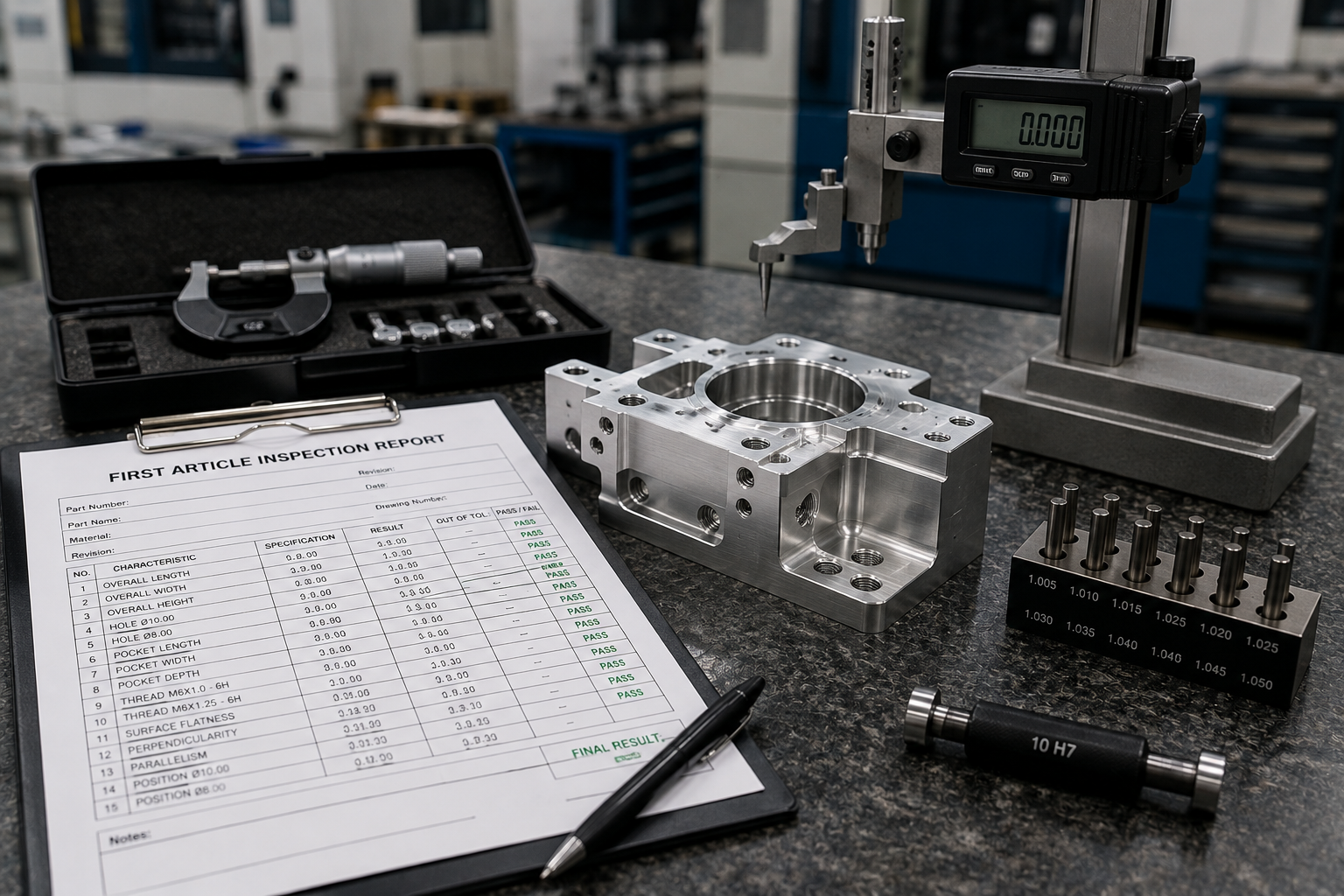
- Documentation: request sample inspection reports, material test certificates, and first article documentation from comparable previous work
- Landed cost: compare quotes on a full delivered, duty-and-VAT-inclusive basis — a lower factory price that ignores freight, duty, and broker fees may not be the lowest total cost
- Logistics: clarify Incoterms, who handles UK customs clearance, realistic sea and air transit times, and whether the supplier has established routing into the UK
- DFM feedback: a supplier who reviews your drawing and flags manufacturability issues before machining saves costly revisions — particularly valuable during prototype development
Where XY Machining Serves UK Engineers
XY Machining supplies UK engineering teams with CNC machining, injection moulding, sheet metal fabrication, and 3D printing — from prototype through production. Every order begins with a drawing review and DFM feedback, progresses through production with documented inspection, and ships with material certificates and a dimensional report. The UK Global Tariff on machined components is light relative to most comparable markets, and our pricing reflects full landed cost to make comparisons straightforward. Upload your drawing for instant pricing and DFM feedback.
Frequently Asked Questions
What does it cost to import CNC machined parts to the UK from overseas?
The duty rate depends on the commodity code of the part. Under the UK Global Tariff, most machinery and machined components attract duty in the low single digits — in some engineering categories, zero percent. On top of duty, import VAT is charged at 20 percent on the customs value plus duty. For VAT-registered businesses, import VAT is recoverable and Postponed VAT Accounting removes the need to pay at the border. The practical non-recoverable cost is the duty percentage and the freight charge.
Does the UK charge extra tariffs on Chinese machined parts?
No. Unlike the United States, the UK does not operate China-specific punitive tariffs. Chinese goods enter under the standard UK Global Tariff, where machinery and machined components typically carry modest duty rates. This is a material cost difference for buyers comparing UK and US sourcing economics.
What standards should I specify for UK CNC machined parts?
Use metric drawings referencing ISO 2768 for general tolerances and ISO 9001 as the quality management baseline. Add AS9100 for aerospace, ISO 13485 for medical devices, and IATF 16949 for automotive production parts. Confirm UKCA marking requirements for your finished product before finalising the design.
Do I need an EORI number to import machined parts?
Yes. A GB EORI number is required to clear UK customs and must be obtained from HMRC via gov.uk before importing. Postponed VAT Accounting lets you account for import VAT on your VAT return rather than paying at the border — register for it separately once you have your EORI.
Is offshore CNC machining still cost-effective for UK buyers in 2026?
For many applications, yes. The UK Global Tariff on machinery is light, there are no China-specific surcharges, and Postponed VAT Accounting removes cash-flow friction. The key is comparing on full landed cost — factory price plus freight, duty, broker fees, and VAT timing — rather than unit price alone. Where quality documentation and lead time requirements are met, offshore machining delivers competitive total cost for UK buyers.