Which are the best CNC machining companies in Germany for precision parts, prototypes, low-volume production, and complex industrial components?
The leading options include DMG MORI, GROB-WERKE, HERMLE, CHIRON, HELLER, INDEX-WERKE, EMAG, TRUMPF, KERN Microtechnik, SUSA S. Sauer, Raditsch Zerspanungstechnik, Protolabs, Xometry, Techpilot, and XY Machining. These companies and manufacturing platforms cover different requirements, from advanced 5-axis machining and CNC turning to rapid prototyping, production machining, and international sourcing. German manufacturers are particularly recognized for precision engineering, automation, quality control, and advanced machining technology.
Germany remains one of Europe’s important manufacturing markets, particularly for automotive, aerospace, medical technology, industrial machinery, automation, and precision engineering. However, choosing a CNC supplier should not be based on company size or brand recognition alone. Buyers should compare machining capabilities, material experience, tolerances, inspection procedures, certifications, production volume, lead times, communication, and total landed cost.
For international buyers, it is also useful to compare German suppliers with experienced overseas manufacturers. XY Machining, for example, provides CNC milling and turning alongside other manufacturing services, giving companies another option when production cost, engineering support, and scalability are important considerations. Its published capabilities include 3-axis and 5-axis CNC machining, DFM feedback, quality inspection, and production support.
How We Selected These CNC Machining Companies
There is no single ranking that can objectively determine the best CNC machining company for every application. A supplier that is ideal for a large automotive production program may not be the right choice for a startup needing ten prototypes.
This list therefore considers factors that matter to engineering and procurement teams, including machining technology, product range, industry experience, automation, precision, production flexibility, quality systems, and suitability for different order sizes. Market research also identifies companies such as DMG MORI, GROB, HERMLE, CHIRON, and HELLER among the significant players in Germany’s machining-center market.
The companies below are not presented as a universal quality ranking. Instead, they represent established manufacturers, machining specialists, and digital manufacturing providers that buyers may evaluate depending on their project requirements.
Top CNC Machining Companies in Germany at a Glance
| Company | Main Strength | Suitable For |
| DMG MORI | Advanced CNC and 5-axis technology | Industrial production and complex machining |
| GROB-WERKE | Automation and machining systems | Automotive and high-volume manufacturing |
| HERMLE | High-precision 5-axis machining | Complex precision components |
| CHIRON | High-speed machining | Automotive and industrial parts |
| HELLER | Multi-axis machining systems | Heavy-duty industrial production |
| INDEX-WERKE | CNC turning and turn-mill | Precision rotational components |
| EMAG | Automated turning and production | Automotive and industrial production |
| TRUMPF | Laser and advanced manufacturing | Sheet metal and industrial components |
| KERN Microtechnik | Ultra-precision machining | Micro and precision components |
| SUSA S. Sauer | CNC turning and milling | Custom precision parts |
| Raditsch Zerspanungstechnik | 3-, 4-, and 5-axis machining | Prototypes and small series |
| Protolabs | Digital manufacturing | Rapid prototypes and production |
| Xometry | Manufacturing marketplace | Flexible sourcing and multiple processes |
| Techpilot | European supplier network | Supplier discovery and RFQs |
| XY Machining | CNC and full-service manufacturing | Cost-conscious global production |
1. DMG MORI
DMG MORI is one of the most recognizable names in the German machine-tool industry. The company develops CNC machines, machining centers, turning systems, automation solutions, and digital manufacturing technologies.
Its portfolio is particularly relevant when a project requires sophisticated machining strategies, multi-axis capabilities, automation, or integration between machining and digital production systems. In 2026, DMG MORI has continued investing in technologies that expand machining capabilities, including integrated gear-machining functions for CNC and 5-axis machines.
For procurement teams, DMG MORI is particularly relevant when machine capability, automation, and long-term production performance are more important than selecting the lowest-cost supplier.
2. GROB-WERKE
GROB-WERKE is a German manufacturer known for machining systems, automation, and production solutions. Its technology is strongly associated with high-productivity industrial manufacturing.
The company is especially relevant to automotive and other sectors where production automation, cycle time, repeatability, and integration are critical. GROB is also identified among the major companies in Germany’s machining-center market.
Companies evaluating GROB should consider whether their production volume justifies advanced automation and integrated manufacturing equipment.
3. HERMLE
Maschinenfabrik Berthold HERMLE is well known for high-precision machining centers, particularly 5-axis machining technology and automation.
HERMLE’s equipment is used for demanding applications where dimensional accuracy, surface quality, and complex geometries matter. The company reported strong growth at the beginning of 2026, including a 14.9% increase in group orders during the first quarter.
HERMLE can be a strong choice for precision-oriented production where sophisticated multi-axis machining is required.
4. CHIRON
CHIRON Group is a German manufacturer focused on CNC machining centers and production solutions. Its technologies are used for high-speed and high-productivity machining.
CHIRON is particularly relevant to manufacturers producing complex metal components in industries such as automotive, aerospace, and industrial engineering. Buyers considering CHIRON should evaluate machine configuration, automation requirements, part geometry, and production volume rather than selecting equipment solely by axis count.
5. HELLER
Gebr. HELLER Maschinenfabrik is another established German machining technology company. Its solutions are designed for demanding industrial production environments and include horizontal machining centers and production systems.
HELLER is particularly relevant where manufacturers need stable production processes, automation, and repeatable machining performance. The company is also listed among the leading participants in Germany’s machining-center market.
6. INDEX-WERKE
INDEX-WERKE is widely associated with CNC turning and turn-mill technology. Its equipment is suitable for rotational components requiring multiple operations in a controlled production environment.
Turn-mill machining can reduce the number of setups required for certain parts because turning and milling operations can be combined within one machine. This can improve consistency and reduce handling for suitable components.
INDEX is therefore worth considering for shafts, fittings, complex turned components, and production parts requiring combined machining operations.
7. EMAG
EMAG develops CNC machine tools and automated production systems, with strong relevance to turning and high-volume manufacturing.
The company’s technology is particularly suited to industrial environments where automation and production efficiency are major priorities. Automotive suppliers and manufacturers producing large quantities of repeatable components may find EMAG’s integrated approach especially relevant.
For buyers, the key consideration is whether the production volume and part family justify an automated production system.
8. TRUMPF
TRUMPF is best known for industrial laser technology and sheet-metal manufacturing, but its broader manufacturing portfolio makes it relevant to companies evaluating advanced production technologies.
TRUMPF is particularly useful for projects that combine laser processing with other manufacturing requirements. This makes it an interesting option for enclosures, brackets, structural sheet-metal components, and industrial assemblies.
It should not be viewed as a conventional CNC job shop. Instead, its strength lies in integrated industrial manufacturing technologies.
9. KERN Microtechnik
KERN Microtechnik specializes in high-precision machining and is particularly relevant for small, complex, and precision-critical components.
Micro-machining requires more than simply using a smaller cutting tool. Thermal stability, machine rigidity, spindle performance, tool management, measurement, and process control can all influence the final result.
KERN is therefore worth evaluating for applications where conventional production machining cannot provide the required combination of accuracy and feature complexity.
10. SUSA S. Sauer
SUSA S. Sauer GmbH & Co. KG is a German precision machining company offering CNC turning and milling. The company states that it has more than 30 years of experience, around 200 qualified specialists, more than 100 production systems, and 14,000 square meters of production space.
Its services cover individual components, small batches, and larger quantities. This makes SUSA relevant to companies that need a traditional precision manufacturing partner rather than a purely digital quoting platform.
11. Raditsch Zerspanungstechnik
Raditsch Zerspanungstechnik is a family-owned CNC contract manufacturer based near Schweinfurt. The company offers CNC milling up to 5 axes, turning, mill-turn machining, and measurement using Zeiss equipment.
Its published capabilities include prototype, single-part, and small-series production. The company also states that it has been operating since 1997 and is ISO 9001:2015 certified.
This makes Raditsch a relevant option for engineering companies that need custom precision parts without the production volumes associated with major automotive manufacturing programs.
12. Protolabs
Protolabs takes a different approach from traditional German machine shops. It combines digital quoting, automated manufacturing, rapid prototyping, and production services.
Its German-language CNC service includes CNC milling and turning, rapid prototypes, production scaling, and inspection-related options. Protolabs also lists ISO 9001:2015 and other certifications on its manufacturing platform.
This model can be useful for engineers who want to upload CAD data, receive manufacturing feedback, and move quickly from prototype to production.
13. Xometry
Xometry operates a digital manufacturing marketplace that connects buyers with manufacturing suppliers. This model can provide access to different manufacturing processes and supplier capabilities without requiring procurement teams to contact individual machine shops one by one.
Its advantage is flexibility. However, buyers should understand the supplier model and confirm which factory will manufacture the parts, what quality documentation is available, and how repeat orders are controlled.
For highly regulated or traceability-sensitive applications, these details should be confirmed before placing an order.
14. Techpilot
Techpilot is a European manufacturing sourcing platform that connects buyers with manufacturing suppliers. Rather than functioning like a conventional CNC machine shop, it can help procurement teams identify suitable suppliers for machining and other manufacturing processes.
This approach can be useful when a company wants to compare multiple suppliers or source a specialized capability. Buyers should still perform supplier qualification, review certifications, confirm inspection requirements, and evaluate production capacity before approving a supplier.
15. XY Machining
For companies willing to evaluate suppliers outside Germany, XY Machining provides an alternative to the traditional domestic supplier model.
XY Machining offers precision CNC machining with 3-axis and 5-axis capabilities, CNC milling, CNC turning, DFM feedback, inspection, and production support. Its published information positions the company as a direct manufacturing partner for prototypes, low-volume production, and larger production programs.
The advantage for international buyers is that the decision does not have to be limited to German suppliers. A China-based manufacturing partner can sometimes provide competitive production economics while still supporting engineering review and documented quality processes.
For buyers comparing manufacturing routes, it can also make sense to evaluate CNC machining services alongside local German suppliers before making a final sourcing decision.
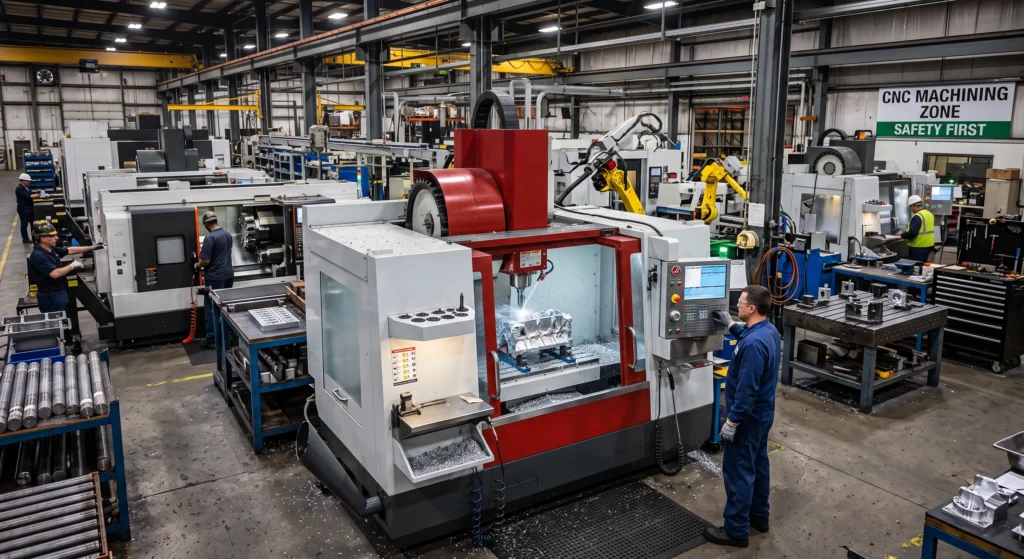
German CNC Machining vs. Overseas Manufacturing
The right supplier depends heavily on what the project is trying to optimize. German manufacturers can be attractive when local production, proximity, engineering communication, and European supply-chain requirements are priorities.
Overseas manufacturing can become more attractive when production volume is higher and unit cost is a major consideration. However, the lowest initial quote should never be treated as the complete cost.
Shipping, customs, inspection, packaging, communication, engineering revisions, tooling, and supplier management all influence the final landed cost.
| Factor | German CNC Supplier | Overseas CNC Supplier |
| Local communication | Usually easier within Germany/Europe | Depends on supplier and support team |
| Production cost | Often higher | Can be more competitive |
| Shipping distance | Short for German buyers | Longer international logistics |
| Prototyping | Strong availability | Strong availability from digital manufacturers |
| High-volume production | Strong | Often highly competitive |
| Supplier selection | Local qualification possible | Requires stronger remote qualification |
| Quality control | Can be audited locally | Documentation and inspection become more important |
| Best fit | Local supply and complex industrial programs | Cost-sensitive prototypes and production |
XY Machining’s own published sourcing comparison notes that supplier selection should consider cost, lead time, communication, quality, and risk rather than unit price alone.
How to Choose the Right CNC Machining Company in Germany
The best CNC machining company is the one whose capabilities match the actual requirements of your part.
Start with the drawing and CAD model. Identify the material, critical dimensions, tolerances, surface finish, threads, quantity, inspection requirements, and delivery target. A supplier that regularly produces similar parts will generally be better positioned to identify manufacturing risks before production begins.
For complex parts, ask about 5-axis machining, workholding, tool access, inspection equipment, and whether the supplier can maintain the required tolerances throughout the production run.
For prototypes and low-volume orders, flexibility becomes more important. A large automated production facility may be technically capable but economically unsuitable for a small batch.
Quality documentation should also be reviewed. Depending on the industry, you may need ISO 9001, IATF 16949, ISO 13485, AS9100, material certificates, first article inspection, dimensional inspection reports, or full traceability.
What Should You Ask a CNC Machining Supplier?
Before approving a supplier, ask for evidence rather than relying only on marketing claims. Request information about machine capabilities, materials, achievable tolerances, inspection equipment, certifications, production capacity, and previous experience with similar components.
It is also important to clarify whether machining is performed in-house or through a subcontractor or supplier network. This distinction can affect quality control, communication, repeatability, and intellectual-property management.
For international production, ask about packaging, shipping terms, customs documentation, quality inspection before shipment, and how engineering changes are handled.
A good supplier should be able to explain not only how it will manufacture your part, but also why the selected process is appropriate.
Final Thoughts
Germany has a strong CNC and precision-engineering ecosystem that covers advanced machining centers, automated production systems, precision turning, micro-machining, contract manufacturing, and digital manufacturing platforms. Companies such as DMG MORI, GROB-WERKE, HERMLE, CHIRON, HELLER, INDEX-WERKE, and EMAG are particularly important when advanced production technology and automation are required.
For custom parts, companies such as SUSA S. Sauer and Raditsch Zerspanungstechnik offer more direct contract-machining models, while Protolabs, Xometry, and Techpilot provide digitally enabled sourcing options.
There is no universal winner. The best CNC machining partner depends on your part geometry, material, tolerance, quantity, quality requirements, delivery schedule, and total budget.
If German production costs or capacity do not fit your project, comparing an international manufacturer such as XY Machining can provide another sourcing route. Its combination of CNC milling, CNC turning, 5-axis machining, DFM support, inspection, and broader manufacturing services makes it relevant for companies looking for a supplier that can support projects from prototype development through production.
For further technical planning, buyers can also review XY Machining’s CNC machining cost guide to understand how material, geometry, tolerances, surface finish, and order volume influence machining costs. The company’s 3D printing vs. CNC machining guide can also help engineers decide whether subtractive or additive manufacturing is more appropriate for a particular component.
Ultimately, the strongest sourcing decision comes from comparing technically qualified suppliers on the complete manufacturing requirement rather than choosing a company simply because it appears first in a search result.
FAQs
1. Which are the best CNC machining companies in Germany?
Leading CNC machining companies in Germany include DMG MORI, GROB-WERKE, HERMLE, CHIRON, HELLER, INDEX-WERKE, EMAG, KERN Microtechnik, SUSA S. Sauer, and Raditsch Zerspanungstechnik. The best option depends on your part complexity, material, tolerances, production volume, quality requirements, and budget.
2. Which German CNC machining companies are best for prototypes and low-volume production?
For prototypes and low-volume production, companies such as SUSA S. Sauer, Raditsch Zerspanungstechnik, Protolabs, and suppliers available through Xometry or Techpilot can be considered. The right choice depends on required tolerances, materials, quantity, inspection requirements, and delivery time.
3. How do I choose the right CNC machining company in Germany?
Compare machining capabilities, available materials, tolerances, inspection equipment, certifications, production capacity, lead times, communication, and total manufacturing cost. It is also important to select a supplier with experience producing similar components.
4. How much does CNC machining cost in Germany?
CNC machining costs in Germany vary based on material, part complexity, machining time, tolerances, surface finish, tooling, order quantity, inspection requirements, and delivery time. Comparing quotations from multiple qualified suppliers can help determine the most suitable option.
5. Can overseas CNC machining companies be an alternative to German suppliers?
Yes. Overseas manufacturers can be considered when production cost, scalability, or broader manufacturing capabilities are important. Companies such as XY Machining provide CNC milling, CNC turning, 5-axis machining, DFM support, inspection, and production services for international buyers.
About the author Patrick Chen — Applications Engineer, XY Machining Patrick reviews thin-wall designs for US engineering teams at XY Machining and works with the shop floor on the fixturing and toolpaths that keep delicate parts in tolerance. To pressure-test a thin-wall part before quoting, send your model to our team.
About the author Patrick Chen — Applications Engineer, XY Machining Patrick reviews thin-wall designs for US engineering teams at XY Machining and works with the shop floor on the fixturing and toolpaths that keep delicate parts in tolerance. To pressure-test a thin-wall part before quoting, send your model to our team.