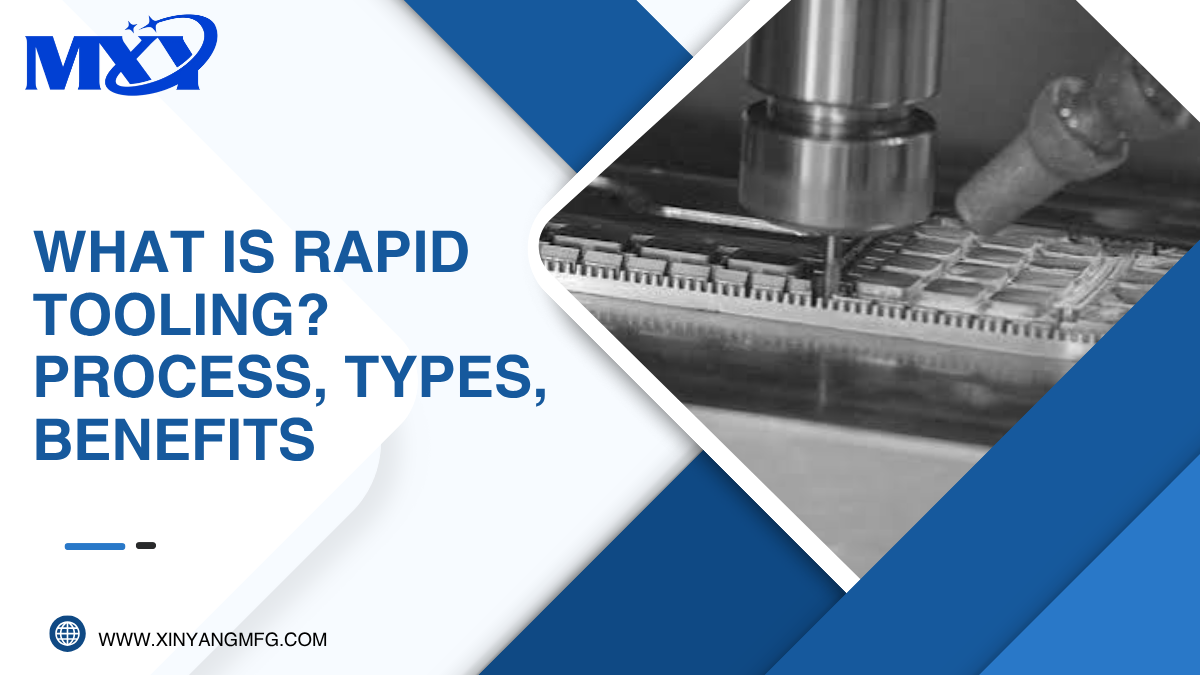
If you are developing a new plastic product and need functional parts fast, waiting 8 to 12 weeks for a hardened steel production mold is not always realistic. That is where rapid tooling comes in. Rapid tooling is a manufacturing approach that produces molds and tooling inserts significantly faster than conventional methods, typically within 7 to 15 business days, so you can validate designs, test materials, and run pilot production without committing to full-scale tooling costs upfront.
In this guide, we explain exactly what rapid tooling is, how the process works step by step, the different types available, the materials involved, where it fits in the product development cycle, and how it compares to conventional tooling and rapid prototyping. Whether you are an engineer evaluating bridge tooling options or a product manager planning a pilot launch, this article gives you the technical context you need to make a confident decision.
What Is Rapid Tooling? Definition and Core Concept
Rapid tooling (RT) is a fast and cost-effective method of manufacturing molds, dies, or forming tools used to produce prototype and low-volume parts. Unlike traditional production tooling, which relies on hardened tool steel and can take two to three months to manufacture, rapid tooling uses softer mold materials such as aluminum alloys (6061, 7075) or pre-hardened steels (P20, NAK80) that can be machined, EDM-cut, or even 3D printed in a fraction of the time.
The core idea is straightforward: you sacrifice some mold longevity (rapid tools typically last 100 to 10,000+ shots, compared to 500,000+ for hardened steel molds) in exchange for dramatically shorter lead times, lower upfront cost, and the ability to iterate on designs before committing to expensive production tooling.
At XY Machining, our rapid tooling services combine advanced CNC machining, wire EDM, and mold flow analysis to deliver production-grade aluminum and steel molds in as little as 7 days, depending on part complexity.
How Does the Rapid Tooling Process Work?
The rapid tooling process follows a structured workflow that mirrors conventional mold tool making but compresses each phase. Here is how it works from start to finish:
Step 1: Design Review and DFM Analysis
Every rapid tooling project begins with a design-for-manufacturability (DFM) review. The engineering team examines your 3D CAD model (STEP or STP files) to evaluate wall thickness uniformity, draft angles, undercuts, gate locations, and parting line placement. This step prevents expensive rework later. At XY Machining, DFM feedback is returned within 24 hours of file upload.
Step 2: Mold Design and Mold Flow Simulation
Based on the DFM results, a mold designer creates the tool layout, including core and cavity splits, runner system, cooling channels, and ejection method. For critical parts, a mold flow simulation (using tools like Moldflow or Moldex3D) predicts fill patterns, weld lines, shrinkage, and warpage before any metal is cut. This analysis is especially important for parts destined for medical device or automotive applications where dimensional accuracy is non-negotiable.
Step 3: Mold Manufacturing
The mold is manufactured using high-speed CNC milling, wire EDM for fine details, and surface grinding for parting line precision. For aluminum molds, the machining process is inherently faster because aluminum cuts 3 to 5 times faster than tool steel. The typical turnaround for a single-cavity aluminum rapid tool is 7 to 10 business days; multi-cavity steel tools take 10 to 15 days.
Step 4: Sampling and Validation (T1 Shots)
Once the mold is assembled, first-article samples (T1 shots) are molded using the specified production-grade resin. These parts are dimensionally inspected against your drawing tolerances using CMM, calipers, or optical comparators. A T1 inspection report is shared with your engineering team for approval before production begins.
Step 5: Low-Volume Production Run
After T1 approval, the mold goes into a controlled injection molding production cycle. Rapid tools can produce anywhere from 50 to 10,000+ parts depending on mold material and part geometry. Every batch undergoes in-process inspection to maintain dimensional consistency.
Types of Rapid Tooling: Direct vs. Indirect
Rapid tooling methods fall into two categories depending on how the mold itself is created:
Direct Rapid Tooling
In direct rapid tooling, the mold or die is fabricated directly from a CAD model using subtractive or additive processes. Common methods include CNC-machined aluminum molds, metal 3D printing (DMLS or SLM) for complex conformal cooling channels, and EDM for high-precision cavity details. Direct tooling is the most widely used approach in commercial rapid tooling because it produces durable, dimensionally accurate molds that can run production-grade resins under real molding conditions.
Indirect Rapid Tooling
Indirect rapid tooling uses a master pattern (often 3D-printed) to create a secondary mold. For example, a stereolithography (SLA) master can be used to produce a silicone rubber mold for urethane casting, or an epoxy tooling shell backed with aluminum filler. Indirect methods are best suited for very low volumes (1 to 50 parts) or when testing cosmetic finishes and ergonomic fit before investing in machined tooling.
Common Rapid Tooling Materials
The choice of mold material determines cost, lead time, surface finish, and expected mold life. Here are the materials most commonly used in rapid tooling:
Aluminum 6061 and 7075: The most popular choice for rapid injection mold tooling. Aluminum machines 3 to 5 times faster than steel, offers excellent thermal conductivity (which reduces cycle times), and can deliver 1,000 to 10,000+ shots depending on resin aggressiveness and part geometry.
P20 Pre-Hardened Steel: A step up in durability (10,000 to 100,000 shots). P20 is used when glass-filled or abrasive resins are required, or when tighter tolerances are needed over a longer production run.
NAK80 Steel: Pre-hardened to approximately 40 HRC with excellent polishability. Ideal for parts requiring SPI A-2 or better surface finishes, such as consumer electronics housings or optical components.
3D-Printed Metal Inserts (DMLS/SLM): Used for conformal cooling channels inside mold cores and cavities. These inserts reduce cycle time by 20 to 40% compared to conventionally drilled cooling lines.
Silicone Rubber Molds: Used in indirect tooling for urethane casting applications. Silicone molds are inexpensive and fast to produce but limited to 10 to 25 pours.
Rapid Tooling vs. Conventional Tooling: Key Differences
Understanding the trade-offs between rapid tooling and conventional (production) tooling helps you make the right decision for each project stage.
Lead Time: Rapid tooling takes 7 to 15 business days. Conventional hardened steel tooling typically requires 8 to 16 weeks.
Cost: A single-cavity aluminum rapid tool can cost 40 to 70% less than an equivalent hardened steel mold, depending on complexity.
Mold Life: Rapid tools last 1,000 to 100,000 shots depending on material. Production molds built from H13 or S136 steel can exceed 500,000 shots.
Tolerances: Rapid tools hold general tolerances of +/-0.05 mm to +/-0.1 mm. Hardened steel production molds can achieve +/-0.02 mm or tighter.
Design Flexibility: Rapid tooling allows faster design iterations. If a part requires geometry changes after initial samples, modifying an aluminum mold is significantly faster and cheaper than recutting hardened steel.
Rapid Tooling vs. Rapid Prototyping: What Is the Difference?
These two terms are closely related but serve different purposes in the product development cycle:
Rapid prototyping creates individual parts directly, typically through 3D printing or CNC machining, for design validation, form-fit checks, or concept models. The parts are made without any mold or tooling.
Rapid tooling creates a mold or die that is then used to produce multiple parts through plastic injection molding or casting. The key advantage is that rapid-tooled parts are produced in production-grade materials under real manufacturing conditions, giving you far more reliable data for functional testing, regulatory submissions, and market trials.
In practice, many product development programs use both: rapid prototyping in the early concept phase, followed by rapid tooling for design verification, bridge production, and pre-launch market testing.
Rapid Tooling Applications Across Industries
Rapid tooling is used wherever speed-to-market matters and traditional tooling timelines create bottlenecks:
Medical Devices: Producing pilot batches of housings, connectors, and fluid-path components in biocompatible resins for design verification and regulatory submissions.
Automotive: Bridge tooling for interior trim panels, sensor housings, and under-hood brackets while production tooling is being manufactured.
Consumer Electronics: Rapid molds for enclosures, buttons, and display bezels allow product teams to test form factor, snap-fit assemblies, and cosmetic finishes before mass production.
Robotics and Automation: Custom housings, end-effector components, and cable management parts for robotic systems where design cycles are measured in weeks.
Consumer Products: Low-volume production for crowdfunding campaigns, limited-edition runs, and market-test batches.
When Should You Use Rapid Tooling?
Rapid tooling makes the most sense in these scenarios:
You need functional parts in production-grade materials for testing, but full-scale tooling is premature. You are running a pilot production batch of 100 to 5,000 units before committing to mass manufacturing. Your product launch timeline cannot absorb 8 to 16 weeks of conventional tooling lead time. You need bridge tooling to keep production running while a hardened steel mold is being built. You want to test multiple design variations without investing in separate production molds for each. You are submitting parts for regulatory testing (FDA, UL, CE) and need molded samples that reflect final manufacturing conditions.
How to Choose a Rapid Tooling Partner
Not every mold shop is equipped for rapid tooling. When evaluating suppliers, consider these factors:
In-House CNC and EDM Capability: Shops that machine molds internally can control lead time and quality better than those outsourcing mold components.
DFM and Mold Flow Analysis: A supplier that provides proactive DFM feedback and mold flow simulation will help you avoid costly rework.
Material Traceability: For medical and aerospace applications, full material certifications and traceability records are essential.
Quality Certifications: Look for ISO 9001:2015 or equivalent quality management systems with documented inspection procedures.
Scalability: Choose a partner who can transition your rapid tool into production tooling without starting over. At XY Machining, our engineers design rapid molds with production scalability in mind, so the transition to hardened steel tooling is streamlined.
Frequently Asked Questions About Rapid Tooling
How long does rapid tooling take?
Most rapid tools are completed in 7 to 15 business days, depending on part complexity, mold material, and number of cavities. Simple single-cavity aluminum molds can be ready in as little as 5 business days.
How many parts can a rapid tool produce?
Aluminum rapid tools typically last 1,000 to 10,000+ shots. P20 steel tools can handle 10,000 to 100,000 shots depending on resin type and part geometry.
What plastics can be used with rapid tooling?
Rapid tools run the same production-grade resins as conventional molds: ABS, PC, PA (Nylon), PP, PE, POM, TPU, PEEK, and glass-filled or mineral-filled compounds. The mold material simply needs to match the resin’s processing temperature and abrasiveness.
Is rapid tooling the same as soft tooling?
Soft tooling is a subset of rapid tooling. It typically refers to silicone molds used for urethane casting, which is an indirect rapid tooling method. CNC-machined aluminum molds, while still considered rapid tooling, are harder and more durable than silicone soft tools.
Can rapid tooling parts pass regulatory testing?
Yes. Because rapid-tooled parts are produced through injection molding using production-grade materials, they are functionally equivalent to mass-produced parts. This makes them suitable for FDA, UL, CE, and other regulatory submissions.
How does rapid tooling compare to 3D printing for production?
3D printing produces parts directly without any mold, making it ideal for one-off prototypes or complex geometries that are difficult to mold. Rapid tooling produces parts through injection molding, which means better material properties, tighter tolerances, and lower per-part cost at volumes above 50 to 100 units. For a deeper comparison.
What is bridge tooling?
Bridge tooling is a specific application of rapid tooling where a lower-cost mold is used to produce parts during the gap between prototype validation and completion of production tooling. It keeps your supply chain running while permanent molds are being built.
Does XY Machining offer rapid tooling services?
Yes. XY Machining provides end-to-end rapid tooling services including DFM analysis, mold design, CNC-machined aluminum and steel molds, T1 sampling, and low-volume injection molding.
Conclusion
Rapid tooling fills a critical gap in product development between early-stage prototyping and full-scale mass production. It gives engineering teams the ability to validate designs using production-grade materials and real molding conditions without the long lead times and high costs of conventional tooling. Whether you need 50 parts for regulatory testing, 1,000 units for a pilot launch, or bridge production to keep your supply chain running, rapid tooling delivers functional, dimensionally accurate parts on a timeline measured in days instead of months.