By Patrick Chen | Applications Engineer, XY Machining
Published July 1, 2026 | Reviewed for accuracy by the XY Machining team
| Quick answer3+2 machining locks the two rotary axes at a fixed angle, then cuts with the three linear axes. Full 5-axis moves all five axes at the same time during the cut.Use 3+2 for prismatic parts that need tool access from several angles. It is more rigid, cheaper to program, and covers most parts.Use full 5-axis only when the geometry is truly freeform: turbine blades, impellers, organic contours, and deep undercuts that a locked angle cannot reach.Both reduce setups compared with 3-axis work. Choosing the right one controls your cost, so ask your 5轴加工 supplier to justify which method your part needs. |
Engineers often ask for 5-axis machining when what they actually need is 3+2. The two are related but not the same, and the gap between them is real money. Pick 3+2 when it will do the job and you save on programming, machine time, and risk. Insist on full 5-axis when the geometry demands it and you get a part that no other method can produce in one setup. This guide explains the difference, when each one wins, and how to tell which your part requires before you request a quote.
It is written for design and sourcing engineers who want to control cost without compromising a part that genuinely needs simultaneous motion.
What 3+2 machining actually is
3+2 machining, also called positional or indexed 5-axis, uses a 5-axis machine in a specific way. The two rotary axes tilt and rotate the part to present a compound angle to the tool, then lock in place. The actual cutting happens with the three linear axes only, exactly like standard 3-axis milling, just from an angled orientation. The tool reaches faces and features that a flat 3-axis setup cannot, without the operator re-fixturing the part between each face.
Because the rotary axes are clamped during the cut, the setup is very rigid. That rigidity lets you run shorter tools at higher feeds with less deflection, which improves surface finish and holds tolerance. For prismatic parts, housings, brackets, manifolds, and anything built from flats, pockets, and holes on multiple faces, 3+2 is usually the right and most economical answer.
What full 5-axis machining actually is
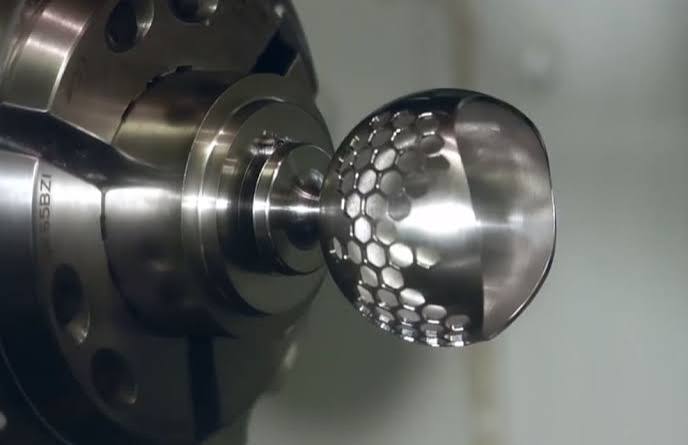
Full 5-axis, also called simultaneous or continuous 5-axis, moves all five axes together while the tool is cutting. The tool tip and the tool angle change constantly along the path, which lets the cutter follow a curved surface and keep an ideal cutting attitude the whole way. This is what produces smooth freeform geometry: turbine and compressor blades, impellers, blisks, medical implants with organic curves, and complex aerospace structural parts.
Simultaneous motion also solves reach problems. A tool can tilt to clear an obstruction and machine a deep undercut or an angled bore that a locked orientation would collide with. The trade-off is complexity. The toolpaths are harder to program, collision risk is higher, machine time per part is longer, and it demands a skilled programmer and operator. You pay for capability you should only buy when the part needs it. Our 5-axis machining service runs both modes, and the first thing we do is decide which one your geometry actually calls for.
Side by side
| 因子 | 3+2 (positional) | Full 5-axis (simultaneous) |
| Axis motion | Rotaries locked, 3 linear axes cut | All 5 axes move during the cut |
| 最佳几何形状 | Prismatic: flats, pockets, holes | Freeform: blades, impellers, curves |
| Rigidity | High, axes clamped | Lower, axes in motion |
| 编程 | Simpler, lower risk | Complex, collision-sensitive |
| Machine time | Shorter | Longer |
| Cost per part | 较低 | Higher |
| 底切 | Only if a fixed angle reaches | Handles complex undercuts |
How to tell which one your part needs
You can usually decide from the model itself. Run through these questions in order.
- Is the part built from flat faces, pockets, bosses, and holes? If yes, 3+2 almost certainly covers it.
- Does it have true curved or blended surfaces that flow in more than one direction at once? That points to full 5-axis.
- Are there undercuts or deep features a straight tool cannot reach from any single fixed angle? If a locked orientation cannot clear them, you need simultaneous motion.
- How tight is the surface finish requirement on curved faces? Continuous 5-axis keeps the tool at an ideal angle, which produces a finer finish on contoured surfaces.
- Is the priority cost and lead time, or geometric capability? If the geometry allows 3+2, that is the cheaper and faster path.
When a part is on the border, the safe move is to send it to a supplier who runs both and let them advise. A shop that only owns 3-axis machines will push you toward multiple setups, and a shop selling 5-axis time may over-specify. A 精密加工 partner with both capabilities has no reason to steer you wrong.
Why 3+2 saves money on most parts
The cost advantage of 3+2 comes from three places. First, the locked rotary axes make the setup stiff, so the machine cuts faster and holds tolerance with fewer finishing passes. Second, the programming is closer to standard 3-axis work, which cuts engineering time and reduces the chance of a costly collision. Third, presenting multiple faces in one fixturing removes the extra setups, re-clamping, and re-indicating that drive up cost and stack up tolerance error on a 3-axis job. For the large share of industrial parts that are essentially prismatic, 3+2 delivers most of the benefit of 5-axis at a lower price.
When full 5-axis is worth every dollar
There are parts that only simultaneous 5-axis can produce correctly, and for those the higher cost is not optional, it is the price of a conforming part. Aerospace flow-path components like impellers and blisks have blade surfaces that must be swept with a continuously changing tool angle. Medical and dental parts with organic curvature need the finish and accuracy that only continuous motion gives. Deep, angled, or undercut features that no fixed orientation can reach require the tool to move through the geometry. If your part lives in 航空航天 or another sector where freeform surfaces are the norm, budget for full 5-axis from the start rather than discovering the need after a failed 3+2 attempt.
A note on setups and tolerance
The quiet win in both methods is setup reduction. Every time a part is unclamped and re-fixtured on a 3-axis machine, a small position error can creep in, and those errors accumulate across faces. Machining multiple faces in a single 3+2 or 5-axis setup keeps every feature referenced to the same origin, which tightens the true position of holes and features relative to each other. For parts with strict feature-to-feature tolerances, single-setup machining is often the real reason to move off 3-axis, independent of whether the geometry is curved.
The bottom line
3+2 and full 5-axis are not competitors, they are two tools for two jobs. Prismatic parts that need multi-face access belong on 3+2, where rigidity and simpler programming keep cost down. Freeform surfaces, complex undercuts, and the finest contoured finishes belong on full 5-axis, where simultaneous motion earns its higher price. Read your geometry first, then choose the method, and you will stop paying for capability you do not need while still getting the parts that truly require it.
Not sure which side your part falls on? Upload the model and our team will tell you exactly which method it needs and quote both if it is a close call. Start a manufacturability review, or see our full CNC machining capabilities.
常见问题
What is the difference between 3+2 and 5-axis machining?
3+2 machining, also called positional or indexed 5-axis, tilts the part to a fixed compound angle using the two rotary axes, locks them, and cuts with the three linear axes. Full 5-axis moves all five axes simultaneously during the cut. 3+2 suits prismatic parts and costs less, while simultaneous 5-axis is needed for freeform surfaces and complex undercuts.
Is 3+2 machining cheaper than full 5-axis?
Yes, for parts that suit it. The locked rotary axes make the setup rigid, the programming is simpler and lower-risk, and machining multiple faces in one setup removes extra fixturing. That combination lowers cost and lead time. Full 5-axis costs more because continuous toolpaths take longer to program and run and carry higher collision risk.
When do I actually need simultaneous 5-axis machining?
You need simultaneous 5-axis when the part has true freeform surfaces that flow in more than one direction, such as turbine blades and impellers, or deep undercuts and angled features that no fixed orientation can reach. It also produces a finer finish on curved faces because the tool holds an ideal cutting angle throughout the path.
Can 3+2 machining reduce the number of setups?
Yes. By tilting the part to present several faces to the tool without re-fixturing, 3+2 machines multiple faces in one setup. That keeps every feature referenced to the same origin, which tightens feature-to-feature tolerances and removes the position errors that accumulate when a part is re-clamped on a 3-axis machine.
Does 3+2 machining give a better surface finish?
On flat and angled faces, the high rigidity of a locked 3+2 setup lets the machine run shorter tools with less deflection, which supports a clean finish and tight tolerance. On genuinely curved surfaces, simultaneous 5-axis usually gives the better finish because the tool maintains an optimal cutting angle along the whole contour.
| About the authorPatrick Chen — Applications Engineer, XY MachiningPatrick supports US engineering teams through DFM review and process selection at XY Machining. He spends most of his week deciding which parts belong on a 3+2 setup and which truly need simultaneous 5-axis motion. To get a process recommendation for your part, send your CAD file for a manufacturability review. |