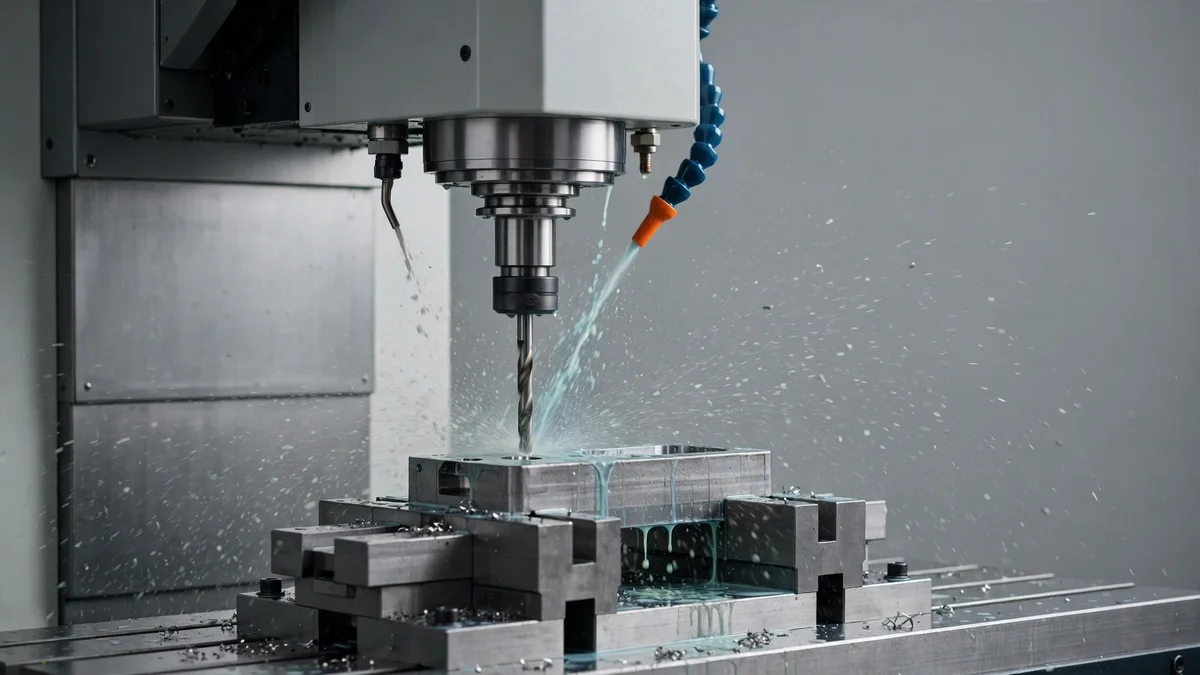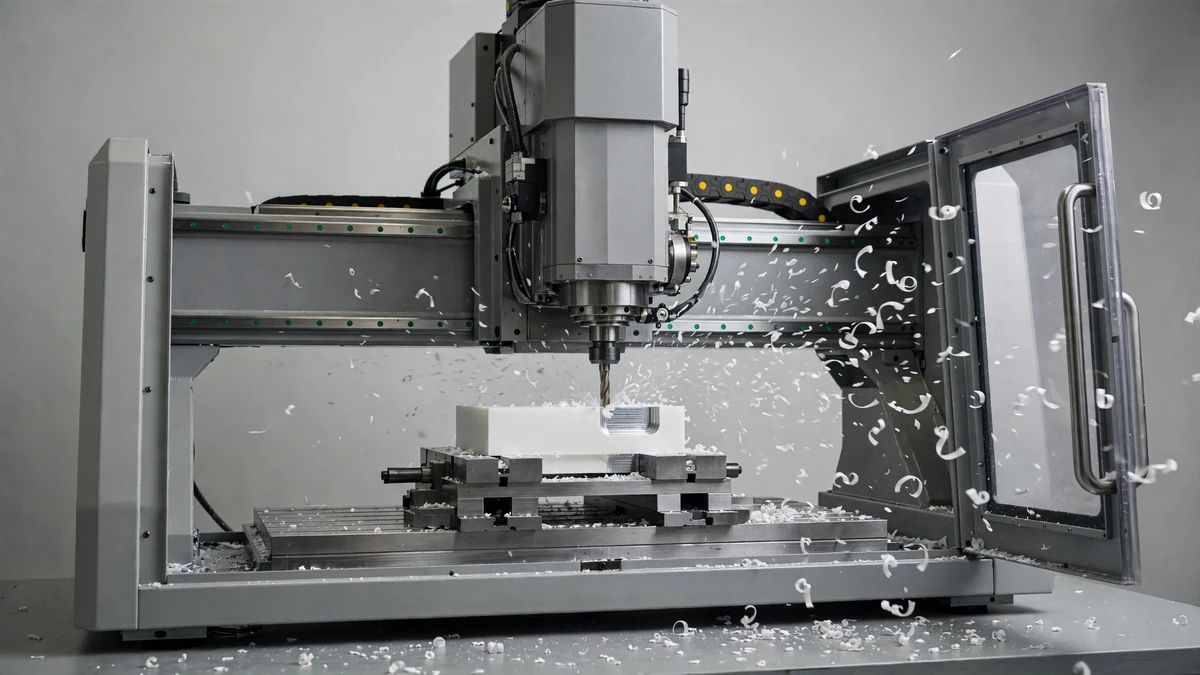
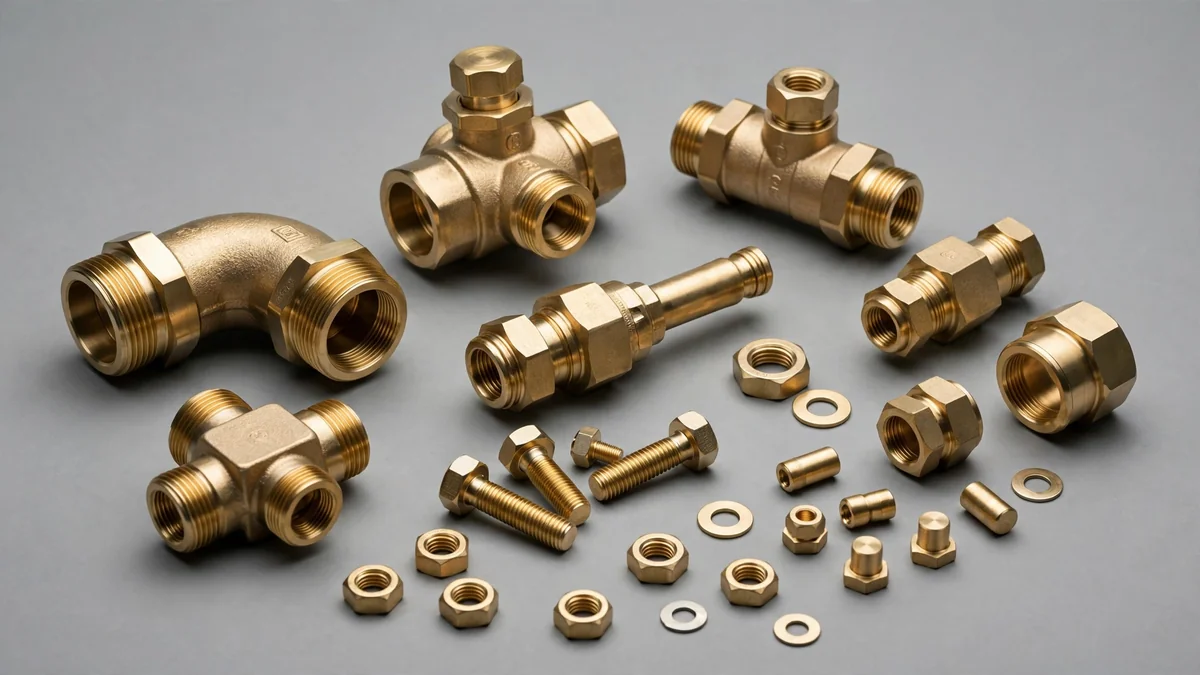
Brass CNC machining is the precision turning and milling of copper-zinc alloys into fittings, connectors, valves and small mechanical parts. Free-cutting brass cuts cleanly, holds a fine finish and breaks into short chips, so it suits small parts in volume. When choosing a CNC machining material for tight tolerances and a good-looking surface, brass is near the top of the list.
This guide covers the grades, speeds, tolerances and finishes that matter, plus the weak points: dezincification, tarnish, lead rules and the parts brass should never be used for. Every number comes from published shop data.
What Is Brass CNC Machining?
Brass CNC machining means cutting brass bar, plate or rod on a CNC lathe or mill to make a finished part. The material is an alloy of copper and zinc, with small amounts of lead in the free-cutting grades. A CNC machine follows a program to turn, mill, drill and tap the part, often in one setup.
Brass suits CNC work because it is soft enough to cut fast and hard enough to hold its shape. Its specific cutting pressure is about one third that of 1018 steel, so tools last longer and cutting forces stay low. Chips break short instead of wrapping around the tool.
Why Brass Cuts So Well
The secret is the zinc. Below about 35% zinc, brass is single-phase alpha brass, which is ductile and cuts with long chips. Above that level a second, zinc-rich beta phase appears, and the alloy becomes alpha-beta brass. The beta phase is harder and more brittle, so it breaks the chip into short pieces.
Lead helps too. The 3% lead in C36000 acts as a lubricant inside the cut, so the tool slides rather than drags and the surface comes out smooth. Lead-free grades lose that help, so they cut with higher force and need lighter finishing passes.
Brass Grades Compared
Five grades cover almost all brass CNC work, and the choice is usually between free-cutting C36000 and cartridge brass C26000. C36000 is the default for machined parts: it cuts the fastest, holds the tightest tolerances and gives the best finish. C26000 suits parts that are drawn or formed as well as machined.
| Grade | Composition (Cu / Zn / Pb) | Machinability | Tensile strength | Hardness | Best for |
|---|---|---|---|---|---|
| C36000 free-cutting brass | 61.5% / 35.5% / 3% | 100% (baseline) | 58,000 psi; yield 124–310 MPa | Brinell 63–130 | Fittings, valves, terminals |
| C35300 | — | 90% | — | — | Plumbing fittings, low-lead parts |
| C38500 architectural bronze | — | 90% | — | — | Architectural hardware, decorative parts |
| C26000 cartridge brass | 70% / 30% / — | 30% | Yield 95 MPa | Brinell 54 | Cartridge cases, decorative parts |
| C46400 naval brass | — | 30% | — | — | Marine hardware, naval parts |
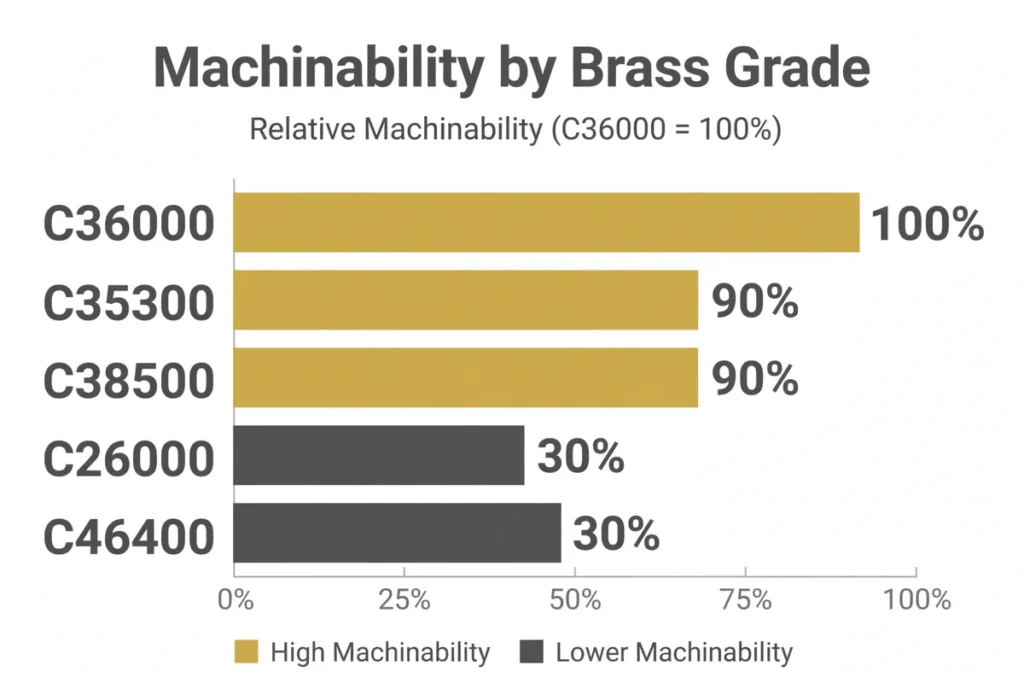
The property tables behind this comparison are published data: C36000 shows 53% elongation, 138 MPa fatigue strength and a density of 8.49 g/cm³, while C26000 shows 65% elongation, 90 MPa fatigue strength and 8.53 g/cm³. Brass as a family spans 300–550 MPa tensile strength and 60–90 HRB hardness.
Cutting Speeds and Feeds
Brass runs fast. On C36000, shop ranges put rough turning at 200–300 m/min with a feed of 0.10–0.25 mm/rev, and finishing at 300–400 m/min with 0.05–0.08 mm/rev. A light finishing pass of 0.15–0.3 mm radial depth gives the best surface. The table unifies the published ranges for brass CNC machining in metric and imperial units.
| Operation | Speed, m/min | Speed, SFM | Feed, mm/rev | Notes |
|---|---|---|---|---|
| Turning, roughing | 200–300 | 500–800 | 0.10–0.25 | — |
| Turning, finishing | 300–400 | 600–1,000 | 0.05–0.08 | Finish pass 0.15–0.3 mm radial |
| Milling | 200–400 | 600–1,000 | 0.10–0.30 rough; 0.05–0.15 finish | Coated carbide |
| Drilling | 80–120 | 200–400 | 0.15–0.25 | 118° jobber drill; no peck on C36000 |
Drilling deserves a note of its own. Use a 118° jobber drill at 80–120 m/min with a feed of 0.15–0.25 mm/rev, and do not peck on C36000 — the short chips clear on their own. On stringier C27400, peck and drop the feed by about 30%. C36000 often runs dry; lead-free grades usually need flood coolant. Treat the table ranges as starting points.
Reading the Chips
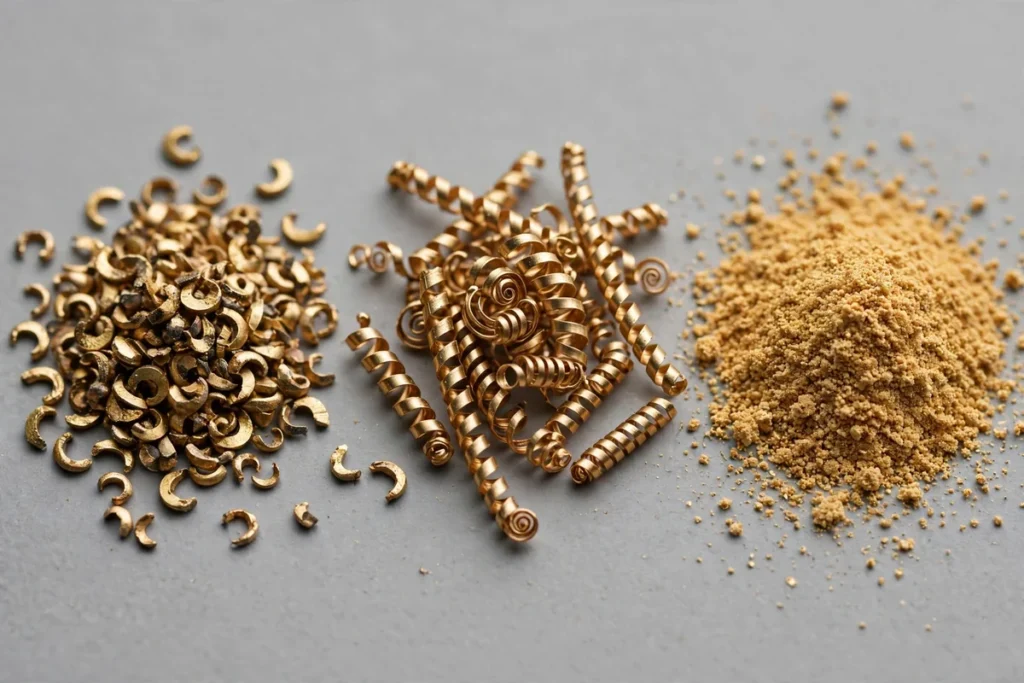
The chips tell you whether the cut is right, and on brass the signal is easy to read. Short comma-shaped chips mean the speed and feed are correct: the material breaks cleanly at the tool. Long spirals mean the feed is too light or the edge radius too large. Powdery chips mean the speed is too high and the tool is rubbing.
Fix the chip before you fix anything else. If the chips are long, raise the feed first; if they are powdery, drop the speed. C27400 is the grade most likely to give trouble, with stringier chips and a risk of built-up edge. C36000 rarely needs attention here, which is another reason it is the default grade.
Tolerances and Surface Finishes You Can Hold
Shops quote three tolerance bands for brass CNC machining, and the guides agree. Standard work holds ±0.05 mm, precision work holds ±0.005 mm on critical features, and micro parts hold ±0.003 mm. The tight band is real — it is quoted by three guides — but it applies to critical features only. Our guide to CNC machining tolerances explains how these bands compare across materials.
| Tolerance class | Value | Where it applies |
|---|---|---|
| Standard | ±0.05 mm | General dimensions, non-critical features |
| Precision | ±0.005 mm | Critical features: bores, threads, mating diameters |
| Micro | ±0.003 mm | Micro parts |
The largest brass part shops quote is about 1,000 mm, though one guide cites a 4,000 mm machine envelope. Finish follows tolerance: standard work runs Ra 0.8–1.6 µm, or 32–64 µin, while a finishing pass reaches Ra 0.2–0.8 µm, or 16 µin and better. Tighten only the features that need it.
Finishes for Brass Parts
Brass CNC machining leaves a good surface straight off the tool, and most parts need little more than a light deburr. The standard as-machined finish runs Ra 0.8–1.6 µm, and a finishing pass takes it to Ra 0.2–0.8 µm. From there the choice is about looks and protection: polish it, plate it, lacquer it, or leave the natural patina to develop.
| Finish | Surface (Ra) | Best use |
|---|---|---|
| As-machined | 0.8–1.6 µm (32–64 µin) | Functional parts, valve bodies, fittings |
| Fine finish (finishing pass) | 0.2–0.8 µm (16 µin or better) | Sealing faces, visible parts |
| Polished and buffed | — | Decorative parts, musical instruments |
| Electroless nickel | Follows the base finish | Wear and corrosion protection |
| Clear lacquer | No change to Ra | Tarnish protection on decorative brass |
| Bead-blasted or brushed | Matte; no Ra quoted | Non-reflective housings |
| Antiqued or patina | — | Decorative hardware |
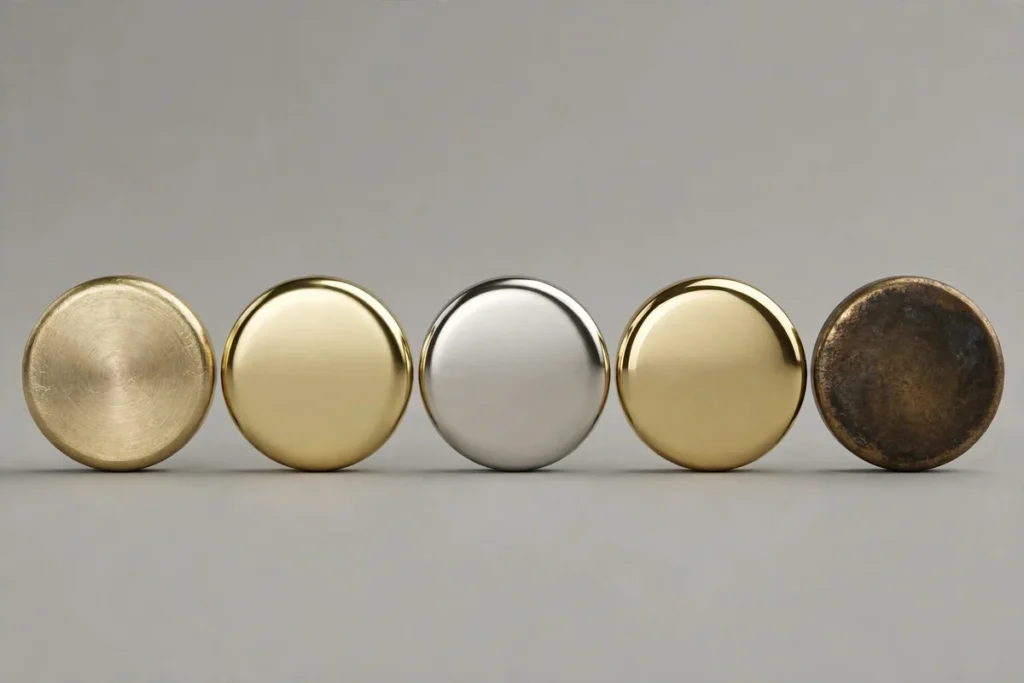
Two warnings matter here. First, anodizing is not a brass finish at all — it is an aluminum process, and any guide that lists it for brass is wrong. Second, plating follows the base finish: a base of Ra 1.6–3.2 µm shows through the plate as a dull patch, so the machining finish must be right before the part goes to plating.
Designing Parts for Brass CNC Machining
Brass parts are designed around the material’s strengths: fast cutting, a fine finish and clean chip breaking. Keep walls thick enough to stay rigid — below 0.5 mm a wall needs a support or a fixture, and walls under 1.5 mm deflect under cutting force. Small holes below Ø1 mm are possible, but chip evacuation is the limit, not drilling force.
Threads need care on small parts. Tapping below M3 loses parts, so use thread milling there — it also beats tapping on lead-free grades, where the material is tougher. Feature limits worth knowing: a 0.8 mm thin wall and a 0.5 mm by 6 mm slot are about the practical minimums. Laser marking needs characters at least 1.5 mm high.
Thin-Wall Brass Machining
Thin walls are the hardest brass parts to make well, because brass is much less stiff than steel and a thin wall bends under the cutting tool. Use soft jaws or a purpose-made fixture so the clamping force spreads over the part instead of pinching one spot. Keep the finishing cuts shallow, between 0.5 and 2 mm.
Five-axis machining helps here, because it reaches the part from the best angle and cuts setup count and datum error. A Ø6 mm cutter is comfortable at three times its diameter in depth, and probing between operations catches movement before it becomes scrap.
Thermal Growth: Measure Warm, Not Cold
Brass grows as it warms, and on a tight part that growth is bigger than the tolerance. A 60 mm C36000 shaft moves 0.02–0.04 mm in diameter between a cold first cut and a warm tenth cut — enough to push a precision bore out of tolerance. Let the machine and material reach working temperature before the finishing pass.
This is also why first-article inspection should happen after the machine has run a few parts, not on the very first one. A cold first part and a warm tenth part can measure differently on the same program.
Brass vs Aluminum, Copper and Bronze
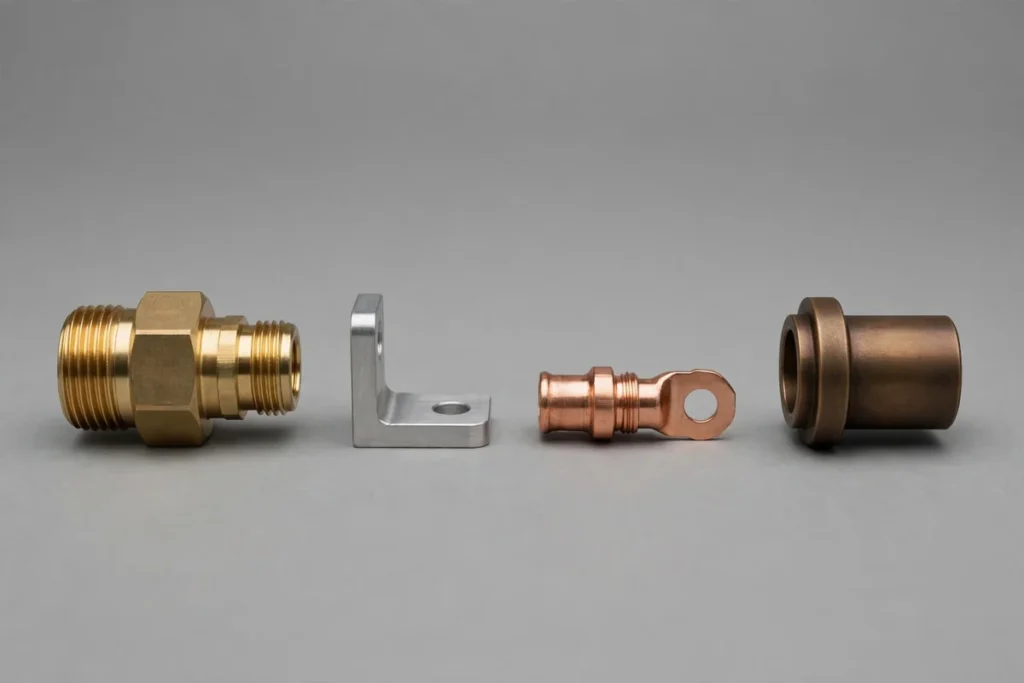
Against aluminum, brass wins on finish and thread quality but loses on weight: brass is about three times denser than aluminum, so a large brass part is heavy and its material bill dominates the cost. Aluminum also anodizes, which brass cannot. Our 6061 vs 7075 aluminum guide covers the aluminum side of that choice.
Against copper, brass wins clearly: pure copper grades like C101 and C110 are gummy, with poor chip breaking and a risk of built-up edge, while brass breaks short chips and holds a fine finish. Against bronze, the picture is closer — architectural bronze C385 machines at 90% and naval brass C464 at 30%, against C36000 at 100%.
When NOT to Use Brass
Brass is the wrong choice for parts that carry a structural load — it is not a strong material, and steel or aluminum will do the job better. It is also wrong for continuous salt spray or chloride service, where dezincification eats the zinc out of the alloy. Service above about 200 °C is another walk-away case.
Weight and size are the other two reasons to walk away. Brass is about three times denser than aluminum, so a large part is heavy for no benefit. And on a large, loose-tolerance part the material bill dominates the price, so the machining advantage of brass never pays back.
Dezincification and Corrosion
Dezincification is the corrosion problem specific to brass. In chloride or salt-spray service, zinc leaches out of the alloy and leaves a weak, porous copper layer behind. The part looks intact but has lost its strength. It is the main reason brass is a poor choice for marine fittings in seawater.
Prevention starts with the grade: high-zinc brasses dezincify faster, so pick a grade suited to the environment. A protective coating such as electroless nickel or clear lacquer helps, and the part should be kept clean and dry in storage.
Lead-Free Brass and Compliance
Lead-free brass, such as silicon brass C69300, replaces the lead with silicon and other elements. It machines well, but not as freely as C36000: cutting forces run higher and finishing passes need to be lighter, so the tolerance ceiling can shift on the tightest features. Quote it when the part touches drinking water or the customer asks for lead-free material.
One warning matters more than any other here: ‘lead-free’ does not automatically mean compliant everywhere. Rules differ by market and by application, and a grade that passes in one place may fail in another. Ask which standard the part must meet, and check the grade against it before quoting.
Cost, Lead Time and Choosing a Supplier
Brass part cost follows the drivers of any machined part: the alloy and its market price, the part geometry and machining time, the tolerance band, and the secondary operations. Material dominates on large parts, machining time dominates on complex ones, and a tight tolerance adds inspection cost on top. Our guide to CNC machining cost explains each driver.
Lead time is short for brass: one shop quotes prototypes in as fast as 3 days, and repeat runs are faster still once the program and tooling are proven. When choosing a supplier, ask four questions: which grades they stock, what tolerances they hold in your material, what their minimum order is, and what secondary work they do in-house.
Frequently Asked Questions
What is CNC machining brass?
CNC machining brass means cutting brass on a CNC lathe or mill to make a finished part. The machine follows a program to turn, mill, drill and tap the part, often in one setup. Free-cutting brass C36000 is the most common grade.
What is the best brass grade for CNC machining?
C36000 free-cutting brass is the best grade for most machined parts. It has the highest machinability rating at 100%, holds the tightest tolerances and gives the best surface finish. C26000 suits drawn or formed parts, and C69300 is the lead-free choice.
How does brass compare to aluminum for CNC machining?
Brass cuts cleaner and holds finer threads than aluminum, and it gives a better as-machined finish. Aluminum is much lighter — brass is about three times denser — and aluminum anodizes, which brass cannot.
What tolerance can brass hold?
Standard brass work holds ±0.05 mm, precision work holds ±0.005 mm on critical features, and micro parts hold ±0.003 mm. The tight band applies to critical features such as bores and threads, not to every dimension.
What finishes can brass parts have?
Common finishes are as-machined, polished and buffed, electroless nickel, clear lacquer, bead-blasted or brushed, and antiqued or patina. Anodizing is not a brass finish — it is an aluminum process.
Is lead-free brass as easy to machine?
Not quite. Lead-free grades such as C69300 cut with higher force than C36000, because they lose the lubricating effect of lead. Finishing passes need to be lighter, and the tolerance ceiling can shift on the tightest features.
What is the smallest hole you can drill in brass?
Holes below Ø1 mm are possible in brass. The limit is chip evacuation, not drilling force: the chips must clear the hole, or the drill breaks. Use a 118° jobber drill at 80–120 m/min with a feed of 0.15–0.25 mm/rev, and do not peck on C36000.
Can you machine a single brass prototype?
Yes. Brass is a good prototype material because it cuts fast, needs little setup beyond the program, and shows the true finish and tolerance of the production part. One shop quotes prototypes in as fast as 3 days.
Conclusion
Brass CNC machining earns its place wherever small parts need tight tolerances, a fine finish and fast turnaround. Free-cutting C36000 is the default grade, the speeds are high, the chips break short, and the finish comes off the tool ready to use.
Before choosing brass, check the part against these rules: size within the machine’s range, a grade that fits the service, tolerances only as tight as the part needs, and a finish chosen before plating. If the part fits, brass will usually beat the alternatives on quality and cost per piece. If you have a brass part in mind, send the drawing to XY Machining for a quote.