CNC turning and CNC milling are the two foundational machining processes, and the difference between them comes down to what moves. In turning, the workpiece rotates while a stationary cutting tool shapes it, which is ideal for round parts like shafts and bushings. In milling, the cutting tool rotates while the workpiece stays fixed, which suits flat and complex prismatic parts like brackets and housings. Most precision parts use one as the primary process, and many use both. Standard machining holds tolerances around ±0.005″, and a capable shop can reach ±0.001″ on critical features, according to Xometry’s overview of CNC machining tolerances.
This guide breaks down each process, the practical differences, how to tell which one your part needs, what each one costs to run, and why so many parts are finished on machines that do both.
What Is CNC Turning?
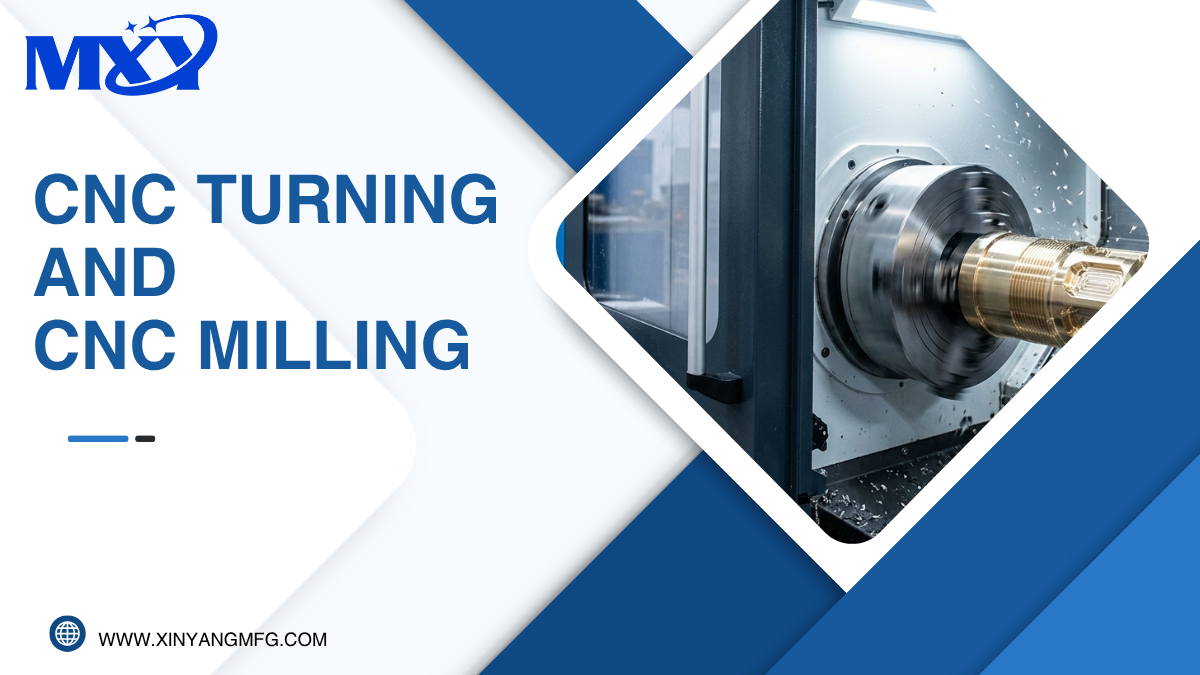
CNC turning shapes a part by spinning it against a stationary cutting tool. The material, usually a round bar, is held in a chuck and rotated at high speed while the tool moves along and across it to remove material. Because the geometry comes from a spinning part and a precise tool path, turning produces accurate round features fast and repeatably — it’s typically the most efficient way to remove material from round stock of any of the common machining processes.
A lathe can turn outside diameters, bore internal holes, cut threads, face the ends, and part off the finished piece, often in a single setup. That efficiency is why turning is the default for anything cylindrical: shafts, pins, bushings, rollers, threaded studs, and fittings. Modern CNC lathes often add live tooling — rotating tools mounted on the turret — which lets the machine mill flats, drill cross-holes, or cut keyways without moving the part to a separate mill, blurring the line between pure turning and pure milling on a single machine.
What Is CNC Milling?
CNC milling does the opposite. The workpiece is clamped in place and a rotating cutting tool moves around it across multiple axes to carve out the geometry. This makes milling the right tool for flat surfaces, pockets, slots, holes in multiple faces, and complex three-dimensional contours that a lathe simply can’t produce.
Milling machines range from 3-axis, where the tool moves in X, Y, and Z, up to 5-axis, where the tool or table also tilts and rotates to reach features from multiple angles in one setup. More axes mean fewer setups, which improves accuracy on complex parts because every time a part is unclamped and repositioned, there’s a chance of introducing alignment error between features. Typical milled parts include brackets, housings, manifolds, plates, and enclosures.
CNC Turning vs. CNC Milling: The Key Differences
The two processes solve different geometry problems. The table below sums up where each one belongs.
| Aspect | CNC-Drehen | CNC-Fräsen |
|---|---|---|
| What moves | Part rotates, tool is stationary | Tool rotates, part is stationary |
| Optimale Geometrie | Round, cylindrical, symmetrical | Flat, prismatic, complex 3D |
| Typische Bauteile | Shafts, pins, bushings, fittings | Halterungen, Gehäuse, Platten, Verteiler |
| Core strength | Fast, precise round features | Versatile, multi-face features |
| Gemeinsame Achsen | 2-axis (plus live/driven tools) | 3-axis to 5-axis |
| Material removal rate on round stock | Generally faster | Slower for purely round geometry |
The simplest way to remember it: if the part looks like it was made on a potter’s wheel, it is a turning part. If it looks like it was carved from a solid block, it is a milling part.
When a Part Needs Both
Plenty of parts are not purely round or purely prismatic. A drive shaft might be turned to its diameters and then need a flat, a keyway, or a cross-hole that only milling can produce. There are two common ways to handle that.
The traditional route turns the part on a lathe, then moves it to a mill for the secondary features. The more efficient route uses a turn-mill (or mill-turn) center, a single machine with a rotating spindle plus driven milling tools, which can turn diameters and mill features in one setup. Doing it in one setup removes handling between machines, which reduces the chance of misalignment and tightens the achievable tolerance between turned and milled features on the same part. For parts that combine round and prismatic features, this is usually the better path, though turn-mill capacity is more limited at most shops than dedicated lathes and mills, so it’s worth confirming a supplier actually has the equipment before assuming it’s available.
Workholding and Surface Finish Differences
The two processes also differ in how the part is held and what surface finish comes off the machine by default. Turning typically holds the part in a three-jaw or collet chuck, which centers round stock automatically and grips it firmly across the entire rotating cycle — this is part of why turned round features are so repeatable. Milling relies on vises, custom fixtures, or vacuum tables to hold a part that doesn’t have a natural centerline, which means fixture design is a bigger part of the engineering work on a milled part than on a turned one.
Surface finish also differs by default. A turned surface, cut by a tool moving in a continuous helical path around a rotating part, tends to leave a fine, consistent finish on cylindrical features without extra work. A milled surface, especially one cut with a ball-nose tool over a 3D contour, can show visible tool-path marks unless a finishing pass or additional polishing is specified. Neither is inherently “better” — they’re just different by-products of how each process removes material, and it’s worth specifying the finish your part actually needs rather than assuming the as-machined result will look a particular way.
How to Decide Which Process Your Part Needs
A few quick questions point you to the right primary process:
- Is the part mostly round? If the dominant geometry is cylindrical, start with turning.
- Is it mostly flat or block-shaped? If features are spread across multiple faces, start with milling.
- Does it have both? Plan for a turn-mill center or a turning-then-milling sequence, and call that out in your drawing so the shop quotes it correctly the first time.
- How tight are the critical features? The tighter the tolerance, the more value there is in minimizing setups, which favors multi-axis milling or turn-mill machines over a multi-step process with several handoffs.
Getting this right at the design stage matters. A part designed around the wrong primary process costs more and takes longer, so it is worth a quick Prüfung der Fertigungsgerechtheit before the drawing is final — a feature that’s trivial to mill might require an awkward, slow secondary operation if the part was designed assuming it would be turned, and vice versa.
Tolerances, Cost, and Materials
Both processes work across the same broad material range: aluminum, stainless and carbon steels, brass, bronze, titanium, and engineering plastics like Delrin, nylon and PEEK. Standard machining holds tolerances around ±0.005″, with ±0.001″ or tighter achievable on critical features when the workholding, tooling, and inspection are right. The practical rule is to specify tight tolerances only where the part’s function needs them, since every extra increment of precision adds inspection time and cost, regardless of whether the part is turned or milled.
Cost behaves somewhat differently between the two. Turning is generally the cheaper process per cubic inch of material removed from round stock, since the continuous rotating cut is efficient and a single lathe operation can often combine several features — OD, bore, threads, face — that would take multiple setups on a mill. Milling costs scale more with geometric complexity than with raw volume: a simple flat plate mills quickly, while a part with deep pockets, thin walls, and multiple orientations can take far longer per part than its size would suggest, because each feature and each setup adds machine time independent of the material being removed.
Bei XY-Bearbeitung, we run both CNC-Drehen und CNC millin, including multi-axis work, with DFM feedback on every quote so we can flag early whether a part is better turned, milled, or finished on a turn-mill center.
Häufig gestellte Fragen
What is the difference between CNC turning and milling?
In CNC turning the workpiece rotates against a stationary tool, which suits round parts. In CNC milling a rotating tool cuts a stationary part, which suits flat and complex geometry. Turning is best for cylindrical features; milling is best for multi-face and 3D features.
Can the same machine do both turning and milling?
Yes. A turn-mill or mill-turn center combines a rotating spindle with driven milling tools, so it can turn diameters and mill features in one setup. This reduces handling and improves accuracy on parts that need both processes, though not every shop has turn-mill capacity, so it’s worth confirming availability.
Which is more accurate, turning or milling?
Neither is inherently more accurate; accuracy depends on the machine, tooling, workholding, and inspection. Both hold standard tolerances around ±0.005″ and can reach ±0.001″ or tighter on critical features in a capable shop.
Do I need turning or milling for my part?
Use turning if the part is mostly round, like a shaft or bushing. Use milling if it is mostly flat or block-shaped with features on multiple faces. Parts with both are best made on a turn-mill center or by turning then milling.
What materials can be turned and milled?
Both processes handle aluminum, stainless and carbon steel, brass, bronze, titanium, and engineering plastics such as Delrin, nylon, and PEEK. Material choice affects cutting speed, tool wear, and surface finish.
Is turning or milling cheaper?
Turning is generally cheaper per unit of material removed from round stock because the cut is continuous and efficient. Milling cost scales more with geometric complexity — pockets, thin walls, and multiple setups — than with part size, so the cheaper option depends on the specific geometry, not a blanket rule.