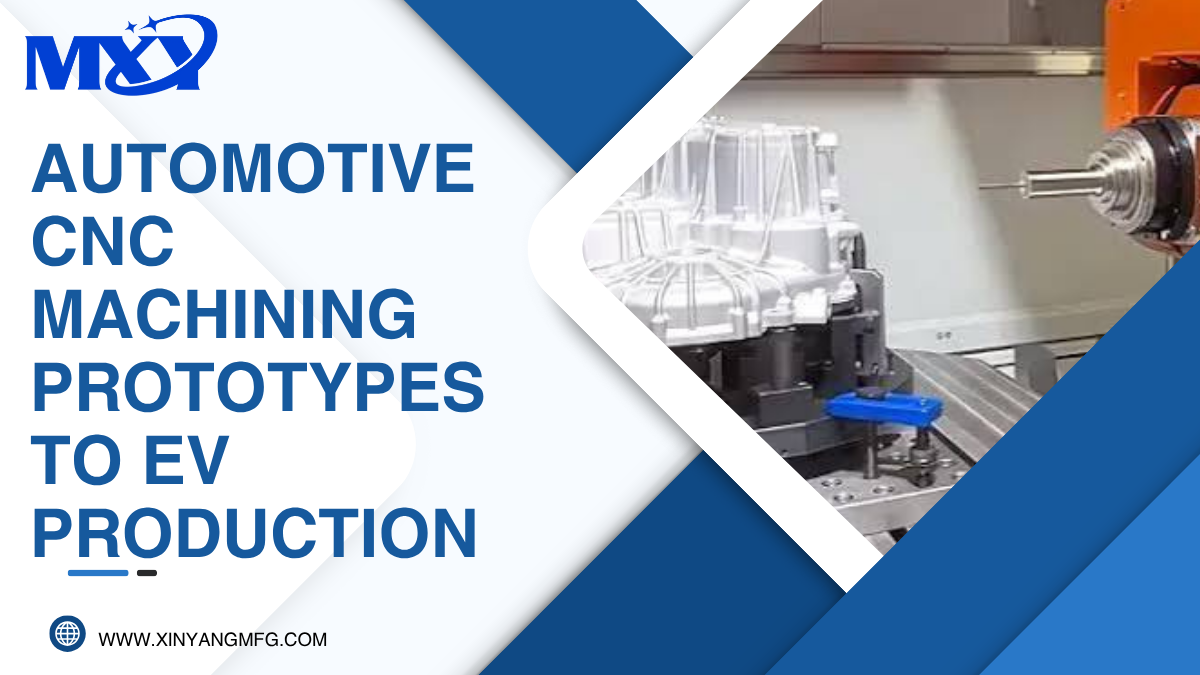
Automotive CNC machining is the precision manufacture of vehicle components — from engine, transmission, and suspension parts to the battery housings and motor components driving the EV transition — usually under the IATF 16949 automotive quality standard. It spans the full lifecycle: quick-turn machined prototypes for design validation, and high-volume production where consistent quality across thousands of identical parts is the priority. Materials run from fast-machining aluminum for lightweight EV structures to hardened steels for drivetrain parts. What defines the field is the demand for repeatable accuracy at scale, because a tolerance that drifts across a production run becomes a field failure, not just a scrap part.
This guide covers the applications, 資料, quality standards, and sourcing considerations for automotive machining, including how the EV shift is changing demand.
Where CNC Machining Fits in Automotive Manufacturing
Automotive relies on CNC加工 for engine, transmission, and suspension parts, producing consistent quality across high-volume production. It shows up at two points in particular: early in development, where engineers need accurate machined prototypes to validate a design before committing to expensive production tooling, and in production, where machined parts either run at volume directly or support the tooling, jigs, and fixtures that make other processes — stamping, casting, injection molding — work correctly.
The common thread is repeatability. An automotive program might need the same part produced identically tens of thousands or even millions of times across the life of a vehicle platform, which puts the emphasis on process control as much as on the machining itself. A part that’s perfect on the first article but drifts slightly by unit 50,000 is a bigger problem in automotive than in almost any other industry, because the cost of a field issue multiplied across a production run dwarfs the cost of the part itself.
Common Automotive Machining Materials
Material choice balances performance, weight, and cost across very different parts:
- Aluminum alloys: widely used for engine components, housings, and lightweight structural parts, and increasingly for EV battery enclosures and motor housings where weight savings extend range. 6061 and 7075 are common grades depending on whether strength or machinability is the priority.
- Steels and alloy steels: used for drivetrain, transmission, and suspension parts that need strength and wear resistance under repeated cyclic loading.
- Stainless steels: used where corrosion resistance matters, including exhaust and certain fluid-handling components.
- Engineering plastics: used for lightweight, non-structural, and electrically insulating components, increasingly important in EV programs where insulating high-voltage systems is a design requirement, not an afterthought.
The shift toward lightweighting, especially in EVs, has pushed aluminum and other lightweight materials into a larger share of machined automotive work, since every kilogram saved in a structural or housing component directly extends battery range.
The Standard: IATF 16949
The automotive industry’s quality benchmark is IATF 16949, a standard built on ISO 9001 with additional automotive-specific requirements for defect prevention, process control, and consistency across the supply chain. It was developed and is maintained by the International Automotive Task Force, a group of automotive manufacturers and their trade associations including Ford, GM, Stellantis, Volkswagen Group, and others, working alongside the Automotive Industry Action Group (AIAG) in North America.
For production automotive parts, most OEMs and Tier 1 suppliers expect their machining suppliers to work to IATF 16949, because it is designed around exactly the challenge automotive faces: holding quality steady across very large volumes using a defined set of “core tools” — Advanced Product Quality Planning (APQP), Production Part Approval Process (PPAP), Failure Mode and Effects Analysis (FMEA), Statistical Process Control (SPC), and Measurement Systems Analysis (MSA) — that are specific to the automotive sector and not part of general ISO 9001. Certification is site-specific and tied to an active customer relationship in the automotive supply chain; a shop generally needs a request for quotation or an active bid from an IATF-member OEM or Tier 1 before it can pursue registration. When sourcing production parts, confirm whether your program requires IATF 16949 or whether a baseline ISO 9001 system is sufficient for your application.
Prototyping vs. Production Machining
Automotive machining splits into two distinct modes. プロトタイピング prioritizes speed and flexibility: engineers need accurate parts quickly to test fit, function, and performance, and to iterate before tooling is cut. A prototype machining supplier needs to turn drawings into functional metal parts in days, not weeks, and needs to be comfortable with designs that are still changing. Production prioritizes consistency and cost per part: once a design is locked, the focus shifts to producing identical parts efficiently at volume with tight process control, often supported by the full IATF 16949 core-tool documentation set.
A supplier that handles both lets a program move from validation to production without switching partners, which preserves the design and process knowledge built up during development. CNC machining is well suited to the prototyping phase because it produces real, functional metal parts from the same materials the production part will use — unlike 3D-printed prototypes, a machined prototype behaves mechanically and thermally like the eventual production part, which matters when the test is validating real-world performance, not just fit.
How EVs Are Changing Automotive Machining
The electric-vehicle transition is reshaping which parts get machined. Internal-combustion engine components — cylinder heads, crankshaft features, fuel-system parts — are giving way to EV-specific parts: battery enclosures and housings, electric motor components, power-electronics housings, and thermal-management parts that keep battery packs and inverters within their operating temperature range. Many of these favor aluminum for its light weight and thermal properties, and several require tight tolerances and clean sealing surfaces, since a battery enclosure that doesn’t seal properly is both a safety and a warranty problem.
For machining suppliers, that means more lightweight-aluminum work and a growing emphasis on the sealing and thermal features those systems depend on — flatness on a battery tray mating surface, surface finish on a cold-plate channel, position tolerance on motor-housing bearing bores. These are different priorities than the wear-resistance and fatigue-life concerns that dominated internal-combustion drivetrain work, and a supplier that has genuinely adapted its process controls to EV-specific features is a meaningfully different proposition than one simply repurposing legacy ICE machining capability.
Typical Automotive Machined Parts
CNC machining produces a broad range of automotive components, including engine parts, transmission and gearbox components, suspension and steering parts, brake components, EV battery housings and enclosures, electric motor and power-electronics housings, and prototype parts across all of these for validation. Many combine tight tolerances with high volume, which is where process control and the right quality system matter most.
How to Source Automotive CNC Machining
Before sending a drawing, confirm four things: whether your program requires IATF 16949 certification or whether ISO 9001 is sufficient, whether you need prototyping, production, or both, the inspection and process-control documentation (PPAP-level, if required) that will accompany the parts, and the projected volumes so the supplier can plan fixturing and quote the production price accurately rather than pricing it as a one-off. Then confirm tolerances and material certifications in writing.
XY Machining provides CNC machining with fast DFM feedback and prototype-to-production support, and serves the automotive sector through its dedicated automotive solutions, including lightweight aluminum work relevant to EV programs. [XY Machining: insert your specific automotive credentials here — for example, IATF 16949 certification status — to strengthen this section with verifiable, named claims.]
よくある質問
What is automotive CNC machining?
Automotive CNC machining is the precision manufacture of vehicle components, from engine, transmission, and suspension parts to EV battery housings and motor components, typically under the IATF 16949 automotive quality standard, across both prototyping and high-volume production.
What materials are used in automotive machining?
Aluminum alloys are widely used for engine components, housings, and EV battery enclosures; steels and alloy steels for drivetrain, transmission, and suspension parts; stainless steels where corrosion resistance matters; and engineering plastics for lightweight, insulating parts.
What quality standard applies to automotive machining?
IATF 16949 is the automotive industry’s quality management standard, built on ISO 9001 with added requirements for defect prevention and consistency across high volumes, including automotive-specific tools like PPAP, FMEA, and SPC. Most OEMs and Tier 1 suppliers expect production machining suppliers to work to it.
How is the EV transition changing automotive machining?
EVs shift demand from engine parts toward battery enclosures, electric motor and power-electronics housings, and thermal-management parts. Many of these favor lightweight aluminum and require tight sealing and thermal features, increasing aluminum machining work and shifting quality priorities toward sealing surfaces and thermal performance.
Can one supplier handle both automotive prototypes and production?
Yes, and it is an advantage. A supplier that does both lets a program move from validation to production without changing partners, preserving the design and process knowledge built up during prototyping.
Does every automotive supplier need IATF 16949 certification?
Not necessarily. IATF 16949 registration generally requires an active request for quotation or bid from an automotive OEM or Tier 1 supplier. Many prototyping and lower-tier suppliers operate to ISO 9001 instead; whether you need full IATF 16949 depends on your program and your direct customer’s requirements.