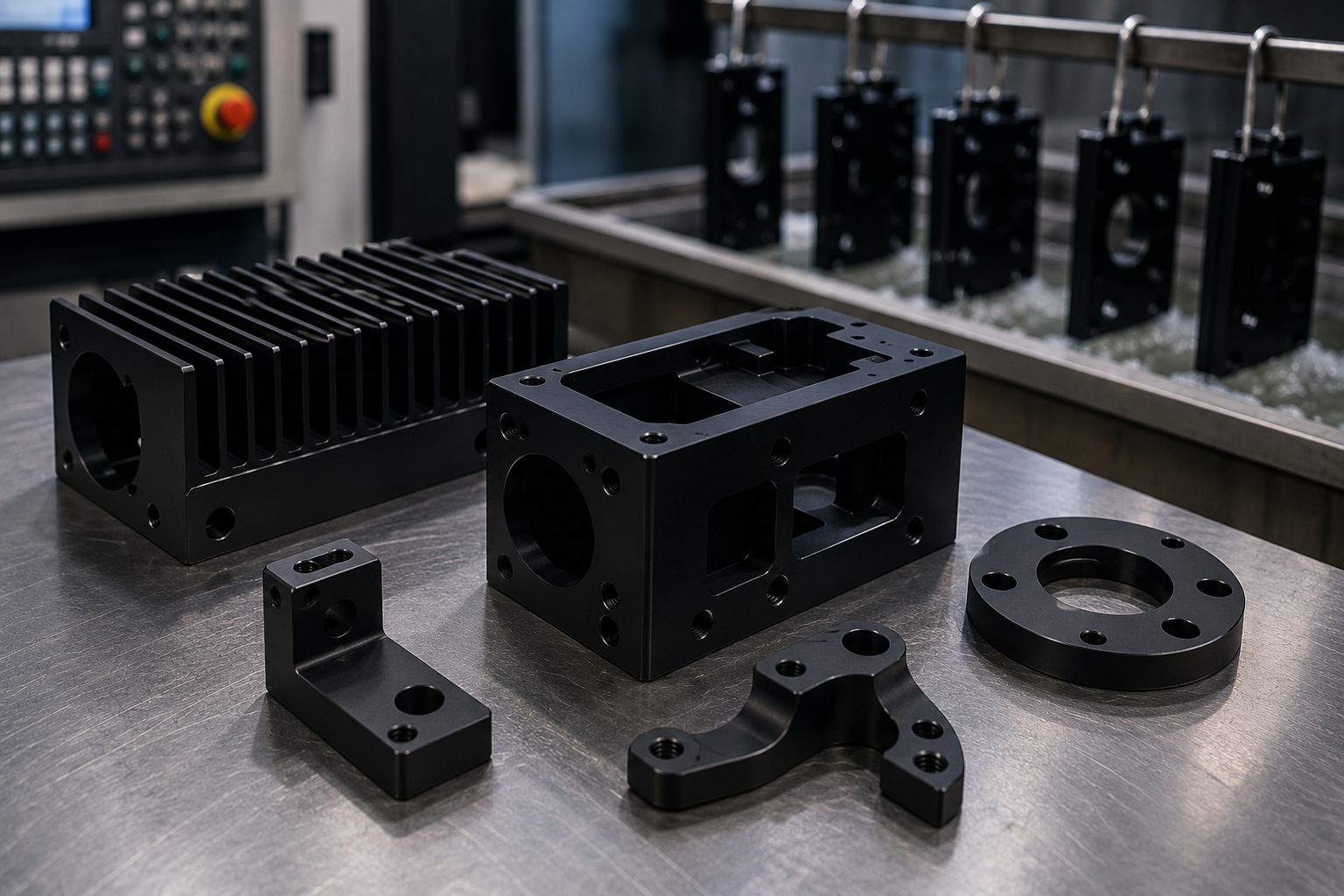
That deep, even black on a laptop hinge, a camera body, a rifle receiver? Almost always anodized aluminum. And it isn’t painted. Paint sits on top and eventually chips. Anodizing turns the surface itself into a hard oxide and locks the dye down inside its pores, so the color wears with the metal instead of flaking off it. For an engineer, black anodize is one of the best-value finishes going on aluminum: it toughens the surface, kills glare, and looks sharp all in a single step.
I’ll walk through how black anodizing actually works, how Type II and Type III differ, what it does to your dimensions (this is the part people miss), and where it earns its keep. It’s one slice of our wider surface finishing options, but it deserves its own deep dive, because so many aluminum parts call for it without the designer really knowing what it changes about the part.
What Anodizing Actually Does
At heart it’s electrolytic oxidation. The part becomes the anode in an acid bath — usually sulfuric — you run current through it, and oxygen from the electrolyte converts the outer skin of aluminum into aluminum oxide. Here’s the key difference from a coating: this layer grows out of the base metal, so it’s part of the part. It can’t delaminate. The fresh oxide is porous, which is exactly what lets the black dye soak deep into the surface. Then a sealing step closes those pores, traps the dye, and locks in corrosion resistance. Since it only works on aluminum and its alloys, anodizing pairs naturally with CNC aluminum machining — and honestly, it’s one of the big reasons people pick aluminum to begin with.
Type II vs Type III Black Anodizing
The one decision that matters most is Type II versus Type III. Same basic chemistry, pushed to two different extremes, and they suit very different jobs.
| 属性 | Type II (decorative) | Type III (hard anodize) |
| Typical thickness | 5–25 µm | 25–100 µm |
| 硬度 | 中等 | Very high (near case-hardened steel) |
| Appearance | Glossy to satin black | Matte, dark grey to black |
| Wear resistance | 好 | 非常棒 |
| Dimensional growth (per surface) | ~2–8 µm | ~12–50 µm |
| 成本 | 较低 | 更高 |
| 最适合 | Consumer, cosmetic, indoor | Wear surfaces, aerospace, military |
Type II is your default for cosmetic and general parts — enclosures, panels, brackets. Type III, the hard anodize, lays down a thicker, far harder layer for anything that slides, wears, or needs extra corrosion protection: pistons, valve bodies, guide rails. The catch is dimensional. Type III grows the part a lot, which lands us on the detail engineers overlook more than any other. The full mechanics live in our anodizing dimensional change guide.
The Detail Everyone Misses: Dimensional Growth
Anodizing doesn’t just coat the surface. It grows it. The oxide builds partly outward and partly into the base metal, so the part gets bigger overall. With Type II the growth is tiny — a few microns a surface. With Type III it can add tens of microns per surface, which means a hole shrinks and a shaft grows by that much on every face. On a tight fit, that’s the whole difference between a part that assembles and one that seizes solid.
So the pros machine external features a touch undersize and internal ones a touch oversize, so the part lands in tolerance after anodizing. Threads and press fits need extra care — threads can bind, and press fits can over-interfere once the oxide shows up. Got critical fits? Read our anodizing and press-fit tolerance guide, and call the finish out properly on the drawing using the conventions in our anodizing drawing callout guide. Get that callout right up front and you save yourself a scrapped batch down the line.
Benefits of Black Anodizing
So what does black anodize actually buy you?
- Corrosion resistance — the sealed oxide shrugs off oxidation and mild chemical exposure.
- Wear resistance — Type III especially, which rivals hardened steel at the surface and fights abrasion.
- Color that won’t chip or peel — the dye lives in the pores, so a scratch doesn’t flake the finish off.
- Electrical insulation — the oxide is non-conductive, handy for electronics enclosures and isolators.
- Glare control — matte black soaks up stray light in optics and camera assemblies.
- Easy upkeep — anodized surfaces wipe clean and hide fingerprints better than bare aluminum.
Anodizing vs Other Black Finishes
Anodize isn’t the only way to blacken aluminum. Powder coat and black paint exist too, and bead blasting changes the texture without adding color. Each has its place. Powder coat lays down a thicker, more impact-resistant skin, but it buries fine detail and piles on more thickness than Type II does. Bead blasting usually happens before anodizing to create that signature even matte look — so the two work together rather than compete, as our bead blasting vs anodizing comparison lays out.
| Finish | Chips/peels? | Adds thickness | Conductive? | 最适合 |
| Type II anodize | 不 | 极简 | 不 | Cosmetic aluminum parts |
| Type III anodize | 不 | 中等 | 不 | Wear + corrosion critical parts |
| 粉末涂层 | Can chip | 高 | 不 | Impact resistance, thick color |
| Black paint | 是 | 低 | 不 | Low-cost, non-critical color |
| Bead blast (pre-anodize) | 不适用 | 无 | 是 | Uniform matte texture base |
常见应用
Black anodize shows up anywhere aluminum has to look good and last. Consumer electronics use it on phone and laptop housings. Aerospace and defense spec hard anodize on wear surfaces and for low reflectivity. Optics and photography lean on matte black anodize to kill internal reflections. Industrial gear uses it on knobs, panels, and guide rails that get handled all day. Firearms and tactical kit favor it for the mix of toughness and looks. Different industries, same reason every time: a finish that’s part of the metal, not just stuck to it.
Design Tips for Anodized Parts
A few things that save headaches:
- Pick an anodizing-friendly alloy — 6061 takes a clean, even black; some casting alloys blotch.
- Account for dimensional growth on every critical feature before you machine, Type III especially.
- Mask or plug threads and press fits if they have to stay at the machined size.
- Spell out type, thickness, and color on the drawing so there’s no guessing.
- Ease sharp external edges — anodize builds unevenly on a knife edge; a small radius finishes cleaner.
Alloy choice matters more than most designers expect. Still picking a grade? Our 6061 vs 6063 aluminum comparison covers how different alloys take a black finish.
常见问题解答
Does black anodizing fade in sunlight?
Organic black dyes can fade under long UV exposure. For outdoor parts, spec a UV-stable or inorganic dye, or go Type III — its thicker oxide holds color better. Indoors, standard black dye stays put for years.
How much does anodizing change part dimensions?
Type II adds roughly 2–8 µm a surface; Type III can add 12–50 µm a surface. On tight fits that’s a lot, so plan the machined size around the growth and let the finished part settle into tolerance.
Can you anodize all aluminum alloys?
Most wrought alloys anodize well, and 6061 and 6063 are excellent. High-silicon casting alloys and some 2000/7000-series grades can come out patchy or take on a grey or yellowish tint. Match the alloy to the look you’re after.
Is anodizing better than painting?
For aluminum, usually yes. Anodize is integral, so it doesn’t chip or peel, it resists wear and corrosion, and it needs no primer. Paint can hit custom colors anodize can’t — but it lacks the durability of an oxide layer that’s part of the metal.
结论
Black anodize turns bare aluminum into a durable, corrosion-resistant, sharp-looking part — with color that’s baked into the metal. Go Type II for cosmetic parts, Type III where wear and toughness rule, and design around the growth every time. Done right, it’s one of the best-value finishes in manufacturing. To spec black anodize on your 数控加工件, or price out Type II against Type III, 索取报价 with your drawing and finish notes.
About the Author
xinyangmfg Engineering Team — Senior Manufacturing Engineer, 12 years in precision CNC machining
xinyangmfg Engineering Team has managed anodizing on thousands of aluminum parts, from cosmetic consumer enclosures to Type III hard-anodized wear components for industrial equipment. Specializing in lining machining tolerances up with finishing growth so parts still fit after anodizing, Hasib writes to help designers dodge the dimensional surprises that scrap otherwise-good batches.