Nylon CNC machining turns engineering plastic into gears, bushings, bearings and wear parts that metal cannot match for weight and quiet running. But nylon moves: it absorbs moisture, expands with heat and springs back after clamping. If nylon is one of several options, start with our guide to choosing a CNC machining material.
What Is Nylon CNC Machining?
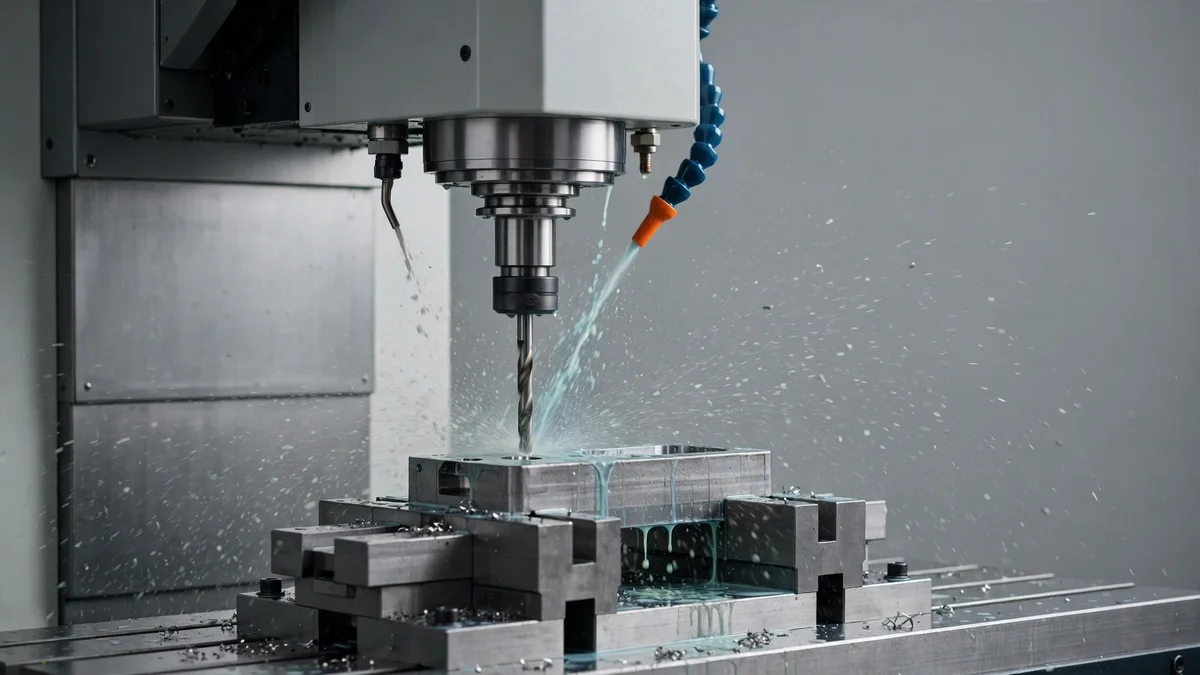
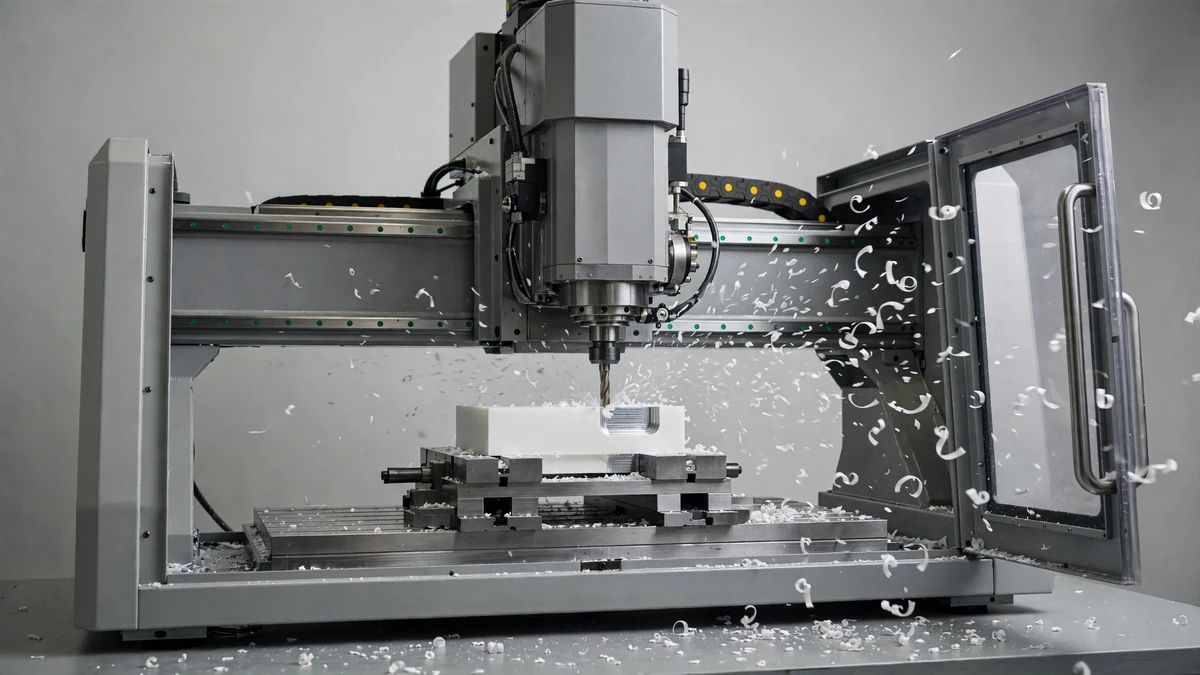
Nylon CNC machining is milling, turning and drilling of nylon stock on a standard CNC machine. Cutting forces run only 10–30% of aluminum’s, so feeds can be high and tools last well on unfilled grades. The challenge is what happens after: moisture, heat and residual stress move the part once it leaves the fixture.
Nylon parts suit work where metal is too heavy, too noisy or too expensive: gears, bushings, rollers, wear pads, insulators and sliding components. Low friction suits moving parts, and toughness suits impact loads. Glass-filled grades add stiffness where plain nylon is too flexible, at the cost of faster tool wear.
Nylon Grades Compared: PA6, PA66 and Glass-Filled
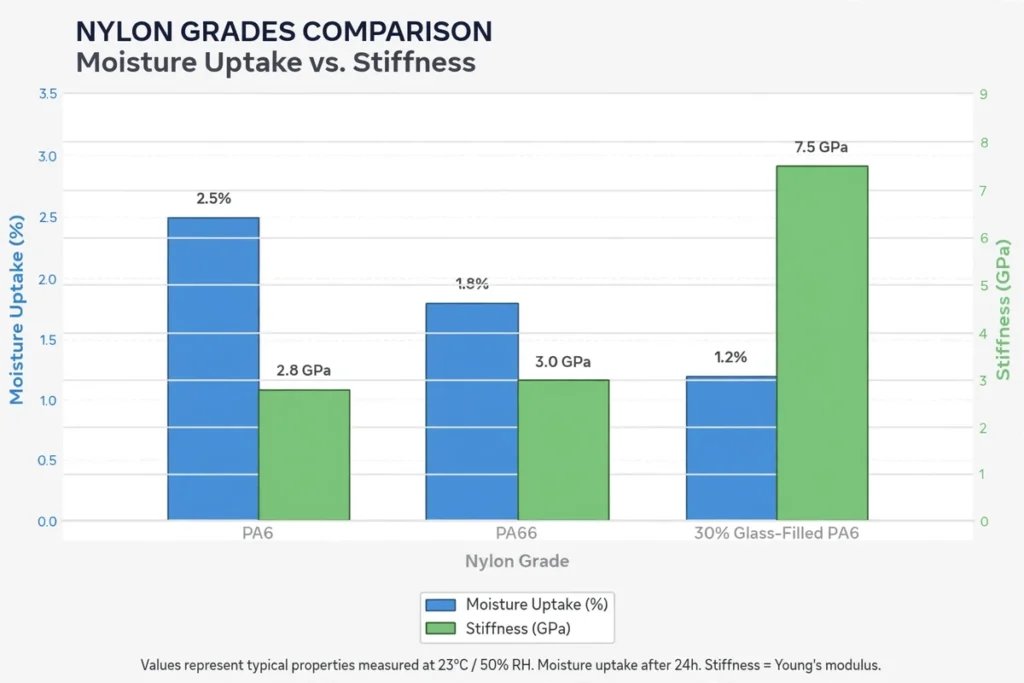
Grade choice sets strength, heat limit and moisture behaviour before a single cut. PA6 is the common all-rounder: tough, wear-resistant and easy to machine, melting at 215–220 °C. PA66 is stiffer and stronger, melts at 255–260 °C and absorbs slightly less water. Cast nylon (PA6G) has lower internal stress and machines more stably in large sections.
Glass-filled nylon (30% glass fibre) roughly doubles or triples stiffness: flexural modulus rises from 2.5–3.2 GPa unfilled to 7.0–9.0 GPa, and heat deflection reaches 180–200 °C. The trade-off is brittleness: elongation falls from 50–100% to 2–5%, and glass filler wears tools fast. Oil-filled and MoS2 grades add lubricity for bearings; PA11 and PA12 absorb far less water but are rarely stocked.
| 属性 | Nylon 6 (PA6) | Nylon 6/6 (PA66) | 30% glass-filled PA6 |
|---|---|---|---|
| 抗拉强度 | 70–80 MPa | 80–90 MPa | 150–190 MPa |
| 弯曲模量 | 2.5–3.0 GPa | 2.8–3.2 GPa | 7.0–9.0 GPa |
| Elongation at break | 50–100% | 40–60% | 2–5% |
| Impact strength | 50–80 J/m | 60–90 J/m | 80–120 J/m |
| 硬度 | R110–120 | R115–125 | R120–130 |
| 密度 | 1.13–1.15 g/cm³ | 1.14–1.16 g/cm³ | 1.35–1.40 g/cm³ |
| Thermal expansion | 80–100 µm/m·K | 70–90 µm/m·K | 20–40 µm/m·K |
| 热变形温度 | 60–80 °C | 80–100 °C | 180–200 °C |
| 吸水率 | 1.5–2.0% | 1.0–1.5% | 0.8–1.2% |
| 熔点 | 215–220 °C | 255–260 °C | 215–220 °C |
Moisture: The Dimension That Moves After the Cut
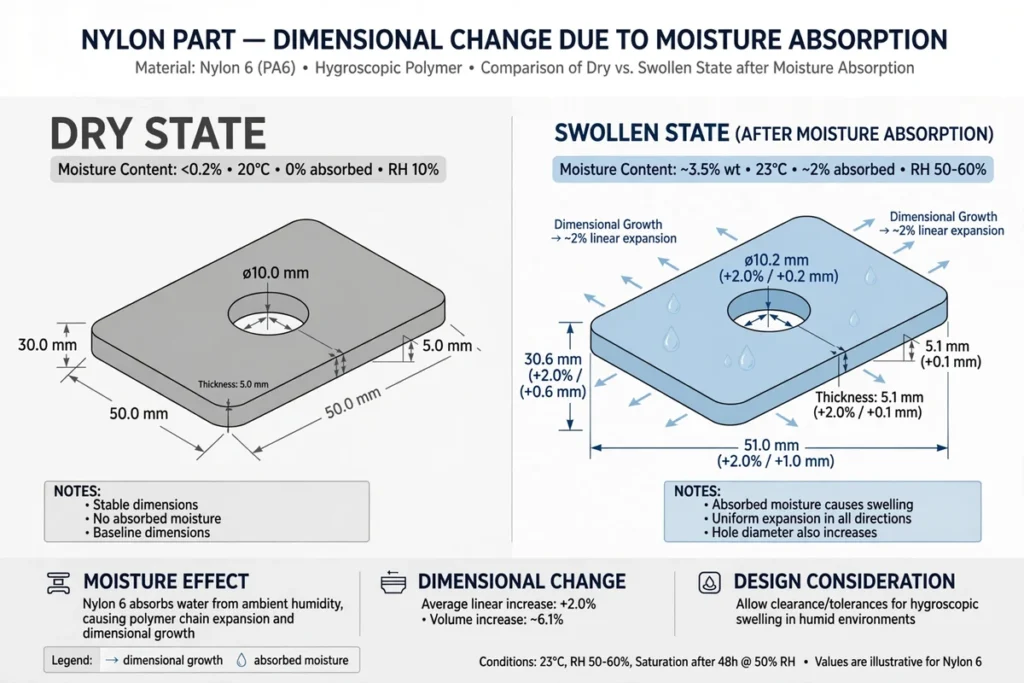
Moisture is the biggest cause of nylon parts measuring out of tolerance. PA6 absorbs 2.5–3% water by weight at 50% relative humidity, PA66 slightly less, and PA12 under 1%. Immersed, PA6 can take up to 10% over time. The often-quoted 1.5–2.0% figure is a 24-hour test value, not the equilibrium figure — always check the measurement condition first.
The growth is what matters. A 100 mm PA6 bar grows 0.2–0.3 mm at normal humidity, and from fully dry to fully saturated it can grow about 2% — 2.0 mm on a 100 mm part. At saturation the modulus falls about 30% and tensile strength 15–25%. A part measured dry and one measured damp are effectively two different parts.
| 年级 | Condition | Moisture uptake | Growth on a 100 mm part |
|---|---|---|---|
| PA6 | 50% relative humidity (equilibrium) | 2.5–3% | 0.2–0.3 mm |
| PA6 | Immersed until saturated | up to 10% | about 2.0 mm (2% linear, dry to saturated) |
| PA66 | 50% relative humidity (equilibrium) | slightly lower than PA6 | slightly less than PA6 |
| PA12 | 50% relative humidity (equilibrium) | under 1% | well under 0.1 mm |
| PA6 | 24-hour immersion test | 1.5–2.0% | not an equilibrium figure |
Drying and Conditioning Before Machining
Dry the stock before cutting, or the part changes size after it leaves the machine. Drying schedules disagree: 75–85 °C for 4–6 hours, 80 °C for 3–4 hours, or 80–100 °C for 4–24 hours. The most quoted schedule is 80 °C for 8–12 hours — treat that as the starting point, adjusting for thickness and moisture.
After machining, let the part stabilise before measuring it. Conditioning at 20–25 °C and 40–60% relative humidity for 24–48 hours is the usual guidance, 72 hours for thick sections. Measure after stabilisation, not straight off the machine, and bag finished parts with desiccant.
Tolerances You Can Realistically Hold
The realistic working tolerance for nylon parts is ±0.05 mm — the consensus across the guides. Tighter work is possible: ±0.02 mm on conditioned stock and small features, ±0.005 mm only on short, thick features that have been dried and conditioned. Our guide to CNC machining tolerances compares these numbers with metals — nylon needs wider tolerances because the material itself moves.
Watch the millimetre-inch trap. One guide quotes ‘±0.005 inches’ as its general nylon tolerance — 0.127 mm, far looser than the ‘±0.005 mm’ claimed elsewhere, and the two are often confused. Aerospace claims of ±0.0005 inches are vendor claims for specific parts, not a standard. Expect Ra 0.8–1.6 µm as machined, with Ra 0.2–0.8 µm reachable only at the cost of surface whitening.
| 应用 | Realistic tolerance | 注释 |
|---|---|---|
| Non-critical features | ±0.13 mm | General machining |
| 精密零件 | ±0.05 毫米 | The realistic consensus |
| High-precision parts | ±0.025 毫米 | Conditioned stock |
| Specialty / aerospace claims | ±0.013 mm | Vendor claims, not a standard |
| Short, thick features only | ±0.005 毫米 | After drying and conditioning |
| General tolerance quoted in inches | ±0.005 in = 0.127 mm | The mm/inch trap |
Cutting Parameters That Work on Nylon
Nylon CNC machining cuts fast, but the numbers disagree — treat every figure below as a starting range to validate with test cuts. Roughing runs 300–600 m/min unfilled and 150–300 m/min glass-filled; finishing runs faster, 600–1200 m/min unfilled and 300–600 m/min filled. Other guides quote lower ranges, 100–300 and 150–300 m/min, which is why test cuts matter more than any single table.
Feed rates run 0.05–0.3 mm per tooth for milling; drilling runs 200–400 m/min unfilled or 100–200 m/min filled. Turning runs 400–800 m/min unfilled and 200–400 m/min filled. Keep radial engagement light — about 20–40% of the tool diameter — and use climb milling with an air blast to clear nylon’s stringy chips. Avoid flood coolant: water adds moisture to a material already fighting it.
| Operation | Unfilled nylon | Glass-filled nylon | Feed / notes |
|---|---|---|---|
| Roughing | 300–600 m/min | 150–300 m/min | 0.05–0.3 mm/tooth |
| 精加工 | 600–1200 m/min | 300–600 m/min | 0.05–0.3 mm/tooth; light radial cuts |
| 转动 | 400–800 m/min | 200–400 m/min | 150–500 ft/min (one guide) |
| 钻探 | 200–400 m/min | 100–200 m/min | 500–1000 RPM (one guide) |
Tooling: What to Use on Unfilled vs Glass-Filled Nylon
Unfilled nylon is kind to tools: high-speed steel works, and sharp two-flute carbide end mills with a high helix angle (35–45°) cut cleanly. Rake angles of 10–20° and generous relief keep the tool from rubbing, which melts nylon and leaves a gummy edge. For long runs, carbide stays sharp longer than HSS.
Glass-filled nylon is a different story: the glass fibre is abrasive and dulls edges fast, so carbide is the minimum and PCD tooling earns its keep on long runs. Expect shorter edge life and higher tooling cost. Drills need a 90–118° point angle, and holes come out oversize by 0.1–0.2 mm, so drill undersize or ream to size.
From Stock to Finished Part: The Machining Sequence
A reliable nylon job follows a sequence, not a single setup. Dry the stock, rough both sides with 0.8–1.5 mm left on, and rest the part 4–12 hours so stress can relax. Finish with light radial cuts of 0.15–0.4 mm, deburr by hand, and bag the part with desiccant. Some shops rest it a full 24 hours and straighten long parts by hand.
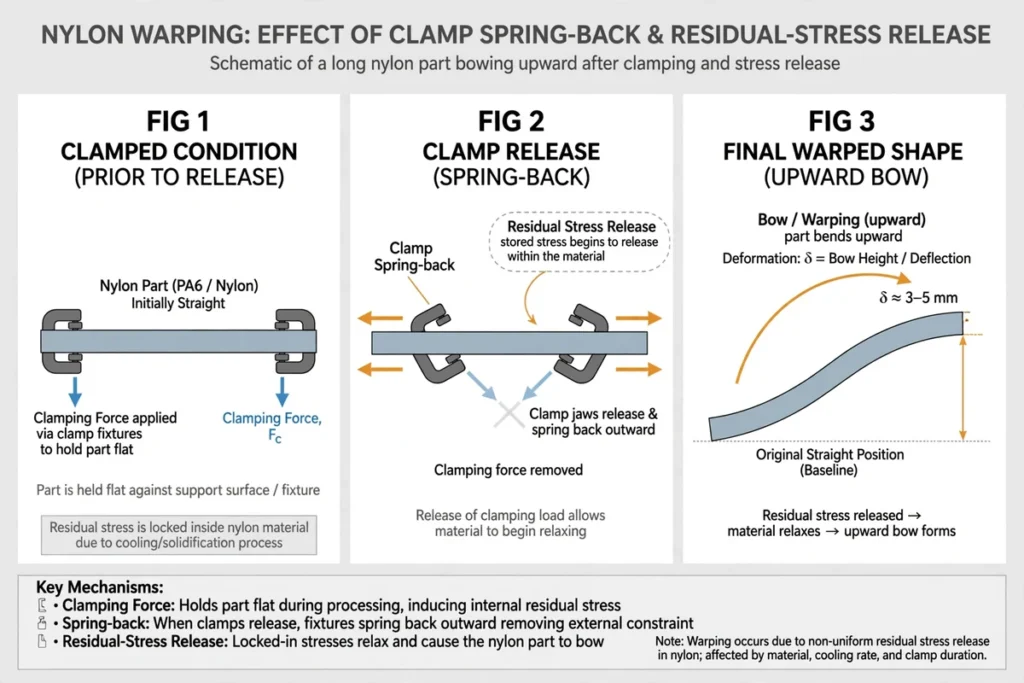
Clamp lightly and support the part: soft jaws, vacuum fixtures or a backing plate spread the load — a hard clamp springs the soft plastic and the part bows when released. Measure with a light touch — a micrometer can squeeze a thin nylon wall — and consider non-contact measurement on thin sections. Inspect after finishing and stabilisation, not before, or the numbers will move.
Design Rules for Nylon Parts
Design nylon parts around movement, not nominal sizes. Keep walls 1.5–5 mm thick — 2–4 mm is the sweet spot — and core out bosses thicker than 50 mm, which shrink unevenly. Give internal corners a 0.5–1.0 mm radius so the tool can cut them cleanly, and use metal inserts for repeated assembly; machined threads should be M4 or larger.
Split tolerances: hold tight numbers only where needed, because every tight tolerance costs inspection time and scrap risk. Remember creep — nylon flows under a steady bolt load, so use wider washers and glass-filled grades where preload must hold. Thinnest sections: about 0.5 mm generally, 0.38 mm cast, 1 mm glass-filled.
Annealing and Stress Relief After Machining
Annealing relaxes stress from extrusion and machining — the reason a part warps days after it measured fine. The recipes disagree: one gives 150–160 °C for 2 hours, cooling no faster than 20 °C per hour; another gives about 300–350 °F, the same range; a third says 10–15 °C below the glass transition temperature for 2–4 hours. Pick the schedule that matches the grade.
Anneal after roughing and after finishing when the part is long or thin: rough, anneal, rest, then finish. The extra day is cheaper than a warped part that has to be remade. If a part still moves after annealing, the cause is usually moisture, not stress — dry it, condition it, and measure again before changing the program.
CNC Machining vs Injection Molding Nylon
CNC machining wins at low volumes, while the design is still changing, or where a few features need tight tolerances. Injection molding wins at high volume, where tooling cost spreads over thousands of parts. High-volume glass-filled work is usually cheaper molded than machined. Our comparison of injection molding vs CNC machining covers the same decision.
Rule of thumb: prototypes and small batches go to the mill; production runs go to the mold. Machining avoids the mold cost entirely. At high volumes the mold pays for itself, especially for glass-filled grades where machining wears tools. Design the part for the process that will make it — a machined part and a molded part are not the same drawing.
Nylon vs POM, PEEK and Aluminum
Nylon’s rivals are POM (acetal), PEEK and aluminum, and each wins in a different corner. POM is the dimensionally stable one: far less moisture uptake, so parts hold size across humidity. PEEK is the high-temperature plastic, for service above 100–150 °C where nylon fails. Aluminum is the metal option when stiffness and heat matter most. Our UHMW vs HDPE guide makes the same comparison for another pair.
The numbers explain the choice. Nylon PA6 holds 70–80 MPa tensile and 2.5–3.0 GPa flexural modulus; glass-filled nylon reaches 150–190 MPa and 7.0–9.0 GPa. Nylon also cuts at only 10–30% of aluminum’s cutting forces, so it machines fast. Pick nylon for wear parts and gears; POM for dimensional stability; PEEK for heat; aluminum when the part must be stiff and hot.
When NOT to Use Nylon
Nylon is the wrong material in four situations. First, where dimensions must stay stable across humidity: a part in tolerance in a dry shop can fail in a damp warehouse. Second, above about 120 °C, where it softens and loses strength. Third, in contact with strong acids or steam. Fourth, where a surface better than Ra 0.8 µm is required — nylon rarely holds it.
In those cases use POM for dimensional stability, PEEK for heat, or a metal where stiffness and temperature matter most. Nylon is also a poor implant material and cannot be steam-autoclaved, so medical parts that need sterilisation belong elsewhere. The rule is simple: if the environment fights nylon’s weaknesses, pick a material without them.
What Nylon CNC Machining Costs (and How Long It Takes)
No guide publishes real per-part prices for nylon machining, so treat any dollar figure elsewhere with suspicion. Cost follows five drivers: grade, volume, tolerance, finishing, and drying and annealing time. Glass-filled grades cost more twice over — dearer material and faster tool wear. Tight tolerances add inspection time and scrap risk; every extra finishing step adds a setup.
Lead time is mostly drying, conditioning and finishing, not cutting. One shop quotes within 12 hours and ships in 3–5 days, but thick parts need 24–72 hours of conditioning first, and annealing adds a day. Allow drying before the cut, a rest after roughing, and stabilisation before inspection — the cutting itself is the fast part.
Where Nylon Parts Are Used
Nylon earns its place in wear and motion: gears, bushings, bearings, rollers and wear pads sliding against metal all day. Automotive and EV work uses it for gears, guides and under-hood parts that need toughness and oil resistance. Medical and lab equipment uses it for instrument housings — never as an implant, never where steam sterilisation is required.
Industrial equipment is the broadest user: conveyor rollers, chain guides, pulleys, valve seats and machine guards. Consumer goods use it for zippers, housings and small mechanisms, and aerospace uses it for light-duty bushings and guides. In every case the reason is the same: nylon is tough, slippery and light, and it survives where brittle plastic would crack.
常见问题解答
Can nylon CNC machining hold ±0.005 mm?
Only on short, thick features that have been dried and conditioned. The realistic working tolerance is ±0.05 mm, and ±0.02 mm is achievable on conditioned stock. Claims of ±0.005 mm on ordinary parts should be treated with suspicion — and check whether the figure is millimetres or inches.
Will my nylon part grow after it leaves the shop?
Yes, if it picks up moisture. PA6 absorbs 2.5–3% water at 50% relative humidity, and a 100 mm part grows 0.2–0.3 mm. From fully dry to fully saturated it can grow about 2%. Dry the stock before machining, condition the part before measuring, and bag it with desiccant for shipment.
Do I need to dry nylon before machining?
Yes. Drying schedules disagree — 75–85 °C for 4–6 hours, 80 °C for 3–4 hours, or 80–100 °C for 4–24 hours — but 80 °C for 8–12 hours is the most quoted schedule. Dry the stock, then keep it dry until the part is finished and bagged.
Should nylon parts be annealed after machining?
Usually yes, especially for long or thin parts. Anneal at 150–160 °C for 2 hours, cooling no faster than 20 °C per hour, relaxes the stress that makes parts warp days later. Other guides give about 300–350 °F or 10–15 °C below the glass transition temperature — pick the one that matches the grade.
Can you machine glass-filled nylon?
Yes, with carbide tooling at minimum and PCD on long runs. Cut glass-filled grades slower — roughing 150–300 m/min against 300–600 m/min for unfilled nylon — and expect shorter edge life. The filler makes the material much stiffer and more heat-resistant, but parts turn brittle, with elongation of only 2–5%.
Nylon or POM — which should I choose?
Choose POM when dimensions must stay stable across humidity, because it absorbs far less moisture than nylon. Choose nylon for toughness, wear resistance and low cost on gears, bushings and sliding parts. Above 100–150 °C, neither is right — look at PEEK or a metal instead.
What surface finish can I expect on nylon?
Expect Ra 0.8–1.6 µm as machined, with Ra 1.6–3.2 µm on rougher work. Ra 0.2–0.8 µm is reachable with sharp tools and light finishing cuts, but the surface can whiten. Better than Ra 0.8 µm is a known limitation — if the drawing demands it, use a secondary process or a different material.
How long does a nylon CNC order take?
One shop quotes within 12 hours and ships in 3–5 days, but that is the cutting time, not the whole job. Thick parts need 24–72 hours of conditioning first, and annealing adds a day. Ask for the full schedule — drying, machining, rest, finishing, stabilisation — not just the ship date.
结论
Nylon CNC machining rewards shops who respect the material’s movement: dry the stock, cut with sharp tools, anneal and rest it, and measure only after stabilisation. If the part must hold size across humidity, survive above 120 °C, or carry a finish better than Ra 0.8 µm, use POM, PEEK or a metal instead. If you have a nylon part in mind, send the drawing to XY Machining for a quote.