What is an overmolding service, how does overmolding work, which materials can be combined, and when should manufacturers use overmolding for prototypes or production parts?
An overmolding service combines two or more materials into a single finished component by molding one material over an existing substrate or component. The process can improve grip, sealing, impact resistance, insulation, appearance, and overall product functionality. Common overmolding combinations include rigid plastics with TPE or TPU, plastic substrates with rubber-like materials, and certain metal inserts combined with thermoplastic materials. The right process depends on the substrate, overmold material, production volume, geometry, required bond strength, and tooling strategy. XY Machining provides overmolding through its custom injection molding service, alongside insert molding, LSR molding, rapid tooling, and production tooling.
Overmolding is not simply a cosmetic operation. A well-designed overmold can consolidate multiple components, reduce assembly steps, create a comfortable grip, protect electronics, improve sealing, and add functional flexibility to an otherwise rigid part. However, the material combination and interface must be engineered carefully. Poor material compatibility, inadequate mechanical interlocking, unsuitable wall thickness, or incorrect tooling can result in weak bonding, flash, warping, or dimensional problems.
What Is Overmolding?
Overmolding is an injection molding process in which a second material is molded over a previously manufactured substrate. The substrate can be a rigid plastic component, metal insert, electronic component, or another suitable part.
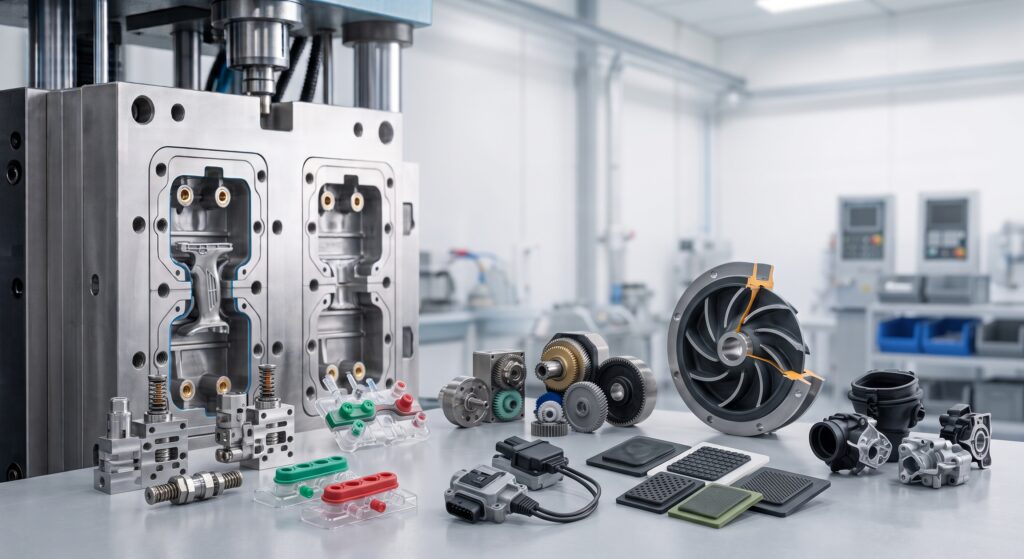
There are several ways to manufacture an overmolded component. In insert overmolding, the first component is produced separately and then placed into a second mold where the overmold material is injected around it. In two-shot molding, both materials are molded within an integrated production process, often using specialized equipment that transfers or rotates the first molded component into a second cavity.
The choice between these approaches depends largely on production volume, material compatibility, part geometry, tooling investment, and automation requirements.
Why Use an Overmolding Service?
The primary benefit of overmolding is part integration. Instead of manufacturing separate components and assembling them afterward, manufacturers can combine different materials into one finished part.
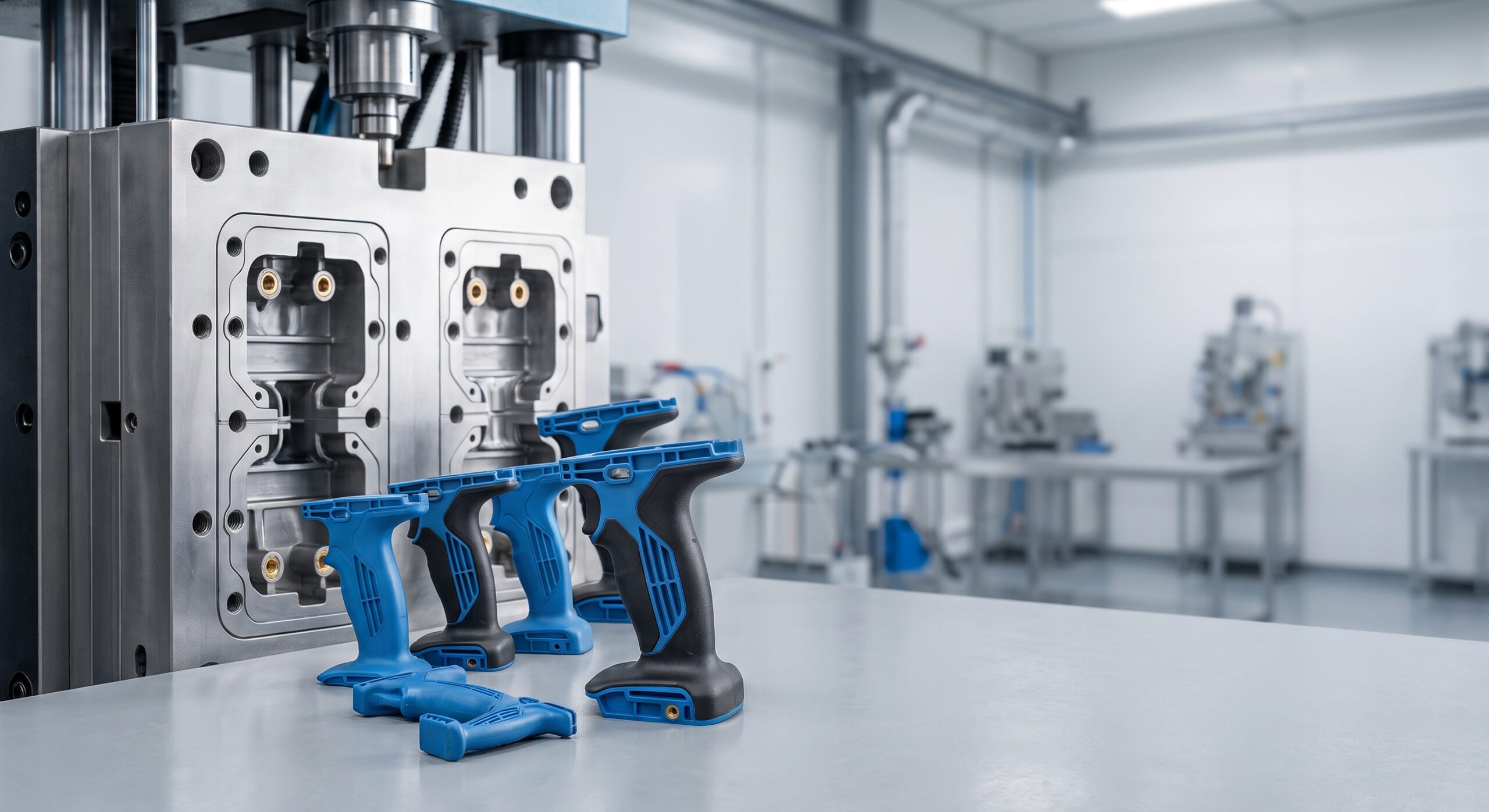
For example, a rigid plastic housing can receive a soft TPE grip. A metal insert can be surrounded by plastic to create a finished mounting component. An electronic component can be encapsulated or protected by a suitable polymer.
Overmolding can also reduce assembly operations. Fewer individual parts can mean fewer fasteners, fewer adhesive operations, less manual labor, and fewer opportunities for assembly errors.
The process can also improve the user experience. Soft-touch surfaces can make handles more comfortable, while elastomeric materials can provide improved grip and vibration absorption.
XY Machining describes overmolding as a process that combines multiple materials into a single part to improve grip, sealing, strength, and functionality.
Common Overmolding Materials
Material selection is one of the most important decisions in an overmolding project. The substrate and overmold must work together mechanically and, where applicable, chemically.
Common overmold materials include TPE, TPU, silicone, and other thermoplastic elastomers. The substrate can include materials such as ABS, PC, PC/ABS, nylon, polypropylene, and other engineering plastics. Metal inserts such as aluminum, brass, or steel can also be used when the design and molding process are appropriate.
The correct material pair depends on the required hardness, flexibility, temperature resistance, chemical exposure, surface feel, color, durability, and bonding method.
For example, a consumer electronics grip may prioritize soft-touch feel and abrasion resistance, while an industrial seal may prioritize chemical resistance and compression behavior.
Material Compatibility Matters
Two materials that appear visually compatible may not bond effectively during molding. Chemical compatibility, melt temperature, surface condition, shrinkage, and processing conditions can all affect the interface.
Some combinations can create a strong molecular bond, while others require mechanical interlocking, primers, surface treatments, or specially formulated materials.
This is why material selection should be completed before tooling begins.
Insert Molding vs. Two-Shot Overmolding
Insert molding and two-shot molding are related but different manufacturing approaches.
Insert molding starts with a separately manufactured substrate. The substrate is positioned inside a mold, and the second material is injected around it. This approach provides flexibility because the substrate and overmold can be produced independently.
Two-shot molding produces both materials using a specialized multi-material molding process. It can provide excellent repeatability and high production efficiency when the design and material pair are suitable.
| Fator | Insert Overmolding | Two-Shot Overmolding |
| Substrato | Made separately | Usually molded within same production cycle |
| Ferramentas | Two-stage tooling approach | Specialized multi-material tooling |
| Automation | Can be manual or automated | Highly automatable |
| Initial investment | Often lower | Usually higher |
| Volume de produção | Prototype to high volume | Best suited to medium/high volume |
| Material flexibility | Broad, depending on substrate | Depends on machine and material pairing |
| Labor | May require substrate loading | Lower manual handling after setup |
| Alterações no projeto | Substrate and overmold can be modified separately | Changes can affect integrated tooling |
| Best use | Flexible production and lower volumes | High-volume repeat production |
For startups or companies validating a new product, insert overmolding may provide a better balance between tooling cost and manufacturing flexibility. At larger volumes, two-shot molding can become attractive because automation and cycle-time efficiency can reduce the per-part cost.
XY Machining’s 2026 overmolding cost analysis similarly distinguishes true two-shot molding from insert overmolding and notes that production volume and material pairing strongly influence the economics.
Overmolding Design Guidelines
Overmolding should be considered during product design rather than added after the main component has already been finalized.
The substrate needs enough structural integrity to withstand molding pressure and temperature. It must also be positioned securely within the mold so it does not shift during injection.
Mechanical interlocking features can be useful when the materials do not naturally form a strong chemical bond. Undercuts, holes, grooves, ribs, and other features can allow the overmold material to physically lock around the substrate.
At the same time, excessive undercuts can complicate tooling and increase cost. The goal is to create sufficient retention without making the mold unnecessarily complicated.
Wall thickness should also be considered carefully. Uneven sections can contribute to warping, sink marks, inconsistent cooling, or dimensional variation.
Parting Lines and Flash
Parting-line location is especially important in overmolding because the interface between mold sections can influence both appearance and sealing performance.
If the parting line crosses a highly visible surface, it may leave an undesirable witness mark. If it crosses a sealing area, flash could interfere with the component’s function.
The manufacturer should review the parting line during DFM before the mold is manufactured.
Bonding and Mechanical Retention
Overmolding can rely on either chemical adhesion, mechanical retention, or a combination of both.
Chemical adhesion occurs when the overmold material bonds directly to the substrate. This requires a compatible material pair and suitable processing conditions.
Mechanical retention uses physical geometry to lock the second material around the first component. This approach can be useful when chemical bonding is weak or unavailable.
For example, an overmold can flow through holes or around specially designed ribs in a rigid substrate. Once cured or cooled, the overmold becomes physically locked to the substrate.
A strong overmold design should not depend on a material bond alone if the application is exposed to significant pulling, twisting, temperature changes, or chemical exposure.
Overmolding for Soft-Touch Products
Soft-touch overmolding is widely used for consumer products because it can improve ergonomics and grip.
Hand tools, power tools, medical equipment, electronic devices, automotive controls, wearable products, and sports equipment can all benefit from elastomeric surfaces.
The hardness of the overmold influences the final feel. A softer material can provide cushioning and grip, while a harder elastomer may offer greater abrasion resistance and structural stability.
Texture also matters. Molded textures can change grip characteristics and hide minor cosmetic imperfections.
For consumer products, engineers should test the complete assembly rather than evaluating the elastomer in isolation. The substrate shape, grip thickness, texture, hardness, temperature, and surface contamination can all influence the user’s perception.
Overmolding for Sealing and Protection
Overmolding can also provide functional protection.
An elastomeric layer can create a barrier around selected areas of a component, helping protect against moisture, dust, vibration, and physical impact when the design and material are appropriate.
Electronics manufacturers may use overmolding to protect cables, connectors, switches, sensors, and other components.
However, overmolding should not automatically be considered waterproof. The final protection level depends on material selection, interface design, mold quality, process control, and validation testing.
If a specific IP rating or environmental requirement is needed, the finished component should be tested against the relevant standard rather than relying solely on the molding process.
Tooling for Overmolding
Tooling is one of the largest cost drivers in an overmolding project.
A simple insert-overmolding application may require a mold for the substrate and a second mold for the overmold. A two-shot design may require a more sophisticated mold with multiple cavities, transfer mechanisms, or rotary equipment.
The tool material also affects cost and durability. Aluminum tooling can be useful for prototypes and lower-volume work, while hardened steel can be appropriate for high-cycle production.
XY Machining offers rapid tooling and production tooling as part of its injection molding capabilities. Its published mold information distinguishes prototype and low-volume tooling from higher-volume mold classes designed for much longer production life.
The right tooling strategy should therefore be based on expected lifetime volume rather than simply selecting the cheapest mold.
Overmolding Manufacturing Process
The process generally begins with a CAD and DFM review.
The manufacturer confirms the substrate geometry, overmold thickness, parting line, gate position, venting, retention features, material compatibility, and mold design.
The substrate is then manufactured, inspected, and prepared for overmolding. If an insert is used, its dimensions and surface condition must be controlled because variation in the insert can directly affect the overmolded part.
The insert is positioned in the mold, manually or automatically depending on the production setup. The second material is injected around the substrate and fills the intended cavity.
After cooling or curing, the completed part is removed and inspected.
The first article is particularly important because it allows engineers to check bonding, dimensions, flash, cosmetic appearance, substrate movement, and functional performance before full production.
What Affects Overmolding Cost?
Overmolding cost depends on the substrate, overmold material, tooling, part geometry, production quantity, cycle time, labor, inspection, and finishing requirements.
Tooling can be a major upfront expense, particularly for two-shot production. Insert molding may have lower initial tooling costs but can introduce additional labor if substrates need to be loaded manually.
Material cost also matters. TPE, TPU, silicone, and specialized elastomers can have different pricing and processing requirements.
Part geometry affects both mold complexity and cycle time. Deep cavities, difficult undercuts, thin walls, complex textures, and tight tolerances can all increase manufacturing effort.
Production volume is another major factor because the tooling and setup costs are spread over the number of parts produced.
| Fator de custo | Lower-Cost Scenario | Higher-Cost Scenario |
| Ferramentas | Simple aluminum or prototype mold | Complex hardened-steel multi-cavity tool |
| Processo | Manual insert molding at low volume | Automated two-shot molding |
| Material | Standard TPE or TPU | Specialized high-performance elastomer |
| Geometria | Simple overmold profile | Complex undercuts and thin sections |
| Volume | Small production run | High-volume program with complex tooling |
| Inspeção | Standard dimensional checks | Tight tolerances and extensive validation |
| Acabamento | Molded surface | Additional cosmetic or secondary operations |
For a detailed understanding of how manufacturing design choices influence costs, XY Machining’s Guia de custos de usinagem CNC explains the relationship between material, geometry, tolerances, setup, finishing, and production quantity. While it focuses on CNC machining, many of the same cost principles apply to overmolding because unnecessary complexity increases processing and inspection requirements.
Overmolding vs. Traditional Assembly
One of the main reasons manufacturers choose overmolding is to reduce assembly.
Consider a product handle made from a rigid plastic core and a separate rubber grip. Traditional manufacturing may require producing both components and then assembling or bonding them.
Overmolding can combine these stages into one finished component.
This can reduce part count and potentially improve consistency. It can also eliminate separate fasteners or adhesives where the overmold provides sufficient retention.
However, overmolding is not automatically cheaper. The tooling investment and molding process need to be compared against the cost of the traditional assembly method.
The correct comparison should include tooling, materials, labor, scrap, cycle time, inspection, and expected production volume.
Overmolding Applications
Overmolding is used across consumer, industrial, automotive, electronics, medical, robotics, and other product categories.
Consumer electronics can use soft-touch overmolds for grips, buttons, protective housings, and wearable interfaces.
Automotive products can use overmolding for switches, handles, controls, connectors, and protective components.
Industrial tools can benefit from elastomeric grips that improve handling and reduce vibration.
Medical and healthcare products can use multi-material molding for certain grips, housings, seals, and functional components, subject to appropriate material and regulatory requirements.
Robotics and automation equipment can use overmolding where electrical protection, grip, cushioning, or part consolidation is needed.
The application determines the required material and validation method. A cosmetic consumer component and an industrial sealing component should not be evaluated using exactly the same criteria.
Overmolding vs. 3D Printing
3D printing and overmolding can serve different stages of product development.
3D printing is useful for quickly validating geometry, fit, and assembly before investing in injection tooling. It can also produce complex shapes without conventional mold construction.
Overmolding becomes more attractive when the final product requires production-like material behavior, repeatable multi-material construction, soft-touch surfaces, or larger quantities.
For early prototypes, a development team may use Impressão 3D to validate the substrate before creating overmolding tooling.
This workflow can reduce the risk of investing in a mold before the basic geometry has been validated. Once the design is stable, the project can move into insert molding or two-shot production.
Overmolding vs. CNC Machining
CNC machining is generally more flexible for low-volume rigid components, especially when the geometry or material makes injection molding impractical.
However, CNC machining does not naturally create a bonded soft-touch layer around a rigid substrate in the same way that overmolding can.
A product may therefore use both processes. CNC machining can produce metal inserts, prototypes, tooling, or precision substrate components, while injection molding creates the final overmold.
XY Machining provides CNC milling and turning alongside injection molding, allowing projects that require multiple manufacturing processes to be managed through one supplier.
Its Guia comparativo entre impressão 3D e usinagem CNC can also help engineers compare additive and subtractive manufacturing when deciding how to produce an initial substrate or prototype.
How to Choose an Overmolding Service
The best overmolding supplier should be evaluated on engineering capability rather than price alone.
Start by checking whether the manufacturer has experience with your substrate and overmold material combination. Ask how the bond is achieved and whether mechanical interlocking, chemical adhesion, primers, or surface preparation are required.
Review the supplier’s tooling capabilities as well. If the project may grow from prototypes to thousands of units, confirm whether the manufacturer can support both rapid tooling and production tooling.
Quality control should also be discussed before the project begins. Ask about dimensional inspection, material traceability, first-article inspection, process controls, and validation testing.
DFM support is particularly valuable because overmolding problems can become expensive after tooling has been completed. A manufacturer that identifies material compatibility, wall-thickness, venting, or parting-line problems early can reduce redesign risk.
Considerações finais
An overmolding service can turn separate materials or components into a more functional, integrated product. It can improve grip, sealing, protection, comfort, insulation, durability, and part consolidation while reducing the need for separate assembly operations.
The most important decisions are made before the first part is molded. Material compatibility, substrate design, mechanical retention, wall thickness, parting lines, gates, vents, tooling, and production volume all influence the final result.
Insert molding can provide flexibility for prototypes and lower-volume manufacturing, while two-shot molding can become more efficient for higher production volumes. The right process should be selected after considering the complete program cost rather than only the tooling quotation.
For manufacturers developing multi-material products, XY Machining provides custom injection molding and overmolding services with support for rapid tooling, production tooling, insert molding, LSR molding, CNC machining, and related manufacturing processes.
The company also supports projects that move between manufacturing processes during product development. For example, engineers can use CNC machining or 3D printing for early prototypes, validate the substrate, and then move into injection molding and overmolding when the design is ready for production.
Ultimately, the best overmolding solution depends on the material pair, component geometry, functional requirements, annual volume, tooling strategy, and quality expectations. A thorough DFM review before tooling begins is one of the most effective ways to reduce manufacturing risk and achieve consistent overmolded parts.
Perguntas frequentes
What is an overmolding service?
An overmolding service manufactures multi-material parts by molding one material over an existing substrate. It is commonly used to add grip, sealing, protection, insulation, cushioning, or other functional properties.
What materials are commonly used for overmolding?
Common overmold materials include TPE, TPU, silicone, and other elastomers. Substrates can include ABS, PC, PC/ABS, nylon, polypropylene, engineering plastics, and suitable metal inserts.
Is overmolding expensive?
Overmolding cost depends on tooling, material, geometry, production volume, cycle time, labor, and inspection. Low-volume insert molding can require less initial investment than automated two-shot molding, while high-volume two-shot production can offer lower labor and cycle costs.
What is the difference between insert molding and overmolding?
Insert molding places a previously manufactured substrate or insert into a mold and injects material around it. Overmolding is the broader multi-material concept and can include insert molding as well as two-shot molding.
Can metal parts be overmolded?
Yes. Suitable metal inserts can be placed inside an injection mold and encapsulated with thermoplastic or elastomeric material. The insert design must account for temperature, adhesion, retention, and dimensional requirements.
Is overmolding suitable for low-volume production?
Yes. Insert overmolding can be suitable for prototypes and low-volume production when the tooling and manual loading requirements are economically justified. For larger volumes, automated processes can become more attractive.
Can XY Machining provide overmolding?
Yes. XY Machining lists overmolding and insert molding within its injection molding capabilities, alongside rapid tooling, production tooling, CNC machining, and finishing services.
Sobre o autor Patrick Chen — Engenheiro de Aplicações, XY Machining Patrick analisa projetos de peças com paredes finas para equipes de engenharia dos EUA na XY Machining e trabalha em conjunto com a equipe de produção na definição de dispositivos de fixação e trajetórias de usinagem que garantam que peças delicadas permaneçam dentro das tolerâncias. Para realizar um teste de pressão em uma peça com paredes finas antes de elaborar o orçamento, Envie seu modelo para nossa equipe.