オーバーモールドサービスとは何か、オーバーモールドはどのように行われるのか、どのような材料を組み合わせることができるのか、そしてメーカーは試作部品や量産部品において、どのような場合にオーバーモールドを採用すべきなのか。
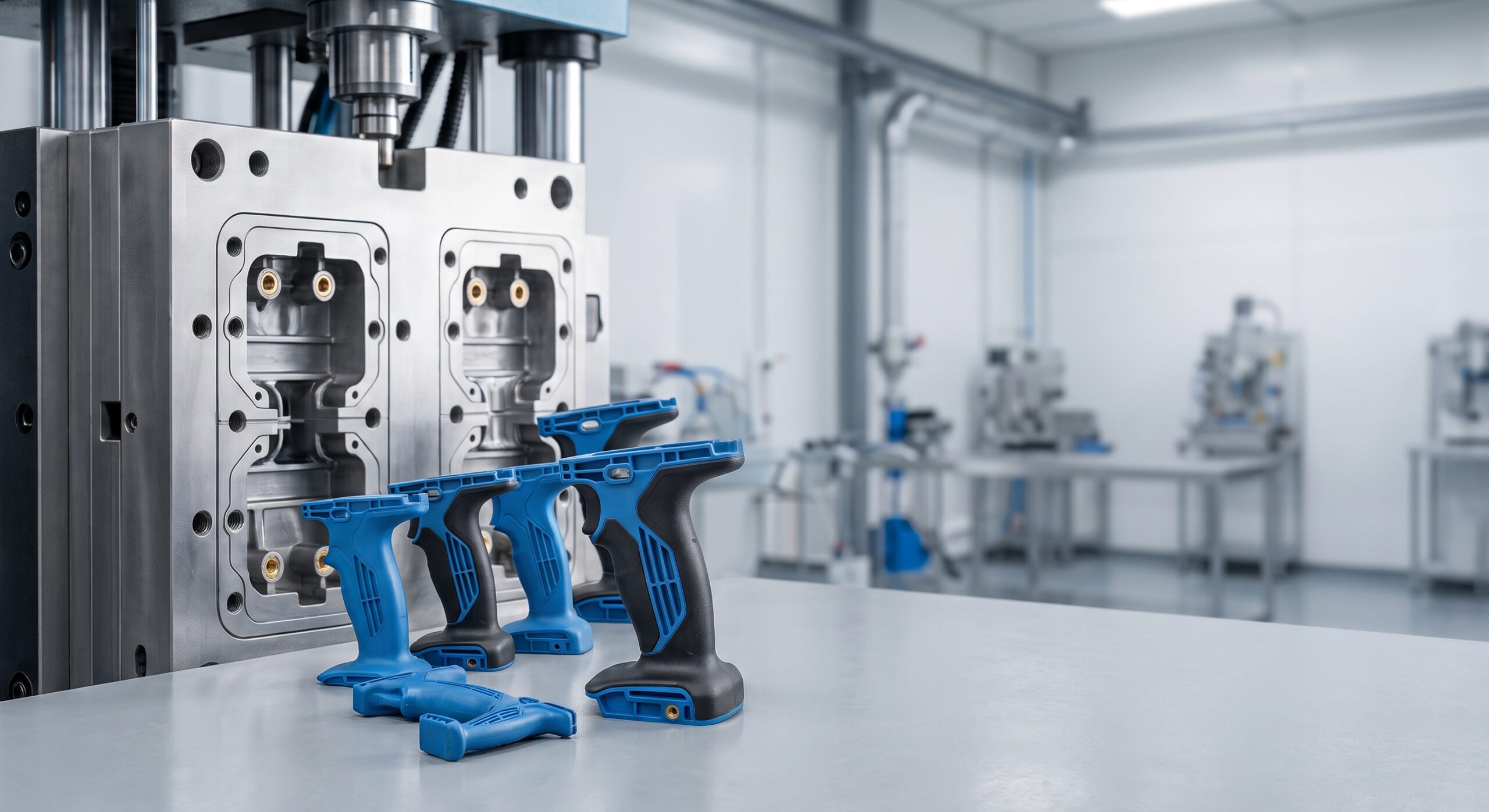
オーバーモールド加工とは、既存の基材や部品の表面に1種類の材料を成形することで、2種類以上の材料を1つの完成部品に組み合わせる加工技術です。このプロセスにより、グリップ性、密閉性、耐衝撃性、絶縁性、外観、および製品全体の機能性を向上させることができます。 一般的なオーバーモールドの組み合わせとしては、硬質プラスチックとTPEやTPUの組み合わせ、プラスチック基材とゴム系材料の組み合わせ、および特定の金属インサートと熱可塑性材料の組み合わせなどが挙げられます。適切なプロセスは、基材、オーバーモールド材料、生産量、形状、必要な接着強度、および金型設計戦略によって異なります。XY Machiningは、自社の カスタム射出成形サービス, 、およびインサート成形、LSR成形、ラピッド金型製作、量産用金型製作。.
オーバーモールドは、単なる外観上の加工ではありません。適切に設計されたオーバーモールドは、複数の部品を一体化し、組み立て工程を削減し、快適なグリップを実現し、電子部品を保護し、密閉性を向上させ、本来は剛性の高い部品に機能的な柔軟性を加えることができます。ただし、材料の組み合わせや接合部については、慎重に設計する必要があります。 材料間の相性が悪い場合や、機械的な噛み合わせが不十分、肉厚が不適切、あるいは金型設計に誤りがあると、接着強度の低下、バリの発生、反り、あるいは寸法上の問題を引き起こす可能性があります。.
オーバーモールドとは何ですか?
オーバーモールドとは、あらかじめ製造された基材の上に、別の材料を成形する射出成形プロセスです。基材としては、硬質プラスチック部品、金属インサート、電子部品、あるいはその他の適切な部品が挙げられます。.
オーバーモールド部品の製造方法にはいくつかの種類があります。インサートオーバーモールドでは、まず最初の部品を別途製造し、それを2つ目の金型に配置した後、その周囲にオーバーモールド用材料を射出成形します。 ツーショット成形では、両方の材料が統合された製造プロセスの中で成形されます。多くの場合、最初に成形された部品を2番目のキャビティへ移送または回転させる専用の装置が使用されます。.
これらの手法のどちらを選ぶかは、生産量、材料の適合性、部品の形状、金型への投資、および自動化の要件に大きく左右されます。.
なぜオーバーモールドサービスを利用するのでしょうか?
オーバーモールドの主な利点は、部品の統合です。別々の部品を製造して後で組み立てるのではなく、メーカーは異なる材料を組み合わせて1つの完成部品にすることができます。.
例えば、硬質プラスチック製のハウジングに、柔らかいTPE製のグリップを取り付けることができます。金属製のインサートをプラスチックで覆うことで、完成した取り付け部品を作ることができます。電子部品を、適切なポリマーで封入したり保護したりすることができます。.
オーバーモールド加工は、組立工程の削減にもつながります。構成部品数が減れば、締結部品の使用本数が減り、接着工程が減り、手作業が少なくなり、組立ミスが発生する可能性も低くなります。.
このプロセスは、ユーザー体験の向上にもつながります。ソフトタッチの表面加工により、ハンドルの握り心地が向上し、エラストマー素材を使用することで、グリップ力や振動吸収性が向上します。.
XY Machining社は、オーバーモールドを、複数の材料を1つの部品に組み合わせることで、グリップ性、気密性、強度、および機能性を向上させるプロセスであると説明しています。.
一般的なオーバーモールド用材料
材料の選定は、オーバーモールドプロジェクトにおいて最も重要な決定事項の一つです。基材とオーバーモールドは、機械的におよび、必要に応じて化学的にも互いに適合していなければなりません。.
オーバーモールドに一般的に使用される材料には、TPE、TPU、シリコーン、その他の熱可塑性エラストマーなどがあります。基材としては、ABS、PC、PC/ABS、ナイロン、ポリプロピレン、その他のエンジニアリングプラスチックなどが挙げられます。また、設計や成形プロセスが適切であれば、アルミニウム、真鍮、鋼などの金属インサートを使用することも可能です。.
適切な材料の組み合わせは、求められる硬度、柔軟性、耐熱性、耐薬品性、表面の感触、色、耐久性、および接合方法によって異なります。.
例えば、民生用電子機器のグリップでは、ソフトな手触りや耐摩耗性が重視される一方、産業用シールでは、耐薬品性や圧縮挙動が重視される場合があります。.
材料の適合性は重要である
見た目は互換性があるように見える2つの材料であっても、成形時に十分に接合しない場合があります。化学的適合性、溶融温度、表面状態、収縮、および加工条件のすべてが、界面に影響を与える可能性があります。.
組み合わせによっては強力な分子結合が形成されるものもあれば、機械的な嵌合、プライマー、表面処理、あるいは特別に配合された材料を必要とするものもあります。.
だからこそ、金型製作に着手する前に材料選定を完了しておくべきなのです。.
インサート成形とツーショットオーバーモールドの比較
インサート成形とツーショット成形は、関連しているものの、異なる製造手法です。.
インサート成形は、別途製造された基板から始まります。この基板を金型内に配置し、その周囲に第2の材料を射出成形します。この手法では、基板とオーバーモールドを別々に製造できるため、柔軟性が高まります。.
ツーショット成形は、特殊な多材料成形プロセスを用いて、2種類の材料を同時に成形する手法です。設計と材料の組み合わせが適切であれば、優れた再現性と高い生産効率を実現できます。.
| 因子 | オーバーモールドの挿入 | ツーショットオーバーモールド |
| 基板 | 別々に作られた | 通常、同じ生産サイクル内で成形される |
| 金型 | 2段階の金型設計アプローチ | 特殊な多材料用金型 |
| 自動化 | 手動でも自動でも可能です | 高度な自動化が可能 |
| 初期投資 | 多くの場合、低い | 通常は高い |
| 生産量 | 試作から大量生産まで | 中~高ボリュームに最適 |
| 材料の柔軟性 | 幅広い(基材によって異なる) | 機械と材料の組み合わせによって異なります |
| 労働 | 基板への積載が必要になる場合があります | セットアップ後の手作業の負担軽減 |
| 設計変更 | 基板とオーバーモールドは個別に変更可能です | 変更は、統合されたツールに影響を与える可能性があります |
| 最適な用途 | 柔軟な生産体制と小ロット生産 | 大量のリピート生産 |
スタートアップ企業や新製品の市場検証を行っている企業にとって、インサートオーバーモールド成形は、金型コストと製造の柔軟性のバランスをより適切に取ることができる可能性があります。生産量が増えるにつれて、自動化やサイクルタイムの効率化によって部品あたりのコストを削減できるため、ツーショット成形が魅力的な選択肢となる場合があります。.
XY Machining社の2026年のオーバーモールドコスト分析でも、同様に、真の2ショット成形とインサートオーバーモールドを区別しており、生産量と材料の組み合わせが経済性に大きな影響を与えることを指摘している。.
オーバーモールドの設計ガイドライン
オーバーモールドは、主要部品がすでに確定した後で追加するのではなく、製品設計の段階で検討すべきである。.
基材には、成形時の圧力や温度に耐えるだけの十分な構造的強度が必要です。また、射出成形中に位置がずれないよう、金型内にしっかりと固定されていなければなりません。.
材料同士が自然に強固な化学結合を形成しない場合、機械的な嵌合構造が有用となることがあります。アンダーカット、穴、溝、リブなどの構造により、オーバーモールド材が基材の周囲を物理的に固定できるようになります。.
一方で、アンダーカットが過度になると、金型の構造が複雑化し、コストが増大する恐れがあります。目標は、金型を不必要に複雑にすることなく、十分な保持力を確保することです。.
また、肉厚についても慎重に検討する必要があります。肉厚にムラがあると、反り、ヒケ、冷却ムラ、あるいは寸法ばらつきの原因となる可能性があります。.
パーティングラインとバリ
オーバーモールドでは、金型セクション間の接合部が外観とシール性能の両方に影響を与える可能性があるため、パーティングラインの位置が特に重要となります。.
分割線が目立ちやすい表面を横切ると、望ましくない跡が残る可能性があります。また、分割線がシール部を横切ると、バリが部品の機能に支障をきたす恐れがあります。.
メーカーは、金型を製造する前に、DFMの過程でパーティングラインを確認すべきである。.
接着と機械的保持
オーバーモールドは、化学的接着、機械的保持、あるいはその両方の組み合わせのいずれかに基づいて行われます。.
化学的接着とは、オーバーモールド材が基材に直接結合する現象のことです。これには、互換性のある材料の組み合わせと、適切な加工条件が必要となります。.
機械的固定では、物理的な形状を利用して、第2の材料を第1の部材の周囲に固定します。この手法は、化学結合が弱い場合や利用できない場合に有用です。.
例えば、オーバーモールドは、硬質基板上の穴の中や、特別に設計されたリブの周囲に流れ込むことがあります。硬化または冷却されると、オーバーモールドは基板に物理的に固定されます。.
用途において、大きな引張力、ねじれ、温度変化、あるいは化学物質への曝露にさらされる場合、堅牢なオーバーモールド設計は、材料間の接着力だけに依存してはならない。.
ソフトタッチ製品向けのオーバーモールド
ソフトタッチのオーバーモールドは、人間工学的な設計やグリップ性を向上させることができるため、消費財に広く採用されています。.
手工具、電動工具、医療機器、電子機器、自動車用制御装置、ウェアラブル製品、スポーツ用品など、あらゆる製品において、エラストマー製の表面がメリットをもたらします。.
オーバーモールドの硬さは、最終的な手触りに影響を与えます。柔らかい素材はクッション性やグリップ力を高める一方、硬いエラストマーは耐摩耗性や構造的安定性を高めることができます。.
質感も重要です。成形された質感は、グリップの特性を変えたり、外観上のわずかな欠陥を目立たなくしたりすることができます。.
消費財の場合、エンジニアはエラストマーを単独で評価するのではなく、組み立てられた製品全体を試験すべきです。基材の形状、グリップの厚さ、質感、硬度、温度、および表面の汚染は、いずれもユーザーの知覚に影響を与える可能性があります。.
シールおよび保護のためのオーバーモールド
オーバーモールドは、機能的な保護も果たすことができます。.
エラストマー層は、部品の特定の領域の周囲にバリアを形成することができ、設計や材質が適切であれば、湿気、ほこり、振動、および物理的な衝撃から部品を保護するのに役立ちます。.
電子機器メーカーは、ケーブル、コネクタ、スイッチ、センサー、その他の部品を保護するために、オーバーモールド加工を採用することがあります。.
ただし、オーバーモールド加工を行ったからといって、自動的に防水性があるとは限りません。最終的な保護レベルは、材料の選定、接合部の設計、金型の品質、工程管理、および検証試験によって決まります。.
特定のIP等級や環境要件が必要な場合は、成形工程のみに頼るのではなく、完成した部品を関連規格に基づいて試験を行う必要があります。.
オーバーモールド用金型
オーバーモールドプロジェクトにおいて、金型は最大のコスト要因の一つです。.
単純なインサートオーバーモールド成形では、基板用の金型とオーバーモールド用の金型がそれぞれ1つずつ必要となる場合があります。一方、ツーショット成形では、複数のキャビティや搬送機構、あるいは回転装置を備えた、より複雑な金型が必要となる場合があります。.
金型の材質も、コストや耐久性に影響を与えます。アルミニウム製の金型は試作や小ロットの生産に適している一方、焼入れ鋼製の金型は大量生産に適しています。.
XY Machiningは、射出成形サービスの一環として、ラピッド金型および量産用金型の提供を行っています。同社が公開している金型情報では、試作用や少量生産用の金型と、はるかに長い生産寿命を想定して設計された大量生産用金型とが区別されています。.
したがって、適切な金型戦略は、単に最も安価な金型を選ぶのではなく、予想される生産総量に基づいて策定されるべきである。.
オーバーモールド製造プロセス
このプロセスは、通常、CADおよびDFMのレビューから始まります。.
メーカーは、基板の形状、オーバーモールドの厚さ、パーティングライン、ゲート位置、ベント、保持構造、材料の適合性、および金型設計を確認します。.
その後、基板の製造、検査、およびオーバーモールド加工に向けた準備が行われます。インサートを使用する場合は、その寸法や表面状態を厳密に管理する必要があります。インサートのばらつきは、オーバーモールド成形品に直接影響を及ぼす可能性があるためです。.
インサートは、生産設定に応じて手動または自動で金型内に配置されます。その後、2番目の材料が基材の周囲に射出され、所定のキャビティを充填します。.
冷却または硬化後、完成した部品を取り出し、検査を行います。.
最初の工程は特に重要であり、これによりエンジニアは、本格生産に入る前に、接合状態、寸法、バリ、外観、基板の移動、および機能性能を確認することができる。.
オーバーモールドのコストに影響を与える要因は何ですか?
オーバーモールドのコストは、基材、オーバーモールド材、金型、部品の形状、生産数量、サイクルタイム、人件費、検査、および仕上げ要件によって異なります。.
金型製作費は、特にツーショット成形の場合、多額の初期費用となる可能性があります。インサート成形は初期の金型製作費が比較的低く抑えられる場合がありますが、基板を手作業でセットする必要がある場合は、追加の人件費が発生する可能性があります。.
材料費も重要な要素です。TPE、TPU、シリコーン、および特殊エラストマーは、価格や加工要件がそれぞれ異なる場合があります。.
Part geometry affects both mold complexity and cycle time. Deep cavities, difficult undercuts, thin walls, complex textures, and tight tolerances can all increase manufacturing effort.
Production volume is another major factor because the tooling and setup costs are spread over the number of parts produced.
| コスト要因 | Lower-Cost Scenario | Higher-Cost Scenario |
| 金型 | Simple aluminum or prototype mold | Complex hardened-steel multi-cavity tool |
| プロセス | Manual insert molding at low volume | Automated two-shot molding |
| 素材 | Standard TPE or TPU | Specialized high-performance elastomer |
| 幾何学 | Simple overmold profile | Complex undercuts and thin sections |
| 巻数 | Small production run | High-volume program with complex tooling |
| 検査 | Standard dimensional checks | Tight tolerances and extensive validation |
| 仕上げ | Molded surface | Additional cosmetic or secondary operations |
For a detailed understanding of how manufacturing design choices influence costs, XY Machining’s CNC加工の費用ガイド explains the relationship between material, geometry, tolerances, setup, finishing, and production quantity. While it focuses on CNC machining, many of the same cost principles apply to overmolding because unnecessary complexity increases processing and inspection requirements.
Overmolding vs. Traditional Assembly
One of the main reasons manufacturers choose overmolding is to reduce assembly.
Consider a product handle made from a rigid plastic core and a separate rubber grip. Traditional manufacturing may require producing both components and then assembling or bonding them.
Overmolding can combine these stages into one finished component.
This can reduce part count and potentially improve consistency. It can also eliminate separate fasteners or adhesives where the overmold provides sufficient retention.
However, overmolding is not automatically cheaper. The tooling investment and molding process need to be compared against the cost of the traditional assembly method.
The correct comparison should include tooling, materials, labor, scrap, cycle time, inspection, and expected production volume.
Overmolding Applications
Overmolding is used across consumer, industrial, automotive, electronics, medical, robotics, and other product categories.
Consumer electronics can use soft-touch overmolds for grips, buttons, protective housings, and wearable interfaces.
Automotive products can use overmolding for switches, handles, controls, connectors, and protective components.
Industrial tools can benefit from elastomeric grips that improve handling and reduce vibration.
Medical and healthcare products can use multi-material molding for certain grips, housings, seals, and functional components, subject to appropriate material and regulatory requirements.
Robotics and automation equipment can use overmolding where electrical protection, grip, cushioning, or part consolidation is needed.
The application determines the required material and validation method. A cosmetic consumer component and an industrial sealing component should not be evaluated using exactly the same criteria.
Overmolding vs. 3D Printing
3D printing and overmolding can serve different stages of product development.
3D printing is useful for quickly validating geometry, fit, and assembly before investing in injection tooling. It can also produce complex shapes without conventional mold construction.
Overmolding becomes more attractive when the final product requires production-like material behavior, repeatable multi-material construction, soft-touch surfaces, or larger quantities.
For early prototypes, a development team may use 3Dプリント to validate the substrate before creating overmolding tooling.
This workflow can reduce the risk of investing in a mold before the basic geometry has been validated. Once the design is stable, the project can move into insert molding or two-shot production.
Overmolding vs. CNC Machining
CNC machining is generally more flexible for low-volume rigid components, especially when the geometry or material makes injection molding impractical.
However, CNC machining does not naturally create a bonded soft-touch layer around a rigid substrate in the same way that overmolding can.
A product may therefore use both processes. CNC machining can produce metal inserts, prototypes, tooling, or precision substrate components, while injection molding creates the final overmold.
XY Machining provides CNC milling and turning alongside injection molding, allowing projects that require multiple manufacturing processes to be managed through one supplier.
Its 3DプリントとCNC加工の比較ガイド can also help engineers compare additive and subtractive manufacturing when deciding how to produce an initial substrate or prototype.
How to Choose an Overmolding Service
The best overmolding supplier should be evaluated on engineering capability rather than price alone.
Start by checking whether the manufacturer has experience with your substrate and overmold material combination. Ask how the bond is achieved and whether mechanical interlocking, chemical adhesion, primers, or surface preparation are required.
Review the supplier’s tooling capabilities as well. If the project may grow from prototypes to thousands of units, confirm whether the manufacturer can support both rapid tooling and production tooling.
Quality control should also be discussed before the project begins. Ask about dimensional inspection, material traceability, first-article inspection, process controls, and validation testing.
DFM support is particularly valuable because overmolding problems can become expensive after tooling has been completed. A manufacturer that identifies material compatibility, wall-thickness, venting, or parting-line problems early can reduce redesign risk.
まとめ
An overmolding service can turn separate materials or components into a more functional, integrated product. It can improve grip, sealing, protection, comfort, insulation, durability, and part consolidation while reducing the need for separate assembly operations.
The most important decisions are made before the first part is molded. Material compatibility, substrate design, mechanical retention, wall thickness, parting lines, gates, vents, tooling, and production volume all influence the final result.
Insert molding can provide flexibility for prototypes and lower-volume manufacturing, while two-shot molding can become more efficient for higher production volumes. The right process should be selected after considering the complete program cost rather than only the tooling quotation.
For manufacturers developing multi-material products, XY Machining provides custom injection molding and overmolding services with support for rapid tooling, production tooling, insert molding, LSR molding, CNC machining, and related manufacturing processes.
The company also supports projects that move between manufacturing processes during product development. For example, engineers can use CNC machining or 3D printing for early prototypes, validate the substrate, and then move into injection molding and overmolding when the design is ready for production.
Ultimately, the best overmolding solution depends on the material pair, component geometry, functional requirements, annual volume, tooling strategy, and quality expectations. A thorough DFM review before tooling begins is one of the most effective ways to reduce manufacturing risk and achieve consistent overmolded parts.
よくある質問
What is an overmolding service?
An overmolding service manufactures multi-material parts by molding one material over an existing substrate. It is commonly used to add grip, sealing, protection, insulation, cushioning, or other functional properties.
What materials are commonly used for overmolding?
Common overmold materials include TPE, TPU, silicone, and other elastomers. Substrates can include ABS, PC, PC/ABS, nylon, polypropylene, engineering plastics, and suitable metal inserts.
Is overmolding expensive?
Overmolding cost depends on tooling, material, geometry, production volume, cycle time, labor, and inspection. Low-volume insert molding can require less initial investment than automated two-shot molding, while high-volume two-shot production can offer lower labor and cycle costs.
What is the difference between insert molding and overmolding?
Insert molding places a previously manufactured substrate or insert into a mold and injects material around it. Overmolding is the broader multi-material concept and can include insert molding as well as two-shot molding.
Can metal parts be overmolded?
Yes. Suitable metal inserts can be placed inside an injection mold and encapsulated with thermoplastic or elastomeric material. The insert design must account for temperature, adhesion, retention, and dimensional requirements.
Is overmolding suitable for low-volume production?
Yes. Insert overmolding can be suitable for prototypes and low-volume production when the tooling and manual loading requirements are economically justified. For larger volumes, automated processes can become more attractive.
Can XY Machining provide overmolding?
Yes. XY Machining lists overmolding and insert molding within its injection molding capabilities, alongside rapid tooling, production tooling, CNC machining, and finishing services.
著者について パトリック・チェン — XY Machining アプリケーションエンジニア パトリックは、XY Machining社において、米国のエンジニアリングチーム向けに薄肉部品の設計をレビューするとともに、繊細な部品を公差内に収めるための治具や工具経路について、現場の作業員と連携して取り組んでいます。見積もりを出す前に薄肉部品の耐圧試験を行うには、, モデルを弊社チームにお送りください.