简答: Choose metal 3D printing when your part has complex internal channels, organic shapes, or you need one to a few units where geometry matters more than cost per part. Choose CNC machining when you need tight tolerances, superior surface finish, proven material properties, or moderate-to-high volumes at the lowest per-part cost. The two are not rivals — additive builds up material layer by layer to make shapes machining cannot, while subtractive cuts material away to make parts stronger, smoother, and more precise. The right choice depends on geometry, tolerance, material, and quantity.
I get asked “which is better” almost weekly, and the honest answer is that it is the wrong question. A better one: what does this specific part need? Once you frame it that way, the decision usually makes itself.
The fundamental difference: adding vs removing
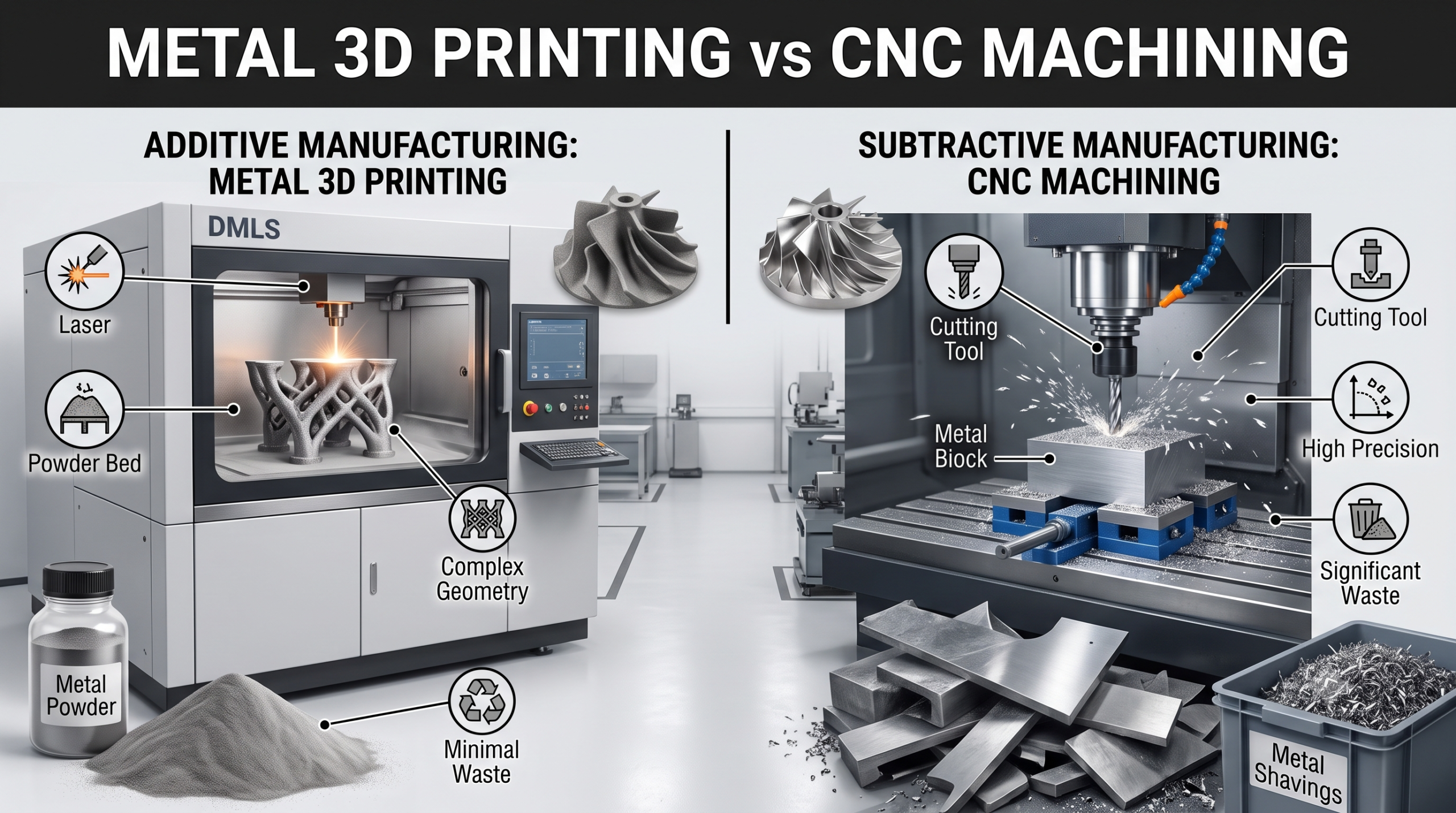
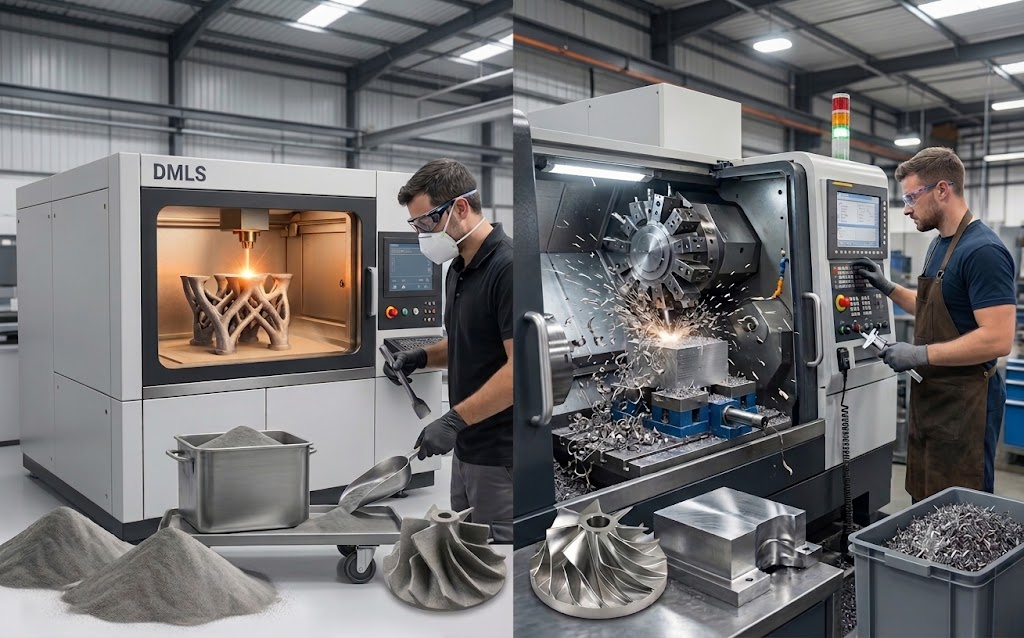
Metal 3D printing (additive manufacturing) builds a part by fusing metal powder layer by layer, most commonly with DMLS/SLM lasers. Nothing is wasted, and geometry that would be impossible to cut is trivial to grow.
数控加工 (subtractive manufacturing) starts with a solid block and cuts away everything that is not the part. It is fast, precise, and works in the exact production alloy you specify.
That single distinction, building up versus cutting away, drives every trade-off below. For a broader view, see our 3D printing vs CNC machining overview.
Head-to-head comparison
| 因子 | Metal 3D Printing | 数控加工 |
| Method | Additive (build up) | Subtractive (cut away) |
| Geometry | Complex, internal channels, lattices | Limited by tool access |
| 宽容 | ±0.1–0.3 mm (as-printed) | ±0.025 mm or tighter |
| 表面处理 | Rough, needs post-processing | Smooth as-machined |
| Material properties | Good, some porosity risk | Full wrought properties |
| Material waste | 极简 | Significant (chips) |
| 最佳音量 | 1–50 | 1–10,000+ |
| Lead time (simple part) | 3–7天 | 2–5 days |
| Cost per part at volume | Stays high | Drops sharply |
Where metal 3D printing wins
Additive manufacturing earns its premium on geometry that subtractive simply cannot reach:
- Internal channels: conformal cooling lines that follow a mold’s shape, impossible to drill straight.
- Organic, topology-optimized shapes: lightweight aerospace brackets with material only where stress flows.
- Consolidated assemblies: printing five parts as one, removing fasteners and failure points.
- Lattice structures: internal honeycombs for weight reduction or controlled energy absorption.
- Low quantities of complex parts: no tooling, so one part costs the same per unit as ten.
If your value is in the geometry (lighter, integrated, internally complex), additive is often the only way to get it.
Where CNC machining wins
Subtractive machining wins whenever the priorities are precision, finish, material integrity, or cost at volume:
- Tight tolerances: machining holds ±0.025 mm and finer, far beyond as-printed additive. See 什么是精密制造.
- 表面处理: machined surfaces are smooth off the machine; printed parts need grinding or polishing.
- Proven material properties: wrought bar stock has predictable, isotropic strength with no porosity.
- Cost at volume: once set up, machining’s per-part cost falls fast; additive’s stays flat.
- 材料选择: any machinable alloy, including 6061 与 7075 铝合金 and hardened steels.
For most functional metal parts at any real quantity, machining is still the workhorse, and usually the cheapest path. Our how to reduce CNC machining costs guide shows how to push that cost lower.
The hybrid reality: they work together
The most sophisticated parts use both. A near-net-shape is 3D printed to get the complex geometry, then CNC machined on the critical faces to hit tolerance and finish. This hybrid approach is common in aerospace and medical: print the impossible geometry, machine the mating surfaces. Treating additive and subtractive as a team, not a choice, is where advanced manufacturing is heading.
A decision framework
Run your part through these questions in order:
| Question | If yes → |
| Does it have internal channels or organic geometry machining can’t reach? | Metal 3D printing |
| Do critical features need tolerance tighter than ±0.1 mm? | CNC machining (or hybrid) |
| Do you need more than ~50 identical parts? | 数控加工 |
| Is surface finish cosmetically or functionally critical? | CNC machining (or post-process the print) |
| Is weight reduction via lattices the main goal? | Metal 3D printing |
| Is lowest cost per part the priority? | 数控加工 |
If your answers split across both columns, you have a hybrid part: print the geometry, machine the critical features.
Cost: the honest picture
The cost curves cross. At quantity one, a complex printed part can be cheaper than machining because there is no tooling or programming overhead relative to its complexity. But additive cost stays roughly flat per part — every unit takes the same hours of build time. Machining has higher setup but its per-part cost falls as the setup amortizes across the run. Somewhere between 10 and 50 parts, depending on complexity, machining becomes cheaper and stays cheaper. Knowing where that crossover sits for your part is the whole cost decision.
Material availability: a factor buyers overlook
One practical detail decides more of these projects than the theory suggests: which alloys each process can actually run. CNC machining works in virtually any machinable metal — dozens of aluminum grades, tool steels, stainless, brass, titanium, copper — because you are cutting standard bar or plate stock that mills and warehouses already produce. Metal 3D printing is limited to the alloys available as qualified, weldable powders, which is a much shorter list: a handful of aluminum, titanium, stainless, and nickel-superalloy grades. If your part must be a specific alloy for corrosion, conductivity, or certification reasons, check powder availability before you commit to additive — I have seen promising printed designs stall simply because the required alloy did not exist as a validated powder. Machining rarely hits that wall, which is one more reason it remains the default for functional metal parts unless the geometry genuinely demands additive.
常见问题
Is metal 3D printing stronger than CNC machined parts? Generally no — CNC machined parts made from wrought bar stock have full, predictable, isotropic material properties, while metal 3D printed parts can carry small porosity and directional (anisotropic) properties from the layer-by-layer build. Modern additive with proper parameters and post-processing like hot isostatic pressing (HIP) closes much of that gap and produces genuinely strong parts. But for a part where maximum, predictable strength is the priority and geometry allows machining, subtractive from solid stock remains the safer structural choice. The right answer depends on the alloy, the post-processing, and how the load runs through the part.
When is metal 3D printing cheaper than CNC machining? Metal 3D printing is usually cheaper at very low quantities — one to a handful of parts — especially when the geometry is complex, because there is no tooling and the cost does not scale with intricacy. Machining that same complex part from solid stock might require expensive multi-axis setups, custom fixturing, and long cycle times. As quantity rises, machining’s per-part cost drops while additive’s stays flat, so the two curves cross somewhere between roughly 10 and 50 parts. Below that crossover, printing often wins on cost; above it, machining pulls ahead and keeps widening the gap.
Can I get a smooth finish on a metal 3D printed part? Yes, but not directly off the printer — as-printed metal surfaces are rough and typically need secondary finishing to become smooth. Common routes include CNC machining the critical faces, media blasting, tumbling, or polishing, and each adds cost and lead time. This is exactly why hybrid workflows are popular: the part is printed for its geometry, then machined only on the surfaces that must be smooth or dimensionally precise. If a cosmetic or sealing surface is central to your part, budget for that post-processing from the start rather than expecting the print to deliver it.
Should I choose additive or subtractive for a prototype? It depends on what the prototype must prove. If you are validating a complex geometry that will eventually be printed in production — internal channels, lattices, consolidated assemblies — prototype with metal 3D printing so the test reflects the real process. If your production part will be machined and you need to verify tolerance, finish, and true material behavior, prototype with CNC machining so the prototype behaves like the final part. Matching the prototype process to the intended production process gives you test data you can actually trust, rather than an approximation you have to caveat.
Making the call
Metal 3D printing versus CNC machining is not a contest to declare a winner. It is a matching exercise. Additive unlocks geometry that machining cannot cut and wins at low quantities of complex parts. Subtractive delivers tolerance, finish, proven strength, and low cost at volume. Frame the decision around your part’s geometry, tolerance, material, and quantity, and let those requirements point you to additive, subtractive, or the increasingly common hybrid of both.
关于作者 陈帕特里克——XY Machining 应用工程师 帕特里克负责审查XY Machining公司美国工程团队设计的薄壁零件,并与车间人员合作,针对夹具和刀具路径进行优化,以确保精密零件的尺寸公差符合要求。为了在报价前对薄壁零件进行压力测试,, 将您的模型发送给我们的团队.