What is a urethane casting service, how does the process work, what materials and molds are used, and when should manufacturers choose urethane casting for prototypes or low-volume production?
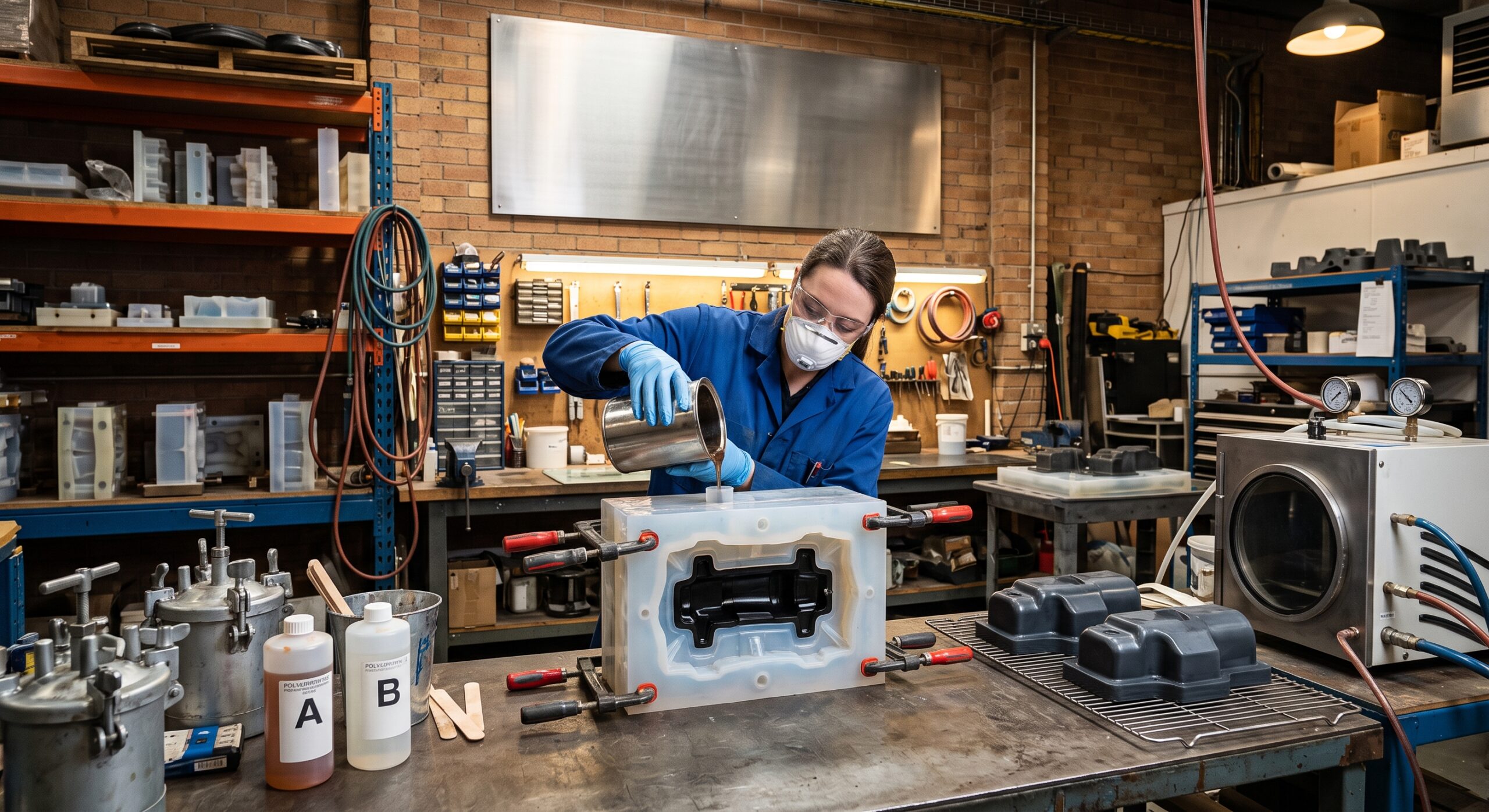
A urethane casting service uses liquid polyurethane resin and silicone molds to produce detailed plastic parts for functional prototypes, product validation, bridge production, and low-volume manufacturing. The process is also commonly called vacuum casting. A master model, often produced through CNC machining or 3D printing, is used to create a silicone mold. Liquid polyurethane is then mixed, poured or injected into the mold under controlled conditions, and cured to produce the final component. Because silicone tooling is faster and less expensive to create than conventional steel injection molds, urethane casting can be a practical option when companies need production-like parts without committing to expensive hard tooling. XY Machining provides urethane casting services for prototypes and low-volume production, with support for different polyurethane properties, surface finishes, and part requirements.
Urethane casting is particularly valuable between the early prototype and full production stages. It can produce parts with complex details, smooth surfaces, and different mechanical properties, including rigid, flexible, transparent, and rubber-like characteristics. The process is not a universal replacement for injection molding or CNC machining. Instead, its value comes from matching the manufacturing process to the required quantity, material behavior, appearance, and development stage.
What Is Urethane Casting?
Urethane casting is a replication process in which polyurethane resin is cast into a silicone mold created from a master pattern. Vacuum casting is commonly used to remove trapped air and improve surface quality and dimensional consistency.
The master model determines many of the characteristics transferred to the silicone mold and subsequently to the cast parts. It can be manufactured using CNC machining, SLA or other 3D printing technologies, depending on the required accuracy, surface finish, and application.
Once the master is approved, silicone is formed around it to create the mold. After the silicone cures, the master is removed, leaving a cavity that represents the required part geometry.
The polyurethane resin is then prepared according to the selected material specification. The two-component system is mixed, introduced into the mold, and cured under controlled conditions. Once cured, the part is removed and any required trimming or finishing is performed.
This relatively simple tooling approach is one of the main reasons urethane casting is popular for product development and low-volume manufacturing.
Why Use a Urethane Casting Service?
The biggest advantage of urethane casting is its balance between speed, tooling cost, part quality, and material flexibility.
Traditional injection molding requires a production mold that can involve substantial design, machining, and validation costs. That investment can make injection molding difficult to justify when a company needs only a few dozen or a few hundred parts.
Urethane casting uses silicone tooling, allowing manufacturers to move from an approved master model to functional parts much faster. XY Machining states that its urethane casting service supports prototypes and low-volume production, with typical production volumes ranging from prototypes to 200+ units depending on the design.
The process can also produce parts that look and feel much closer to injection-molded components than many basic prototype methods. This is useful when engineers need to evaluate assembly, appearance, ergonomics, fit, or mechanical performance before investing in production tooling.
Urethane Casting vs. Injection Molding
Urethane casting and injection molding can both produce plastic parts, but their economics and applications are different.
| Factor | Urethane Casting | Injection Molding |
| Tooling | Silicone mold | Metal production mold |
| Initial tooling cost | Lower | Higher |
| Tooling lead time | Generally faster | Generally longer |
| Ideal volume | Prototypes and low volume | Medium to high volume |
| Material selection | Broad polyurethane options | Broad thermoplastic options |
| Design changes | Easier during early development | More expensive after tooling |
| Surface quality | High, depending on master | High |
| Production scalability | Limited compared with injection molding | Excellent for high volume |
| Typical use | Functional prototypes and bridge production | Production manufacturing |
For example, a company preparing 50 housings for field testing may find urethane casting more practical than investing in a production injection mold. A company expecting 100,000 identical housings may find injection molding more economical because the tooling cost can be distributed over a much larger quantity.
The correct choice depends on total production economics rather than tooling cost alone.
How the Urethane Casting Process Works
A professional urethane casting workflow begins with design review.
The manufacturer evaluates the CAD model for wall thickness, undercuts, draft, parting lines, surface requirements, gates, vents, and other features that can affect mold construction.
The next stage is creating the master model. CNC machining can be useful when the part requires high dimensional accuracy and a smooth surface. 3D printing can be more economical for certain complex geometries or early-stage prototypes.
Once the master model is approved, silicone is used to create the mold. The mold is normally designed around the geometry and intended separation direction. Complex parts may require additional mold sections or inserts.
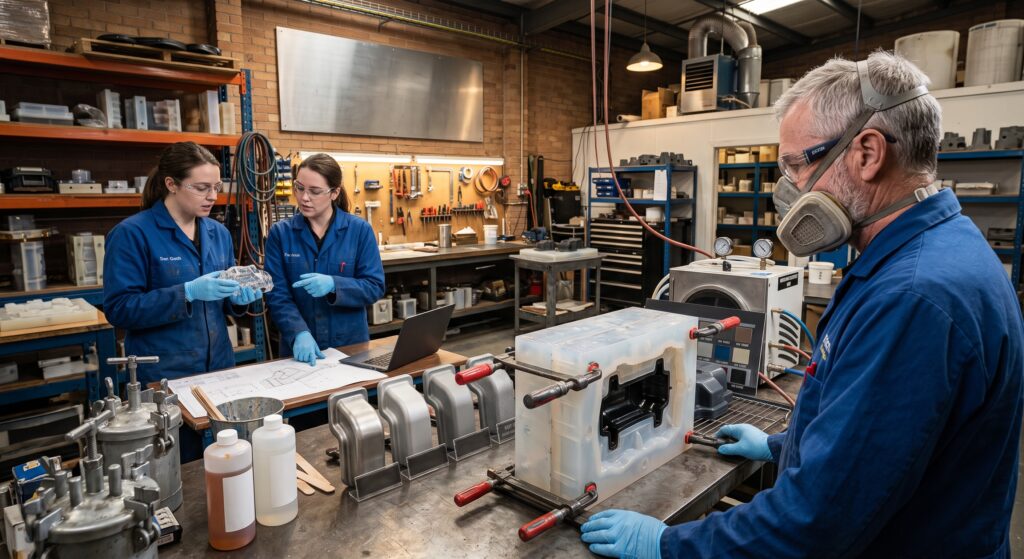
After mold preparation, the polyurethane resin is mixed and cast. Vacuum processing helps reduce air bubbles and improves replication of small features.
The resin cures inside the mold. After curing, the mold is opened and the part is removed. Flash and other excess material may then be trimmed.
Finally, the parts undergo visual and dimensional inspection. Additional finishing can be applied when required.
Urethane Casting Design Guidelines
Designing specifically for urethane casting can improve part quality and reduce unnecessary tooling complications.
Wall thickness is one of the first factors to review. Significant changes in thickness can influence resin flow, curing, shrinkage, and dimensional stability. A more consistent wall structure is generally easier to manufacture.
Undercuts are possible, but they can increase mold complexity. The manufacturer may need to use additional mold sections or design the mold separation around the feature.
Parting-line placement should also be considered early. A poorly positioned parting line can create visible marks or interfere with important sealing or assembly surfaces.
Small features and thin sections require particular attention because they may affect resin flow and mold filling.
XY Machining lists a recommended minimum wall thickness of approximately 1.0 mm for its urethane casting capability, while the actual suitable thickness depends on part geometry, resin selection, and mold design.
This is why a DFM review should happen before tooling begins rather than after the first parts have been produced.
Choosing Urethane Resin
Polyurethane is not a single material with one fixed set of properties. Different resin systems can be selected to replicate different performance characteristics.
A rigid ABS-like polyurethane may be appropriate for housings, covers, brackets, and functional enclosures. A flexible or rubber-like polyurethane can be more suitable when the component requires elasticity or impact absorption.
Transparent polyurethane can be used when optical appearance or internal visibility is important. Other grades may provide higher temperature resistance or flame-retardant properties.
XY Machining lists ABS-like, rubber-like, clear, high-temperature, and flame-retardant polyurethane options for its urethane casting service.
Material selection should be based on the actual application. Engineers should consider temperature, chemical exposure, impact, flexibility, hardness, UV exposure, and expected service conditions rather than choosing a resin simply because it has a similar appearance to the production material.
Urethane Casting Tolerances
Dimensional accuracy depends on several variables, including master-model accuracy, silicone mold behavior, resin properties, part geometry, curing conditions, and production technique.
XY Machining publishes ISO 2768-M as a general tolerance reference for plastics and states that precision tolerances can reach approximately ±0.1 mm depending on geometry.
However, engineers should avoid specifying unnecessarily tight tolerances across the entire component. Tight tolerances can increase manufacturing difficulty and cost.
Instead, identify the dimensions that directly affect assembly, sealing, movement, or functional performance. These critical dimensions should receive appropriate inspection and process attention.
Surface Finishes for Urethane Cast Parts
One of the major strengths of urethane casting is its ability to reproduce the appearance of the master model.
If the master has a smooth polished surface, the cast part can reproduce that finish. If the master has a texture, the texture can also be transferred through the silicone mold.
Additional finishing may be used when a specific appearance is required. XY Machining lists options including bead blasting, brushing, transparent polishing, mirror polishing, and other cosmetic treatments for urethane cast parts.
The selected finish should match the purpose of the prototype. A functional internal component may not need an expensive cosmetic finish, while a product shown to investors, customers, or distributors may require a highly polished appearance.
Urethane Casting Applications
Urethane casting is used across many industries because polyurethane can be formulated to provide different physical characteristics.
In automotive development, it can be used for interior components, housings, covers, ducts, trim parts, and functional prototypes.
In electronics, urethane casting can produce enclosures, covers, buttons, protective components, and other parts that require production-like appearance.
Medical device developers can use the process for certain prototype housings, equipment components, and functional evaluation parts, subject to the material and regulatory requirements of the application.
Industrial equipment manufacturers can use urethane casting for low-volume covers, handles, housings, protective components, and replacement parts.
For consumer products, the process is useful when companies need realistic prototypes for design validation, user testing, marketing samples, or pre-production evaluation.
Urethane Casting for Low-Volume Production
Urethane casting becomes especially useful when the required quantity is too high for one-off prototyping but too low to justify conventional injection molding.
This intermediate stage is sometimes described as bridge production.
For example, imagine a company has completed product development but expects only 100 units before the next design revision. Building expensive production tooling may not make financial sense. Silicone tooling can provide the required components while the company validates the market.
Another advantage is design flexibility. If a design change is needed, the tooling commitment is generally lower than with hardened production tooling.
XY Machining describes its urethane casting process as suitable for prototypes, bridge production, and short-run manufacturing, with silicone tooling designed for faster tooling and lower-volume production.
What Affects Urethane Casting Cost?
Urethane casting cost is influenced by tooling, master-model production, resin, part size, geometry, quantity, finishing, inspection, and labor.
Tool complexity is particularly important. A straightforward component that can be molded using a simple silicone tool will generally require less preparation than a complex component with deep cavities, undercuts, inserts, or multiple mold sections.
The master model also affects the initial investment. CNC machining may provide a highly accurate master with a controlled surface finish, while 3D printing can offer a faster route for certain geometries.
Quantity changes the economics as well. The fixed tooling cost is spread across more parts as production volume increases.
| Cost Factor | Effect on Price | How to Control It |
| Master model | Influences initial tooling preparation | Choose CNC or 3D printing based on requirements |
| Silicone mold | Major upfront cost | Simplify parting and avoid unnecessary complexity |
| Resin | Depends on material grade and quantity | Select material based on actual performance needs |
| Part geometry | Complex parts require more tooling work | Use DFM principles |
| Production quantity | Changes per-part economics | Batch parts where practical |
| Surface finish | Adds post-processing cost | Specify only necessary finishes |
| Inspection | Increases quality-control effort | Focus tight inspection on critical features |
| Inserts | Add assembly and tooling requirements | Use only when function requires them |
For broader manufacturing cost planning, XY Machining’s CNC machining cost guide explains how material, geometry, tolerances, surface finishing, setup, and production volume influence manufacturing costs. The same cost-planning principles can help teams identify expensive design decisions before requesting a urethane casting quotation.
Urethane Casting vs. 3D Printing
3D printing and urethane casting are often used at different points in product development.
3D printing is generally useful when engineers need a quick physical model directly from CAD. It can be especially useful for checking form, assembly clearance, and basic geometry.
Urethane casting becomes more attractive when the prototype needs a production-like surface, specific material behavior, multiple identical units, or realistic functional testing.
A development team might therefore use 3D printing for the first design iteration, CNC machining or high-resolution printing for the master model, and urethane casting for a larger batch of functional prototypes.
XY Machining also publishes a 3D printing vs. CNC machining guide that explains how engineers can select between additive and subtractive processes according to geometry, precision, quantity, and development stage.
The important point is that these processes do not necessarily compete. They can form part of the same product-development workflow.
How to Select a Urethane Casting Service
Choosing a supplier should involve more than comparing the lowest quotation.
First, confirm whether the supplier has experience with the type of part you need. Ask about material options, achievable tolerances, mold life, surface finishes, inspection methods, and production capacity.
Then review the DFM process. A capable supplier should identify potential problems before tooling is produced.
Quality control should also be clear. XY Machining states that its urethane casting projects undergo design review, dimensional inspection, and visual verification, and that its quality management system follows ISO 9001:2015 standards.
Communication is another practical factor. Design revisions are common during prototyping, so the supplier should be able to respond quickly when dimensions, materials, or finishes change.
Finally, consider whether the supplier can support the next manufacturing stage. A company that can provide CNC machining, 3D printing, urethane casting, injection molding, and other processes may reduce the need to transfer the project between multiple vendors.
When Should You Choose Urethane Casting?
Urethane casting is a strong option when you need a limited number of production-like parts, want lower tooling investment, require flexible material options, or need to validate a product before high-volume manufacturing.
It may not be the best choice for every project.
For one simple prototype, 3D printing may be faster and less expensive. For a metal component requiring very tight tolerances, CNC machining may be more appropriate. For tens of thousands of identical thermoplastic parts, injection molding can offer better long-term unit economics.
The process should therefore be selected according to the development stage and technical requirements rather than simply because it is inexpensive.
Final Thoughts
A urethane casting service provides an effective middle ground between rapid prototyping and traditional production tooling. By combining a detailed master model with silicone molds and polyurethane resins, manufacturers can produce functional, visually representative parts without the upfront investment associated with conventional injection molding.
The process is particularly useful for product teams that need prototypes for fit, form, function, material behavior, customer testing, or market validation. It can also support bridge production when demand exists before the design or production volume justifies hard tooling.
The quality of the final result depends heavily on decisions made before casting begins. Material selection, master-model quality, wall thickness, parting lines, undercuts, mold design, resin selection, curing, finishing, and inspection all influence the final component.
For companies planning a prototype or low-volume production run, XY Machining offers urethane casting services alongside CNC machining, 3D printing, injection molding, rapid tooling, and other manufacturing capabilities. This broader process coverage can be useful when a project needs to move from an initial prototype toward production without changing suppliers.
The best manufacturing process is ultimately the one that matches the project’s quantity, material requirements, geometry, tolerance, surface finish, timeline, and budget. When those factors point toward flexible tooling and production-like plastic parts in small quantities, urethane casting can be a practical and cost-effective solution.
Frequently Asked Questions
What is urethane casting used for?
Urethane casting is commonly used for functional prototypes, product validation, bridge production, low-volume manufacturing, cosmetic samples, housings, covers, automotive components, electronics parts, and industrial components.
How many parts can a silicone mold produce?
Mold life varies according to part geometry, resin, mold design, and handling. XY Machining states that one silicone mold typically produces around 15–25 high-quality polyurethane parts, although actual mold life depends on the application.
Is urethane casting cheaper than injection molding?
For prototypes and low-volume production, urethane casting can be more economical because silicone molds generally require less upfront investment than production injection molds. At high volumes, injection molding can become more cost-effective because tooling costs are distributed across many parts.
What materials can be used in urethane casting?
Common options include rigid ABS-like polyurethane, rubber-like polyurethane, transparent polyurethane, high-temperature materials, and flame-retardant formulations. The appropriate material depends on the application’s mechanical, thermal, chemical, and regulatory requirements.
Can urethane casting produce complex parts?
Yes. Urethane casting can reproduce detailed geometries, although undercuts, deep features, thin sections, and complex parting lines may require more sophisticated silicone mold designs.
Is urethane casting suitable for production?
It can be suitable for low-volume and bridge production. It is generally not the first choice for very high-volume manufacturing where injection molding or another scalable process can provide a lower per-part cost.
About the author Patrick Chen — Applications Engineer, XY Machining Patrick reviews thin-wall designs for US engineering teams at XY Machining and works with the shop floor on the fixturing and toolpaths that keep delicate parts in tolerance. To pressure-test a thin-wall part before quoting, send your model to our team.