What is liquid silicone rubber prototype manufacturing, how should an LSR prototype be designed, and which factors affect material selection, tooling, molding quality, cost, and production readiness?
Liquid silicone rubber (LSR) prototyping is a manufacturing approach used to create flexible, heat-resistant, chemically resistant, and highly detailed prototype components before full-scale production. LSR is commonly considered for seals, gaskets, membranes, valves, medical components, wearable products, baby-care products, and other parts that require elastic performance. The process typically uses a two-component liquid silicone system that is metered, mixed, injected into a mold, and cured inside the tooling. For companies developing products that need the actual behavior of silicone rather than a rigid plastic approximation, LSR prototypes can provide more meaningful functional validation.
A successful LSR prototype starts before the mold is manufactured. Material hardness, part geometry, wall thickness, draft, undercuts, parting lines, gates, vents, tolerances, surface finish, and demolding requirements all influence the final result. XY Machining provides liquid silicone rubber molding as part of its broader injection molding and prototyping capabilities, allowing engineers to move from CAD design and DFM review toward functional prototypes and production tooling.
What Is Liquid Silicone Rubber?
Liquid silicone rubber is a two-part silicone material supplied in liquid form and cured into an elastomer. Unlike conventional thermoplastics, LSR is processed as a reactive material and forms a flexible rubber component after curing.
LSR is particularly useful when a product requires flexibility, sealing performance, temperature resistance, chemical resistance, electrical insulation, or long-term elastic behavior. Its combination of flexibility and durability makes it suitable for applications where a rigid prototype material would not accurately represent the final product.
LSR is available in different grades and hardness levels. Shore hardness is commonly used to describe how resistant a silicone material is to indentation. Selecting the correct hardness is important because a seal, button, medical component, and flexible protective cover can have very different mechanical requirements.
The material grade should also be selected according to the application’s temperature range, chemical exposure, regulatory requirements, color requirements, and expected service life.
Why Use LSR for Prototype Development?
The main reason to use LSR for a prototype is functional validation.
A visual prototype can confirm dimensions and appearance, but it may not accurately demonstrate how a flexible seal compresses, how a membrane flexes, or how a silicone button responds to repeated use. LSR prototypes can provide a much closer representation of the final material behavior.
This makes the process valuable during product development because engineers can test fit, flexibility, sealing, compression, tactile response, assembly, and interaction with other components before committing to high-volume production tooling.
For example, an electronics manufacturer developing a waterproof enclosure may need to verify whether a silicone gasket compresses correctly against the enclosure housing. A rigid plastic prototype cannot provide the same information. An LSR prototype can reveal whether the gasket geometry and material hardness provide the required sealing behavior.
LSR Prototype Design Considerations
Good LSR prototype design requires close cooperation between the product designer and manufacturer. The CAD model should not simply be sent for tooling without checking whether the geometry can be filled, vented, cured, and removed from the mold efficiently.
| Design Factor | Why It Matters | Typical Engineering Focus |
| Wall thickness | Influences filling and curing | Keep thickness consistent where practical |
| Draft | Helps part release from tooling | Use appropriate draft for rigid mold features |
| Parting line | Affects flash and appearance | Place it away from critical sealing surfaces |
| Gates | Controls material flow | Position to reduce air traps and flow problems |
| Vents | Allows trapped air to escape | Place vents near potential air-trap areas |
| Undercuts | Can complicate demolding | Use suitable tooling or core features |
| Tolerances | Control functional performance | Specify only critical dimensions tightly |
| Shore hardness | Controls flexibility | Select according to application requirements |
| Surface finish | Affects appearance and release | Match finish to functional and cosmetic needs |
These factors should be reviewed during design-for-manufacturing (DFM). XY Machining states that its molding service includes engineering review and DFM feedback before production, which can help identify manufacturability problems before tooling is finalized.
Wall Thickness and Geometry
Wall thickness is one of the most important factors in LSR part design. Large variations in section thickness can affect material flow, curing behavior, shrinkage, and dimensional consistency.
A designer should avoid unnecessary changes in thickness where possible. If a thick area is structurally required, transitions should be designed carefully rather than creating abrupt changes.
Thin sections may require appropriate flow analysis and gate placement, while very thick sections can require additional consideration of curing and dimensional stability.
The correct wall thickness depends on the material grade, part geometry, mold design, application, and manufacturing process. Therefore, generic minimum-wall recommendations should not replace supplier-specific DFM review.
Draft Angles and Demolding
Although silicone is flexible, mold design still requires careful consideration of part release.
Draft can make it easier to remove features from the tooling, particularly when the mold contains deeper cavities or textured surfaces. However, the required draft depends on the geometry and mold construction.
Complex LSR parts may include undercuts, grooves, lips, sealing features, or other geometry that cannot simply be pulled directly from a two-piece mold.
In such cases, the tooling may require slides, lifters, collapsible features, inserts, or alternative parting strategies. These tooling decisions can significantly affect prototype cost and lead time.
Parting Lines, Gates, and Vents
The parting line is where mold sections meet. In an LSR component, its location can influence flash, appearance, sealing performance, and post-molding finishing.
For cosmetic components, the parting line should generally be positioned where it has minimal visual impact. For sealing components, it should not interfere with critical sealing surfaces unless the tooling and finishing process can control the resulting feature.
Gate placement is equally important because it determines how the liquid silicone enters and fills the cavity. The manufacturer needs to consider flow distance, feature geometry, air evacuation, and the location of critical surfaces.
Venting allows displaced air to escape from the cavity. Poor venting can contribute to incomplete filling, trapped air, surface defects, or inconsistent appearance.
These decisions should be finalized during mold design rather than after the first molding trial.
Choosing the Right LSR Material
Material selection should be based on the application’s actual requirements rather than simply choosing a familiar silicone grade.
Important factors include hardness, operating temperature, chemical exposure, flexibility, compression behavior, color, transparency, electrical properties, and regulatory requirements.
Medical and healthcare applications may require specific grades and documentation. Consumer products may prioritize appearance, tactile response, and color. Industrial seals may prioritize compression performance, chemical resistance, and temperature stability.
If the prototype will be used for functional testing, the material should be as close as practical to the production material. Otherwise, test results may not accurately represent production performance.
LSR Prototype Tooling Options
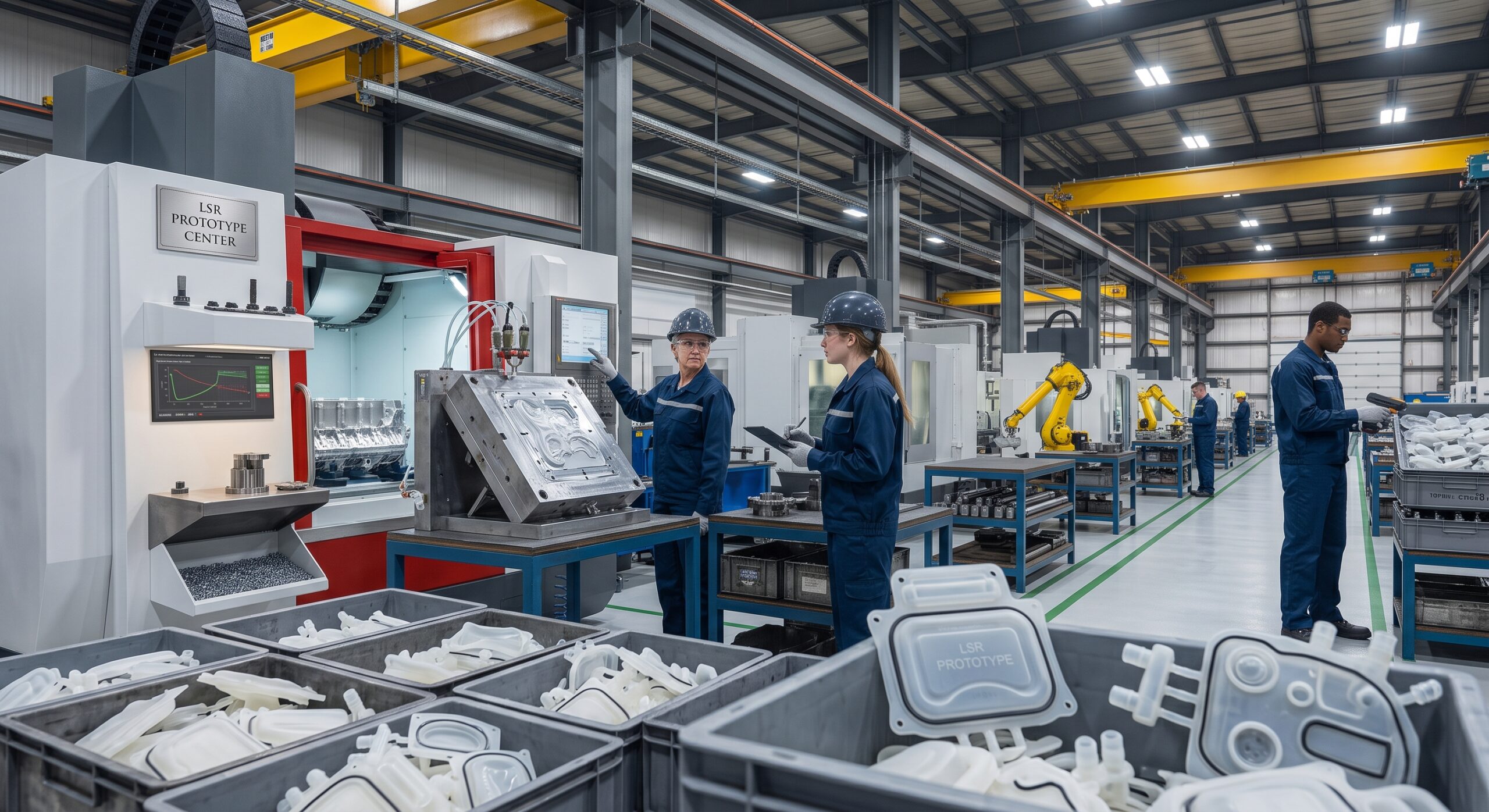
Tooling is one of the biggest differences between a silicone prototype and a simple 3D-printed concept model.
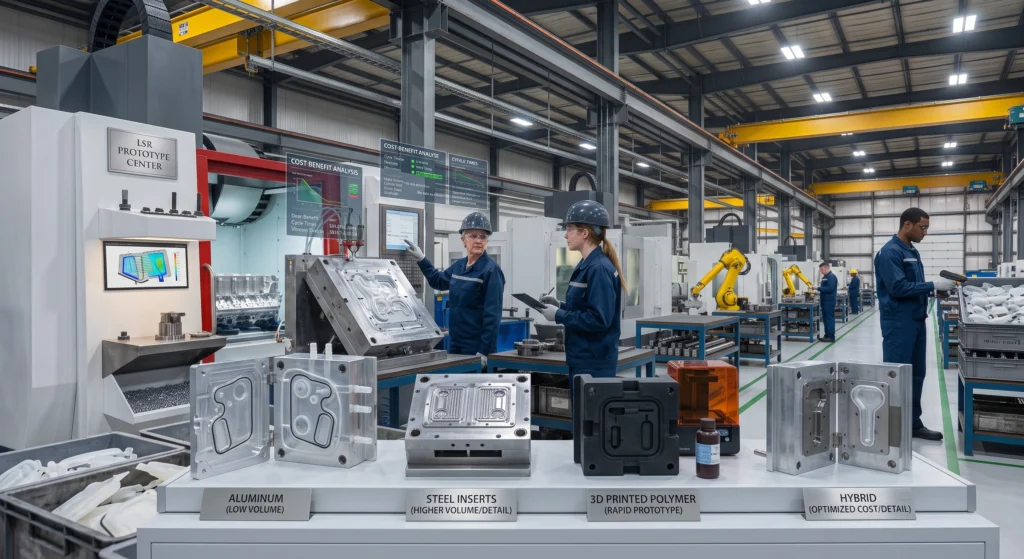
For early-stage development, manufacturers may use prototype tooling strategies that reduce upfront investment. As the design becomes stable and production volume increases, the project can transition to durable production tooling.
XY Machining’s injection molding service describes rapid tooling for prototypes and low-volume runs and production tooling for larger-volume manufacturing. It also states that its tooling can use aluminum and hardened steel depending on the production requirement.
| Tooling Approach | Best Use | Main Advantage | Main Limitation |
| Prototype tooling | Early functional validation | Lower initial tooling commitment | Limited production life |
| Aluminum tooling | Prototypes and low-volume production | Faster and generally less expensive | Lower durability than hardened steel |
| Hardened steel tooling | Production programs | Long tool life and repeatability | Higher initial tooling investment |
| Insert-based tooling | Complex or changing designs | Flexible feature modification | More tooling complexity |
The correct tooling strategy depends on expected quantity, design stability, geometry, required tolerance, and production life.
LSR Prototype Manufacturing Process
The manufacturing process generally begins with CAD and technical drawing review. The manufacturer evaluates the geometry, material, tolerances, parting line, gate locations, venting, and tooling requirements.
After DFM approval, the mold is manufactured and inspected. The liquid silicone components are then prepared for molding.
LSR systems commonly consist of two components that are precisely metered and mixed before injection. The material enters the mold cavity, where controlled heat initiates curing. After curing, the part is removed, inspected, and prepared for any required finishing or assembly.
The first molded samples are particularly important. They allow the engineering team to evaluate dimensions, appearance, flash, parting lines, material behavior, and functional performance.
If problems are identified, the mold or process may need adjustment before the design is approved for production.
Quality Control for LSR Prototypes
Quality control should be planned before manufacturing rather than added after the prototype is completed.
Dimensional inspection can verify critical features such as sealing diameters, mounting dimensions, wall thickness, and interfaces with mating components.
Visual inspection can identify flash, air traps, incomplete filling, surface defects, contamination, and cosmetic inconsistencies.
Functional testing may be more important than dimensional inspection for some LSR components. A gasket, valve, membrane, or flexible button can meet its dimensional drawing while still failing its functional requirement.
The inspection plan should therefore be based on what the component actually needs to accomplish.
For regulated industries, additional documentation may be required, including material certificates, batch traceability, inspection reports, and process documentation.
Common LSR Prototype Defects
Several manufacturing problems can occur when the design, tooling, or molding parameters are not properly controlled.
Flash can occur when silicone escapes through gaps between mold components. Excessive flash can affect sealing surfaces and may require trimming or tooling correction.
Air entrapment can occur when air cannot escape efficiently as silicone fills the cavity. Appropriate venting and gate design can help reduce this risk.
Incomplete filling can result from unsuitable flow conditions, insufficient material movement, poor venting, or problematic geometry.
Dimensional variation can be influenced by material behavior, mold temperature, curing conditions, shrinkage, tooling accuracy, and process consistency.
These issues are why prototype molding should be treated as an engineering validation process rather than simply a method of producing sample parts.
LSR Prototyping vs. 3D Printing
3D printing can be excellent for quickly validating the shape and basic fit of a component, but it does not necessarily reproduce the behavior of production LSR.
A printed elastomeric material may have different elasticity, compression behavior, surface characteristics, chemical resistance, and long-term performance.
Therefore, the best prototype process depends on what needs to be tested.
If the objective is simply to check dimensions, enclosure fit, or assembly clearance, 3D printing may be sufficient. If the objective is to test sealing, flexibility, tactile performance, or silicone-specific behavior, an LSR prototype is usually more representative.
For a broader comparison of manufacturing approaches, XY Machining also provides 3D printing and CNC machining guidance that can help engineers determine which process is appropriate at different product-development stages.
LSR Prototype Cost Factors
LSR prototype pricing depends on several variables, including part size, geometry, material, tooling complexity, number of cavities, tolerances, surface finish, quantity, and inspection requirements.
Tooling often represents a significant portion of the initial cost because the mold must be designed and manufactured before parts can be produced.
A simple single-cavity prototype mold may be substantially less expensive than a complex multi-cavity production mold with slides, inserts, automated features, and tight tolerances.
Quantity also affects the economics. If only a few prototypes are required, expensive production tooling may not be justified. If the design is already validated and thousands of parts will be produced, a more durable production tool can reduce the long-term per-part cost.
For additional guidance on manufacturing economics, the CNC machining cost guide explains how design complexity, setup, material, finishing, and production volume can influence manufacturing cost. Although the guide focuses on CNC machining, the broader principle applies to prototype planning: design decisions made before production can have a significant effect on total cost.
When Should You Use LSR for a Prototype?
LSR is particularly appropriate when the final product will depend on silicone’s flexibility, elasticity, temperature resistance, sealing properties, or tactile behavior.
Typical applications include:
- Medical and healthcare components where flexible, precise parts are required.
- Seals and gaskets where compression and recovery need to be tested.
- Valves and membranes where controlled flexibility is important.
- Wearable products where softness and skin-contact performance matter.
- Electronic protection components where flexible sealing and environmental resistance are required.
- Consumer products where tactile response and flexible interfaces need to be validated.
- Baby-care products and other applications where the selected silicone grade must meet specific regulatory and material requirements.
The exact suitability of LSR depends on the application’s technical and regulatory requirements, so material selection should be confirmed with the manufacturer and material supplier.
How to Prepare an LSR Prototype RFQ
A detailed RFQ helps manufacturers provide more accurate quotations and identify potential design problems earlier.
The package should normally include the 3D CAD model, 2D technical drawing, required material or silicone grade, Shore hardness, color, quantity, critical tolerances, surface requirements, expected application, and target delivery date.
If the part is a seal or gasket, provide information about the mating components and the intended compression or sealing conditions.
If the component will be exposed to chemicals, heat, pressure, oils, or repeated flexing, this information should also be included.
For regulated applications, specify documentation and certification requirements before tooling begins.
Final Thoughts
Liquid silicone rubber prototyping is most valuable when engineers need to validate the real functional behavior of a flexible silicone component before committing to full production. The process can reveal problems with sealing, compression, flexibility, fit, tactile response, material selection, and mold design that may not be visible with a simple visual prototype.
The strongest results come from treating LSR prototyping as an engineering process from the beginning. Material selection, wall thickness, draft, parting lines, gates, vents, tolerances, tooling, and inspection requirements should all be considered before the mold is manufactured.
For companies developing LSR components, working with a supplier that can provide both DFM support and a path from prototype tooling to production tooling can reduce unnecessary redesign and supplier handoffs. XY Machining’s injection molding and LSR molding service supports this broader prototype-to-production approach, including rapid tooling, production tooling, engineering review, and quality control.
When a product requires flexible silicone performance, LSR molding can provide a much more meaningful prototype than a rigid plastic model. The right combination of material, design, tooling, process control, and inspection gives engineering teams a better foundation for moving from prototype validation to reliable production.
FAQs About LSR Prototype Manufacturing
What is liquid silicone rubber prototype manufacturing?
Liquid silicone rubber (LSR) prototype manufacturing is a process used to create functional silicone prototype parts before full-scale production. It uses a two-component liquid silicone material that is mixed, injected into a mold, and cured to produce flexible and durable components.
What factors should be considered when designing an LSR prototype?
Important factors include wall thickness, draft angles, undercuts, parting lines, gates, vents, tolerances, surface finish, and Shore hardness. These design elements affect material flow, curing, demolding, appearance, dimensional accuracy, and overall part performance.
How do I choose the right LSR material for a prototype?
LSR material should be selected based on the application’s required hardness, flexibility, temperature resistance, chemical exposure, compression behavior, color, and regulatory requirements. For functional testing, the prototype material should be as close as practical to the intended production material.
How much does LSR prototype manufacturing cost?
LSR prototype cost depends on part size, geometry, material, tooling complexity, cavity count, tolerances, surface finish, quantity, and inspection requirements. Prototype tooling can reduce the initial investment when only a small number of parts are needed.
Is LSR prototyping better than 3D printing for silicone parts?
LSR prototyping is generally more suitable when engineers need to test the actual flexibility, sealing, compression, tactile response, or other silicone-specific properties of the final component. 3D printing can be more suitable for quickly checking basic dimensions, fit, and assembly.
About the author Patrick Chen — Applications Engineer, XY Machining Patrick reviews thin-wall designs for US engineering teams at XY Machining and works with the shop floor on the fixturing and toolpaths that keep delicate parts in tolerance. To pressure-test a thin-wall part before quoting, send your model to our team.