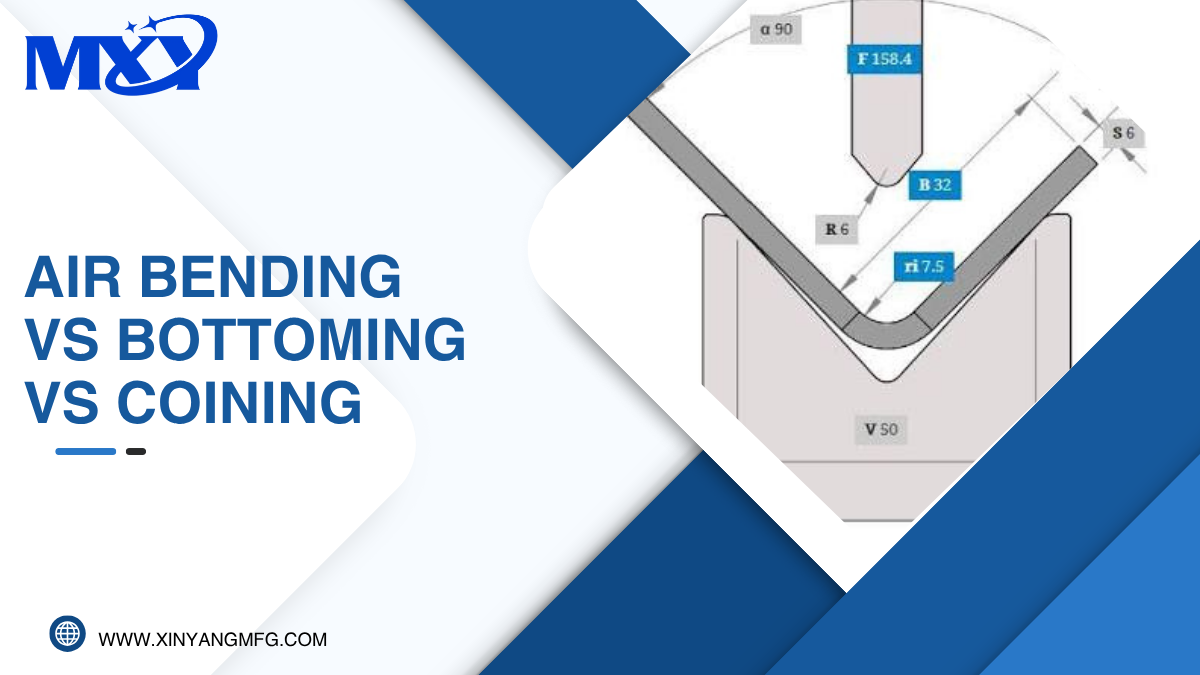
On a press brake, the same V-die can form a bend three different ways. Air bending stops the punch before the sheet contacts the die bottom, setting the angle by punch depth alone and leaving an air gap. Bottoming drives the sheet fully against the die walls so the tooling geometry controls the angle. Coining drives the punch tip into the metal under extreme force, thinning the material at the bend line and locking in the angle with minimal springback.
Force, accuracy, and tooling cost increase from air bending to bottoming to coining. Flexibility and economy run the other way. For most fabrication work, air bending is the economical default. Bottoming and coining are step-ups warranted by specific tolerance or repeatability requirements — and this guide explains exactly when they apply.
This guide covers the mechanics of each method, the force and springback trade-offs, material considerations, and a practical decision framework. For the dimensional design rules behind any bend, see our 钣金折弯设计指南. For the full range of sheet metal forming operations, see our 钣金成形工艺 指南。.
Air Bending: Mechanics and Trade-Offs
In air bending, the punch descends into the V-die until the sheet makes contact at three points: the punch tip and the two die shoulders. The sheet spans the die opening between the shoulders, leaving an air gap beneath. Punch depth — not die geometry — determines the bend angle. By adjusting how far the punch travels, the same tooling set produces a range of angles shallower than the die opening angle.
This is air bending’s primary advantage: one punch-and-die combination can produce many different angles. A 90-degree die can form bends anywhere from 90 to approximately 175 degrees by adjusting punch travel. In practice, this means fewer tooling changeovers and more flexibility for varied-angle parts, which keeps programming and setup time low.
The trade-off is springback. When the punch retracts, the elastic portion of the bend strain recovers and the part springs open toward its flat state. The springback angle depends on the yield strength and work-hardening characteristics of the material, the bending radius-to-thickness ratio, and the die opening width. Higher-yield materials — 304 stainless steel, 6061-T6 aluminum, high-strength cold-rolled steel — spring back more than mild steel or annealed aluminum. CNC press brake controllers compensate by over-bending, but the compensation is based on nominal material properties and varies with coil-to-coil material variation.
Air bending requires the least tonnage of the three methods because the bending force acts over the full die opening width rather than conforming the material to a die face. This makes it practical on lighter presses and reduces tooling wear.
Bottoming: Mechanics and Trade-Offs
Bottoming — also called bottom pressing or touch-die bending — drives the sheet against the sidewalls of the V-die. Unlike air bending, the material conforms to the die face, so the bend angle is governed by the tooling geometry rather than punch depth alone. This transfers angular control from the program to the die, producing more consistent, repeatable bends with noticeably less springback.
Bottoming requires three to five times the tonnage of air bending for the same material and thickness. The sheet must be conformed to the die rather than simply bent over a span, which demands substantially more force. The press must have sufficient capacity for the combination of material, thickness, and flange length, and a separate die is required for each target angle. Changing the target angle means changing the die.
Springback in bottoming is reduced but not eliminated. Because the material at the bend radius is not fully plastically displaced — as it is in coining — some elastic recovery still occurs. However, the springback is more consistent and predictable than in air bending because the material conformation is more fully controlled. Tool makers account for residual springback by designing die angles slightly sharper than the nominal target.
Bottoming is the correct choice when a fixed-angle part is produced in quantity and the tolerance requirement is tighter than air bending springback correction can reliably achieve — typically when angular tolerance is tighter than plus or minus one degree, or when material lot variation causes angle scatter that cannot be corrected by program adjustment.
Coining: Mechanics and Trade-Offs
Coining applies extreme force — often ten times or more the tonnage required for air bending — to drive the punch tip into the outer fiber of the sheet metal at the bend line. The material yields fully in both compression and tension: plastic strain is driven far past the elastic range, and the material thins slightly at the bend apex. This full plastification means elastic recovery is minimal — springback is typically below 0.5 degrees on well-matched tooling and material.
The result is the most accurate, most repeatable angle achievable on a press brake. Coining can hold angular tolerances of plus or minus 0.25 degrees or better, and the tight, sharp inside radius produced is consistent across a production run regardless of material strength variation within the batch.
The cost is substantial. The press must generate significantly more tonnage. Tooling wears faster because the forces involved are much higher. The sharp, thinned bend radius creates a stress concentration that must be considered in fatigue analysis if the part is dynamically loaded. For most features on most parts, coining is unnecessary cost. For the features that genuinely require it, there is no substitute.
Comparison: Air Bending vs Bottoming vs Coining
|
因子 |
气系弯曲 |
Bottoming |
铸币 |
|
Force required |
最低 |
3–5× air bending |
10×+ air bending |
|
Angle accuracy |
Good (±1–2°) |
Better (±0.5–1°) |
Best (<±0.25°) |
|
Springback |
Most — material-dependent |
Reduced, more predictable |
Minimal (<0.5°) |
|
Tooling per angle |
One set, many angles |
Angle-specific die |
Angle-specific, heavy duty |
|
Tool wear |
低 |
中等 |
高 |
|
Cost per bend |
最低 |
中等 |
最高 |
|
最适合 |
General fabrication |
Repeatable production runs |
Tight tolerance, sharp radii |
Springback in Depth: Why It Matters and How Each Method Handles It
Springback is elastic recovery after bending force is removed. Every metal is partly elastic and partly plastic when bent. The plastic portion stays deformed; the elastic portion recovers. The ratio is determined by the yield strength of the material divided by its elastic modulus — the higher this ratio, the more springback.
304 stainless steel, 17-4 PH, and 6061-T6 aluminum all have relatively high yield-to-modulus ratios and spring back significantly. Mild steel (A36 or A1011) springs back less. Annealed aluminum springs back least among common materials.
Air bending manages springback through over-bend compensation programmed into the CNC controller. The controller uses a springback model based on material, thickness, and geometry to calculate the required punch depth. This works well for consistent material but is sensitive to lot-to-lot variation in yield strength and work-hardening rate.
Bottoming makes springback more consistent by conforming the material to the die. The residual springback is smaller and more predictable, which makes it easier to compensate in tooling design. Coining eliminates most of the springback problem by yielding the material fully at the bend radius.
From a design standpoint: specify the tightest tolerance band your functional requirements actually need, and no tighter. Specifying coining where bottoming would achieve the tolerance adds cost without benefit. Specifying bottoming where air bending with springback compensation is sufficient does the same.
Mixing Methods on a Single Part
Many parts benefit from using different methods on different features. A sheet metal enclosure might use air bending for the main panel flanges at plus or minus two degrees, bottoming for the connector face cutout flanges at plus or minus one degree, and coining at a single precision mounting flange at plus or minus 0.25 degrees. Mixing methods is normal practice and is specified feature by feature on the drawing — either as a tolerance callout (which the fabricator interprets) or as an explicit method call-out if the designer has a firm preference.
If your drawing specifies only tolerances and not methods, your fabricator will select the most economical method that reliably achieves each tolerance. In most cases, this produces the best cost result without requiring the designer to specify bending methods explicitly.
How to Choose: A Decision Framework
Start with air bending. For any feature where the angular tolerance is plus or minus one degree or looser, air bending with CNC springback correction is the right default. It is the most flexible, uses the least press tonnage, and is the most economical option across the widest range of materials.
Move to bottoming when the angular tolerance is tighter than plus or minus one degree on a feature produced in quantity. When the same angle must be produced consistently across a long run and material variation cannot be corrected by program adjustment, bottoming provides the repeatability that air bending cannot.
Specify coining only for features requiring tighter than plus or minus 0.5 degrees, very sharp inside radii approaching the material thickness, or when springback variability in the specific material makes bottoming insufficient. Coining should be the exception on any given part, not the rule.
常见问题解答
What is the main difference between air bending and bottoming?
Air bending sets the angle by punch depth, leaving an air gap between sheet and die bottom. This makes it flexible — one tooling set produces many angles — but springback is higher and more variable. Bottoming presses the sheet fully against the die walls, transferring angle control to the tooling geometry. The result is more precise and repeatable, at the cost of angle-specific tooling and higher tonnage.
Why does coining reduce springback so much?
Coining uses extreme force to drive the punch tip into the metal at the bend radius, yielding the material fully and slightly thinning it. The degree of plastic deformation is large enough that elastic recovery — springback — is minimal, leaving the part within a fraction of a degree of the tooled angle.
Which method uses the least press tonnage?
Air bending, by a wide margin. Bottoming typically requires three to five times the tonnage of air bending for the same material and thickness. Coining can require ten times or more. Press capacity determines which methods are available on a given machine.
When should I default to air bending?
Air bending is the right default for the large majority of sheet metal parts — any feature where angular tolerance is plus or minus one degree or looser, where part geometry and material are within the range of CNC springback compensation, and where tooling flexibility and low press tonnage matter. Step up to bottoming or coining only when the specific tolerance or repeatability requirement demands it.
Can a single part use multiple bending methods?
Yes, and this is common. A part with one critical joint requiring plus or minus 0.25 degrees and several standard flanges at plus or minus 1.5 degrees might use coining on the critical bend and air bending on the rest. Mixing methods is specified feature by feature on the drawing as a tolerance callout or explicit method call-out.