Kurze Antwort
Thread milling vs tapping comes down to speed against control. Thread milling is slower per hole, but one cutter covers many sizes, cutting forces stay low, and the thread can be milled all the way to the bottom of a blind hole.
Tapping is faster and cheaper for small, standard threads in high-volume production, because the tap cuts the whole thread in one pass. For large or custom threads, tough materials, and blind holes, thread milling is the better choice.
Two ways to cut the same thread
Every CNC machined part with an internal thread was either tapped or thread-milled. Both operations produce the same output — a threaded hole — but they work by entirely different mechanisms, and the choice between them has real consequences for tool breakage risk, tolerance, material compatibility, and cost.
Both methods are available as part of our CNC-Bearbeitungsdienstleistungen, und das Threading geht oft Hand in Hand mit den Prozessauswahlen in unserem CNC-Drehen vs. CNC-Fräsen Leitfaden.
How tapping works
Tapping drives a dedicated tap directly into a pre-drilled hole in a single axial plunge. The tap geometry matches the thread form exactly, so the operation is fast and requires minimal programming. For high volumes of standard threads in ductile materials, tapping is hard to beat on speed and economy.
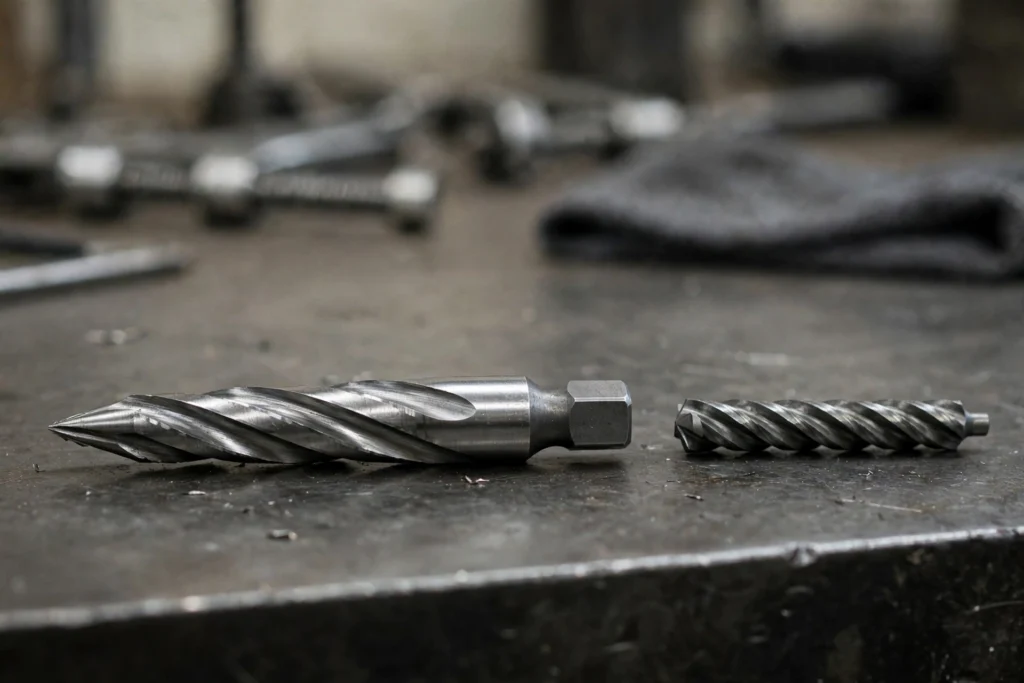
A tap is a hardened cutting tool ground with flutes and a thread form that matches the target internal thread exactly. It is mounted in the spindle and driven axially into a pre-drilled hole at a feed rate synchronized to its pitch — this is rigid tapping, the standard mode on modern CNC machining centers.
Rigid tapping and cycle time
In rigid tapping, spindle speed and axial feed are electronically synchronized so the tap advances exactly one pitch per revolution, then reverses and extracts in one continuous cycle.
For a part with thirty M5 holes in 6061 aluminum, tapping is extremely productive — cycle time per hole is typically one to three seconds for standard sizes. One tap per thread size and pitch means five different M-size threads require five taps, consuming five tool magazine slots. In high-volume dedicated cells, this is negligible. In job-shop work with complex parts running mixed thread specifications, tool magazine management becomes a real consideration.
Chip management
Die Spanabfuhr ist beim Gewindeschneiden schwieriger als beim Gewindefräsen, insbesondere bei Sacklöchern. Die Schneidrillen müssen die Späne beim Vorschub des Gewindebohrers aus dem Loch abtransportieren. Bei Werkstoffen, die lange, fadenförmige Späne bilden – Edelstahl 304, Titan, einige Nickellegierungen –, sammeln sich die Späne um die Schneidrillen an und erhöhen die Gefahr des Festfressens und des Bruchs. Ausführungen mit Spiralnuten (Gun-Tap) befördern die Späne axial aus Sacklöchern heraus und verringern dieses Risiko, beseitigen es jedoch nicht vollständig.
When a tap breaks
Its vulnerability is tool breakage: a broken tap inside a blind hole in a hard material is often unrecoverable and can scrap an otherwise complete part.
Wenn ein Gewindebohrer bricht – insbesondere bei einem gehärteten Werkstoff in einem Sackloch –, handelt es sich in der Regel um gehärteten HSS oder Hartmetall, der sich nicht herausbohren lässt. Die Funkenerosion (EDM) ist oft die einzige zuverlässige Methode zur Entfernung, die jedoch kostspielig und zeitaufwendig ist. Je nach Komplexität und Wert des Bauteils kann das Ergebnis ein Ausschuss sein.
How thread milling works
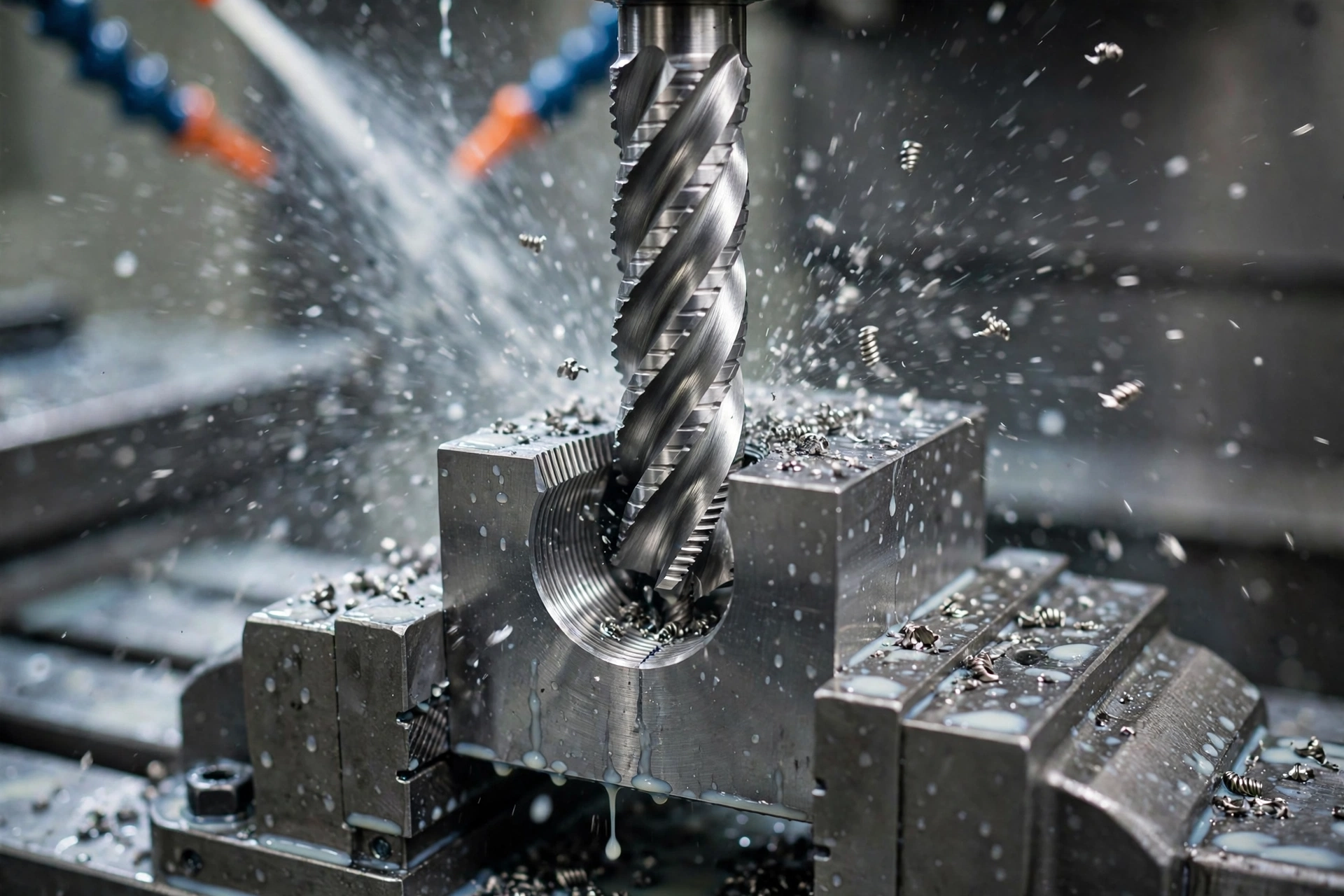
Thread milling uses a smaller rotating cutter that follows a helical CNC toolpath — circling the hole in X and Y while advancing in Z — to generate the thread form over several passes. The cutter does not match the thread diameter, which means one tool covers a range of thread sizes at the same pitch, and fit can be fine-tuned by adjusting the toolpath radius.
Thread milling is slower and requires more sophisticated programming, but it is safer, more flexible, and better suited to hard materials, large threads, blind holes requiring clean bottom engagement, and expensive parts where breakage risk cannot be accepted.
The cutter and the toolpath
A thread mill is a multi-tooth rotating cutter, typically solid carbide with a wear-resistant coating, that the CNC machine moves along a helical path — interpolating simultaneously in X, Y, and Z — to generate the thread form. The cutter’s tooth geometry matches the thread profile, and the toolpath diameter determines the thread size.
Because the path diameter controls the size rather than the tool body, a single thread mill can produce multiple thread sizes sharing the same pitch by adjusting the programmed radius.
Fit control and safety
Das Gewindefräsen ermöglicht zudem eine Kontrolle über die Gewindepassung, die beim Gewindebohren nicht gegeben ist. Durch eine Verschiebung des programmierten Werkzeugbahnradius um einige Mikrometer kann der Bediener die Passungsklasse verschärfen oder lockern, ohne das Werkzeug zu wechseln. Dies ist besonders wertvoll bei Gehäusen für Präzisionsinstrumente, Hydraulikarmaturen und Fluidanschlüssen, bei denen die Passungsklasse von Teil zu Teil überprüft und angepasst werden muss.
Der Sicherheitsvorteil ist erheblich. Der Gewindefräser ist kleiner als der Durchmesser des fertigen Gewindes. Sollte er brechen, kann das Bruchstück aus dem Gewinde herausfallen oder mit einem Magneten oder einer Pinzette entfernt werden. Das Werkstück lässt sich in der Regel wiedergewinnen – ein deutlicher Unterschied zu einem abgebrochenen Gewindebohrer in einem Sackloch.
The speed trade-off
Thread milling is slower: multiple helical passes per hole rather than one axial plunge. It requires a CNC machining center capable of simultaneous three-axis interpolation and a CAM system or thread-milling canned cycles. For very high volumes of standard threads in ductile materials, the per-hole time disadvantage adds up and tapping is more economical.
Thread milling is also the tool of choice on a mill-turn center, where the same setup turns and mills the part — one cutter covers the sizes that would need a whole set of taps.
Thread milling vs tapping: comparison table
Thread milling vs tapping comes down to brute-force speed against flexibility and control. The right choice depends on thread size, material, hole type, and the accuracy your part needs.
| Faktor | Anzapfen | Gewindefräsen |
|---|---|---|
| Zykluszeit pro Bohrung | Am schnellsten – ein einziger Eintauchvorgang | Langsamer – spiralförmiger Mehrfachdurchlauf |
| Programmierkomplexität | Einfacher Zyklus mit starrem Hahn | Spiralförmige Interpolation, CAM erforderlich |
| Werkzeug nach Größe/Steigung | Ein Gewindegang pro Größe und Steigung | Eine Fräse deckt viele Größen ab (gleiche Teilung) |
| Bruchgefahr | Mäßig bis hoch; teilweise Reste | Niedrig; Fräser fällt frei herunter |
| Die besten Materialien | Aluminum, mild steel, brass | Titan, Edelstahl, gehärtete Stähle |
| Leistung bei Sacklöchern | Risiko der Späneansammlung; Auslaufzone am Boden | Unteres Gewinde reinigen; Späne werden nach außen abgeleitet |
| Garnqualität und Passform | Gut; durch die Geometrie des Wasserhahns behoben | Hervorragend; einstellbar über den Werkzeugweg-Offset |
| Rechts- und Linkshänder | Separater Wasserhahn erforderlich | Gleiche Fräsmaschine, umgekehrte Werkzeugbahnrichtung |
| Außengewinde | Nicht zutreffend | Möglich mit spiralförmiger Schnittbahn mit Steigung |
| Optimale Lautstärke | Großvolumige Standardgewinde | Grobe bis mittlere, Präzisions- oder Sondergewinde |
If your priority is speed, tapping often wins. If your priority is precision and flexibility, thread milling is the better choice.
Material guide: when to tap and when to thread mill
Aluminiumlegierungen
Aluminum alloys — 6061, 7075, cast grades — are the natural home of tapping. The material is ductile, produces manageable chips, and its relatively low yield strength keeps tapping forces and wear modest. Standard HSS or cobalt taps produce thousands of holes before wearing out.
Thread milling in aluminum is possible and preferred for threads M20 and above or blind holes needing clean bottom engagement, but for M3 through M16 at volume, tapping is more economical.
Stainless steels
Stainless steels — 304, 316, 17-4 PH — work-harden rapidly, generate long stringy chips, and are abrasive to cutting edges. Tapping in stainless is possible with sharp spiral-flute taps, appropriate cutting fluid, and careful synchronization, but wear is faster and breakage risk is higher than in aluminum.
Thread milling is often the better choice for M12 and above in stainless: the cutter engages a smaller chip cross-section per pass, work-hardening is distributed across multiple light cuts, and breakage risk is substantially reduced.
Titanium alloys
Titanium alloys — 6Al-4V in particular — concentrate heat at the cutting edge due to low thermal conductivity, accelerating wear and increasing galling risk. Tapping titanium requires carbide taps, high-pressure through-spindle coolant, and conservative speeds — and breakage remains a real risk. Thread milling in titanium with solid carbide cutters and appropriate coatings provides better heat management and far lower breakage risk. For structural aerospace threads in titanium, thread milling is the industry standard.
Hardened steels
Gehärtete Stähle mit einer Härte von über etwa 40 HRC werden in der Regel nicht mit Gewindebohrern bearbeitet – das Bruchrisiko ist zu hoch. Durch Gewindefräsen mit Hartmetallfräsern, die für harte Werkstoffe ausgelegt sind, lassen sich Gewinde bis zu einer Härte von etwa 65 HRC herstellen, allerdings ist der Werkzeugverschleiß hoch und die Vorschubgeschwindigkeiten müssen konservativ gewählt werden.
Blind holes: thread milling’s key advantage
A blind hole — one that does not pass through the workpiece — creates specific challenges for both methods. With a standard taper tap, the chamfer geometry prevents full thread engagement for three to five pitches from the bottom of the hole. A bottoming tap reduces this to one to two pitches, but chip packing at the bottom increases breakage risk.
If full thread engagement close to the blind end is a structural requirement, note it on the drawing so your machinist can select the right tap type or recommend thread milling.
Threads all the way to the bottom
Thread milling handles blind holes more cleanly. The cutter begins the helical path at the bottom of the thread depth and spirals upward toward the hole entrance, so chips move toward the open end rather than packing at the bottom.
The cutter can engage the thread form within one pitch of the blind end, providing nearly full engagement across the specified thread depth. For blind holes where thread depth is limited and full engagement is structurally required, thread milling is typically the correct choice.

Choosing the right method: a decision framework
Default to tapping
Default to tapping when: the material is aluminum, mild steel, or brass; the thread is a standard size and pitch; the volume is sufficient to justify dedicated tapping cycles; and the hole depth and part value do not create unacceptable breakage risk. For most high-volume work in ductile materials, tapping is the economical default.
Choose thread milling
Entscheiden Sie sich für das Gewindefräsen, wenn einer der folgenden Punkte zutrifft: Das Material ist Edelstahl, Titan oder gehärteter Stahl; das Gewinde hat die Größe M20 oder größer, eine ungewöhnliche Steigung oder ist linksgewindig; die Bohrung ist blind und erfordert einen sauberen Gewindeeingriff am Boden; die Passungsklasse ist „eng“ und eine Anpassung pro Bauteil ist erforderlich; oder der Wert des Bauteils ist so hoch, dass ein Bruch des Gewindebohrers, der das Bauteil unbrauchbar macht, einen erheblichen Verlust darstellen würde.
Use both on the same part
Use both on the same part where it makes sense: tap the twenty M5 holes in the aluminum bracket; thread mill the two M30 features in the stainless insert. Specifying a single method for an entire part often leaves cost or quality on the table.
Häufig gestellte Fragen
Ist das Gewindefräsen immer besser als das Gewindeschneiden?
Nicht immer. Das Gewindefräsen ist flexibler, bei harten Werkstoffen sicherer und ermöglicht eine anpassbare Passform – ist jedoch langsamer und erfordert leistungsfähigere Maschinen sowie eine ausgefeiltere Programmierinfrastruktur. Das Gewindeschneiden ist bei Standardgewinden in duktilen Werkstoffen in der Serienfertigung schneller und einfacher. Die beste Methode hängt vom Werkstoff, der Gewindegröße und -art, der Bohrungsgeometrie, dem Wert des Bauteils und dem Produktionsvolumen ab.
Wann sollte ich das Gewindefräsen anstelle des Gewindeschneidens verwenden?
Für harte Werkstoffe – Titan, Edelstahl, gehärtete Stähle –, große oder ungewöhnliche Gewinde, Sacklöcher, die einen sauberen Eingriff am Boden erfordern, enge Passungstoleranzen, bei denen eine Nachjustierung erforderlich ist, sowie teure Teile, bei denen ein gebrochener Gewindebohrer zu einem kostspieligen Ausschuss führen würde.
Warum ist das Gewindebohren schneller als das Gewindefräsen?
Ein Gewindebohrer schneidet das gesamte Gewinde in einem einzigen axialen Einstich, was in der Regel ein bis drei Sekunden pro Bohrung dauert. Beim Gewindefräsen muss die Maschine über mehrere Durchgänge hinweg einen vollständigen spiralförmigen Durchgang ausführen – dabei um die Bohrung herumkreisen und gleichzeitig axial vorrücken. Bei großen Stückzahlen von Standardgewinden ist der Zeitvorteil des Gewindebohrens pro Bohrung erheblich.
Was passiert, wenn ein Gewindebohrer in einem Sackloch bricht?
A broken tap in a blind hole is one of the hardest recovery situations in CNC machining. Taps are hardened HSS or carbide and cannot be drilled out. EDM (electrical discharge machining) is often the only reliable removal method, expensive and time-consuming, and the part may be scrapped. Thread milling significantly reduces this risk: the cutter is smaller than the hole and, if it breaks, the fragment typically falls free, leaving the part recoverable.
Können beim Gewindefräsen Linksgewinde hergestellt werden?
Ja. Beim Gewindefräsen werden Linksgewinde durch Umkehrung der Richtung der spiralförmigen Werkzeugbahn hergestellt – ein Wechsel des Werkzeugs oder des Werkzeughalters ist nicht erforderlich. Beim Gewindeschneiden ist für jede Linksgewindegröße ein separater Linksgewindebohrer erforderlich, der bei umgekehrter Spindeldrehung eingesetzt wird.
What is thread milling?
Thread milling is a CNC process that cuts a thread with a rotating cutter moving in a helical toolpath. The cutter advances in small increments, so cutting forces stay manageable, and the same cutter can produce different thread diameters and pitches by changing the toolpath.
What is a thread mill?
A thread mill is a rotating cutting tool with multiple teeth that cuts internal threads by helical interpolation. Unlike a tap, which needs a dedicated tool for every thread size, one thread mill can cut several sizes and pitches.
What are the downsides of thread milling?
Thread milling is slower per hole than tapping, costs more up front, and needs CNC programming expertise to set up the helical toolpath. For small standard threads in high volume, those costs are hard to justify — which is why tapping still wins there.