哪些趋势将塑造2026年的制造业?
阅读我们的《2026年制造业展望》。.

攻丝与螺纹铣削:该选择哪种螺纹加工方法?

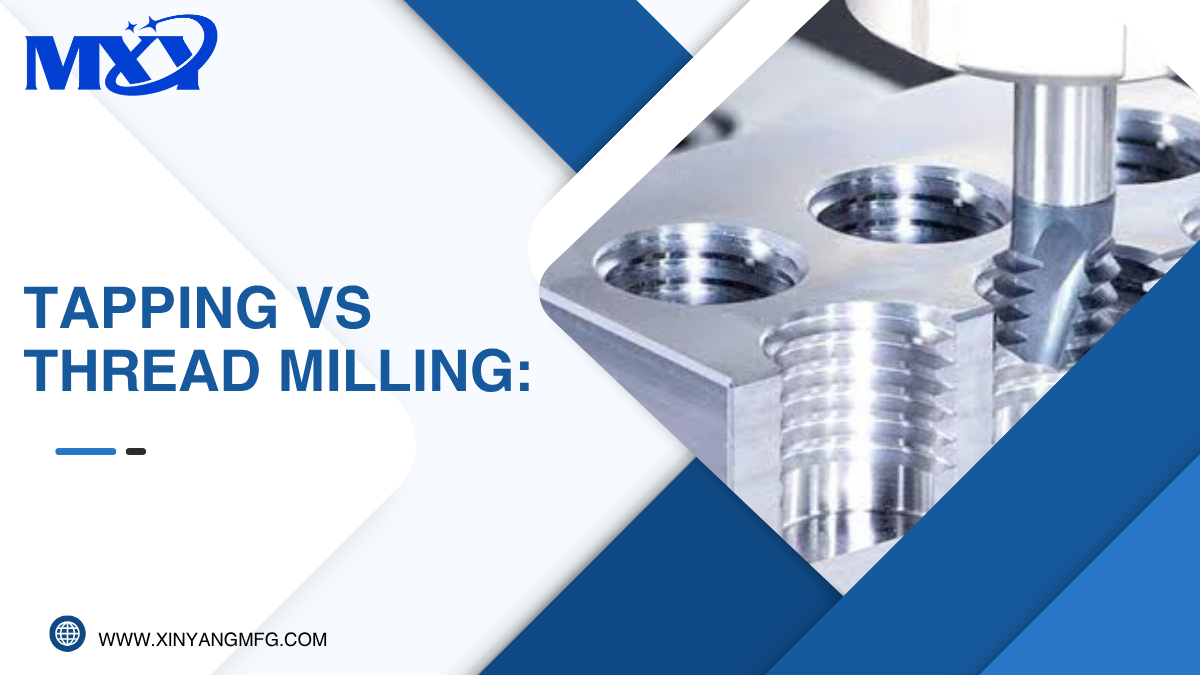
攻丝与螺纹铣削

Every CNC machined part with an internal thread was either tapped or thread-milled. Both operations produce the same output — a threaded hole — but they work by entirely different mechanisms, and the choice between them has real consequences for tool breakage risk, tolerance, material compatibility, and total cost.

Tapping drives a dedicated tap directly into a pre-drilled hole in a single axial plunge. The tap geometry matches the thread form exactly, so the operation is fast and requires minimal programming. For high volumes of standard threads in ductile materials, tapping is hard to beat on speed and economy. Its vulnerability is tool breakage: a broken tap inside a blind hole in a hard material is often unrecoverable and can scrap an otherwise complete part.

Thread milling uses a smaller rotating cutter that follows a helical CNC toolpath — circling the hole in X and Y while advancing in Z — to generate the thread form over several passes. The cutter does not match the thread diameter, which means one tool covers a range of thread sizes at the same pitch, and fit can be fine-tuned by adjusting the toolpath radius. Thread milling is slower and requires more sophisticated programming, but it is safer, more flexible, and better suited to hard materials, large threads, blind holes requiring clean bottom engagement, and expensive parts where breakage risk cannot be accepted.

This guide compares both methods across every factor that matters: speed, tool inventory, breakage risk, material compatibility, blind hole performance, thread quality, and volume economics. Both methods are available as part of our 数控加工服务, ,而且线程通常与我们中的进程选择相配合 数控车削与铣削的对比 指南。.

轻敲疗法的作用原理

A tap is a hardened cutting tool ground with flutes and a thread form that matches the target internal thread exactly. It is mounted in the spindle and driven axially into a pre-drilled hole at a feed rate synchronised to its pitch — this is rigid tapping, the standard mode on modern CNC machining centres. In rigid tapping, spindle speed and axial feed are electronically synchronised so the tap advances exactly one pitch per revolution, then reverses and extracts in one continuous cycle.

For a part with thirty M5 holes in 6061 aluminium, tapping is extremely productive — cycle time per hole is typically one to three seconds for standard sizes. One tap per thread size and pitch means five different M-size threads require five taps, consuming five tool magazine slots. In high-volume dedicated cells, this is negligible. In job-shop work with complex parts running mixed thread specifications, tool magazine management becomes a real consideration.

Chip management is more challenging in tapping than in thread milling, especially in blind holes. Flutes must carry chips out of the hole as the tap advances. In materials that produce long, stringy chips — 304 stainless, titanium, some nickel alloys — chips pack around the flutes and increase binding and breakage risk. Spiral-flute (gun-tap) designs lift chips axially out of blind holes and reduce but do not eliminate this risk.

When a tap breaks — particularly in a hardened material in a blind hole — it is typically hardened HSS or carbide and cannot be drilled out. EDM (electrical discharge machining) is often the only reliable removal method, which is expensive and time-consuming. Depending on part complexity and value, the result may be scrap.

螺纹铣削的工作原理

A thread mill is a multi-tooth rotating cutter, typically solid carbide with a wear-resistant coating, that the CNC machine moves along a helical path — interpolating simultaneously in X, Y, and Z — to generate the thread form. The cutter’s tooth geometry matches the thread profile, and the toolpath diameter determines the thread size. Because the path diameter controls the size rather than the tool body, a single thread mill can produce multiple thread sizes sharing the same pitch by adjusting the programmed radius.

Thread milling also provides control over thread fit that tapping does not. By shifting the programmed toolpath radius by a few microns, the operator can tighten or loosen the fit class without changing tools. This is particularly valuable for precision instrument housings, hydraulic fittings, and fluid connectors where the fit class must be verified and adjusted part-to-part.

The safety advantage is significant. The thread mill cutter is smaller than the finished thread diameter. If it breaks, the fragment can fall free of the thread or be extracted with a magnet or forceps. The part is typically recoverable — a sharp contrast to a broken tap in a blind hole.

Thread milling is slower: multiple helical passes per hole rather than one axial plunge. It requires a CNC machining centre capable of simultaneous three-axis interpolation and a CAM system or thread-milling canned cycles. For very high volumes of standard threads in ductile materials, the per-hole time disadvantage adds up and tapping is more economical.

Tapping vs Thread Milling: Comparison Table

因子敲击Thread Milling
Cycle time per holeFastest — single plungeSlower — helical multi-pass
Programming complexitySimple rigid tap cycleHelical interpolation, CAM required
Tool per size/pitch每种尺寸和节距各一个螺纹One mill covers many sizes (same pitch)
Breakage riskModerate–high; scraps partLow; cutter falls free
最佳材料Aluminium, mild steel, brassTitanium, stainless, hardened steels
Blind hole performanceChip-packing risk; runout zone at bottomClean bottom threads; chips exit outward
Thread quality and fitGood; fixed by tap geometryExcellent; adjustable by toolpath offset
Right- and left-handSeparate tap requiredSame mill, reverse toolpath direction
External threadsNot applicablePossible with climb-cut helical path
最佳音量大流量,标准螺纹Low–medium, precision or unusual threads

Material Guide: When to Tap and When to Thread Mill

Aluminium alloys — 6061, 7075, cast grades — are the natural home of tapping. The material is ductile, produces manageable chips, and its relatively low yield strength keeps tapping forces and wear modest. Standard HSS or cobalt taps produce thousands of holes before wearing out. Thread milling in aluminium is possible and preferred for threads M20 and above or blind holes needing clean bottom engagement, but for M3 through M16 at volume, tapping is more economical.

Stainless steels — 304, 316, 17-4 PH — work-harden rapidly, generate long stringy chips, and are abrasive to cutting edges. Tapping in stainless is possible with sharp spiral-flute taps, appropriate cutting fluid, and careful synchronisation, but wear is faster and breakage risk is higher than in aluminium. Thread milling is often the better choice for M12 and above in stainless: the cutter engages a smaller chip cross-section per pass, work-hardening is distributed across multiple light cuts, and breakage risk is substantially reduced.

Titanium alloys — 6Al-4V in particular — concentrate heat at the cutting edge due to low thermal conductivity, accelerating wear and increasing galling risk. Tapping titanium requires carbide taps, high-pressure through-spindle coolant, and conservative speeds — and breakage remains a real risk. Thread milling in titanium with solid carbide cutters and appropriate coatings provides better heat management and far lower breakage risk. For structural aerospace threads in titanium, thread milling is the industry standard.

Hardened steels above approximately 40 HRC are generally not tapped — the breakage risk is prohibitive. Thread milling with carbide cutters designed for hard material can produce threads up to approximately 65 HRC, though tool wear is high and feed rates must be conservative.

Blind Holes: Thread Milling’s Key Advantage

A blind hole — one that does not pass through the workpiece — creates specific challenges for both methods. With a standard taper tap, the chamfer geometry prevents full thread engagement for three to five pitches from the bottom of the hole. A bottoming tap reduces this to one to two pitches, but chip packing at the bottom increases breakage risk. If full thread engagement close to the blind end is a structural requirement, note it on the drawing so your machinist can select the right tap type or recommend thread milling.

Thread milling handles blind holes more cleanly. The cutter begins the helical path at the bottom of the thread depth and spirals upward toward the hole entrance, so chips move toward the open end rather than packing at the bottom. The cutter can engage the thread form within one pitch of the blind end, providing nearly full engagement across the specified thread depth. For blind holes where thread depth is limited and full engagement is structurally required, thread milling is typically the correct choice.

Choosing the Right Method: A Decision Framework

Default to tapping when: the material is aluminium, mild steel, or brass; the thread is a standard size and pitch; the volume is sufficient to justify dedicated tapping cycles; and the hole depth and part value do not create unacceptable breakage risk. For most high-volume work in ductile materials, tapping is the economical default.

Choose thread milling when any of the following apply: the material is stainless steel, titanium, or hardened steel; the thread is M20 or larger, an unusual pitch, or left-hand; the hole is blind and requires clean bottom thread engagement; the fit class is tight and per-part adjustment is needed; or the part value is high enough that a broken tap scrapping it would be a significant loss.

Use both on the same part where it makes sense: tap the twenty M5 holes in the aluminium bracket; thread mill the two M30 features in the stainless insert. Specifying a single method for an entire part often leaves cost or quality on the table.

常见问题解答

Is thread milling always better than tapping?

Not always. Thread milling is more flexible, safer in hard materials, and provides adjustable fit — but it is slower and requires more capable machine and programming infrastructure. Tapping is faster and simpler for standard threads in ductile materials at volume. The best method depends on material, thread size and type, hole geometry, part value, and production volume.

在什么情况下应该使用线铣削而不是攻丝?

For hard materials — titanium, stainless steel, hardened steels — large or unusual threads, blind holes needing clean bottom engagement, tight fit tolerances where adjustment is needed, and expensive parts where a broken tap would be a costly scrapping event.

Why is tapping faster than thread milling?

A tap cuts the complete thread in a single axial plunge, typically in one to three seconds per hole. Thread milling requires the machine to complete a full helical pass — circling the hole while advancing axially — over multiple passes. For high volumes of standard threads, the per-hole time advantage of tapping is significant.

What happens if a tap breaks inside a blind hole?

A broken tap in a blind hole is one of the most difficult recovery situations in CNC machining. Taps are hardened HSS or carbide and cannot be drilled out. EDM (electrical discharge machining) is often the only reliable removal method, which is expensive and time-consuming, and the part may ultimately be scrapped. Thread milling significantly reduces this risk: the cutter is smaller than the hole and, if it breaks, the fragment typically falls free, leaving the part recoverable.

Can thread milling produce left-hand threads?

Yes. Thread milling produces left-hand threads by reversing the direction of the helical toolpath — no change in tool or tool holder is needed. Tapping requires a separate left-hand tap for each left-hand thread size, to be run with spindle rotation reversed.

联系我们

从原型到量产——您值得信赖的合作伙伴

XY Machining 为需要严格公差、有据可查的质量控制和可靠交货的工程团队提供精密数控加工服务。从原型开发到批量生产,我们严格按照您的技术图纸制造功能完备、可直接投入生产的零部件。 我们的团队将先进的数控铣削和车削能力与规范化的检测流程相结合,确保无论零件复杂程度如何,都能实现高精度、高重复性和稳定的加工结果。.
联系我们吧!
保证在12小时内及时回复