Réponse rapide
Thread milling vs tapping comes down to speed against control. Thread milling is slower per hole, but one cutter covers many sizes, cutting forces stay low, and the thread can be milled all the way to the bottom of a blind hole.
Tapping is faster and cheaper for small, standard threads in high-volume production, because the tap cuts the whole thread in one pass. For large or custom threads, tough materials, and blind holes, thread milling is the better choice.
Two ways to cut the same thread
Every CNC machined part with an internal thread was either tapped or thread-milled. Both operations produce the same output — a threaded hole — but they work by entirely different mechanisms, and the choice between them has real consequences for tool breakage risk, tolerance, material compatibility, and cost.
Both methods are available as part of our Services d'usinage CNC, et le multithreading va souvent de pair avec les choix de processus dans notre Tournage CNC vs fraisage guide.
How tapping works
Tapping drives a dedicated tap directly into a pre-drilled hole in a single axial plunge. The tap geometry matches the thread form exactly, so the operation is fast and requires minimal programming. For high volumes of standard threads in ductile materials, tapping is hard to beat on speed and economy.
A tap is a hardened cutting tool ground with flutes and a thread form that matches the target internal thread exactly. It is mounted in the spindle and driven axially into a pre-drilled hole at a feed rate synchronized to its pitch — this is rigid tapping, the standard mode on modern CNC machining centers.
Rigid tapping and cycle time
In rigid tapping, spindle speed and axial feed are electronically synchronized so the tap advances exactly one pitch per revolution, then reverses and extracts in one continuous cycle.
For a part with thirty M5 holes in 6061 aluminum, tapping is extremely productive — cycle time per hole is typically one to three seconds for standard sizes. One tap per thread size and pitch means five different M-size threads require five taps, consuming five tool magazine slots. In high-volume dedicated cells, this is negligible. In job-shop work with complex parts running mixed thread specifications, tool magazine management becomes a real consideration.
Chip management
La gestion des copeaux est plus difficile lors du taraudage que lors du fraisage de filets, en particulier dans les trous borgnes. Les rainures doivent évacuer les copeaux hors du trou à mesure que le taraud avance. Dans les matériaux produisant des copeaux longs et filandreux — acier inoxydable 304, titane, certains alliages de nickel —, les copeaux s'accumulent autour des rainures et augmentent le risque de grippage et de rupture. Les modèles à rainures hélicoïdales (tarauds « gun-tap ») évacuent les copeaux axialement hors des trous borgnes et réduisent ce risque, sans toutefois l’éliminer.
When a tap breaks
Its vulnerability is tool breakage: a broken tap inside a blind hole in a hard material is often unrecoverable and can scrap an otherwise complete part.
Lorsqu'un taraud se casse — en particulier s'il s'agit d'un matériau trempé dans un trou borgne —, il est généralement en acier rapide trempé (HSS) ou en carbure et ne peut pas être percé pour être extrait. L'électroérosion (EDM) est souvent la seule méthode fiable pour l'extraire, mais elle est coûteuse et prend beaucoup de temps. Selon la complexité et la valeur de la pièce, celle-ci peut finir à la casse.
How thread milling works
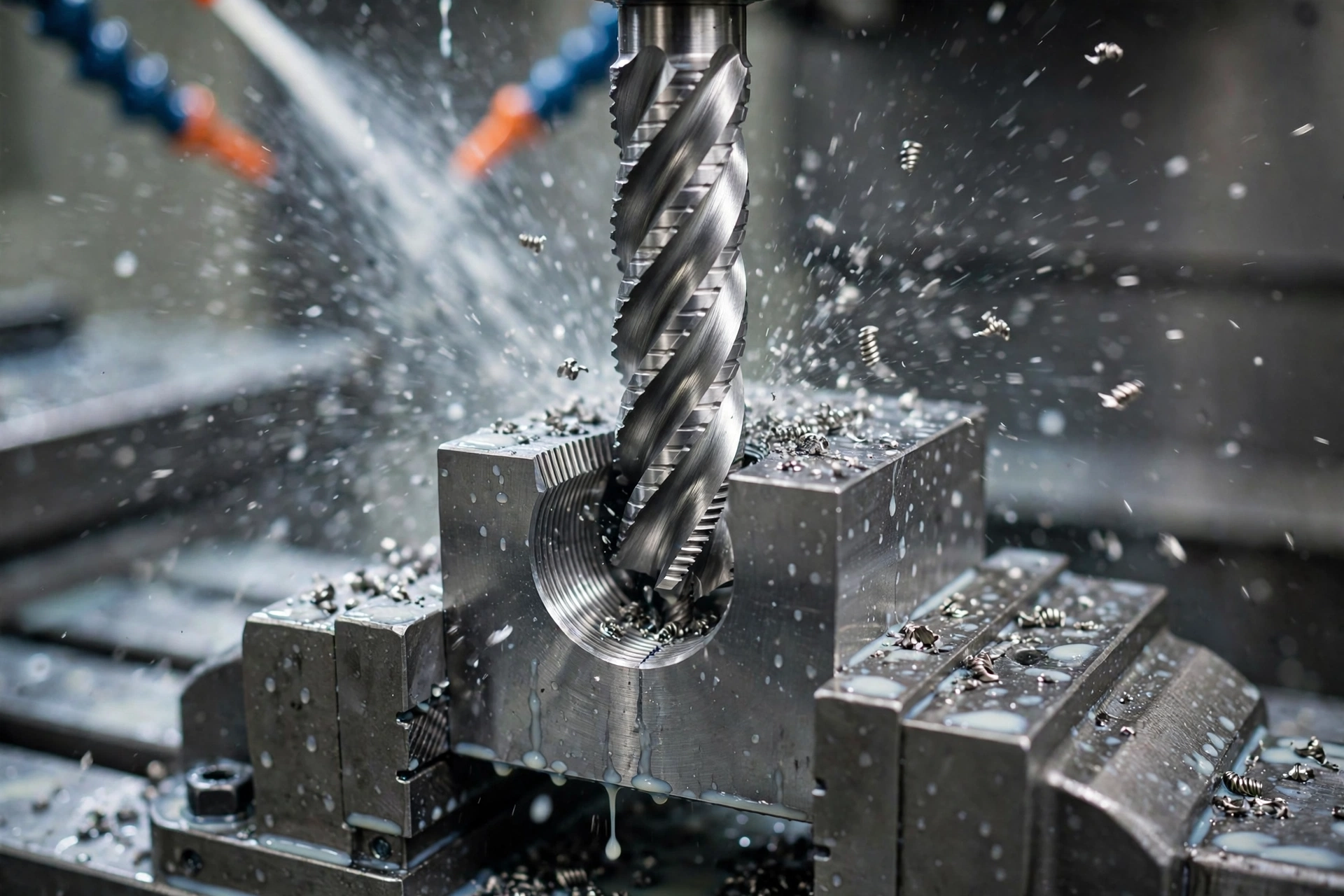
Thread milling uses a smaller rotating cutter that follows a helical CNC toolpath — circling the hole in X and Y while advancing in Z — to generate the thread form over several passes. The cutter does not match the thread diameter, which means one tool covers a range of thread sizes at the same pitch, and fit can be fine-tuned by adjusting the toolpath radius.
Thread milling is slower and requires more sophisticated programming, but it is safer, more flexible, and better suited to hard materials, large threads, blind holes requiring clean bottom engagement, and expensive parts where breakage risk cannot be accepted.
The cutter and the toolpath
A thread mill is a multi-tooth rotating cutter, typically solid carbide with a wear-resistant coating, that the CNC machine moves along a helical path — interpolating simultaneously in X, Y, and Z — to generate the thread form. The cutter’s tooth geometry matches the thread profile, and the toolpath diameter determines the thread size.
Because the path diameter controls the size rather than the tool body, a single thread mill can produce multiple thread sizes sharing the same pitch by adjusting the programmed radius.
Fit control and safety
Le fraisage de filetage permet également de contrôler l'ajustement du filetage, ce que le taraudage ne permet pas. En modifiant de quelques microns le rayon de la trajectoire d'outil programmée, l'opérateur peut resserrer ou desserrer la classe d'ajustement sans changer d'outil. Cela s'avère particulièrement utile pour les boîtiers d'instruments de précision, les raccords hydrauliques et les connecteurs de fluides, où la classe d'ajustement doit être vérifiée et ajustée pièce par pièce.
L'avantage en termes de sécurité est considérable. La fraise à fileter est plus petite que le diamètre du filetage fini. En cas de rupture, le fragment peut se détacher du filetage ou être extrait à l'aide d'un aimant ou d'une pince. La pièce est généralement récupérable, ce qui contraste fortement avec le cas d'un taraud cassé dans un trou borgne.
The speed trade-off
Thread milling is slower: multiple helical passes per hole rather than one axial plunge. It requires a CNC machining center capable of simultaneous three-axis interpolation and a CAM system or thread-milling canned cycles. For very high volumes of standard threads in ductile materials, the per-hole time disadvantage adds up and tapping is more economical.
Thread milling is also the tool of choice on a mill-turn center, where the same setup turns and mills the part — one cutter covers the sizes that would need a whole set of taps.
Thread milling vs tapping: comparison table
Thread milling vs tapping comes down to brute-force speed against flexibility and control. The right choice depends on thread size, material, hole type, and the accuracy your part needs.
| Facteur | Perçage | Fraisage de filets |
|---|---|---|
| Durée du cycle par trou | Le plus rapide — une seule plongée | Plus lent — hélicoïdal à passages multiples |
| Complexité de la programmation | Cycle simple de robinetterie rigide | Interpolation hélicoïdale, CAM requis |
| Outil par taille/pas | Un taraud par taille et par pas | Une fraise permet de réaliser plusieurs tailles (même pas) |
| Risque de casse | Modéré à élevé ; partie « chutes » | Faible ; la fraise tombe librement |
| Les meilleurs matériaux | Aluminum, mild steel, brass | Titane, acier inoxydable, aciers trempés |
| Performances des trous borgnes | Risque d'accumulation de copeaux ; zone de déviation vers le bas | Nettoyer les filets inférieurs ; les copeaux sont évacués vers l'extérieur |
| Qualité et coupe du tissu | Bien ; corrigé par la géométrie du robinet | Excellent ; réglable par décalage de trajectoire d'outils |
| Pour droitiers et gauchers | Un robinet séparé est nécessaire | Même fraise, sens de parcours inverse |
| Filetages extérieurs | Sans objet | Possible avec une trajectoire hélicoïdale à coupe ascendante |
| Meilleur volume | Filetages standard à grand débit | Filetages de faible à moyen pas, de précision ou atypiques |
If your priority is speed, tapping often wins. If your priority is precision and flexibility, thread milling is the better choice.
Material guide: when to tap and when to thread mill
Alliages d'aluminium
Aluminum alloys — 6061, 7075, cast grades — are the natural home of tapping. The material is ductile, produces manageable chips, and its relatively low yield strength keeps tapping forces and wear modest. Standard HSS or cobalt taps produce thousands of holes before wearing out.
Thread milling in aluminum is possible and preferred for threads M20 and above or blind holes needing clean bottom engagement, but for M3 through M16 at volume, tapping is more economical.
Stainless steels
Stainless steels — 304, 316, 17-4 PH — work-harden rapidly, generate long stringy chips, and are abrasive to cutting edges. Tapping in stainless is possible with sharp spiral-flute taps, appropriate cutting fluid, and careful synchronization, but wear is faster and breakage risk is higher than in aluminum.
Thread milling is often the better choice for M12 and above in stainless: the cutter engages a smaller chip cross-section per pass, work-hardening is distributed across multiple light cuts, and breakage risk is substantially reduced.
Titanium alloys
Titanium alloys — 6Al-4V in particular — concentrate heat at the cutting edge due to low thermal conductivity, accelerating wear and increasing galling risk. Tapping titanium requires carbide taps, high-pressure through-spindle coolant, and conservative speeds — and breakage remains a real risk. Thread milling in titanium with solid carbide cutters and appropriate coatings provides better heat management and far lower breakage risk. For structural aerospace threads in titanium, thread milling is the industry standard.
Hardened steels
Les aciers trempés dont la dureté dépasse environ 40 HRC ne sont généralement pas taraudés : le risque de rupture est trop élevé. Le fraisage de filets à l'aide de fraises en carbure conçues pour les matériaux durs permet d'obtenir des filets d'une dureté pouvant atteindre environ 65 HRC, mais l'usure de l'outil est importante et les vitesses d'avance doivent être modérées.
Blind holes: thread milling’s key advantage
A blind hole — one that does not pass through the workpiece — creates specific challenges for both methods. With a standard taper tap, the chamfer geometry prevents full thread engagement for three to five pitches from the bottom of the hole. A bottoming tap reduces this to one to two pitches, but chip packing at the bottom increases breakage risk.
If full thread engagement close to the blind end is a structural requirement, note it on the drawing so your machinist can select the right tap type or recommend thread milling.
Threads all the way to the bottom
Thread milling handles blind holes more cleanly. The cutter begins the helical path at the bottom of the thread depth and spirals upward toward the hole entrance, so chips move toward the open end rather than packing at the bottom.
The cutter can engage the thread form within one pitch of the blind end, providing nearly full engagement across the specified thread depth. For blind holes where thread depth is limited and full engagement is structurally required, thread milling is typically the correct choice.

Choosing the right method: a decision framework
Default to tapping
Default to tapping when: the material is aluminum, mild steel, or brass; the thread is a standard size and pitch; the volume is sufficient to justify dedicated tapping cycles; and the hole depth and part value do not create unacceptable breakage risk. For most high-volume work in ductile materials, tapping is the economical default.
Choose thread milling
Optez pour le fraisage de filetage dans les cas suivants : le matériau est de l'acier inoxydable, du titane ou de l'acier trempé ; le filetage est de calibre M20 ou supérieur, présente un pas inhabituel ou est à gauche ; le trou est borgne et nécessite un engagement net du filetage au fond ; la classe d’ajustement est serrée et un réglage au cas par cas est nécessaire ; ou la valeur de la pièce est suffisamment élevée pour qu’un taraud cassé entraînant sa mise au rebut représente une perte importante.
Use both on the same part
Use both on the same part where it makes sense: tap the twenty M5 holes in the aluminum bracket; thread mill the two M30 features in the stainless insert. Specifying a single method for an entire part often leaves cost or quality on the table.
Foire aux questions
Le fraisage fileté est-il toujours préférable au taraudage ?
Pas toujours. Le fraisage de filetage offre davantage de souplesse, est plus sûr dans les matériaux durs et permet un ajustement sur mesure — mais il est plus lent et nécessite des machines plus performantes ainsi qu’une infrastructure de programmation plus sophistiquée. Le taraudage est plus rapide et plus simple pour les filetages standard dans les matériaux ductiles, en cas de production en série. Le choix de la meilleure méthode dépend du matériau, de la taille et du type de filetage, de la géométrie du trou, de la valeur de la pièce et du volume de production.
Dans quels cas dois-je privilégier le fraisage fileté plutôt que le taraudage ?
Pour les matériaux durs — titane, acier inoxydable, aciers trempés —, les filetages de grande taille ou atypiques, les trous borgnes nécessitant un engagement parfait au fond, les tolérances d'ajustement serrées nécessitant un réglage, ainsi que les pièces coûteuses pour lesquelles la rupture d'un taraud entraînerait une mise au rebut onéreuse.
Pourquoi le taraudage est-il plus rapide que le fraisage de filets ?
Un taraud réalise le filetage complet en une seule plongée axiale, ce qui prend généralement entre une et trois secondes par trou. Le fraisage de filetage nécessite que la machine effectue un passage hélicoïdal complet — en tournant autour du trou tout en avançant axialement — sur plusieurs passes. Pour les volumes élevés de filetages standard, le gain de temps par trou offert par le taraudage est considérable.
Que se passe-t-il si un taraud se casse à l'intérieur d'un trou borgne ?
A broken tap in a blind hole is one of the hardest recovery situations in CNC machining. Taps are hardened HSS or carbide and cannot be drilled out. EDM (electrical discharge machining) is often the only reliable removal method, expensive and time-consuming, and the part may be scrapped. Thread milling significantly reduces this risk: the cutter is smaller than the hole and, if it breaks, the fragment typically falls free, leaving the part recoverable.
Le fraisage de filets permet-il de réaliser des filets à gauche ?
Oui. Le fraisage de filetage permet de réaliser des filetages à gauche en inversant le sens de la trajectoire hélicoïdale de l'outil ; aucun changement d'outil ni de porte-outil n'est nécessaire. Le taraudage nécessite quant à lui un taraud spécifique pour chaque taille de filetage à gauche, à utiliser avec la rotation de la broche inversée.
What is thread milling?
Thread milling is a CNC process that cuts a thread with a rotating cutter moving in a helical toolpath. The cutter advances in small increments, so cutting forces stay manageable, and the same cutter can produce different thread diameters and pitches by changing the toolpath.
What is a thread mill?
A thread mill is a rotating cutting tool with multiple teeth that cuts internal threads by helical interpolation. Unlike a tap, which needs a dedicated tool for every thread size, one thread mill can cut several sizes and pitches.
What are the downsides of thread milling?
Thread milling is slower per hole than tapping, costs more up front, and needs CNC programming expertise to set up the helical toolpath. For small standard threads in high volume, those costs are hard to justify — which is why tapping still wins there.