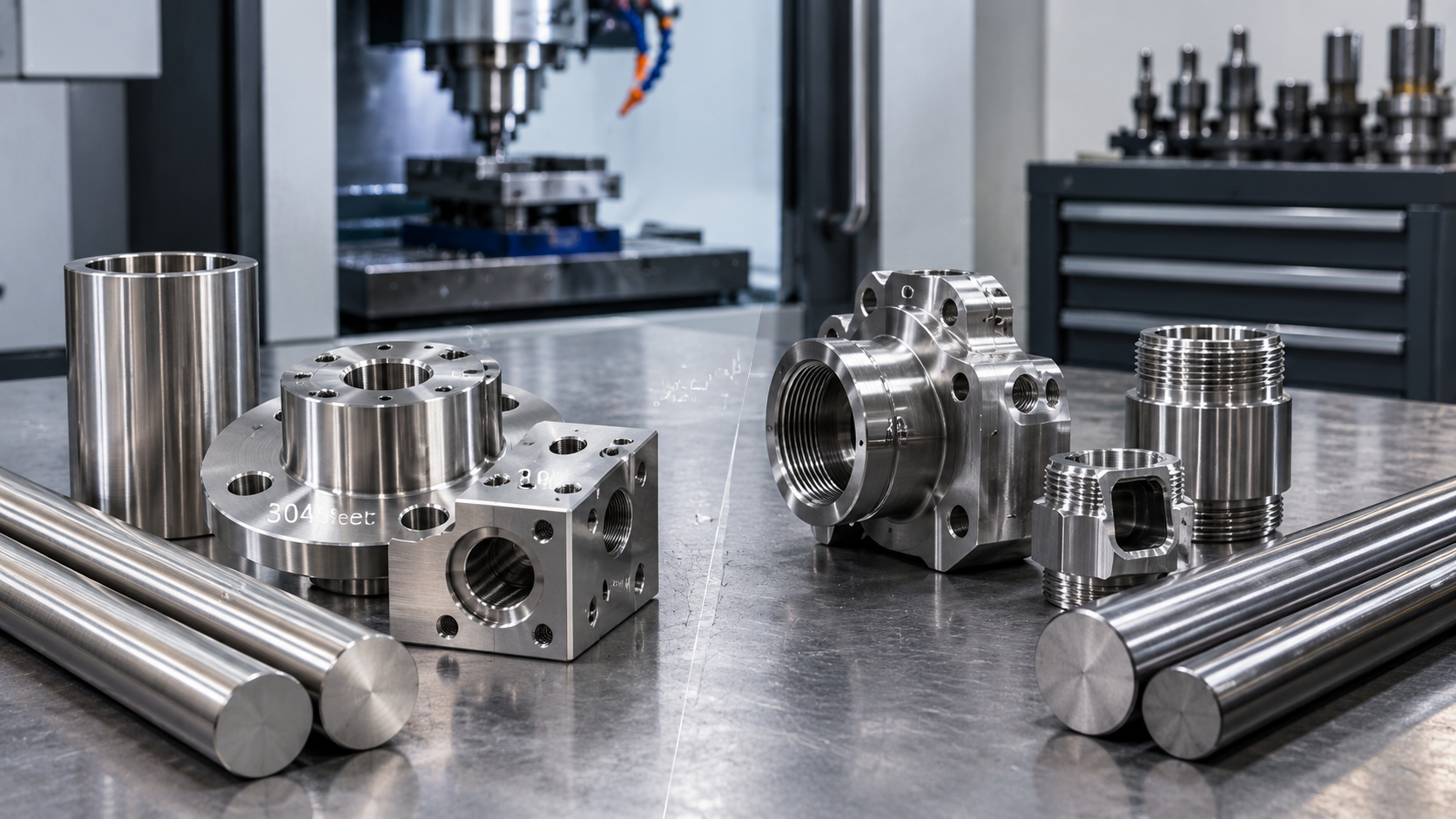
Ask ten machinists which stainless they grab first and most say 304 without blinking. It’s the workhorse of the austenitic family. It cuts, welds, and finishes about how you’d expect, and that predictability is worth a lot on the floor. But “default” and “correct” aren’t the same thing. I’ve watched good 304 brackets rust through in a coastal box in under two years. I’ve also watched buyers pay up for 316 on a part that never meets anything nastier than office air. So the real question isn’t “which grade is better?” It’s narrower than that. Where does the part live, who looks after it, and what’s the budget?
Below, I’ll walk the grades the way I actually size them up on a job. Chemistry first. Then how they behave under a tool, then corrosion, cost, and where each one belongs. Still weighing your wider options? Our CNC materials guide runs through the full metal-and-plastic menu. This piece stays tight on the one call that trips up most buyers: 304 or 316.
The Core Difference: Molybdenum Changes Everything
Both are austenitic stainless steels. Same family, same face-cantered cubic structure – the thing that leaves them non-magnetic when annealed, tough, and easy to form. Both lean on chromium too, at least 16% of it, to build the passive oxide film that keeps rust off. So far they look like twins. Then you get to one element, and they stop looking alike: molybdenum.
316 carries 2–3% molybdenum. 304 carries none. That little bit of moly stiffens the passive film against chloride ions – and chlorides are the exact thing that drives pitting and crevice corrosion. It’s why people call 316 “marine grade.” It’s why you find it in surgical implants, pharma tanks, and food gear that gets hosed down with chlorinated sanitizer every shift. Chromium and nickel handle the basic stainlessness on both. The moly is the part that lets 316 shrug off the environments that quietly eat 304 alive.
| Propriété | AISI 304 | AISI 316 |
| Chromium | 18–20% | 16–18% |
| Nickel | 8–10.5% | 10–14% |
| Molybdenum | Aucun | 2–3% |
| Carbon (max) | 0.08% | 0.08% |
| Pitting Resistance (PREN) | ~18–20 | ~24–28 |
| Density | 8.00 g/cm³ | 8.00 g/cm³ |
| Typical yield strength | 215 MPa | 205 MPa |
| Relative cost (bar stock) | Valeur de référence (1,0x) | ~1.2–1.5x |
That PREN row is worth a beat. PREN stands for Pitting Resistance Equivalent Number, and you work it out as %Cr + 3.3×%Mo + 16×%N. Treat it as a single number for how well a grade fends off localized corrosion. Higher is better. 316 clears 304 by roughly 30–40% here. And honestly? That gap alone explains most of the field failures I’ve watched happen when someone specced the wrong grade.
Machinability: Why Both Feel “Gummy” and How to Cut Them
Neither grade cuts like aluminum. Buyers new to stainless are usually caught out by the cycle times and the tooling bill. Here’s why. Austenitic stainless work-hardens fast, so if the tool dwells or rubs instead of slicing cleanly, the surface hardens right ahead of the edge – and the next pass is fighting a tougher material than the last one did. The rule we live by on the floor is simple: get under the skin and stay there. Constant feed, sharp tooling, and enough depth of cut to shear the metal, not smear it.
Of the two, 304 is the more forgiving. 316 has more nickel plus that molybdenum, which makes it tougher and quicker to build up an edge, so it tends to run 10–20% slower and burn through inserts faster. Where the design gives you room, free-machining variants help — 304L, 316L for weldability, or 303 when the corrosion demands are lighter. It’s the sort of trade-off our CNC turning service team chews on every time we quote stainless, because tool life and cycle time are where most of the cost hides.
Parameters we actually run
A few numbers from the floor. Sharp coated carbide, TiAlN or AlTiN, swapped out before it dulls – a worn edge is what kicks off work hardening in the first place. Surface speeds stay moderate: roughly 80–120 m/min for 304, 60–90 for 316. Flood coolant, never mist. Stainless holds heat, and heat at the cutting zone wrecks both the tool and the finish. Climb mill where you can, hold a steady chip load so nothing rubs, and bolt everything down rigid — chatter work-hardens the surface in a heartbeat.
The takeaway for buyers is short. 304 usually quotes a little cheaper than 316, and not just on raw metal — on machining time too. If your part lives somewhere mild, that double saving is real money you get to keep.
Corrosion Resistance in the Real World
Here’s where the two grades really part ways. In dry indoor air, light moisture, or contact with food that isn’t salty or acidic, 304 lasts more or less forever. No reason to pay for 316. But the second chlorides show up, the whole story flips.
Where each grade holds up:
- 304 is reliable indoors, in fresh water, and in most architectural and kitchen jobs away from the coast.
- 316 is the safe call within a few miles of the ocean, in pool hardware, and anywhere de-icing salt gets used.
- For chemical processing — acids, brines, chlorinated cleaning — 316 (or 316L for welded work) is standard.
- For implantable or fluid-contact parts, 316L is the baseline, which is why it dominates our medical device work.
Picture a real case: a machined sensor housing bolted to an offshore platform. Spec 304 and you’re inviting pits around the threaded holes and crevices inside a year or two. Spec 316 and that same housing runs a decade. When corrosion resistance is the whole reason you reached for stainless, the moly premium is pocket change next to a field failure and a replacement crew. On parts headed for demanding sectors, pairing the right grade with documented assurance qualité is what separates a part that passes inspection from one that survives service.
Surface Finishing and Passivation
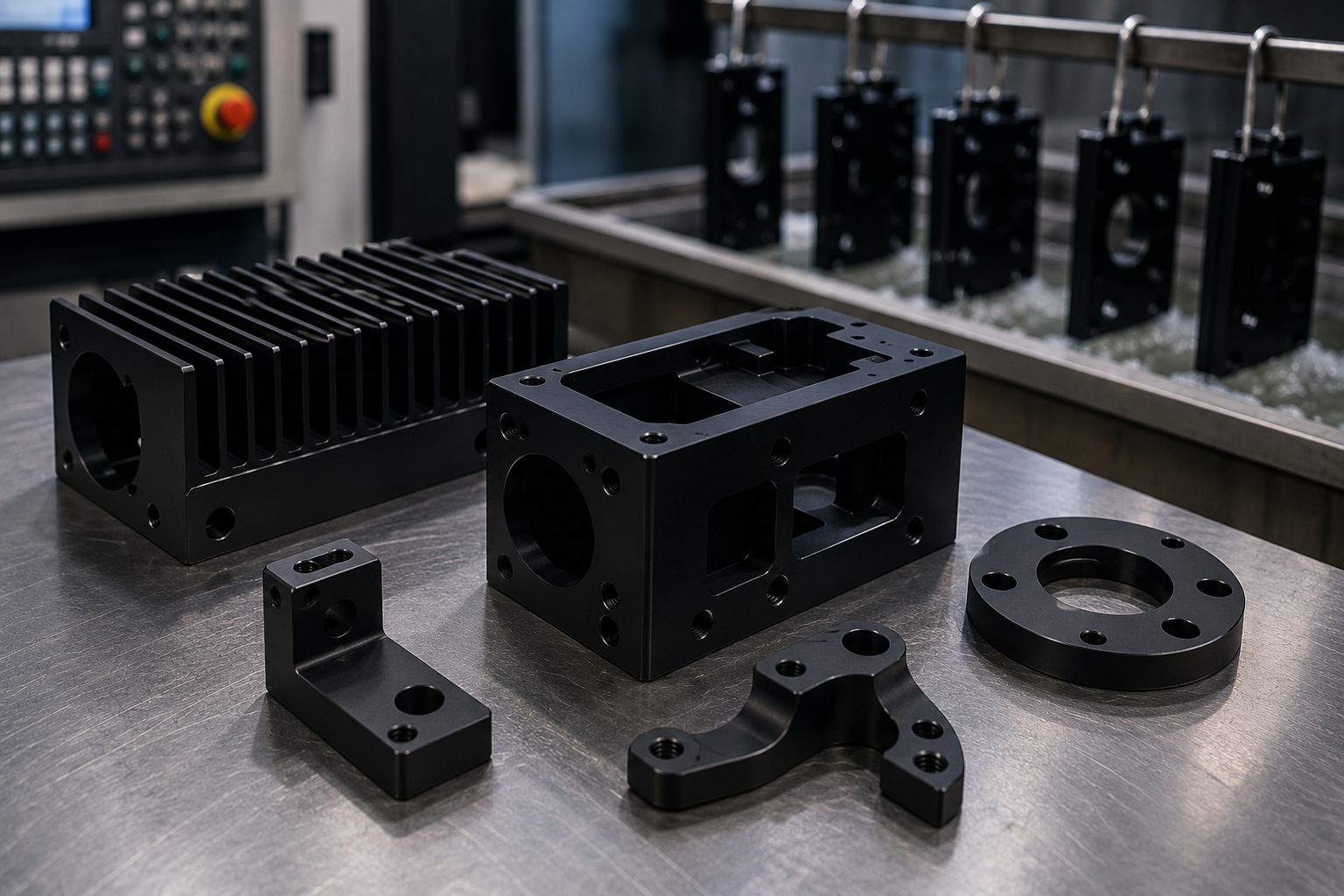
Both grades take a wide range of finishes. Bead blasting, electropolishing, brushing, passivation – they all play nicely. Passivation earns a special mention. It’s a chemical bath, usually nitric or citric acid, that strips free iron off the machined surface and thickens the passive chromium-oxide layer. Why does that matter? Because machining can smear iron off your tooling onto the part, and that iron rusts – leaving spots that make perfectly good stainless look defective. Passivate after machining and you get the full corrosion resistance back. Our options de finition de surface page lays out what’s available, but treat passivation as mandatory on any stainless part where looks or corrosion life matter.
| Decision factor | Points to 304 | Points to 316 |
| Environment | Indoor, dry, fresh water, mild | Coastal, marine, chloride, chemical |
| Budget priority | Lowest material + machining cost | Longevity over upfront cost |
| Industrie | Architecture, food (non-salt), general | Medical, marine, pharma, chemical |
| Maintenance access | Easy to inspect / replace | Sealed, buried, or hard to service |
| Weldability need | Use 304L for welded assemblies | Use 316L for welded assemblies |
| Regulatory pressure | Rarely specified by spec | Often required by spec/standard |
Cost: What You Are Actually Paying For
On raw bar stock, 316 usually runs 20–50% over 304. Blame the extra nickel and the moly — both ride volatile commodity prices. Now add the slower machining and the shorter tool life. Stack it all up and the finished-part premium for 316 tends to land around 25–40% for the same geometry. Spend it where the part needs it and you’ve bought survival. Spend it where it doesn’t and you’ve just handed away margin. The whole discipline is matching grade to service condition. Reaching for 316 “to be safe” is how a BOM quietly gets expensive.
How This Compares to Aluminum
Here’s a curveball. Sometimes the buyer weighing stainless should really be weighing aluminum. If weight matters and the environment is only moderately corrosive, an anodized aluminum part can beat stainless on both strength-to-weight and cost. So early on, it pays to read our aluminum CNC machining guide next to this one. The honest answer is sometimes neither 304 nor 316 — it’s 6061-T6 with a protective finish. Tight-tolerance features behave differently across materials too, so check the CNC tolerances guide before you lock down critical dimensions.
Foire aux questions
Is 316 stainless always better than 304?
No. 316 handles chlorides better, but 304 machines faster, costs less, and does exactly the same job in a mild environment. “Better” depends on where the part serves. Over-speccing 316 indoors just burns money for no gain.
Can you tell 304 and 316 apart by looking?
Not a chance — they look identical. You need a chemical spot test, an XRF gun, or a mill certificate to be sure. Never guess on a corrosion-critical part; ask for the material cert every time.
What is the difference between 304 and 304L?
The “L” just means low carbon: 0.03% max instead of 0.08%. Why care? Lower carbon resists sensitization — that chromium-carbide dropout at the grain boundaries that welding can kick off. So 304L and 316L are the ones you want for welded assemblies. Machining a part with no welding? Plain 304 or 316 is fine.
Which grade is used for medical and food equipment?
316L rules medical and pharma because of its chloride resistance and how easily it cleans up. Food gear often uses 304 — unless salt or aggressive sanitizers are in play, and then it’s 316.
En résumé
Default to 304 for cost-sensitive parts in mild conditions. Step up to 316 the moment chlorides, salt, chemicals, or medical service enter the picture. The molybdenum in 316 isn’t marketing — it’s the line between a part that lasts and one that pits. Not sure which way to go? Send us the drawing and the service conditions and our engineers will point you at the right stainless before you cut a chip. Explore our Services d'usinage CNC or demander un devis for grade-specific pricing on your stainless parts.
About the Author
Yicen Precision Engineering Team – Senior Manufacturing Engineer, 12 years in precision CNC machining
Yicen Precision Engineering Team has programmed and supervised stainless, aluminum, and titanium production across medical, aerospace, and industrial contracts, specializing in material selection and DFM reviews. With hundreds of stainless-steel parts qualified through first-article inspection and passivation, Hasib writes to help buyers dodge the costly grade-selection mistakes that surface on the shop floor.