
In practice, DMLS vs SLM is a naming difference, not a process difference. Direct metal laser sintering (DMLS) and selective laser melting (SLM) are both metal 3D printing processes that spread a thin layer of metal powder, scan it with a laser in an inert gas atmosphere, and fully melt it into a dense part, layer by layer.
Short answer
Short answer: Today’s DMLS and SLM machines do the same job. Both are laser powder bed fusion for metals. The names come from two equipment makers, not from two different physics. What changes your part quality is the machine, the parameter set, the powder and the post-processing, so specify those rather than the acronym.
Where the Two Names Came From
Both terms date from the mid-1990s, when metal laser systems first reached the market. DMLS is a trademark associated with EOS, the German machine builder. SLM became the name used by SLM Solutions, another German company.
“Sintering” in DMLS is misleading by modern standards. Sintering means fusing particles below their melting point. Early systems did partially sinter powder, but current machines melt it completely. Even EOS’s own German expansion of the acronym uses the word for melting. So a quote for DMLS or SLM usually buys the same technology under a different brand.
DMLS vs SLM: Side-by-Side Comparison
| Factor | DMLS | SLM |
|---|---|---|
| Process family | Laser powder bed fusion | Laser powder bed fusion |
| Powder state during build | Fully melted on current machines | Fully melted |
| Origin of the name | EOS trademark | SLM Solutions |
| Atmosphere | Argon or nitrogen | Argon or nitrogen |
| Typical materials | Titanium, stainless, nickel alloys, aluminum, cobalt chrome | Same range |
| Supports needed | Yes | Yes |
| Typical post-processing | Stress relief, support removal, machining, optional HIP | Same |
Some articles claim SLM uses far more laser power, or that each name suits different metals. Published figures contradict each other, and power varies more between machine models than between DMLS and SLM. We would not choose a supplier on that basis.
What Standards Call It: Powder Bed Fusion
Standards bodies avoid brand names. The terminology standard ISO/ASTM 52900, maintained jointly by ISO and ASTM Committee F42, groups both under powder bed fusion. Newer ISO/ASTM documents label the laser-metal version PBF-LB/M (powder bed fusion, laser beam, metal). That is also the answer to whether SLM and LPBF are the same thing: LPBF is the generic name.
Material specifications follow the same logic. ASTM F3184, for example, covers 316L stainless steel made by powder bed fusion, regardless of which brand of machine built it. The ISO additive manufacturing portfolio lists the wider set of process and qualification standards. For buyers, the takeaway is simple: write the standard and the alloy on your drawing, not a brand acronym.
How Does DMLS or SLM Compare With EBM and Binder Jetting?
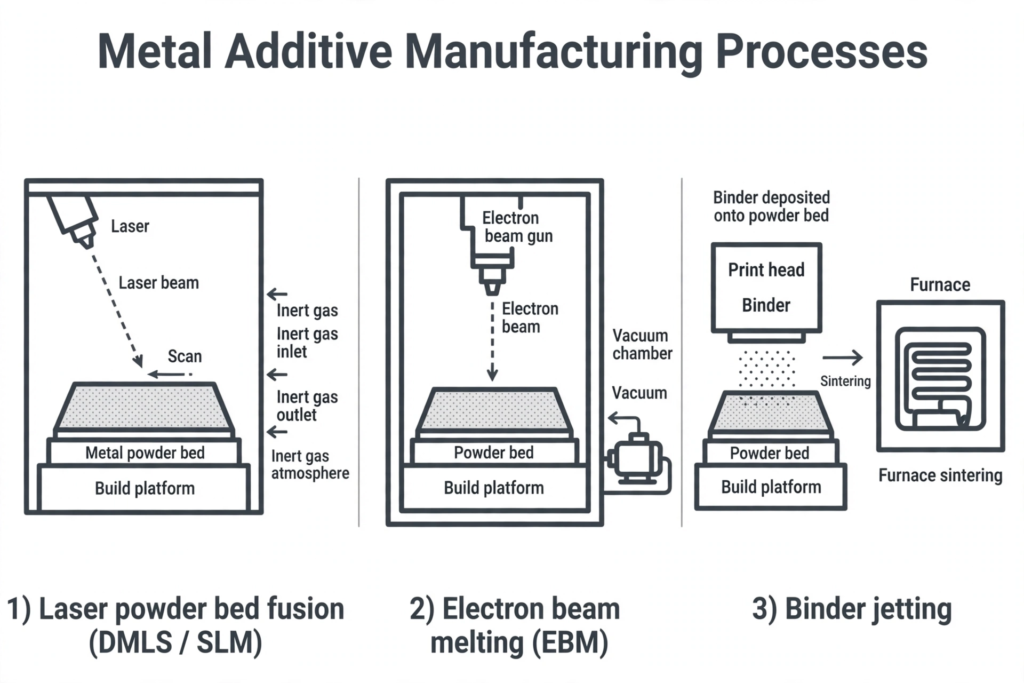
The real differences are between process families, not brand names. Electron beam melting (EBM) uses an electron beam in a vacuum instead of a laser in inert gas. It runs hot, lowering residual stress, but surfaces are rougher, and it is used mainly for titanium.
Binder jetting glues powder with a binder, then sinters the part in a furnace. Shrinkage makes dimensions harder to hold. SLS is a polymer process for nylon parts. It is often confused with DMLS but does not make metal parts. Our guide to SLA, SLS, FDM and MJF covers the plastic processes.
| Process family | Energy source | Atmosphere | Key trade-off |
|---|---|---|---|
| Laser powder bed fusion (DMLS / SLM) | Laser | Argon or nitrogen | Needs supports, stress relief and usually machining |
| Electron beam melting (EBM) | Electron beam | Vacuum | Rougher surfaces, but lower residual stress; used mainly for titanium |
| Binder jetting | Binder, then furnace sintering | — | Shrinkage makes dimensions harder to hold |
What Actually Changes Your Part Quality
With the name set aside, five things decide part quality.
| Factor | What it decides |
|---|---|
| Machine and parameter set | Laser count, spot size, layer thickness and scan strategy affect density and surface. Ask which machine and which qualified parameters will be used. |
| Powder | Particle size, chemistry and how often powder is reused affect porosity and mechanical properties. |
| Build orientation and supports | These decide where support marks land, how much distortion occurs and which surfaces need finishing. |
| Heat treatment | Stress relief before removal from the plate is standard. Hot isostatic pressing (HIP) closes internal porosity and is common for fatigue-critical titanium and nickel parts. |
| Machining | As-built surfaces are rough and tolerances are looser than machined ones. Critical bores, sealing faces and threads are normally finished by CNC. |
A common mistake is leaving machining allowance off the print. Add stock to every face that will be machined.
Downsides of Laser Powder Bed Fusion
Metal laser printing is not cheap or simple. Machines cost hundreds of thousands of dollars, powder is expensive, and builds run for many hours. Parts need supports, stress relief and usually machining. Build size is limited, and large overhangs or trapped powder cause failures.
The trade-off depends on the part. For complex, low-volume parts with internal channels or lattice structures, these costs are justified. For simple blocks and brackets, CNC machining from billet is usually cheaper and faster. For prismatic titanium parts, machining titanium from bar is still the default.
| Part type | Usually the better route |
|---|---|
| Complex, low-volume parts with internal channels or lattice structures | Laser powder bed fusion; the costs are justified |
| Simple blocks and brackets | CNC machining from billet, usually cheaper and faster |
| Prismatic titanium parts | Machining titanium from bar is still the default |
Frequently Asked Questions
Are DMLS and SLM the same?
For practical purposes, yes. Both are laser powder bed fusion processes that fully melt metal powder layer by layer in an inert atmosphere. DMLS is an EOS trade name and SLM came from SLM Solutions. Differences between individual machines and parameter sets matter far more than the label a supplier uses.
What are the downsides of selective laser sintering?
Selective laser sintering (SLS) is a polymer process, so its limits are rough surfaces, some porosity and a narrow range of nylon materials. For metal laser powder bed fusion, the main downsides are high machine and powder cost, support removal, residual stress, limited build size and the need for machining.
Are SLM and LPBF the same?
Yes. LPBF, or laser powder bed fusion, is the generic name for the process family, and standards documents use it to avoid brand terms. SLM is one commercial name for laser powder bed fusion of metals, as is DMLS. Specify LPBF or PBF-LB/M with the alloy when ordering parts.
What does DMLS stand for?
DMLS stands for direct metal laser sintering. The name dates from early systems that partially sintered powder. Modern DMLS machines melt the powder completely, so the process now works the same way as SLM. The term is associated with EOS, the German company that commercialized it in the mid-1990s.
How does DMLS or SLM compare with EBM and binder jetting?
The real differences are between process families, not brand names. Electron beam melting (EBM) uses an electron beam in a vacuum instead of a laser in inert gas. It runs hot, lowering residual stress, but surfaces are rougher, and it is used mainly for titanium. Binder jetting glues powder with a binder and then sinters the part in a furnace, and shrinkage makes dimensions harder to hold.
Choosing Between DMLS vs SLM Suppliers
Do not choose a supplier because it says DMLS instead of SLM, or the reverse. Choose on alloy, machine and qualified parameters, heat treatment and HIP options, inspection, and finish machining capability.
Check standards references against the current edition before putting them on a drawing. If you have a metal part in mind, send XY Machining your CAD file and ask for a quote that includes printing, heat treatment and finish machining. Our 3D printing services page lists the metal and plastic processes we offer.