Choosing between a hot runner vs cold runner feed system is one of the first decisions in any injection mold project, and it shapes everything that follows: tooling cost, cycle time, scrap rate, and part quality. Neither system is universally better.
The right answer depends on your production volume, resin, part cosmetics, and budget. This guide explains how each system works, compares them side by side, and shows how to work out which one pays off for your part.
What Is a Hot Runner System?
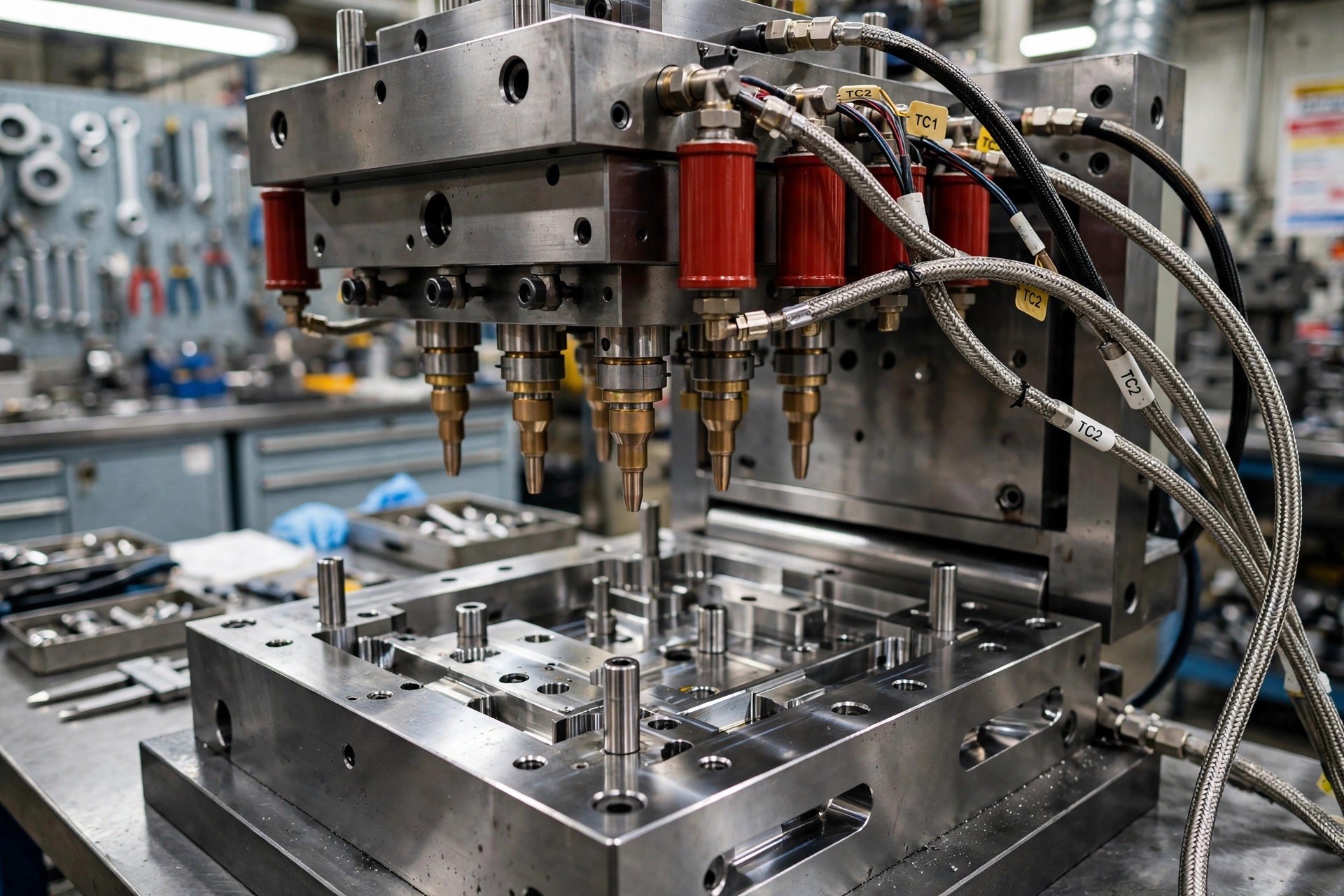
A hot runner system delivers molten plastic from the machine nozzle to each cavity through a heated manifold. Electric heater cartridges keep the manifold and its nozzles at melt temperature, and a dedicated temperature controller holds each zone within a few degrees. Because the plastic in the runner never cools, there is no solidified runner to eject: each shot produces only finished parts.
Hot runners are most often paired with multi-cavity or family molds, where one manifold feeds 2, 4, 8, or more drops. They also allow sequential valve gating on large parts, which helps control weld lines and packing. The trade-off is complexity: the mold carries heaters, thermocouples, wiring, and a controller that a cold runner tool simply does not need.
What Is a Cold Runner Mold?
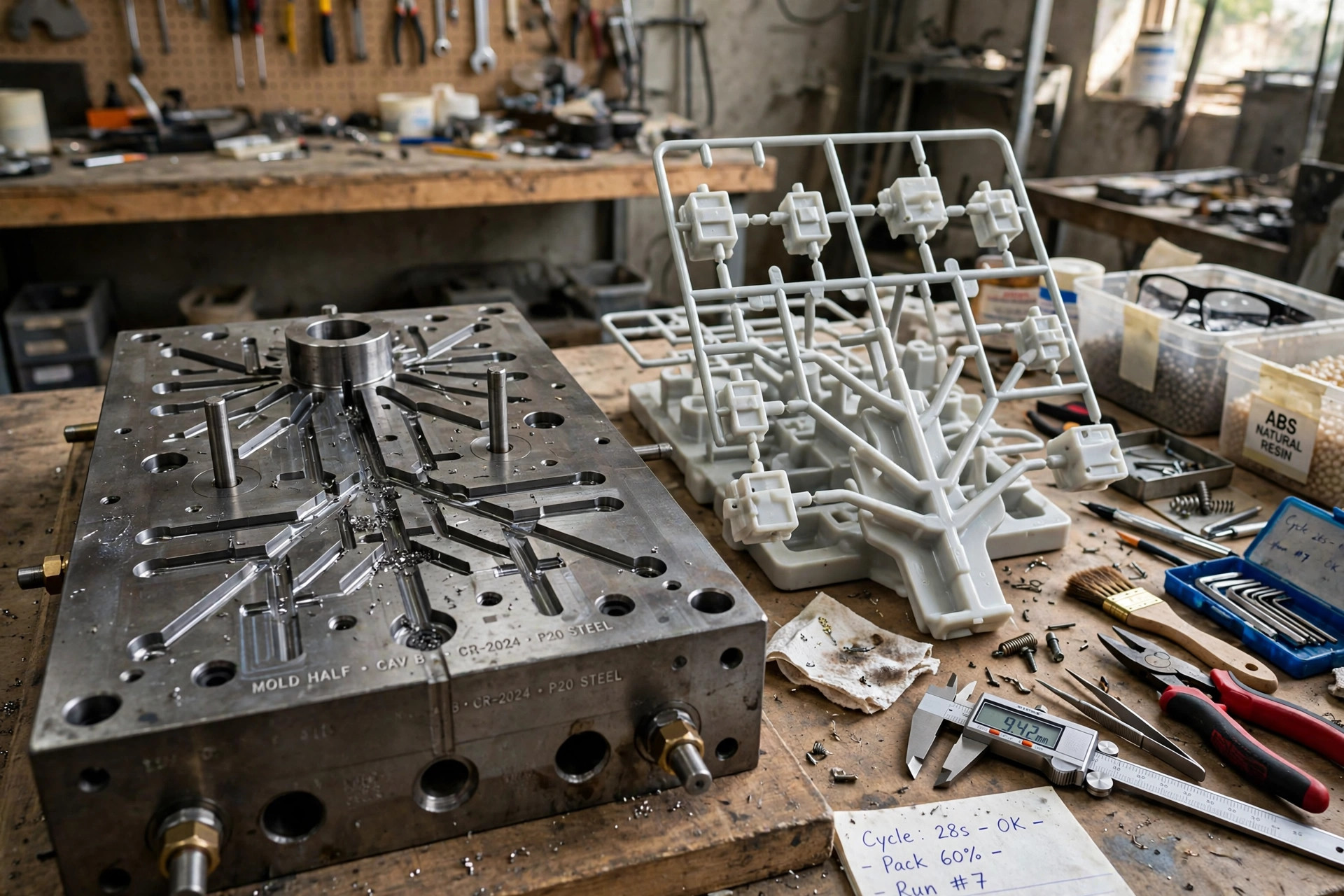
In a cold runner mold, plastic travels from the sprue through unheated channels machined into the mold plates. The runner cools along with the part, so every shot ejects the finished parts still attached to a solidified sprue and runner tree. An operator or a robot separates the parts, and the runner is either scrapped or ground up and blended back into the feed as regrind, where the material and quality plan allow it.
Cold runner tools are mechanically simple: no heaters, no controller, and nothing electrical inside the mold. Two-plate and three-plate designs cover most parts, and almost any resin, including heat-sensitive grades, runs well in them. Their costs show up later, in longer cycle times, material waste, and the labor of separating and handling runners. For background on the overall process, see the moldeo por inyección overview.
Hot Runner vs Cold Runner: Side-by-Side Comparison
The table below sums up the differences that matter most when you are designing or quoting a tool.
| Factor | Hot Runner | Cold Runner |
|---|---|---|
| Coste de los utillajes | Higher; manifold, nozzles, heaters, and controller add cost per drop | Lower; simple machined channels, no electronics |
| Tiempo de ciclo | Faster; no runner to cool, pack, or eject | Slower; runner cooling often sets the cycle |
| Material waste | Almost none; plastic stays molten in the system | Runner scrap on every shot; regrind may or may not be reusable |
| Part quality and cosmetics | Small gate vestige; valve gates leave almost no mark | Gate marks are removed with the runner; extra handling can scratch parts |
| Resin compatibility | Most resins; heat-sensitive grades can degrade during long residence | Nearly universal, including heat-sensitive and filled resins |
| Color and material changes | Slow; the full manifold volume must be purged | Fast; only the barrel and a short sprue to clear |
| Maintenance | Higher; heaters, seals, and tips wear and need specialists | Low; channels are cleaned and polished like the rest of the tool |
| Best production volumes | Medium to high, typically tens of thousands of parts and up | Prototypes and low volumes, from a few hundred parts |
| Multi-cavity suitability | Excellent; balanced flow to many drops, including family molds | Workable, but runner volume and imbalance grow with cavity count |
What a Hot Runner Mold Costs, and When It Pays Back
Hot runner mold cost is the main reason teams hesitate. As a typical market range, a hot runner system adds several thousand dollars per drop once you count the manifold, nozzles, and controller, so a multi-cavity tool can land 20 to 50 percent above an equivalent cold runner tool. When you request custom injection molds, ask for both runner options to be quoted so the premium is a real number, not a guess.
When the Hot Runner Premium Pays Back
The payback comes from three places. First, cycle time: removing runner cooling commonly trims seconds from every shot, which compounds across hundreds of thousands of cycles. Second, material: on small parts, a cold runner can waste 15 to 40 percent of each shot’s resin, and virgin resin is rarely cheap. Third, labor: parts come off the mold ready for the next step, with no degating or runner handling.
As a rough rule, if your program will run fewer than about 10,000 parts, the cold runner’s lower tooling cost usually wins. Well above that, the hot runner’s per-part savings typically overtake the premium, and the gap widens with every added cavity.
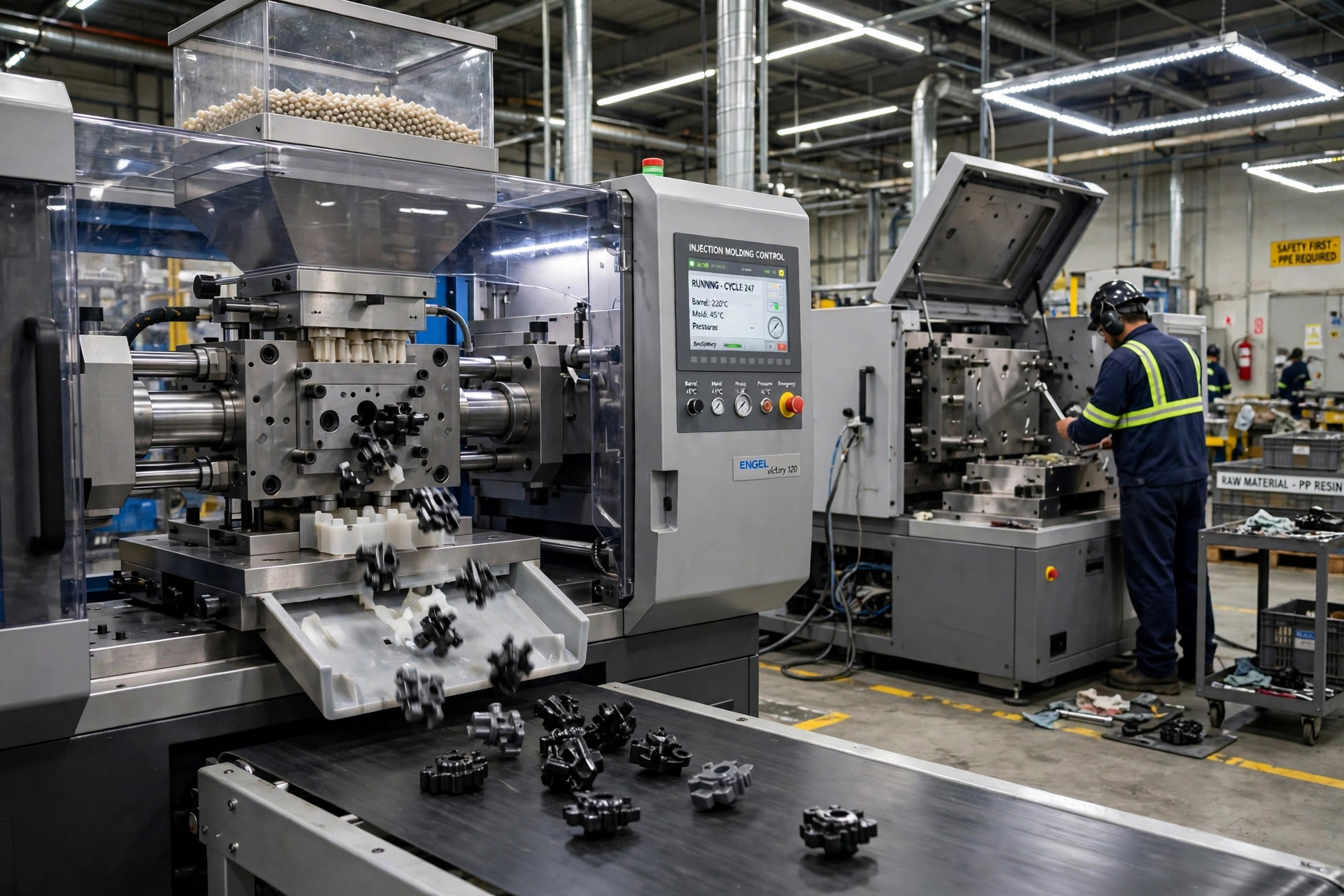
Hot Runner Advantages and Disadvantages
Advantages
- No runner scrap, so material cost per part drops and regrind quality issues disappear
- Shorter cycles and higher output from the same press
- Better gate cosmetics and balanced filling on multi-cavity tools
- Parts eject ready for packing or assembly, which suits automation
Disadvantages
- Higher tooling cost and a longer mold build
- More maintenance, with heaters, seals, and nozzle tips as wear items
- Slow color and material changes, because the whole manifold must be purged
- Risk of resin degradation for heat-sensitive materials held at melt temperature
Cold Runner Advantages and Disadvantages
Advantages
- Lower tooling cost and a simpler, faster mold build
- Runs virtually any resin, including heat-sensitive and glass-filled grades
- Quick color and material changes, helpful for short runs and sampling
- Simple maintenance that most in-house toolrooms can handle
Disadvantages
- Runner scrap on every shot, plus regrind cost and quality risk
- Longer cycles, because the runner must cool before ejection
- Extra labor or automation to separate, trim, and handle parts
- Runner size grows with cavitation, wasting resin and press capacity
Hot Tip vs Valve Gate: Hot Runner Types in Brief
Within hot runner systems, the gate design is the next decision. A hot tip gate feeds the cavity through a heated nozzle tip and is the simpler, cheaper option. It works well for small parts and hidden gates, but it can leave a small raised vestige, and some resins string or drool at the tip.
A valve gate uses a mechanical pin to open and close each gate. It leaves almost no visible mark, gives precise control over filling and packing, and supports sequential gating on large parts. The trade-off is cost and complexity: valve gate drops need pneumatics or hydraulics and more maintenance. For cosmetic housings and large flat parts, valve gating is usually worth it; for small technical parts, a hot tip is usually enough.
Which System Should You Choose? A Quick Decision Guide
Choose a cold runner when volumes are low, the design is still changing, one tool must run many colors or resins, or the resin is heat-sensitive. It is also the safer default for prototypes and bridge production while demand is being proven.
Choose a hot runner when the design is frozen, volumes are medium to high, cycle time or material cost dominates your part price, or gate cosmetics matter. Multi-cavity and family molds benefit the most. Most programs pair the runner decision with moldeo por inyección process planning during DFM.
If You Are Unsure: Model Both Options
If you are unsure, model both options: compare the tooling premium against runner resin cost and cycle time savings over your expected lifetime volume, and have your molder quote the injection mold tooling both ways. At XY Machining, the runner choice is reviewed during DFM before steel is cut, so the decision rests on your volumes and part requirements rather than habit.
Hot Runner and Cold Runner: Key Differences in Injection Molding Systems
Feed Path: Heated vs Unheated Runners
This hot runner definition and comparison to cold runner systems starts with the feed path. Both runner systems in injection molding move molten plastic from the machine nozzle to the mold cavities, but they do it in opposite ways.
A hot runner uses a heated runner to transfer molten thermoplastic to each cavity: an externally heated hot runner manifold system holds the resin at melt temperature, so the plastic is injected into the mold and only the part solidifies.
Ejection and Cost Comparison
A cold runner system uses an unheated runner channel to transfer the same melt, so the part and the runner eject together and you need to separate the runner from the plastic parts after every shot. In a hot runner vs cold runner injection molding comparison, the key differences are waste, cycle time and tooling complexity, and a direct comparison to hot runner tooling shows why high-volume programs accept the premium.
A cold runner injection molding comparison against the same part usually favors the simpler tool on price alone.
Flow and Gate Types in Multi-Cavity Tools
The matching definition and comparison to hot runner tooling also covers gate types and flow. Hot runner injection molding suits multi-cavity work because hot runner systems in injection molding balance flow to every cavity, while cold runner systems in injection molding suit simple tools where the runner volume stays small.
Hot runner and cold runner molds differ in how resin flows through the runner: in a hot runner mold vs cold runner mold test, the hot runner keeps viscosity steady, while the cold runner lets the melt cool as it travels. Size the runner to avoid premature freezing in a cold runner, and size of the runner matters more as cavitation grows.
Runner Sizing and the Cost Trade-Off
Runner vs cold runner injection molding debates usually end the same way: cold runner injection molding wins on tooling cost, while hot runner injection molding wins on waste and cycle time.
Daily Operation and Gate Types
On the shop floor, the differences show up in daily operation. Compared to the cold runner, a hot runner tool runs with less operator attention, although robotics to separate the runner from the part are common on cold runner cells where automation handles degating. Hot runner designs vary by gate type, but all of them use an external heat system runner layout: heaters outside the flow channel keep the melt ready.
Pressure Drop and Material Behavior
Runner systems are used in injection molding across both families, and runner systems have a wide range of sizes, so injection pressure drop must be checked: material in the runner adds resistance, and the runner and the mold must be balanced together. The injection of material types with different viscosities changes the pressure picture further.
When using hot runner tooling, watch residence time, since cold runner counterparts handle heat-sensitive grades better. Thermoplastic materials compared to cold runner options behave the same in the barrel; the difference is only what happens after the nozzle.
Economics and Dimensional Accuracy
A new injection molding program should compare hot runner vs cold runner economics early, since cold runners cost less up front but waste more per unit time than cold runner estimates sometimes assume: parts per unit time than cold runner cells often favor hot runner tools once volumes rise.
Versus cold runner tooling, a hot runner also holds tighter dimensions than those from cold runner tools on multi-cavity work, because every cavity sees the same melt condition. Slower than hot runner cycles, cold runner cycles add cooling time for the runner itself, which is waste production in cold runner cells that hot runner tools avoid entirely.
Recycling, Trimming and Short Runs
If you recycle the runner to avoid waste, remember that runner to avoid waste still costs labor and regrind handling, and a three-plate cold runner can reduce some of that handling by ejecting the runner separately. Parts produced via cold running carry gate marks that must be trimmed, and the production process of cold running suits short runs where tooling cost dominates.
A final comparison to cold running should weigh those trims against the hot runner premium.
Volume, Cosmetics and the Quote
For buyers of plastic injection molding, the decision usually comes down to volume and cosmetics. The advantages of hot runner systems are clearest on an injection molding machine running tens of thousands of plastic parts: parts produced by hot runner tools need no degating, and compared to hot runner tooling, a cold runner tool looks cheaper until scrap and labor are counted.
In a cold runner vs hot runner injection molding review, ask your molder to quote both: the type of hot runner (hot tip or valve gate) and the type of cold runner (two-plate or three-plate) change the price, and custom injection molding programs should compare the full molding process, not just the tool quote.
Final Checks Before Steel Is Cut
Whether you choose hot runner or cold runner mold systems, confirm the injection molding process window, the mold systems maintenance plan, and how mold cavities will be balanced before steel is cut. A final hot runner vs cold runner systems check should cover maintenance access and spare parts.
Preguntas frecuentes
What is the difference between a hot runner and a cold runner?
A hot runner keeps plastic molten inside a heated manifold and nozzles, so only the part solidifies and is ejected. A cold runner uses unheated channels, so the sprue and runners solidify with every shot and are ejected with the parts, then separated and scrapped or reground.
What is a hot runner?
A hot runner is a heated feed system built into an injection mold. A manifold distributes molten plastic to nozzles at each cavity, and electric heaters with a temperature controller keep the resin at melt temperature between shots. Because the runner never solidifies, shots produce finished parts only, with no runner waste.
What are the disadvantages of hot runner molds?
Hot runner molds cost more to build and maintain. The manifold, nozzles, heaters, and controller add significant tooling cost, and color or material changes take longer because the whole system must be purged. Heat-sensitive resins can degrade while sitting in the hot manifold, and repairs usually need a specialist rather than in-house toolroom staff.
Which hot runner system is best, hot tip or valve gate?
Valve gate is usually best for visible, cosmetic parts because the pin closes the gate mechanically and leaves almost no mark. Hot tip gates cost less, are simpler, and suit small or hidden gates, but they can leave a small vestige and may string or drool. The right choice depends on part appearance, resin, and budget.
How much more does a hot runner mold cost than a cold runner mold?
A hot runner system typically adds several thousand dollars per drop to the mold price, so a multi-cavity hot runner tool can cost 20 to 50 percent more than an equivalent cold runner tool. The premium is usually recovered through faster cycles, zero runner scrap, and less secondary labor once volumes reach the tens of thousands.