Holes look like the simplest feature on a machined part, and that is exactly why they quietly drive so much cost. A drawing full of oddball diameters, blind holes deeper than the drill can comfortably reach, and threads called out with tolerances no application needs — each one adds tool changes, slower feeds, and inspection time. Master a handful of hole-design rules and you make parts that are cheaper to cut, faster to deliver, and easier to inspect, without giving up any real function.
This guide explains the three hole categories machinists deal with every day — drilled, tapped, and threaded — and the design-for-manufacturing rules that keep each affordable. It pairs well with our broader CNC design techniques guide, which covers wall thickness, pockets, and radii; here we focus specifically on holes.
The Three Hole Types and When to Use Each
Drilled holes
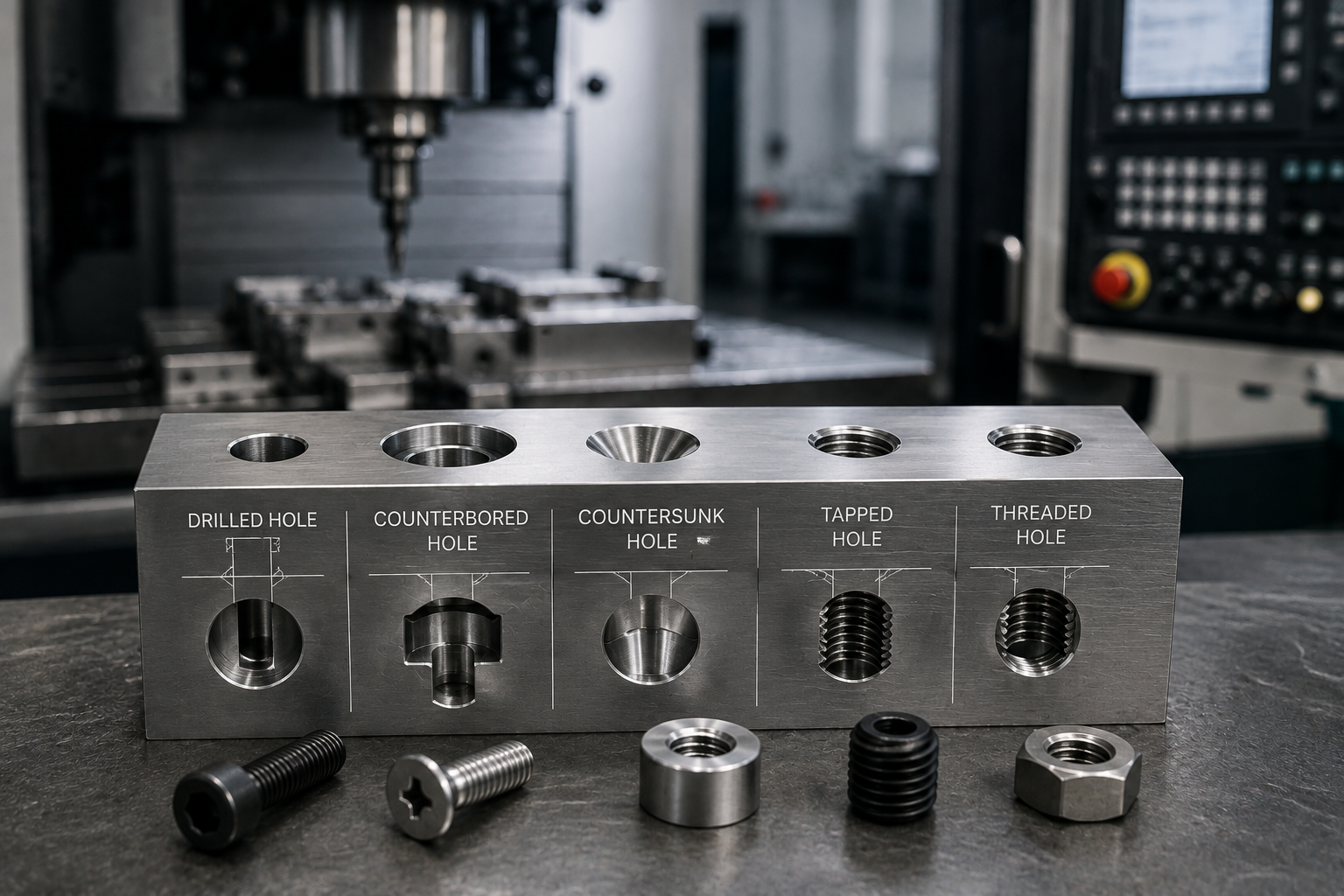
A drilled hole is the baseline: a rotating drill bit plunges to create a round hole. It is the fastest, cheapest hole to make, and it is the right choice for clearance holes where a bolt or dowel simply passes through. Drilled holes come off the tool with a standard tolerance and a characteristic conical bottom (on blind holes) formed by the drill point — a detail that matters when you specify depth.
Tapped holes
A tapped hole has internal threads cut into it so a screw can engage. Tapping is a two-step operation — drill the correct tap-drill diameter, then run a tap to form the threads. Because the tap-drill size is dictated by the thread, tapped holes are where standard-versus-custom drilling really pays off. Specify a common thread (M3, M4, M5, ¼-20) and the shop already has the tap and the correct drill on hand.
Threaded and precision holes
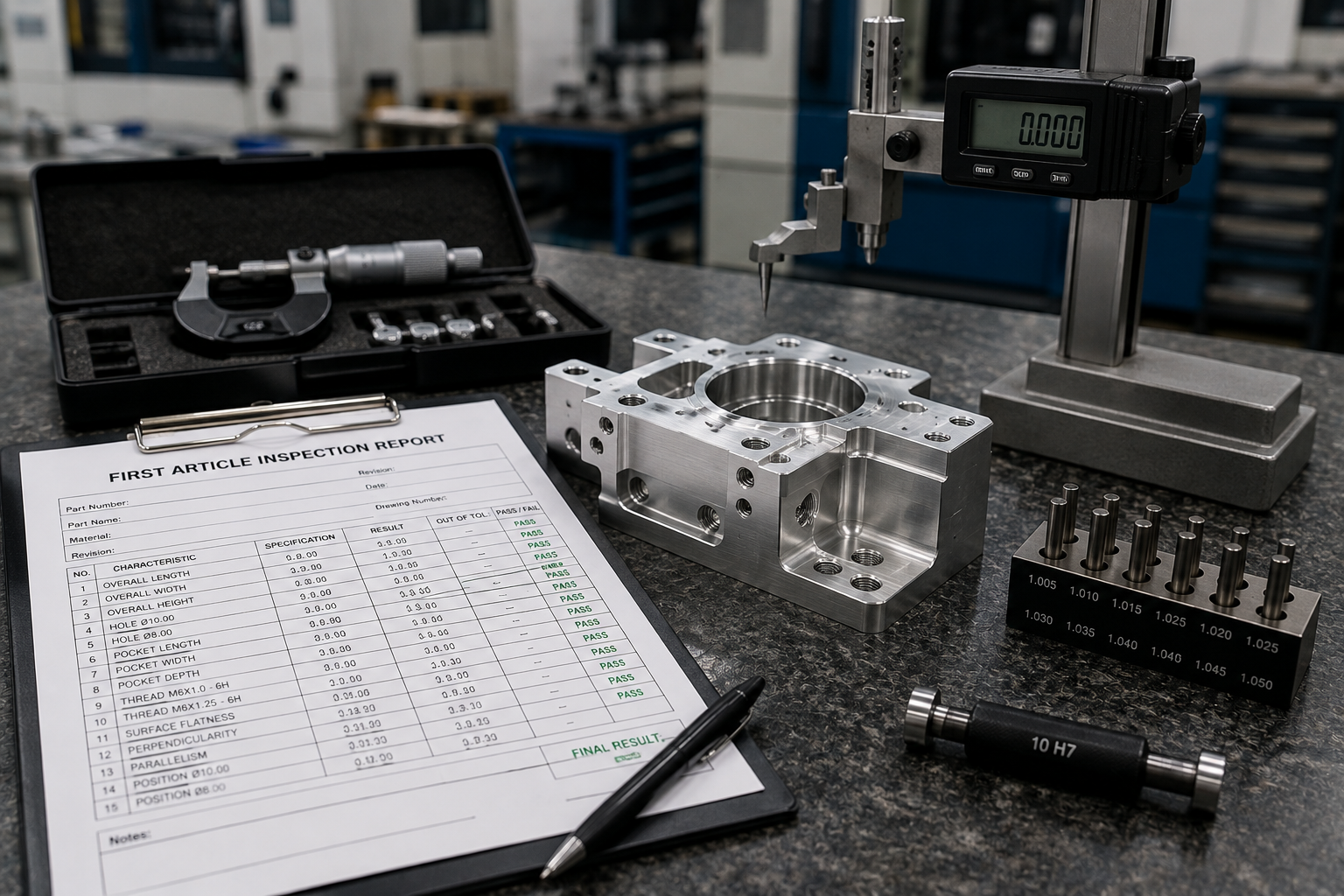
When a hole must hold a tight diameter tolerance — a bearing seat, a dowel-pin location, a hydraulic fitting — drilling alone is not accurate enough. These holes are reamed or bored to a precise diameter and finish. That extra operation costs more, so reserve tight tolerances for holes that genuinely need them. Understanding what each tolerance band actually costs is easier with our CNC machining tolerances guide open alongside this one.
| Hole type | Typical tolerance | Relative cost | Idéal pour |
| Drilled | ±0.075 mm (±0.003 in) | Lowest | Clearance holes, fasteners passing through |
| Reamed | ±0.013 mm (±0.0005 in) | Moyen | Dowel pins, bearing seats, precise fits |
| Bored | ±0.005 mm (±0.0002 in) | Élevé | Large or very precise bores |
| Tapped | Class 2B thread | Moyen | Screws threading into the part |
| Counterbored | Drilled + flat seat | Moyen | Recessing socket-head cap screws |
| Countersunk | Angled seat (82°/90°) | Low–Medium | Flush flat-head screws |
Design-for-Manufacturing Rules That Save Money
Rule 1: Use standard drill diameters
Every non-standard hole diameter risks a custom or ground tool, which adds cost and lead time. Design around common metric and imperial drill sizes. If a hole is just a clearance for a fastener, round to the nearest standard size that clears the bolt — the exact diameter rarely matters.
Rule 2: Respect the depth-to-diameter ratio
Standard drilling is comfortable up to about 4× the hole diameter. Beyond that, chip evacuation and drill deflection become problems, requiring peck drilling, special coolant-fed drills, or gun drilling — all of which cost more and slow the job. Keep holes shallow relative to their diameter wherever the design allows, and flag any hole deeper than 5× diameter as a cost driver.
- Up to 4× diameter: standard drilling, no premium.
- 4×–10× diameter: peck drilling or special tools, moderate premium.
- Beyond 10× diameter: gun drilling or deep-hole processes, significant premium.
Rule 3: Avoid holes that break through walls at an angle
A drill entering or exiting an angled or curved surface tends to wander or break. Where possible, add a small flat (a spotface) so the drill starts on a perpendicular surface. Truly angled holes on contoured parts are doable, but they often need Usinage CNC à 5 axes to hold position — worth knowing before you commit to the geometry.
Rule 4: Design threads for real engagement, not maximum depth
More thread depth is not more strength past a point. For most materials, thread engagement of 1× to 1.5× the diameter develops the full strength of the fastener; threading deeper just adds tapping time and tap-breakage risk, especially in tough alloys. In aluminum, 2× diameter of engagement is generous. Call out only the engagement you need.
Blind Holes vs Through Holes
A through hole exits the opposite side of the material; a blind hole stops partway. Through holes are cheaper and easier — chips clear out the bottom and there is no exact depth to control. Blind holes require depth control and complicate chip evacuation and tapping, since a bottoming tap and thread relief are needed to thread near the bottom. Whenever function allows, favor through holes.
One detail engineers forget: the conical bottom of a drilled blind hole. When you dimension blind-hole depth, specify whether it is to the full-diameter depth or to the drill point, because that cone eats usable thread length. And remember that every hole leaves an edge that needs deburring — designing holes that are easy to reach keeps that finishing step quick and cheap.
| Design choice | Cheaper option | More expensive option |
| Hole direction | Through hole | Blind hole |
| Diameter | Standard drill size | Custom / ground diameter |
| Depth | Under 4× diameter | Deep hole (>5× diameter) |
| Tolérance | As-drilled (±0.075 mm) | Reamed / bored (±0.01 mm) |
| Thread depth | 1–1.5× diameter engagement | Full-depth blind tap |
| Entry surface | Flat / perpendicular | Angled or curved surface |
Counterbores and Countersinks
Two common variations round out hole design. A counterbore is a flat-bottomed recess that lets a socket-head cap screw sit flush or below the surface. A countersink is an angled seat (commonly 82° for imperial flat-head screws, 90° for metric) that receives a flat-head screw. Both are routine operations on any Service de fraisage CNC, but each adds a tool and an operation, so use them only where a recessed or flush fastener is actually required.
Foire aux questions
What is the minimum wall thickness around a hole?
A common guideline is to keep at least the hole’s radius of material between the hole edge and the part edge or an adjacent hole — more in brittle materials. Too little material risks breakout during drilling and weak, deformable walls in service.
How deep can a tapped hole go?
Threads are typically only useful to about 1.5–2× the diameter of engagement; beyond that they add little strength. Mechanically, blind tapped holes should leave room below the last thread for chips and the tap point, so drill deeper than the thread depth you call out.
Should I use metric or imperial threads?
Use whichever matches your fasteners and your market, but be consistent within a part. What matters for cost is choosing common thread sizes the shop already tools for, rather than rare pitches that require special taps.
Why are angled holes more expensive?
A drill hitting a sloped surface deflects and can break, and holding true position often requires a 5-axis setup or a spotface to give the drill a flat start. Both add machining time and, sometimes, tooling.
En résumé
Well-designed holes are the quiet difference between a part that quotes cheap and one that does not. Use standard diameters, keep depth under 4× diameter, favor through holes, tap only the thread engagement you need, and reserve tight tolerances for holes that truly require them. Apply these rules and your Pièces usinées par CNC get faster and cheaper with no loss of function. If you want a DFM review of your hole callouts before production, our engineering support team will flag the cost drivers — or simply demander un devis with your drawing.
About the Author
xinyangmfg Engineering Team — Senior Manufacturing Engineer, 12 years in precision CNC machining
xinyangmfg Engineering Team has run thousands of DFM reviews, catching hole-design issues — non-standard diameters, deep blind holes, over-specified threads — before they reached the shop floor. Specializing in drilling and threading strategy across aluminum, stainless, and titanium, Hasib writes to help engineers design holes that machine cleanly the first time.