One of the most expensive mistakes I see in early manufacturing decisions is picking the production method before the volume is actually known. A startup commits to a $30,000 injection mold for a part they end up selling 400 of. An established manufacturer keeps CNC machining a component at 50,000 units a year when a mold would have paid for itself in two months. Neither method is wrong in the abstract — each is wrong for the other’s volume. Getting this decision right protects both your cash flow and your schedule.
This article compares low volume CNC machining against mass production across the factors that actually move the decision: cost structure, lead time, tooling, flexibility, and quality. By the end you should be able to place your own project on the volume curve and know which side of the break-even line you fall on.
Defining the Two Approaches
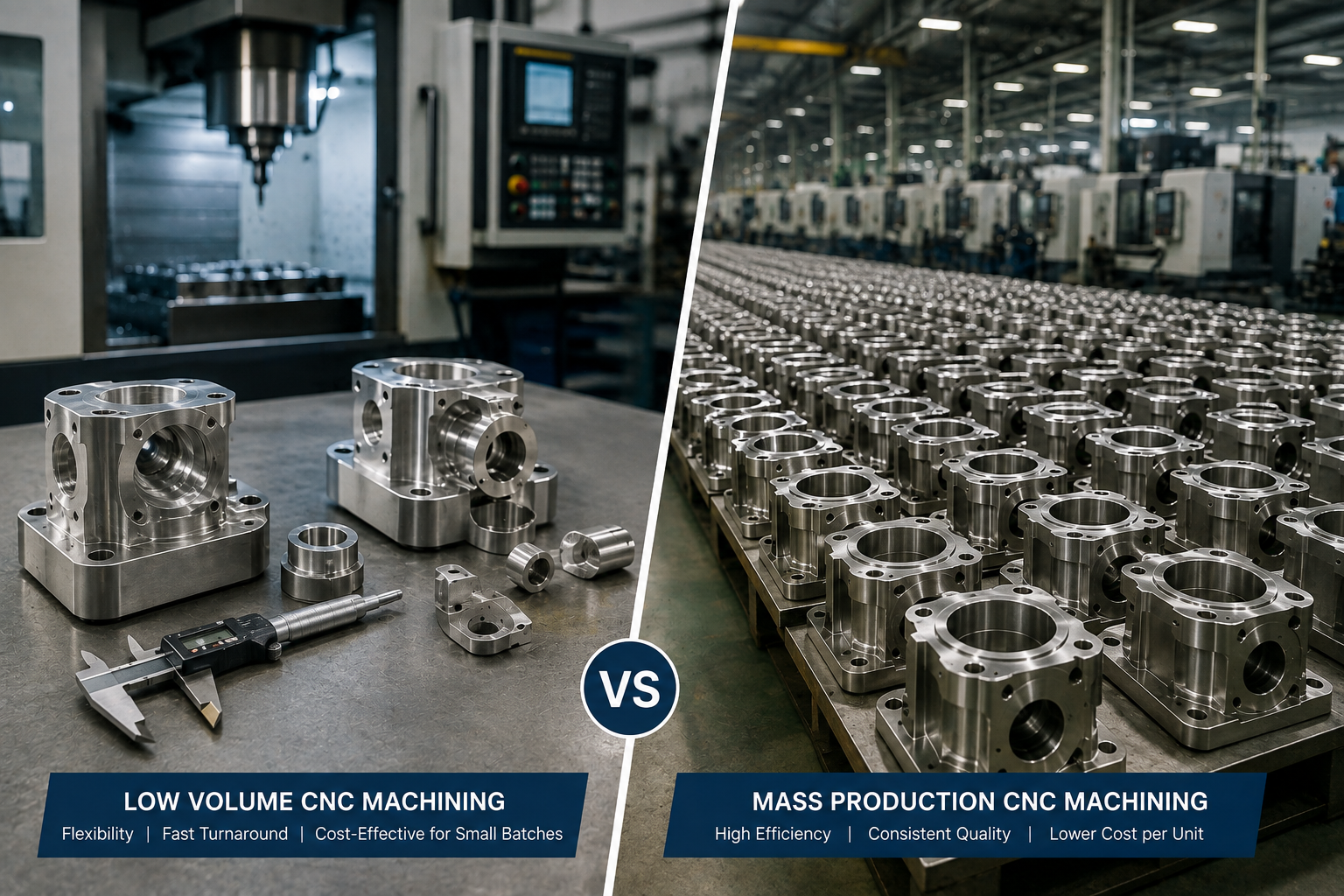
Low volume CNC machining means producing anywhere from a single part to a few thousand using computer-controlled milling and turning. There is no dedicated tooling — the same machines that cut your prototype cut your production batch, using standard tools and custom programs. It sits on a continuum with prototyping; if you want the full picture of how prototype work transitions into production, our rapid prototyping vs production machining guide walks through that handoff in detail.
Mass production means high-volume manufacturing where per-part cost is minimized through amortized tooling and automation. For plastics this usually means moldeo por inyección; for metal it can mean die casting, stamping, or highly automated CNC cells with pallet changers and bar feeders. The defining trait is a large upfront investment that only makes sense when spread across many units.
Cost Structure: The Heart of the Decision
The two methods have fundamentally different cost curves. CNC machining has near-zero fixed cost and a relatively flat per-part cost driven by machine time. Mass production carries a large fixed tooling cost but a very low per-part cost once tooling exists. Plot both on the same graph and they cross at the break-even quantity.
Table 1: Cost-structure comparison between low volume CNC machining and mass production.
| Cost element | Low Volume CNC | Producción en serie |
| Tooling / mold cost | $0 (uses standard tools) | $5,000–$100,000+ |
| Per-part cost (metal) | Moderate, flat | Low after amortization |
| Setup cost | Low, per batch | High, one-time |
| Economical quantity | 1–1,000 | 5,000+ |
| Cost of a design change | Reprogram (hours) | New tooling ($$$) |
| Upfront capital risk | Minimal | Significant |
The strategic insight buried in that table is the cost of a design change. In CNC machining, revising a feature means editing a program — hours of work, not dollars of scrap tooling. In molding or casting, a design change can mean cutting a new tool. For any product still evolving, that flexibility has real financial value, which is why so many companies keep Servicios de mecanizado CNC running well into their first production year before committing to hard tooling.
Lead Time and Speed to Market
Speed is where low volume CNC machining is hard to beat. Because there is no tooling to build, parts can ship in days. A typical machined batch moves from approved drawing to finished parts in one to two weeks. Injection molding, by contrast, requires four to eight weeks just to build and validate the mold before the first good part comes off the press.
- Low volume CNC: 3–15 business days from drawing to parts, no tooling wait.
- Mass production tooling: 4–8 weeks (or more) before first article.
- Design iteration on CNC: same-week turnaround for revisions.
- Design iteration on hard tooling: weeks and tooling cost per change.
For products racing a market window, or for bridge production while a mold is being built, low volume machining keeps revenue flowing and keeps the schedule honest. Many teams machine the first few hundred units, launch, and switch to molding only once demand is proven.
Flexibility and Complexity
CNC machining shrugs off geometric complexity that would require expensive tooling elsewhere. Undercuts, deep pockets, tight internal tolerances, and multi-axis contours are routine — especially with Mecanizado CNC de 5 ejes, which reaches features in a single setup that would need multiple molds or fixtures to reproduce at volume. CNC also lets you switch materials freely: run a batch in aluminum, then the next in stainless or titanium, with only a program and tooling adjustment rather than a whole new production line.
Mass production trades that flexibility for throughput. Once tooling is cut, geometry and material are largely fixed, and the whole system is optimized to make one part very cheaply and very fast. That is exactly what you want at scale — and exactly what handicaps you while a design is still moving.
Quality Considerations
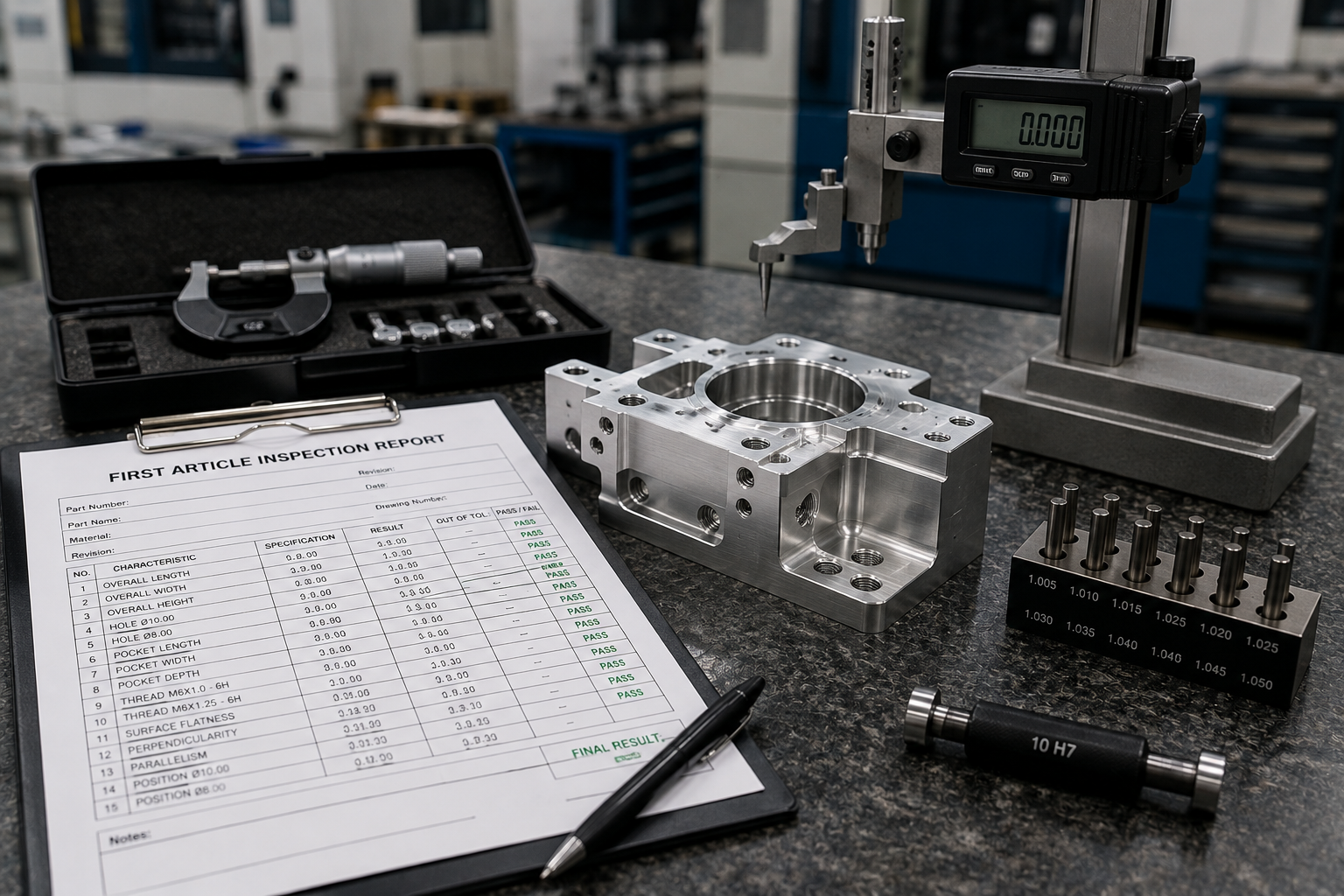
Both approaches can hit tight tolerances, but they get there differently. CNC machining achieves precision directly from the cutting process, so every part is inspected against the same program-driven geometry — ideal for low volumes where sampling a large lot is not practical. High-volume processes rely on validated tooling and statistical process control across big batches. Either way, a disciplined quality control process — first article inspection, in-process checks, and final CMM verification — is what keeps parts inside spec. The method changes; the need for inspection does not.
Table 2: Decision guide for matching production method to project characteristics.
| If your project has… | Lean toward |
| Volume under ~1,000 units | Low volume CNC machining |
| A design still being refined | Low volume CNC machining |
| A tight launch deadline | Low volume CNC machining |
| Complex geometry or exotic metals | Low volume CNC machining |
| Stable design, volume in the thousands | Mass production (molding/casting) |
| Lowest possible per-unit cost at scale | Mass production |
| Simple geometry, plastic, huge volume | Moldeo por inyección |
Finding Your Break-Even Point
The honest answer to “which is right” is a calculation, not an opinion. Estimate your per-part CNC cost, then estimate the amortized cost of the mass-production alternative (tooling cost divided by expected volume, plus the low per-part cost). Where those two numbers meet is your break-even quantity. Below it, CNC wins on total cost; above it, tooling wins. Complexity pushes the break-even point higher, because complex parts are expensive to tool. Simple, high-volume parts push it lower.
A practical middle path many manufacturers use: machine the launch quantity, validate the design and demand in the real market, then invest in tooling once the numbers justify it. This staged approach caps your downside risk while keeping the door open to low-cost scale later.
Preguntas frecuentes
At what quantity should I switch from CNC to injection molding?
There is no universal number, but for plastic parts the crossover often lands between 1,000 and 10,000 units. Simple parts justify tooling sooner; complex parts stay economical on CNC longer. Run the break-even calculation with your actual tooling quote and per-part CNC price.
Is low volume CNC machining more expensive per part?
Per part, yes — CNC has a higher unit cost than amortized mass production. But it carries no tooling investment, so at low volumes the total project cost is far lower. The per-part figure only matters once volume is high enough to spread tooling thin.
Can CNC machining handle production volumes at all?
Absolutely. With automation — bar feeders, pallet changers, lights-out running — CNC handles tens of thousands of parts, especially in metal where molding is not an option. The question is whether dedicated tooling would be cheaper at your specific volume.
What if my design is not finalized?
Then low volume CNC machining is almost always the right call. Committing to hard tooling before a design stabilizes risks scrapping that tooling on the next revision. Machine until the design freezes, then tool up.
Conclusión
Low volume CNC machining wins on speed, flexibility, and low upfront risk; mass production wins on per-unit cost once volume is high and the design is frozen. Place your project on the volume curve, run the break-even math, and let the numbers decide rather than defaulting to either method. If you want a data-backed recommendation for your specific part, review real examples in our case studies o get a quote and we will model both scenarios against your projected volume.
About the Author
xinyangmfg Engineering Team — Senior Manufacturing Engineer, 12 years in precision CNC machining
xinyangmfg Engineering Team has guided dozens of hardware teams through the prototype-to-production transition, running break-even analysis on projects from 50-unit runs to five-figure production programs. Specializing in DFM and production-method selection, Hasib helps buyers avoid both premature tooling spend and over-machined high-volume parts.