Swiss machining is a precision turning process for small parts that need tight tolerances and a fine surface finish. A Swiss-type lathe feeds bar stock through a guide bushing and cuts right next to the support, so long, thin parts stay stable. It is one of the CNC工作機械の種類 built for miniature work, and it is the standard choice for bone screws, connector pins and watch components.
The process was developed in Switzerland for watchmaking, where parts were too small and too slender for a conventional lathe. The same idea now serves medical, electronics, aerospace and robotics work. If a part is small, round and needed in volume, this is usually the first process to consider.
What Is Swiss Machining?
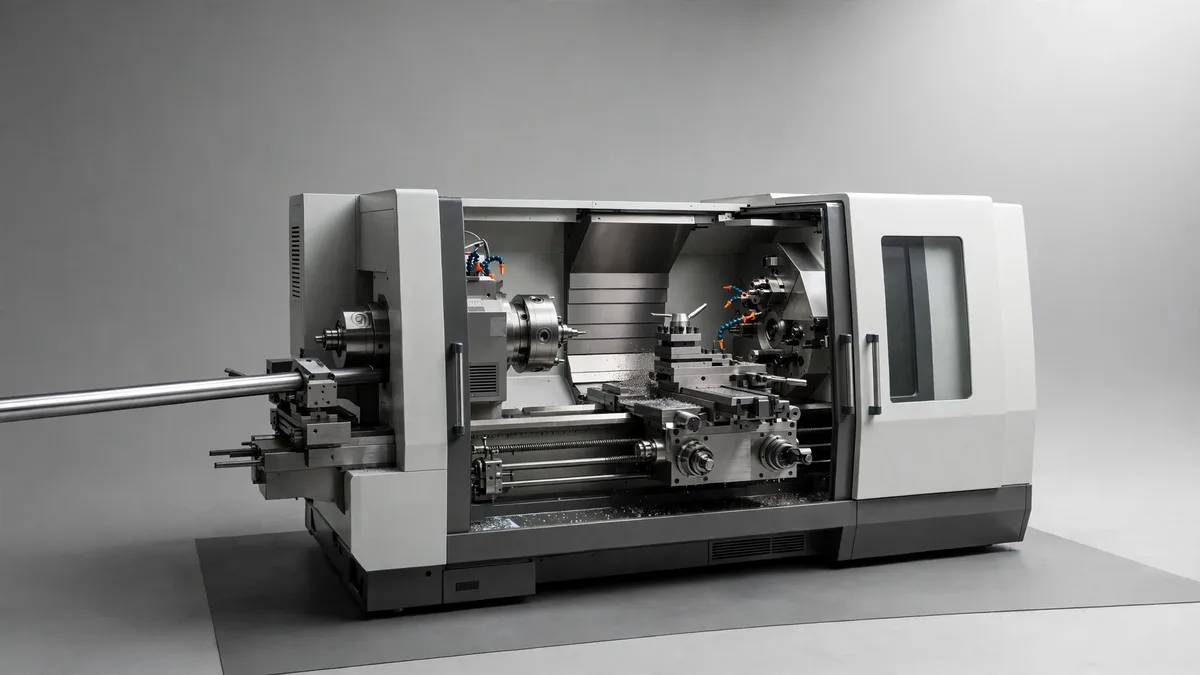
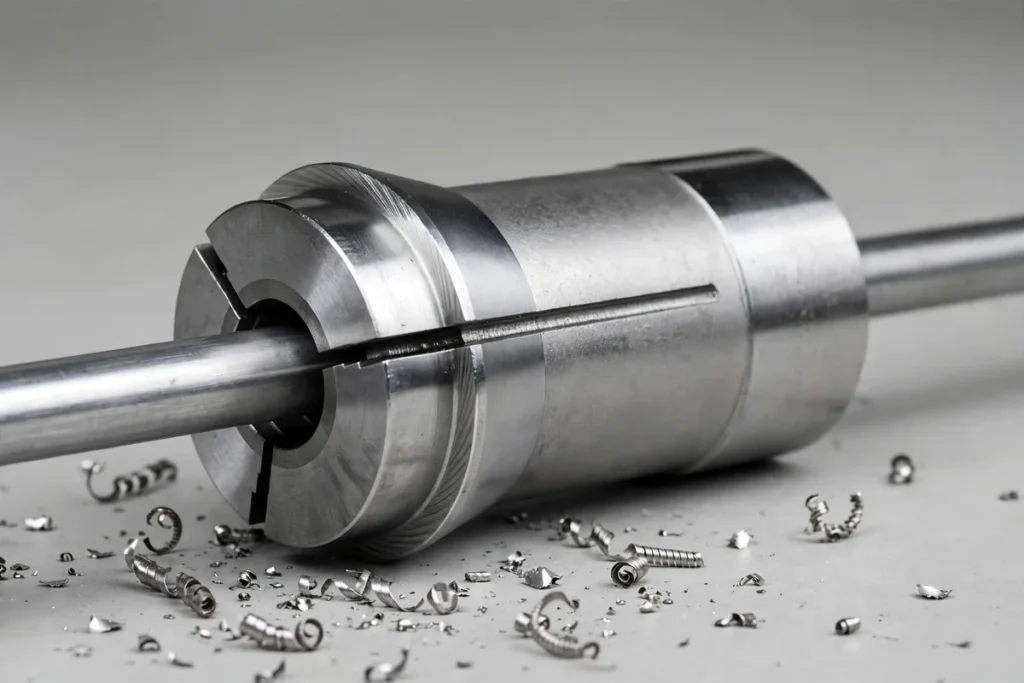
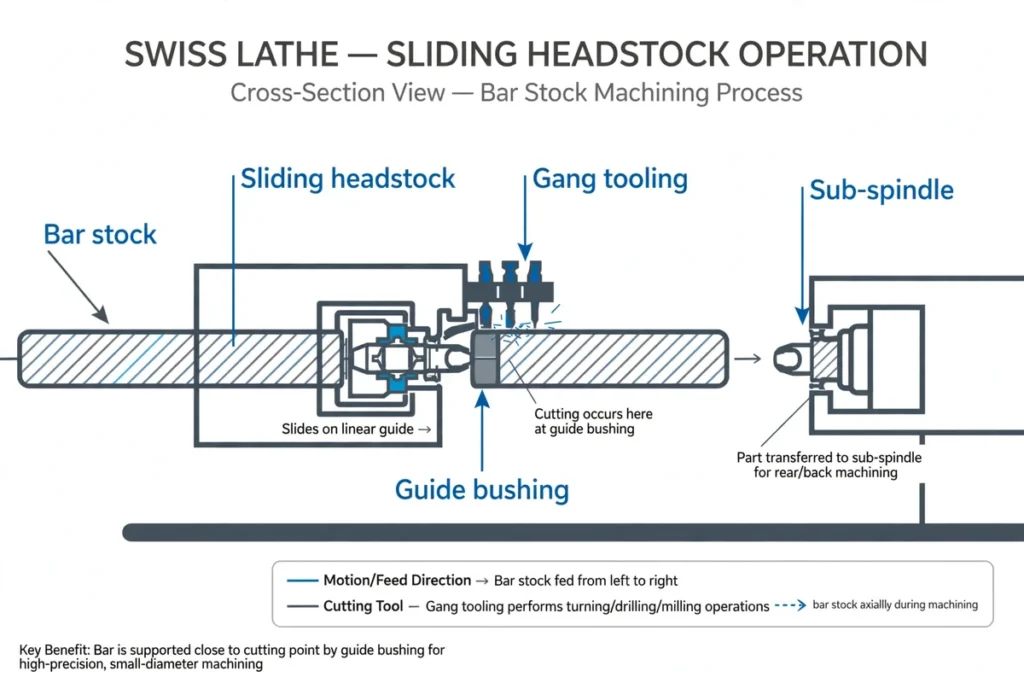
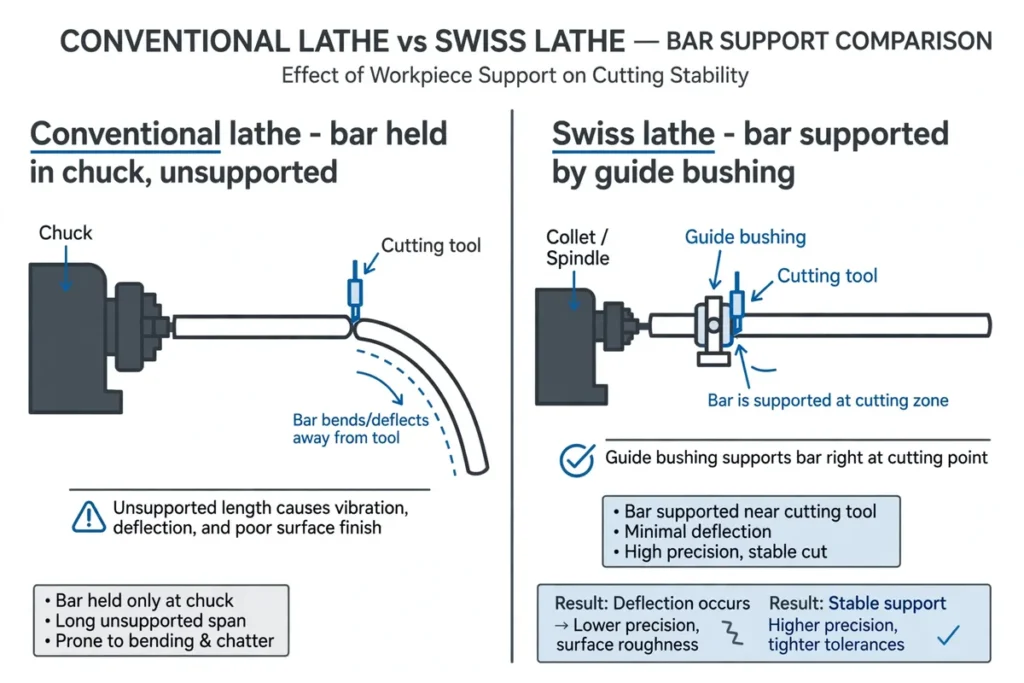
Swiss machining is CNC turning on a sliding-headstock lathe, also called a Swiss-type lathe or Swiss screw machine. The bar stock slides through a guide bushing while the headstock moves, so the cutting always happens millimetres from the support. That support is the whole difference: on a conventional lathe the bar sticks out of the chuck unsupported, and a long thin part deflects under cutting pressure.
The name “Swiss screw machining” comes from the original use: tiny screws for watches. Modern Swiss machines are CNC-controlled and far more capable, with live tooling for milling and drilling, and a sub-spindle that takes the part over for back-working. One bar in, one finished part out, with no second setup in most cases.
How Does a Swiss Lathe Work?
The cycle starts with bar stock loaded into a bar feeder, which pushes the bar through the headstock and the guide bushing. The headstock slides the bar forward while gang tools or a turret cut the outside diameter, and the guide bushing holds the bar exactly where the cut happens. Because the cut is always next to the support, the part cannot flex, even at length-to-diameter ratios above 3:1.
Live tools then add milled flats, cross holes and slots without removing the part. When the front work is done, the sub-spindle grips the part, the main spindle cuts it off, and the sub-spindle machines the back face. The finished part drops out while the next bar length is already feeding, and the machine can run unattended for 8 to 24 hours.
Swiss Turning vs Conventional CNC Turning
The two processes overlap, but they are built for different parts. Swiss turning wins on small, slender, high-precision work in volume. Conventional turning wins on larger parts, short runs and simple geometry. The table below gives the comparison with numbers.
When a part could go either way, size and volume decide. Under 32 mm diameter in the hundreds or thousands, Swiss usually wins on cost per piece. Over that size, or for a handful of prototypes, a conventional lathe is the better call.
| 因子 | Swiss turning | Conventional CNC turning |
|---|---|---|
| Typical part diameter | Up to 32 mm (1.25 in); some machines to 50 mm | No practical small limit; large parts welcome |
| Best part shape | Long, thin, small-diameter parts | Short, large-diameter parts |
| 一般的な許容差 | ±0.001 mm (±0.0002–0.001 in) | ±0.01 mm or looser |
| 表面仕上げ | Ra 0.16 µm (16–32 µin) | Ra 0.8–1.6 µm |
| 長さ対直径比 | Above 3:1 without deflection | Needs steady rests above ~3:1 |
| Setup time | 2–8 hours (longer, more tools) | Shorter, fewer tools |
| 最適な音量 | 100 to 100,000+ pieces | Prototypes to medium runs |
| 二次加工 | Rarely needed (live tools + sub-spindle) | Common (second setup) |
Tolerances and Surface Finishes You Can Hold
The process is specified where tolerance and finish matter. Standard work holds ±0.0002 to 0.001 inches, with surface finishes of 16 to 32 microinches Ra. Plastics run looser, around ±0.001 to 0.003 inches and 32 to 64 microinches Ra, because they move with temperature. Concentricity of ±0.002 mm is achievable on round features.
| 素材 | 一般的な許容差 | Typical finish | 注記 |
|---|---|---|---|
| ステンレス鋼 | ±0.0002–0.001 in | 16–32 µin Ra | Work-hardens; sharp tools and steady feed matter |
| Brass (C36000) | ±0.0002–0.001 in | 16–32 µin Ra | Free-machining; best finish of the common metals |
| アルミニウム | ±0.0005–0.001 in | 16–32 µin Ra | Gummy grades smear; polished tools help |
| チタン | ±0.0005–0.001 in | 16–32 µin Ra | Low cutting speeds; heat control is critical |
| Plastics (nylon, Delrin) | ±0.001–0.003 in | 32–64 µin Ra | Thermal expansion and moisture move dimensions |
Tighter tolerances are possible, but they cost time and money. A tolerance should be as loose as the part allows, because every extra decimal adds inspection and scrap risk. Our guide to CNC milling and turning covers how turning tolerances compare across processes.
What Does Swiss Turning Cost?
Swiss turning costs more to set up and less per part at volume. Setup takes 2 to 8 hours, with many tools to set and the guide bushing to size. Cycle time runs 10 to 90 seconds for simple parts and 2 to 6 minutes for complex ones. Machines cost over $150,000 for an entry model and over $400,000 for a multi-channel one, so the hourly rate runs higher than a basic lathe.
Per-part cost depends on material, part complexity, tolerance and volume. Simple brass parts in the thousands cost little per piece: the machine runs unattended and the cycle is short. Tight tolerances, exotic materials and low volumes push the price up, as setup spreads over fewer parts. As a rule of thumb, Swiss beats conventional turning on cost once volume pays back the setup. Pricing needs a drawing; our CNC加工の費用 guide explains cost drivers.
Lead Time for Swiss Machined Parts
Lead time follows the same logic as cost. The first run takes longer because of setup and first-article inspection, while repeat runs are fast once the program and tooling are proven. Material availability and secondary finishing, such as plating, add more time than the machining itself on most orders.
Materials for Swiss Turning
Almost any bar-stock material can run on a Swiss lathe, but some cut far better than others. Brass is the easiest: free-machining C36000 cuts cleanly, holds a fine finish and suits fittings, valves and terminals. Stainless steel is the workhorse for medical and food parts, but it work-hardens, so feeds must stay steady and tools sharp.
Aluminum machines fast but gummy grades smear without polished tooling and good coolant. Titanium suits aerospace and medical implants, yet it needs low cutting speeds and careful heat control. Engineering plastics such as nylon, Delrin and PEEK work well for insulators, bushings and gears, but their dimensions move with temperature and moisture, so tolerances stay looser than on metals. Carbon steel and copper round out the common list for shafts, pins and electrical parts.
Designing Parts for Swiss Turning
Good Swiss parts are designed around the guide bushing. Keep walls at least 0.5 to 0.8 mm thick, and give internal corners a radius larger than the tool diameter so the tool can cut them cleanly. Long parts are fine, but the length-to-diameter ratio should stay realistic for the material; very slender plastic parts will still bend despite the bushing support.
Use the checklist below before sending a drawing. Parts that follow it quote faster and machine with fewer problems.
| Design rule | ガイドライン |
|---|---|
| Part diameter | Up to 32 mm (1.25 in) for most machines |
| 肉厚 | Minimum 0.5–0.8 mm |
| 内角の半径 | Larger than the cutting tool diameter |
| 長さ対直径比 | Above 3:1 is possible; confirm with the shop |
| スレッド | Cut or rolled in the same setup where possible |
| 許容差 | Tighten only the features that need it |
| Deep narrow cavities | Avoid where possible; they trap chips |
| Sharp corners | Break edges; a small chamfer prevents burrs |
Bar Feeding and Unattended Running
A bar feeder is what makes Swiss machining a production process rather than a one-off operation. It holds a full-length bar, pushes it through the headstock as each part is cut, and loads the next bar when one runs out. Without it, the operator would feed short bars by hand and the machine would sit idle most of the day.
With a feeder and a parts catcher, the machine runs lights-out through the night. That unattended time is where the per-part cost falls: the same setup that took hours to prove now produces parts while nobody is watching. It is also why Swiss suits repeat orders so well; the second run starts from a proven program.
Surface Finish, Burrs and Deburring
Swiss parts usually leave the machine with a finish good enough to use as-is, around 16 to 32 microinches Ra on metals. The guide bushing keeps vibration down, which is half the reason the finish is so fine. The other half is sharp tooling and the right cutting fluid for the material.
Burrs are the main finishing problem on small parts. A burr on a 2 mm pin can be bigger than the feature it sits on, so edges need a small chamfer in the design and the tooling must stay sharp. Light deburring by tumbling or brushing handles most parts, while critical edges are deburred by hand. Designing the chamfer in from the start is cheaper than removing burrs later.
When NOT to Use a Swiss Lathe
A Swiss lathe is the wrong choice for parts larger than the bar capacity, usually above 32 mm (1.25 in). It is also wrong for parts that do not start as bar stock, such as forgings or castings, which cannot feed through a guide bushing. Short parts waste material too: every bar change leaves a 5 to 12 inch remnant, so a very short part in a small quantity carries a heavy material penalty.
Low volumes and prototypes are usually better on a conventional lathe, where setup is shorter and cheaper. Simple geometry with loose tolerances is also a poor fit; the machine’s precision is wasted on a part any lathe could make. A large flat milled face or a big bore is also a poor fit; a machining centre will do it faster. Pick the process that fits the part, not the fanciest machine.
Industries and Typical Parts
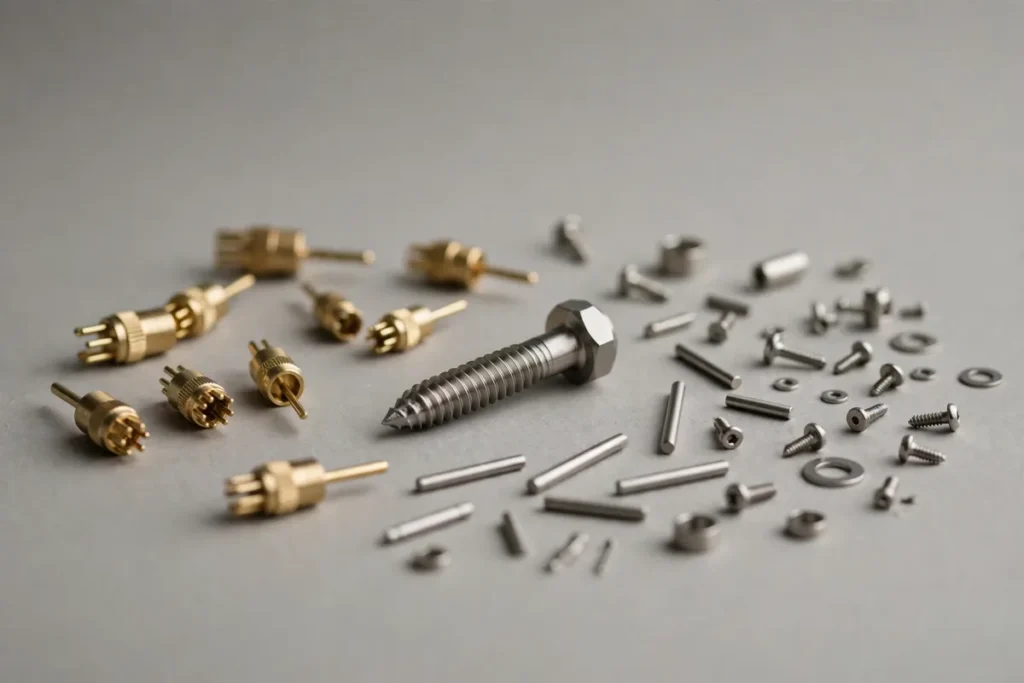
Medical work is the largest Swiss market: bone screws, surgical pins, dental implants and instrument shafts, all in stainless steel or titanium with tight tolerances and a fine finish. Electronics follows with connector pins, terminals and antenna parts in brass and copper, where the small size and high volume suit the process exactly.
Aerospace uses Swiss parts for fuel-system components, fasteners and sensor housings. Automotive work includes injector parts, valve components and sensor shafts. Robotics, where XY does much of its work, needs miniature gears, shafts and joints in small batches with tight tolerances; our on-demand CNC machining for robotics guide covers how those parts are specified. Watchmaking, the original Swiss trade, still uses the process for gears, screws and shafts.
| 産業 | Typical Swiss-machined parts |
|---|---|
| 医療 | Bone screws, surgical pins, dental implants, instrument shafts |
| エレクトロニクス | Connector pins, terminals, antenna parts |
| 航空宇宙 | Fuel-system components, fasteners, sensor housings |
| 自動車 | Injector parts, valve components, sensor shafts |
| ロボティクス | Miniature gears, shafts, joints |
| Watchmaking | Gears, screws, shafts |
How to Choose a Swiss Machining Supplier
Ask four questions before placing an order. First, what bar diameters can their machines take, and does your part fit? Second, what tolerances do they hold in your material, and can they show inspection reports? Third, what is their minimum order, and how do they handle repeat runs? Fourth, what secondary work can they do in-house, such as plating or heat treatment?
A good supplier answers with numbers, not adjectives. They will tell you the tolerance they hold on your material, the setup time your part needs, and whether a design change would cut the cost. If a shop cannot answer those questions, keep looking; the cheapest quote on a Swiss part is rarely the one with the fewest questions.
よくある質問
What is Swiss machining?
Swiss machining is CNC turning on a sliding-headstock lathe. Bar stock feeds through a guide bushing and the cut happens right next to the support, so small, long, thin parts can be turned to tight tolerances without bending.
What is a Swiss machine?
A Swiss machine is a sliding-headstock lathe, also called a Swiss-type lathe. The headstock moves the bar through a guide bushing while gang tools cut the part, and live tools and a sub-spindle finish it in the same setup.
What is Swiss screw machining?
Swiss screw machining is the original name for the process, from its use making tiny watch screws. Today it means the same as Swiss machining: precision turning of small parts on a Swiss-type lathe.
How do Swiss screw machines work?
A bar feeder pushes bar stock through the guide bushing. The sliding headstock moves the bar while tools cut the outside diameter, live tools add milled features, and a sub-spindle takes the part for back-working before it drops out finished.
Why choose Swiss screw machining?
Choose it for small, slender parts in volume that need tight tolerances and a fine finish, especially when the part needs milling, drilling and back-working. One setup replaces several operations, which saves time and keeps every feature aligned.
What is the difference between CNC Swiss and Escomatic machining?
Both are Swiss-type processes, but a CNC Swiss lathe is programmed and can cut complex shapes with live tooling, while an Escomatic is a cam-driven Swiss machine built for very high-volume production of simple parts. CNC Swiss suits varied work; Escomatic suits long runs of one simple part.
What is Swiss turn machining used for?
It is used for bone screws, connector pins, shafts, fasteners, gears and sensor parts in medical, electronics, aerospace, automotive and robotics work. Any small round part needed in volume is a candidate.
Which industries use CNC Swiss machines?
Medical, electronics, aerospace, automotive, robotics and watchmaking use them most. Medical and electronics lead because their parts are the smallest and need the tightest tolerances.
Can Swiss machines have live tooling?
Yes. Most modern Swiss lathes carry live tools for milling, drilling and tapping, so flats, cross holes and slots are cut in the same setup without removing the part.
Is Swiss turning expensive?
Setup costs more than on a conventional lathe, usually 2 to 8 hours, but the per-part cost drops fast at volume because the machine runs unattended and needs no second setup. For small parts in the thousands, it is often the cheapest option per piece.
結論
Swiss turning earns its place wherever small parts need tight tolerances in volume. The guide bushing is the key: it supports the bar exactly where the cut happens, so long thin parts stay true. Add live tooling and a sub-spindle, and one setup turns a bar into a finished part with milling, drilling and back-working included.
Before choosing it, check the part against these rules: diameter under 32 mm, bar stock, enough volume to pay back the setup, and tolerances that need the process. If the part fits, it will usually beat conventional turning on quality and cost per piece. If you have a small precision part in mind, send the drawing to XY Machining for a quote; we will tell you honestly whether Swiss is the right process.