Quick answer: Urethane casting — also called polyurethane vacuum casting — produces 10 to a few hundred production-quality plastic parts using a soft silicone mold instead of expensive steel tooling. A master pattern (usually 3D printed or machined) is used to make a silicone mold, and liquid polyurethane resin is cast into that mold under vacuum to eliminate bubbles. It bridges the gap between one-off prototyping and full injection molding: real material properties, fine detail, and smooth finishes, at a fraction of injection-mold tooling cost and lead time.
I reach for urethane casting whenever a client needs 50 good-looking, functional parts next week and cannot justify a $20,000 injection mold for a design that might still change. It is the most underrated process in the low-volume toolbox.
How urethane casting works, step by step
The process is elegant because the mold itself is cheap and fast to make:
- Master pattern: a high-quality master is produced, usually by CNC machining or SLA 3D printing, then finished smooth.
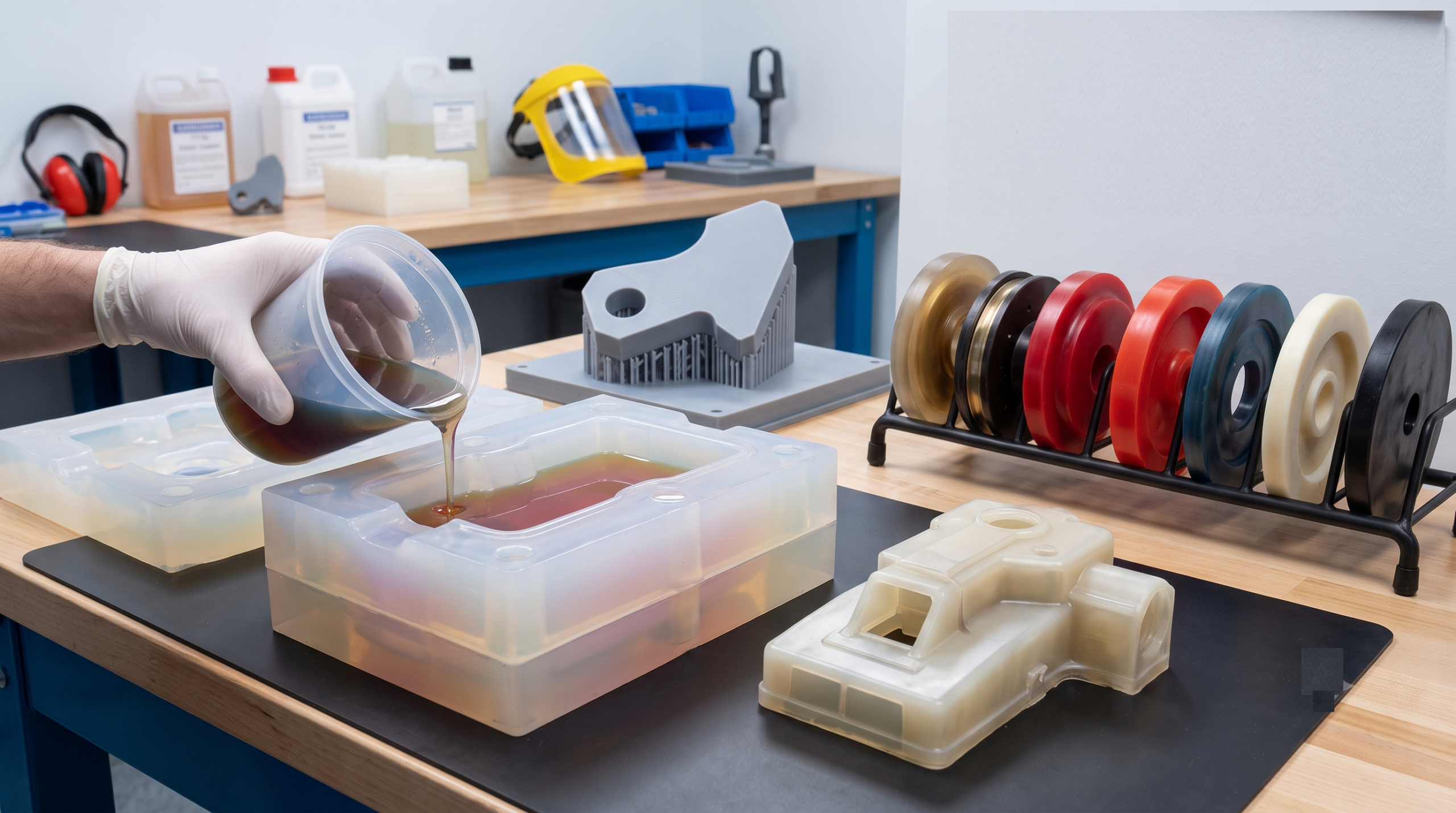
- Silicone mold: liquid silicone is poured around the master and cured, then cut open to remove it, leaving a precise cavity.
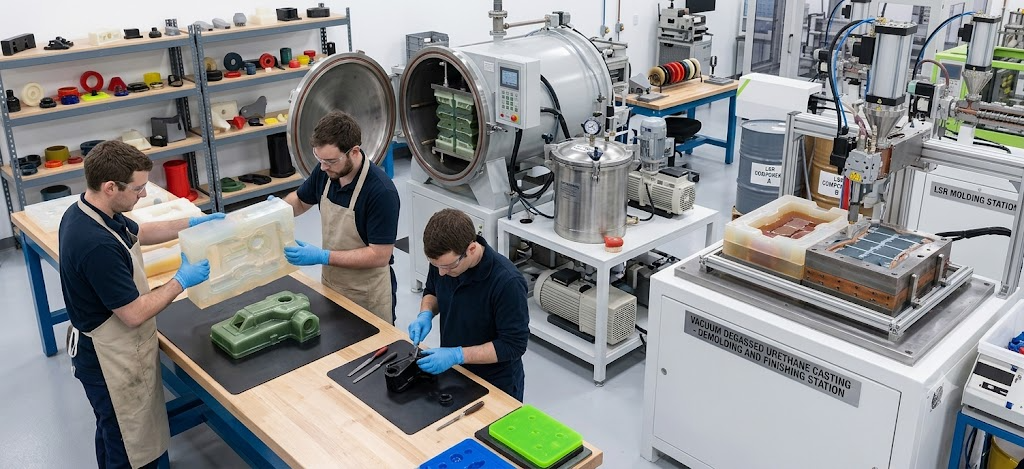
- Vacuum casting: polyurethane resin is poured into the silicone mold inside a vacuum chamber, which pulls out air bubbles for a flawless part.
- Curing and demold: the resin cures in an oven, the flexible mold is peeled back, and the part comes out.
- Finishing: parts can be painted, textured, or assembled.
One silicone mold typically yields 15–25 parts before it wears, which is exactly why the process suits low-volume runs.
Why choose urethane casting
The appeal is a specific combination of speed, cost, and quality that neither prototyping nor production molding offers on its own.
- No hard tooling. Silicone molds cost a fraction of steel injection molds.
- Fast. First parts in days, not the weeks an injection tool takes.
- Production-like quality. Smooth surfaces, fine detail, real cosmetic finish.
- Material range. Resins mimic ABS, rubber, PP, and even clear or overmolded parts.
- Low risk. Cheap to iterate if the design changes.
For a dedicated overview of the process, see our urethane casting page.
Where urethane casting fits vs the alternatives
The honest way to choose a process is by quantity and intent. Here is where urethane casting sits between its neighbors.
| Process | Best quantity | Tooling cost | Lead time | Material realism |
| 3D printing | 1–10 | None | 1–3 days | Prototype-grade |
| Urethane casting | 10–300 | Low (silicone) | 3–10 days | Production-like |
| Injection molding | 1,000+ | High (steel) | 4–8 weeks | Full production |
| CNC machining | 1–500 | None | 3–10 days | Full material |
The pattern is clear: urethane casting owns the awkward middle — too many parts for printing, too few to justify an injection mold. That is the bridge to a market launch, a trade show, a pilot run, or a crowdfunding fulfillment.
Materials and finishes
Urethane resins are formulated to imitate the behavior of common production plastics, which is what makes cast parts feel real rather than like prototypes.
| Resin type | Mimics | Typical use |
| Rigid ABS-like | ABS / PC | Enclosures, housings, structural parts |
| Rubber-like | TPE / silicone | Seals, grips, flexible components |
| Clear / transparent | PMMA / PC | Lenses, light pipes, covers |
| Glass-filled | Filled nylon | Stiffer, higher-heat parts |
| Flame-retardant | UL-rated plastics | Electrical housings |
On finish, cast parts take paint, texture, and color beautifully — often good enough for functional testing, marketing photos, and even short commercial sales. Color can be added into the resin or applied afterward.
Cost drivers and lead time
What actually moves the price and the schedule on a urethane casting job:
- Master pattern quality: a rough master means rough parts; time spent finishing the master pays off across every copy.
- Part size and volume: larger parts use more resin and bigger molds.
- Mold count: because each silicone mold yields ~20 parts, a run of 200 needs multiple molds.
- Material: clear and flame-retardant resins cost more than standard rigid.
- Finishing: painting, texturing, and assembly add labor.
A typical run of 25–50 rigid enclosures lands in the 5–10 business day range, master included. When your volumes eventually cross into the thousands, that is the signal to move to low-volume injection molding and amortize a real steel tool.
When NOT to use urethane casting
Being honest about limits builds trust in the process:
- Very high volumes: past a few hundred parts, injection molding is cheaper per part.
- Extreme tolerances: cast parts hold looser tolerances than precision CNC machining.
- High heat or structural loads: production thermoplastics or metal outperform cast urethane.
- Long-term dimensional stability: some resins creep over time under load.
Match the process to the job and urethane casting is a hero; force it past its range and it disappoints.
How to get better cast parts: practical tips
The quality of a urethane casting run is decided long before resin is poured. A few habits separate a clean, repeatable run from a frustrating one:
- Invest in the master. Every surface flaw, layer line, or tool mark on the master is copied into every part. Time spent sanding and sealing the master is multiplied across the whole run — it is the highest-leverage step in the process.
- Design in draft and radii. Even though silicone molds are flexible, slight draft angles and generous internal radii make demolding cleaner and extend mold life.
- Plan for shrinkage on critical features. If a bore or boss must fit a mating part, either compensate the master or machine that feature after casting.
- Choose the resin before the master. Different resins shrink and flow differently; picking the material first lets the master be sized correctly.
- Batch your colors and finishes. Casting all same-color parts together, and grouping finishing steps, keeps cost and consistency under control.
A supplier who talks through these details with you up front is one who understands that casting quality is engineered, not lucky. That conversation early is what turns a rough pilot run into parts you can confidently put in front of customers or investors.
Frequently asked questions
How many parts can I make with urethane casting? A single silicone mold reliably produces about 15–25 parts before the cavity begins to degrade and detail softens. For larger runs, multiple molds are made from the same master, so quantities up to a few hundred are practical and economical. Beyond roughly 300–500 parts, the cumulative cost of remaking silicone molds starts to exceed what a steel injection tool would cost to amortize, which is the natural point to switch processes. For anything under a few hundred parts, urethane casting is usually the fastest and cheapest route to production-quality units.
How is urethane casting different from injection molding? The core difference is the mold. Urethane casting uses a soft silicone mold that is cheap and fast to make but wears out after ~20 parts; injection molding uses a hard steel tool that costs thousands and takes weeks but lasts for hundreds of thousands of shots. Casting wins decisively on speed and upfront cost for low volumes, giving you production-like parts in days. Injection molding wins on per-part cost, consistency, and material performance once volumes reach the thousands. They are complementary stages, not competitors — many products cast first, then transition to injection molding at scale.
What tolerances can urethane casting hold? Urethane casting typically holds tolerances around ±0.1–0.3 mm depending on part size and geometry, which is looser than CNC machining or injection molding but perfectly adequate for enclosures, housings, and most functional prototypes. The main reason is that resin shrinks slightly on cure and the silicone mold is flexible. If your part has a few critical mating features, the common solution is to machine those specific features after casting, or to design the master with the shrinkage compensated. For truly tight-tolerance parts, machining remains the better choice.
Can cast urethane parts be used as final products, not just prototypes? Yes, for the right volumes and applications. The cosmetic and functional quality of vacuum-cast parts is high enough for commercial use — many products sold in quantities of dozens to a few hundred (specialty medical devices, low-volume consumer electronics, trade-show units, crowdfunding rewards) ship as cast urethane. The limitation is not quality but economics and durability: past a few hundred units injection molding becomes cheaper, and cast resins are less robust under sustained heat or structural load than production thermoplastics. Within its range, cast urethane is a legitimate end-use manufacturing method.
Where this leaves you
Urethane casting services solve the low-volume problem that stops so many hardware projects: how to get 10–300 production-quality parts without paying for, or waiting on, steel injection tooling. Build a great master, choose a resin that matches your production plastic, and use casting as the bridge from prototype to a real pilot run. When volumes finally justify it, graduate to injection molding — but until then, few processes deliver this much finished quality this fast.
About the author Patrick Chen — Applications Engineer, XY Machining Patrick reviews thin-wall designs for US engineering teams at XY Machining and works with the shop floor on the fixturing and toolpaths that keep delicate parts in tolerance. To pressure-test a thin-wall part before quoting, send your model to our team.