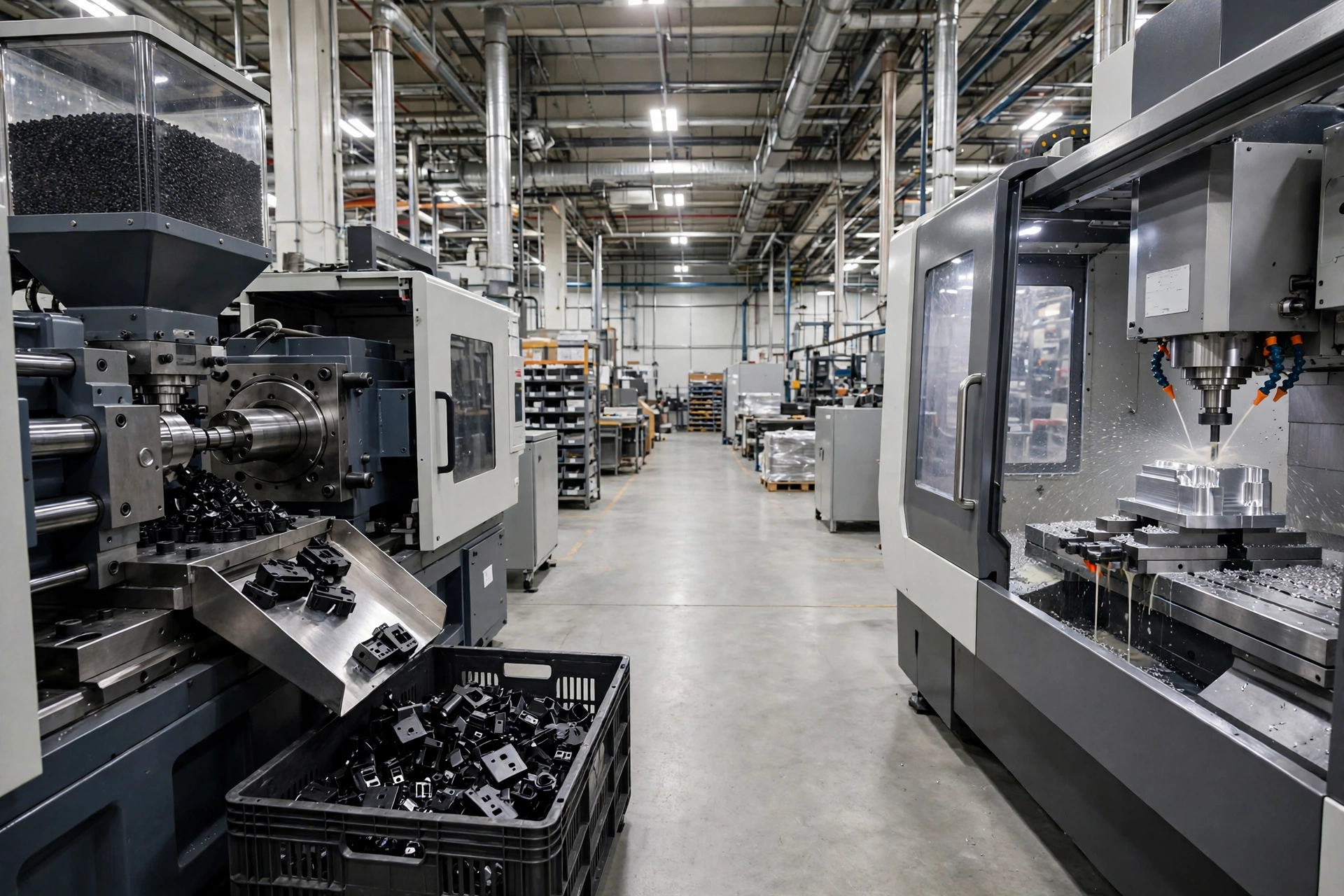
射出成形 produces the cheapest plastic part per unit and the most expensive first part. CNC加工 and 3D printing invert that: no tooling to pay for, but a per-part price that barely improves as quantity grows. The whole decision comes down to where those two curves cross, and that point is not fixed. It moves with your tool cost and part geometry, and can sit anywhere from under a hundred parts to several thousand.
This guide gives you the formula to find your own crossover, then covers the factors that can override cost entirely: tolerance, material properties, design freedom, and how soon you actually need parts in hand.
損益分岐点の計算式
One equation answers the core question: break-even quantity = tooling cost ÷ (per-part cost of the alternative − molded per-part cost). In plain terms, divide what the mold costs by what each molded part saves you.
Take a mold that costs $8,000. Machined parts cost $35 each and molded parts cost $3 each, so every molded part saves $32. The mold pays for itself at 250 units. Beyond that, every part is pure saving; below it, you have spent money on tooling you will never recover.
Reading the break-even matrix
| 金型費 | Saving $10 per part | Saving $25 per part | Saving $50 per part |
|---|---|---|---|
| $3,000 | 300個 | 120個 | 60個 |
| $8,000 | 800個 | 320個 | 160個 |
| $20,000 | 2,000個 | 800個 | 400個 |
| $40,000 | 4,000個の部品 | 1,600個 | 800個 |
この傾向は心に留めておく価値がある。安価なアルミニウム金型を使った単純な部品であれば、数百個程度の生産でも成形を行う価値がある。一方、もともと機械加工コストが安かった部品のために、複雑な多キャビティの鋼製金型を使用する場合、数万個の生産が必要になるかもしれない。単一の「損益分岐点」という数値を提示する人は、あくまで推測に過ぎない。.
3つのプロセスを実際に比較してみると
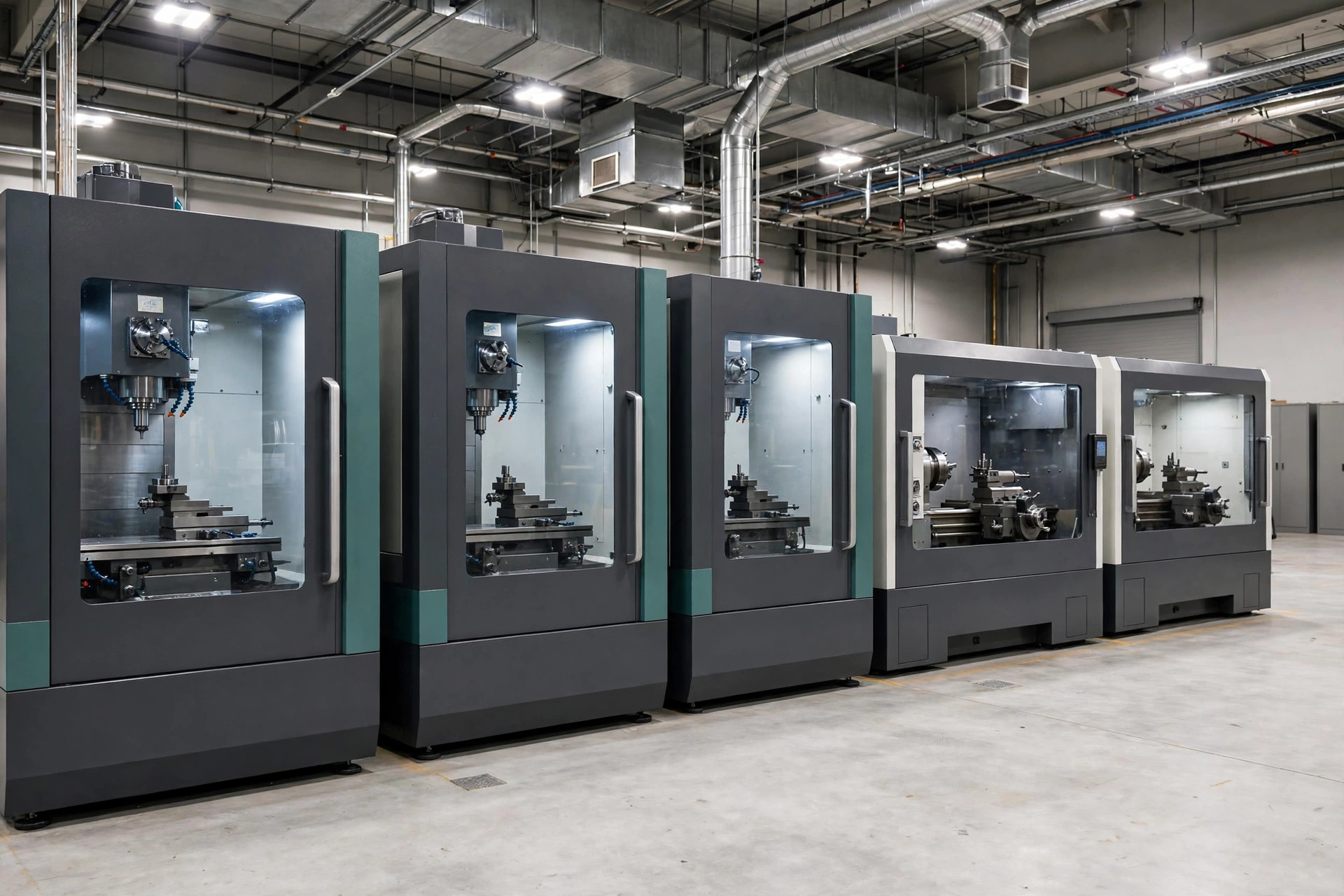
Before you run the numbers, it helps to see the three processes side by side. The table below compares injection molding, CNC machining and 3D printing on the eight factors that decide most projects. For the machines behind the machining column, see our guide to the types of CNC machines.
| 因子 | 射出成形 | CNC加工 | 3Dプリント |
|---|---|---|---|
| 初期金型費用 | アルミニウム製または焼入れ鋼製の金型が必要 | なし、治具のみ | なし |
| 大量生産時の部品単価 | 他を圧倒的に引き離して最安値 | ゆっくりと落下し、サイクル時間は固定されています | ほぼ横ばい、材料要因によるもの |
| 最初のパートまでの時間 | 金型の製作には通常、15~25営業日かかります | 日 | 日 |
| 一般的な許容差 | キャビティの公差は±0.015 mm、部品間の再現性は±0.08 mm程度 | ISO 2768-Cはプラスチック全般については一般的な規格であるが、測定可能な特性についてはより厳格な規定が設けられている | 技術によって、約±0.2~±0.5 mm |
| 材料特性 | 完全等方性のバルク物性 | 当該銘柄の総合的な市場特性 | 異方性があり、積層ごとに強度が低下する |
| 設計の自由度 | 喫水、船体の均一性、および排気による制約 | 工具の到達範囲および内側のコーナー半径による制約 | 格子および内部チャネルを含めた最大値 |
| 設計変更 | 鋼材を切断するとコストが高くなる | 無料です。プログラムを再実行するだけでOKです。 | 無料 |
| 最適なボリューム帯 | 数百から数百万 | 1から数千 | 1から数百 |
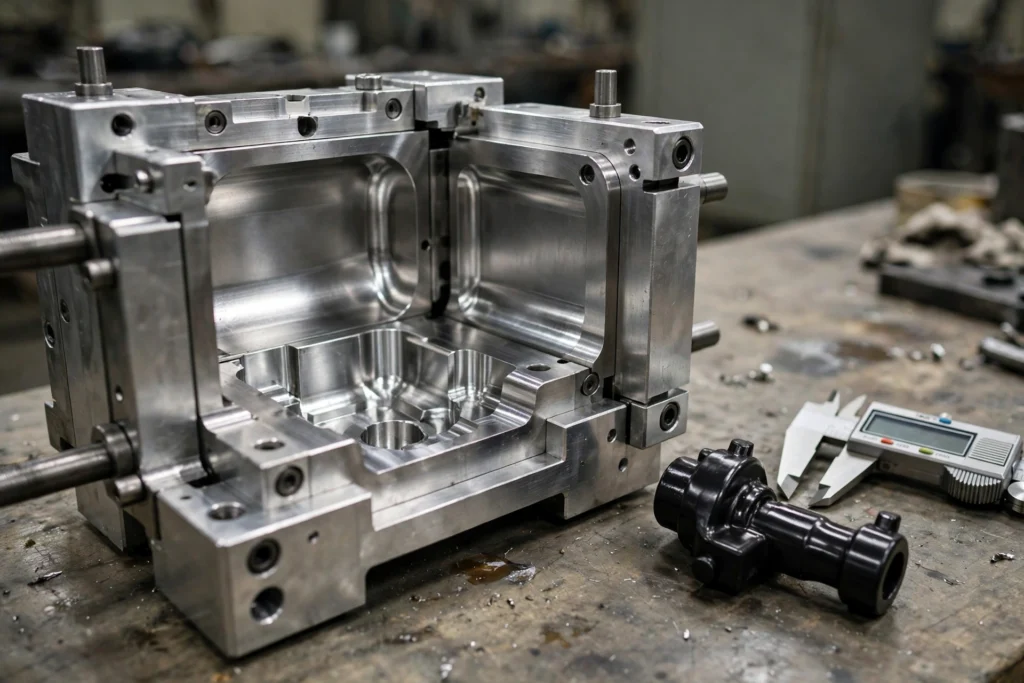
100個、1,000個、10,000個の部品ではどうなるのか
約100個の部品
A mold almost never pays for itself at this volume, unless the part is expensive to machine. Additive wins on geometry-heavy parts; machining wins where you need real material properties and a tighter fit. The design is also least likely to be frozen here, and paying for tooling before a design settles is the most common way to waste money on a plastic part. Our 3D printing technologies overview shows which process suits which prototype.
約1,000個の部品
The decision genuinely goes either way. Machined or printed parts still work, but the cumulative spend starts looking uncomfortable next to a tool that would have paid for itself. An aluminum bridge tool is usually the right answer: it costs a fraction of a hardened steel production tool, delivers real molded parts in the correct resin, and typically covers several thousand shots before wear becomes an issue.
当社の ラピッドツーリングサービス exists specifically for this band, so you can run market tests or a pilot launch while a production tool is being built.
約10,000個以上の部品
Molding wins clearly, and the conversation shifts to cavitation. A single-cavity tool makes one part per cycle and is cheapest to build. A multi-cavity tool costs more but slashes the cost per part, and generally starts paying off around the ten thousand mark.
A family mold produces several different parts in one cycle, which suits matched sets and assemblies. Size cavitation to annual volume, not to the first order. The same volume logic applies to metal parts in our 小ロットのCNC加工と大量生産の比較 guide, though the thresholds differ.
コストが必ずしも決定的な要因とは限らない
Plenty of projects choose a process that costs more per part, because something else matters more. Four factors regularly override the break-even maths.
材料特性
Molded and machined parts both carry the full bulk properties of the polymer. Printed parts do not: most additive processes build in layers, so strength across the build direction is lower than within a layer.
That matters for a functional bracket carrying load in a known direction, and not for a housing that only needs to hold its shape. If a printed prototype passed testing but the production part must survive the same load in a different orientation, that is a real engineering risk, not a paperwork detail.
許容差と再現性
Molding is extremely repeatable once dialled in, but it is not the tightest process. Shrinkage varies by resin, typically around 0.5% to 2%, and is not uniform across a part with varying wall thickness. Machining plastic gives tighter control on individual features and no shrinkage to predict — so critical mating features on molded parts are sometimes machined after molding rather than molded to size.
設計の自由度と制約
Molding needs uniform walls, generally 0.6 to 4.5 mm depending on resin, plus draft of about 1 to 3 degrees on faces perpendicular to the pull direction. Undercuts need slides or lifters, which add tooling cost. Machining needs no draft, but cannot produce a sharp internal corner — a round tool leaves a radius — and thin walls chatter while deep pockets need long tools that deflect.
Additive imposes almost no geometric limits, but support removal on internal features can be difficult and surface finish depends on layer height. A part designed for one process often quotes badly in another, and redesigning a machined part for molding — rather than sending the same model — is usually where the biggest savings are found.
最初のパートまでの時間
Tooling takes weeks; machining and printing take days. If a launch date is fixed, the honest comparison is total programme cost, including the consequence of being late. Bridge tooling was invented for this: run real molded parts from a fast aluminum tool while the hard tooling is still being cut.
材料の入手可能性はプロセスによって異なります
あるプロセスに存在する材料が、他のプロセスにも自動的に存在するとは限らないため、このことが、多くの人が予想するよりも早い段階で選択肢を絞り込むことになる。.
射出成形
Molding has the widest resin library: commodity ABS, PP and PE, plus engineering PC, nylon, POM and PC-ABS blends, with filled and flame-retardant variants. Colour is compounded into the resin, so it stays consistent through the part.
CNC加工
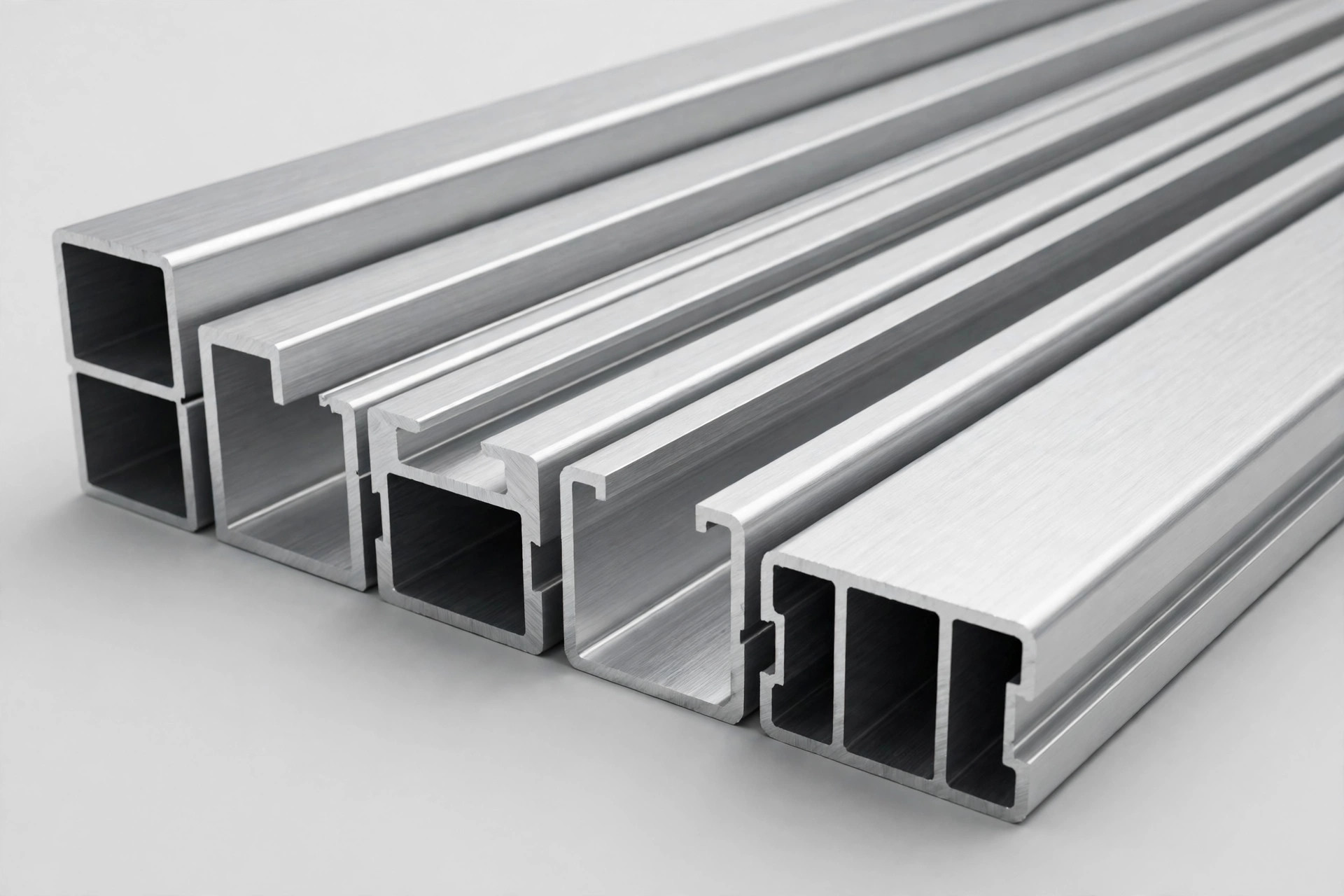
Machining stock shapes favour rigid engineering plastics — POM, nylon, PC, acrylic, PEEK and PP all machine predictably in plate and rod. Soft, rubbery materials machine poorly, and some plastics release internal stress as material is removed, so parts can warp after machining. Stress-relieving the stock before finishing passes is the usual remedy.
3Dプリント
Additive has the narrowest list, and each technology supports its own family. Properties rarely match the equivalent molded grade exactly — printed nylon powder is not molded PA66. Treating a printed material as a direct substitute for the production resin is a mistake worth avoiding during validation. Metal processes such as DMLS vs SLM have their own material limits too.
Material can decide the process outright. A specific flame-retardant grade with certification may leave molding as the only route, while PEEK in small quantities is usually more sensible machined from stock than tooled up.
見積書に記載されていない費用
The quote shows tooling and per-part cost. Five other costs sit outside it, and each one can change the answer.
- Design freeze risk. Once steel is cut, a feature change can mean welding and re-cutting the tool, or replacing it. Machined or printed parts absorb changes for free. If the design is still moving, that flexibility has real monetary value.
- Tool ownership and storage. Agree in writing who owns the mold, where it is stored, and what happens if you move suppliers. Contractual, not technical — and easiest to settle before the tool exists.
- Secondary operations. Molded parts may need trimming, tapping, ultrasonic welding, labelling or texture finishing. Machined parts often need deburring and finishing. These are per-part costs outside the headline price.
- Inspection. Higher volumes mean sampling plans and documentation. That is a cost of the production stage, not the prototype stage — budget for it before the first order, not after.
- Cash flow timing. Tooling is paid up front, before a single part ships. A tool that pays back at 800 units is still a real constraint if the first order is 300.
実用的な意思決定の流れ
Rather than starting from the process, start from four questions about the part. Is the design frozen? If not, avoid tooling entirely until it is. What is the realistic annual volume — not the first order? Tooling should be sized to the annual figure.
Which properties are non-negotiable? Isotropic strength, chemical resistance, temperature rating and regulatory compliance all narrow the material list before cost enters the picture. When do you need parts? A fixed launch date can justify a bridge tool that looks inefficient on a spreadsheet.
Three routes most projects follow
The answers usually point at one of three routes. Print for validation, then machine for pilot builds, then mold for production. Or skip printing and machine straight through if the part needs full material properties from day one. Or go directly to an aluminum tool if volume is clearly above break-even and the design is settled.
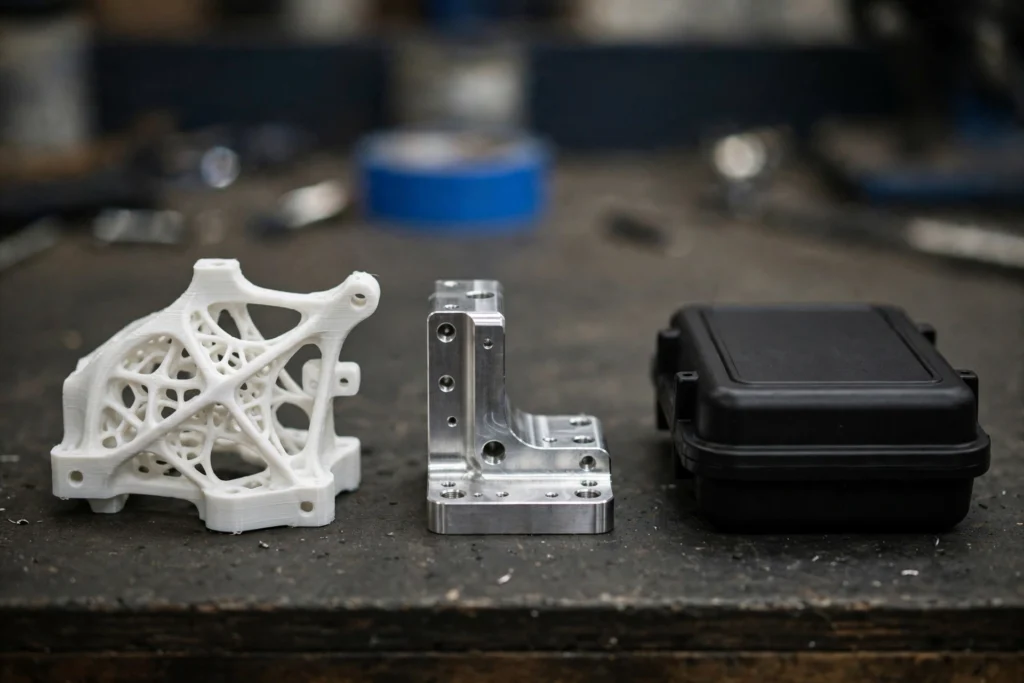
大量生産であっても、成形が最適な解決策ではない場合
量だけで金型の導入を正当化することはできません。通常、次のような場合には、成形は適切な手段とは言えません:
- The part exceeds practical mold sizes — most tooling sits well inside a 1300 by 900 by 500 mm envelope.
- The material is available as stock but not as an injectable resin, which covers several high-performance engineering plastics.
- 少量で多くのバリエーションが必要な場合、加工部品群の方が工具群よりも優れています。.
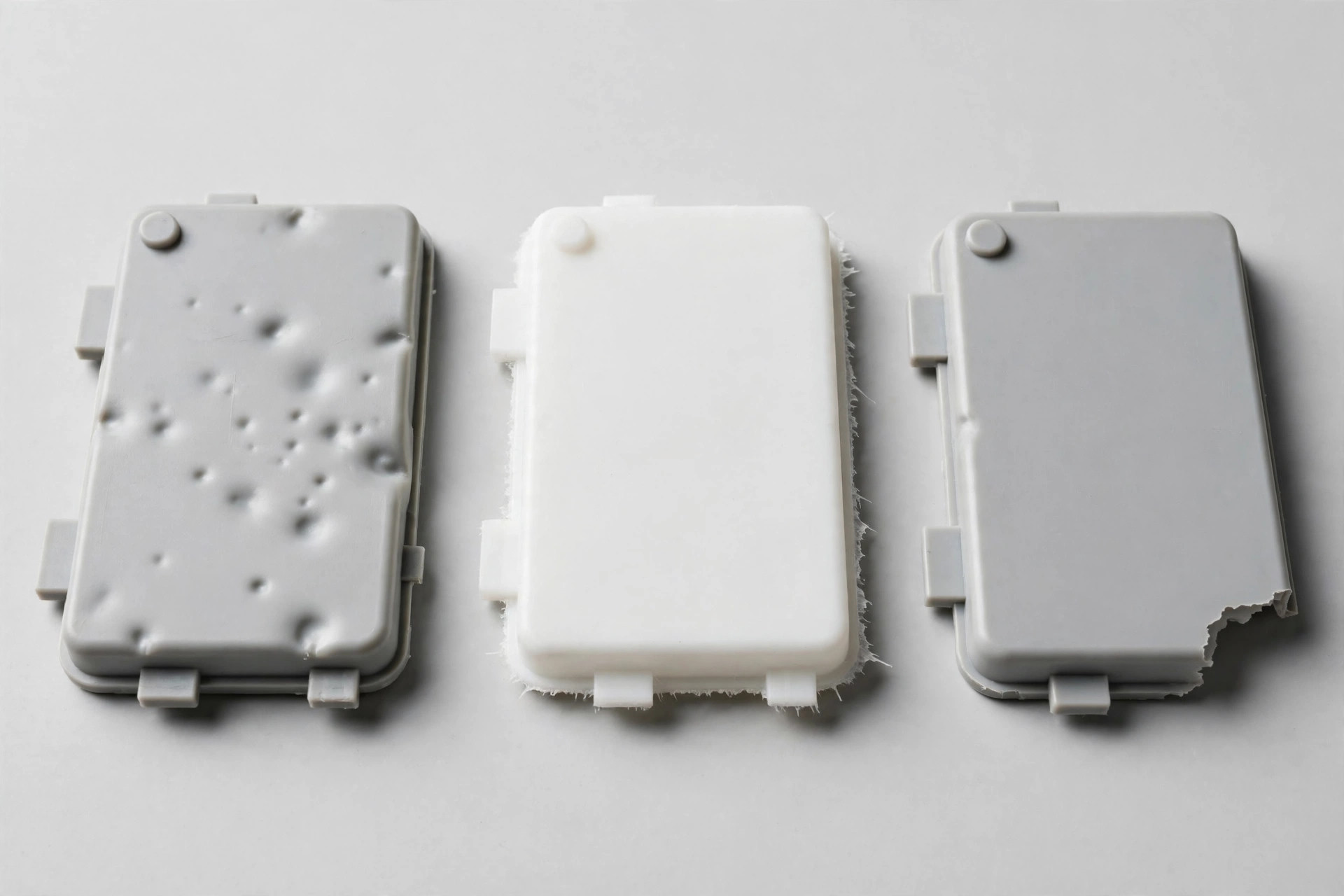
- 壁の断面は重く、不均一であるため、再設計することはできません。断面が厚いと沈下が生じ、サイクル時間が長くなるからです。.
- プログラムの寿命が短すぎるため、このツールは投資回収量に達することはないだろう。.
Sink, flash and other molded-part issues are covered in our 射出成形の欠陥 ガイド。.
その部品に適したルートを検討する
これを解決する最も確実な方法は、実際の目標数量を明記した上で、同じモデルについて複数の工程から見積もりを取り寄せることです。100個、1,000個、10,000個の3つの数量について、一度に一括で見積もりを依頼してください。これら3つの数字の傾向は、一般的なルールよりも多くのことを教えてくれます。なぜなら、それらは平均的な部品ではなく、実際の形状を反映しているからです。.
That is how XY Machining handles the question. Send a CAD file with your target volume and we return pricing across 射出成形, CNC加工 そして 3Dプリント, with design-for-manufacturability feedback inside 24 hours. If a mold is not the lowest-cost route at your quantity, the honest answer is more useful than the bigger order.
よくある質問
どの程度の数量になれば、射出成形はコスト面でのメリットが出るのでしょうか?
一概に言える数字はありません。金型コストを、代替案と比較した1個あたりのコスト削減額で割ってみてください。アルミニウム製の金型を使った単純な部品であれば、数百個程度で採算が取れる場合もありますが、複雑な鋼製金型の場合は数千個必要になることもあります。
射出成形部品は、機械加工部品と同じ公差を満たすことができますか?
通常、個々の形状についてはそうではありません。成形は再現性が高いですが、樹脂の収縮は肉厚や材料によって異なります。重要な嵌合部については、成形時に直接所定の寸法に成形するのではなく、成形後に機械加工される場合があります。
3Dプリントされた部品は、量産用途に十分な強度があるのでしょうか?
多くの用途ではその通りですが、プリントされた部品は異方性があり、造形方向に沿って強度が低下します。ポリマーそのものの特性を仮定するのではなく、実際の造形方向における荷重条件を検証してください。
ブリッジツーリングとは何ですか?また、どのような場合に使用すべきですか?
量産用の鋼製金型が製作されている間に、実際の成形部品を生産できる、迅速かつ低コストなアルミニウム製金型です。試作生産や市場調査、あるいはハードツールが完成する前に発売日が迫っているあらゆるプロジェクトに適しています。
最初の試作品は、機械加工すべきか、それともプリントすべきか?
形状、適合性、幾何学的精度を確認する際は、3Dプリントを活用しましょう。これが最も迅速かつ低コストな方法だからです。一方、プロトタイプに負荷をかけて試験を行う場合や、実際の材料で試験を行う場合、あるいは許容誤差が3Dプリントでは確保できないほど厳しい場合は、機械加工を行ってください。機械加工されたプロトタイプは量産品と同様の挙動を示すため、その試験結果は成形工程にもそのまま反映されます。
射出成形とCNC加工、どちらが安価ですか?
It depends on quantity. Below the break-even point, CNC machining is cheaper because there is no tooling to pay for. Above it, injection molding wins by a wide margin, because the per-part cost falls to a few dollars. Run the formula in this guide with your own tooling and per-part costs to find your crossover, and see our CNC machining cost breakdown for what drives the machining side.
When should I use injection molding instead of CNC machining?
Use injection molding when the design is frozen, the annual volume is above break-even, and the part needs the full properties of a molded resin. Use CNC machining when volumes are low, the design is still moving, or you need tight tolerances on individual features without tooling.