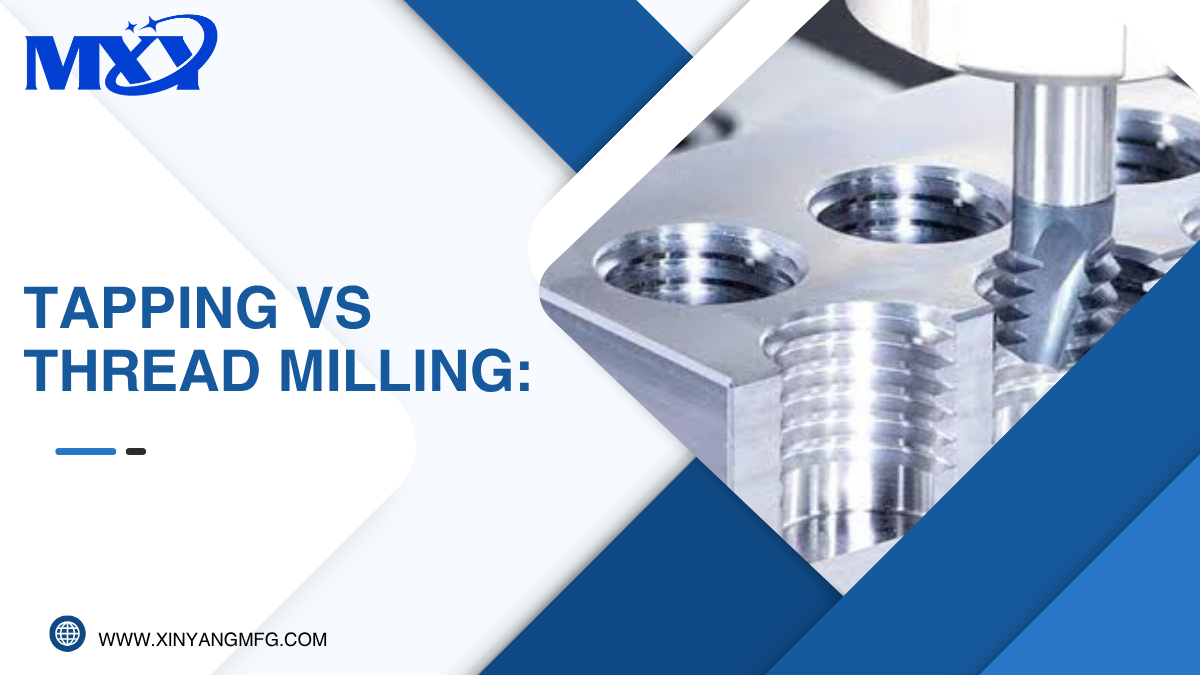
Chaque pièce usinée par CNC comportant un filetage interne a été soit taraudée, soit filetée par fraisage. Ces deux opérations aboutissent au même résultat — un trou fileté —, mais elles reposent sur des mécanismes totalement différents, et le choix entre les deux a des conséquences concrètes sur le risque de rupture d'outil, les tolérances, la compatibilité des matériaux et le coût total.
Le taraudage consiste à enfoncer un taraud spécifique directement dans un trou pré-percé, en une seule plongée axiale. La géométrie du taraud correspondant exactement à la forme du filetage, l'opération est rapide et ne nécessite qu'une programmation minimale. Pour la production en grande série de filetages standard dans des matériaux ductiles, le taraudage est difficile à battre en termes de rapidité et de rentabilité. Son point faible réside dans la rupture de l'outil : un taraud cassé à l'intérieur d'un trou borgne dans un matériau dur est souvent irrécupérable et peut entraîner la mise au rebut d'une pièce par ailleurs conforme.
Le fraisage de filetage utilise une fraise rotative plus petite qui suit une trajectoire CNC hélicoïdale — décrivant un cercle autour du trou selon les axes X et Y tout en avançant selon l'axe Z — afin de former le filetage en plusieurs passes. La fraise n’a pas le même diamètre que le filetage, ce qui signifie qu’un seul outil couvre une gamme de tailles de filetage de même pas, et que l’ajustement peut être affiné en modifiant le rayon de la trajectoire d’usinage. Le fraisage de filets est plus lent et nécessite une programmation plus sophistiquée, mais il est plus sûr, plus flexible et mieux adapté aux matériaux durs, aux gros filets, aux trous borgnes nécessitant un engagement net au fond, ainsi qu’aux pièces coûteuses pour lesquelles le risque de rupture est inacceptable.
Ce guide compare ces deux méthodes en tenant compte de tous les facteurs importants : rapidité, gamme d'outils, risque de casse, compatibilité des matériaux, performances sur les trous borgnes, qualité du filetage et rentabilité en termes de volume. Ces deux méthodes sont disponibles dans le cadre de notre Services d'usinage CNC, et le multithreading va souvent de pair avec les choix de processus dans notre Tournage CNC vs fraisage guide.
Comment fonctionne la technique du tapping ?
Un taraud est un outil de coupe trempé, rectifié avec des rainures et dont la forme du filetage correspond exactement au filetage interne cible. Il est monté dans la broche et enfoncé axialement dans un trou pré-percé à une vitesse d’avance synchronisée avec son pas — il s’agit du taraudage rigide, le mode standard sur les centres d’usinage CNC modernes. Dans le taraudage rigide, la vitesse de rotation de la broche et l'avance axiale sont synchronisées électroniquement de sorte que le taraud avance exactement d'un pas par tour, puis inverse son sens de marche et s'extrait en un cycle continu.
Pour une pièce comportant trente trous M5 en aluminium 6061, le taraudage est extrêmement productif : le temps de cycle par trou est généralement compris entre une et trois secondes pour les dimensions standard. Un taraud par taille de filetage et par pas signifie que cinq filetages de taille M différents nécessitent cinq tarauds, occupant ainsi cinq emplacements dans le magasin d'outils. Dans les cellules dédiées à la production en grande série, cela est négligeable. Dans le cadre d’un atelier de sous-traitance traitant des pièces complexes présentant des spécifications de filetage variées, la gestion du magasin d’outils devient un véritable enjeu.
La gestion des copeaux est plus difficile lors du taraudage que lors du fraisage de filets, en particulier dans les trous borgnes. Les rainures doivent évacuer les copeaux hors du trou à mesure que le taraud avance. Dans les matériaux produisant des copeaux longs et filandreux — acier inoxydable 304, titane, certains alliages de nickel —, les copeaux s'accumulent autour des rainures et augmentent le risque de grippage et de rupture. Les modèles à rainures hélicoïdales (tarauds « gun-tap ») évacuent les copeaux axialement hors des trous borgnes et réduisent ce risque, sans toutefois l’éliminer.
Lorsqu'un taraud se casse — en particulier s'il s'agit d'un matériau trempé dans un trou borgne —, il est généralement en acier rapide trempé (HSS) ou en carbure et ne peut pas être percé pour être extrait. L'électroérosion (EDM) est souvent la seule méthode fiable pour l'extraire, mais elle est coûteuse et prend beaucoup de temps. Selon la complexité et la valeur de la pièce, celle-ci peut finir à la casse.
Comment fonctionne le fraisage de filets ?
Une fraise à fileter est une fraise rotative à plusieurs dents, généralement en carbure monobloc avec un revêtement résistant à l'usure, que la machine CNC déplace le long d'une trajectoire hélicoïdale — en effectuant simultanément une interpolation selon les axes X, Y et Z — afin de générer la forme du filetage. La géométrie des dents de l'outil correspond au profil du filetage, et le diamètre de la trajectoire d'usinage détermine la taille du filetage. Comme c'est le diamètre de la trajectoire qui détermine la taille plutôt que le corps de l'outil, une seule fraise à fileter peut produire plusieurs tailles de filetage partageant le même pas en ajustant le rayon programmé.
Le fraisage de filetage permet également de contrôler l'ajustement du filetage, ce que le taraudage ne permet pas. En modifiant de quelques microns le rayon de la trajectoire d'outil programmée, l'opérateur peut resserrer ou desserrer la classe d'ajustement sans changer d'outil. Cela s'avère particulièrement utile pour les boîtiers d'instruments de précision, les raccords hydrauliques et les connecteurs de fluides, où la classe d'ajustement doit être vérifiée et ajustée pièce par pièce.
L'avantage en termes de sécurité est considérable. La fraise à fileter est plus petite que le diamètre du filetage fini. En cas de rupture, le fragment peut se détacher du filetage ou être extrait à l'aide d'un aimant ou d'une pince. La pièce est généralement récupérable, ce qui contraste fortement avec le cas d'un taraud cassé dans un trou borgne.
Le fraisage de filets est plus lent : il nécessite plusieurs passes hélicoïdales par trou plutôt qu'une seule plongée axiale. Il requiert un centre d'usinage CNC capable d'effectuer une interpolation simultanée sur trois axes, ainsi qu'un système de FAO ou des cycles fixes de fraisage de filets. Pour les très grands volumes de filets standard dans des matériaux ductiles, le temps supplémentaire nécessaire par trou finit par peser dans la balance et le taraudage s'avère plus économique.
Taraudage ou fraisage de filets : tableau comparatif
| Facteur | Perçage | Fraisage de filets |
| Durée du cycle par trou | Le plus rapide — une seule plongée | Plus lent — hélicoïdal à passages multiples |
| Complexité de la programmation | Cycle simple de robinetterie rigide | Interpolation hélicoïdale, CAM requis |
| Outil par taille/pas | Un taraud par taille et par pas | Une fraise permet de réaliser plusieurs tailles (même pas) |
| Risque de casse | Modéré à élevé ; partie « chutes » | Faible ; la fraise tombe librement |
| Les meilleurs matériaux | Aluminium, acier doux, laiton | Titane, acier inoxydable, aciers trempés |
| Performances des trous borgnes | Risque d'accumulation de copeaux ; zone de déviation vers le bas | Nettoyer les filets inférieurs ; les copeaux sont évacués vers l'extérieur |
| Qualité et coupe du tissu | Bien ; corrigé par la géométrie du robinet | Excellent ; réglable par décalage de trajectoire d'outils |
| Pour droitiers et gauchers | Un robinet séparé est nécessaire | Même fraise, sens de parcours inverse |
| Filetages extérieurs | Sans objet | Possible avec une trajectoire hélicoïdale à coupe ascendante |
| Meilleur volume | Filetages standard à grand débit | Filetages de faible à moyen pas, de précision ou atypiques |
Guide des matériaux : quand utiliser un taraud et quand utiliser une fraise à fileter
Les alliages d’aluminium — 6061, 7075, nuances moulées — se prêtent naturellement au taraudage. Ce matériau est ductile, produit des copeaux faciles à évacuer, et sa limite d’élasticité relativement faible permet de maintenir les forces de taraudage et l’usure à un niveau modéré. Les tarauds standard en acier rapide (HSS) ou au cobalt permettent de percer des milliers de trous avant de s'user. Le fraisage de filets dans l'aluminium est possible et privilégié pour les filetages de M20 et plus ou pour les trous borgnes nécessitant un engagement net au fond, mais pour les filetages de M3 à M16 en série, le taraudage est plus économique.
Les aciers inoxydables — 304, 316, 17-4 PH — s’écrouissent rapidement, produisent des copeaux longs et filiformes et sont abrasifs pour les arêtes de coupe. Le taraudage de l’acier inoxydable est possible avec des tarauds à spires hélicoïdales bien affûtés, un fluide de coupe adapté et une synchronisation minutieuse, mais l’usure est plus rapide et le risque de rupture plus élevé qu’avec l’aluminium. Le fraisage de filets est souvent le meilleur choix pour les filetages M12 et supérieurs dans l’acier inoxydable : la fraise engage une section transversale de copeaux plus petite à chaque passe, l’écrouissage est réparti sur plusieurs passes légères et le risque de rupture est considérablement réduit.
Les alliages de titane — en particulier le 6Al-4V — concentrent la chaleur au niveau de l'arête de coupe en raison de faible conductivité thermique, ce qui accélère l'usure et augmente le risque de grippage. Le taraudage du titane nécessite des tarauds en carbure, un arrosage à haute pression par la broche et des vitesses modérées — et le risque de rupture reste bien réel. Le fraisage de filets dans le titane à l'aide de fraises en carbure monobloc dotées de revêtements adaptés permet une meilleure gestion de la chaleur et réduit considérablement le risque de rupture. Pour les filetages structurels en titane utilisés dans l’aérospatiale, le fraisage de filets est la norme dans l’industrie.
Les aciers trempés dont la dureté dépasse environ 40 HRC ne sont généralement pas taraudés : le risque de rupture est trop élevé. Le fraisage de filets à l'aide de fraises en carbure conçues pour les matériaux durs permet d'obtenir des filets d'une dureté pouvant atteindre environ 65 HRC, mais l'usure de l'outil est importante et les vitesses d'avance doivent être modérées.
Trous borgnes : l'avantage majeur du fraisage fileté
Un trou borgne — c'est-à-dire un trou qui ne traverse pas la pièce — pose des défis spécifiques pour ces deux méthodes. Avec un taraud conique standard, la géométrie du chanfrein empêche l'engagement complet du filetage sur trois à cinq pas à partir du fond du trou. Un taraud à fond réduit cette distance à un ou deux pas, mais l'accumulation de copeaux au fond augmente le risque de rupture. Si l’engagement complet du filetage à proximité de l’extrémité borgne est une exigence structurelle, indiquez-le sur le plan afin que votre opérateur puisse choisir le type de taraud approprié ou recommander le fraisage du filetage.
Le fraisage de filets permet un usinage plus propre des trous borgnes. La fraise commence sa trajectoire hélicoïdale au fond de la profondeur du filetage et remonte en spirale vers l’entrée du trou, de sorte que les copeaux sont évacués vers l’extrémité ouverte au lieu de s’accumuler au fond. La fraise peut s’engager dans la forme du filetage à moins d’un pas de l’extrémité borgne, assurant ainsi un engagement quasi complet sur toute la profondeur spécifiée du filetage. Pour les trous borgnes où la profondeur de filetage est limitée et où un engagement complet est requis pour des raisons structurelles, le fraisage de filetage est généralement le choix le plus approprié.
Choisir la bonne méthode : un cadre décisionnel
Opter par défaut pour le taraudage lorsque : le matériau est de l'aluminium, de l'acier doux ou du laiton ; le filetage est de taille et de pas standard ; le volume est suffisant pour justifier des cycles de taraudage dédiés ; et la profondeur du trou ainsi que la valeur de la pièce ne présentent pas de risque de rupture inacceptable. Pour la plupart des travaux à grand volume sur des matériaux ductiles, le taraudage est la solution par défaut la plus économique.
Optez pour le fraisage de filetage dans les cas suivants : le matériau est de l'acier inoxydable, du titane ou de l'acier trempé ; le filetage est de calibre M20 ou supérieur, présente un pas inhabituel ou est à gauche ; le trou est borgne et nécessite un engagement net du filetage au fond ; la classe d’ajustement est serrée et un réglage au cas par cas est nécessaire ; ou la valeur de la pièce est suffisamment élevée pour qu’un taraud cassé entraînant sa mise au rebut représente une perte importante.
Utilisez les deux méthodes sur une même pièce lorsque cela s'avère judicieux : taraudez les vingt trous M5 du support en aluminium ; fraisez les deux trous M30 de l'insert en acier inoxydable. Le fait de prescrire une seule méthode pour l'ensemble d'une pièce entraîne souvent des compromis en termes de coût ou de qualité.
Foire aux questions
Le fraisage fileté est-il toujours préférable au taraudage ?
Pas toujours. Le fraisage de filetage offre davantage de souplesse, est plus sûr dans les matériaux durs et permet un ajustement sur mesure — mais il est plus lent et nécessite des machines plus performantes ainsi qu’une infrastructure de programmation plus sophistiquée. Le taraudage est plus rapide et plus simple pour les filetages standard dans les matériaux ductiles, en cas de production en série. Le choix de la meilleure méthode dépend du matériau, de la taille et du type de filetage, de la géométrie du trou, de la valeur de la pièce et du volume de production.
Dans quels cas dois-je privilégier le fraisage fileté plutôt que le taraudage ?
Pour les matériaux durs — titane, acier inoxydable, aciers trempés —, les filetages de grande taille ou atypiques, les trous borgnes nécessitant un engagement parfait au fond, les tolérances d'ajustement serrées nécessitant un réglage, ainsi que les pièces coûteuses pour lesquelles la rupture d'un taraud entraînerait une mise au rebut onéreuse.
Pourquoi le taraudage est-il plus rapide que le fraisage de filets ?
Un taraud réalise le filetage complet en une seule plongée axiale, ce qui prend généralement entre une et trois secondes par trou. Le fraisage de filetage nécessite que la machine effectue un passage hélicoïdal complet — en tournant autour du trou tout en avançant axialement — sur plusieurs passes. Pour les volumes élevés de filetages standard, le gain de temps par trou offert par le taraudage est considérable.
Que se passe-t-il si un taraud se casse à l'intérieur d'un trou borgne ?
Un taraud cassé dans un trou borgne constitue l’un des cas les plus difficiles à résoudre en usinage CNC. Les tarauds sont en acier rapide (HSS) trempé ou en carbure et ne peuvent pas être extraits par perçage. L’électroérosion (EDM) est souvent la seule méthode fiable pour les retirer, mais elle est coûteuse et prend beaucoup de temps, et la pièce peut finalement être mise au rebut. Le fraisage de filetage réduit considérablement ce risque : la fraise est plus petite que le trou et, en cas de rupture, le fragment tombe généralement librement, ce qui permet de récupérer la pièce.
Le fraisage de filets permet-il de réaliser des filets à gauche ?
Oui. Le fraisage de filetage permet de réaliser des filetages à gauche en inversant le sens de la trajectoire hélicoïdale de l'outil ; aucun changement d'outil ni de porte-outil n'est nécessaire. Le taraudage nécessite quant à lui un taraud spécifique pour chaque taille de filetage à gauche, à utiliser avec la rotation de la broche inversée.